
Justin Cronin at Wikipedia
Order "The Passage" HERE
INTRODUCTION: "It happened fast. Thirty-two minutes for one world to die, another to be born. First, the unthinkable: a security breach at a secret U.S. government facility unleashes the monstrous product of a chilling military experiment. Then, the unspeakable: a night of chaos and carnage gives way to sunrise on a nation, and ultimately a world, forever altered. All that remains for the stunned survivors is the long fight ahead and a future ruled by fear - of darkness, of death, of a fate far worse."
"The Passage" is the huge hype novel of the summer from Random House - and it's huge at almost 800 pages, while the hype is partly deserved. The blurb of the novel of which I quoted the first lines above did not interest me overtly much, so I did not include it in my 2010 Anticipated Books post.
Quite unexpectedly I received an arc of the novel and as I do with all books I receive and do not have a definite opinion about as my interest goes, I opened it though fully expecting to leave me cold. And I was wrong since the first 250 pages of the novel are among the best I've read in a long time, hooking me from the first line, though the the main body of the novel that starts in earnest the announced trilogy and is 500 pages long slows down considerably and while good enough to keep my interest, is far from the level of those pages that are like a long introduction and to which the blurb really refers.
FORMAT/CLASSIFICATION: "The Passage" has two distinct parts. The near future sequence that leads to the apocalypse in the first blurb line above and the main body of the novel that starts roughly 100 years from now with the daily life and routine of an isolated compound on the West Coast where a small community of humans has manged to survive so far.
Connecting the two parts is Amy the mysterious girl that was taken to be experimented on as a young child and now 100 years or so later looks like a teen. The other main characters are FBI agent Brad Wolgast, death row inmate Anthony Carter and young African nun Lacey in the near future thread, while in the main part, young "watchers" - ie militiamen/women of the colony that protect it from the "virals" aka ageless and seemingly non-sentient, instinct driven, "pseudo-vampires" that populate most of North America now - Peter Jaxon, Alicia Donadio and Peter's older brother Theo.
"The Passage" starts as an apocalyptic thriller that "ends our civilization" in 32 minutes and in a relatively short time turns most surviving humans into the "virals" described above, at least in North America, and then it morphs into a post-apocalyptic SF novel of discovery, exploration and survival. The book ends at a good stopping point and I am in for the second installment, though I wish it will regain the intensity of the opening pages.
ANALYSIS: The near future storyline is visceral, with great characters and of the "really, really cannot put it down kind" though the action is more psychological and of the "waiting for everything to go to hell" type rather than hordes of monsters devouring humanity. I am not going to talk more about this part since for once a lot of what I have seen so far in reviews and mentions of the book covers only this thread and for another this part is just a long introduction, superbly done and setting up what comes next, but the following storyline is the "meat and potatoes" of the novel and presumably of the series.
After a short interlude, "The Passage" switches to the colony life in the year 92AV and it becomes almost YA and very detail-oriented, describing the "refuge" and its people in almost obsessive minutiae and slowing a lot down for the next 200 pages. After that, the book gets better and there are adventures, discoveries and more when the young heroes get "hey ho, let's find out if anyone else human and not viral is around", but still the second part of the novel and the real start of the series is way too long giving the impression that the author fell to much in love with his new characters and felt the need to describe their actions in mind numbing detail.
The other main issue I had with the second part beside the unnecessary and tedious details of how life has been organized in the colony, which families were the founders and what positions they occupied, details that anyway prove to be of very little consequence as the novel moves on, was the lack of urgency of the characters' actions.
I agree that growing up as the few isolated humans that have to defend daily, or better put nightly their home - "virals" after all are pseudo-vampires so have a problem with sunlight - will skew the worldview of our heroes and what they consider "routine", but even so the lack of urgency in their actions feels somewhat contrived and then later events I would not want to spoil seem also in contradiction with the presented colony stability of almost 100 years.
Once the exploration and discovery part start, "The Passage" picks up considerably and while it still does not attain the intensity of the introduction and keeps to some extent the verbose habits and wearing detail of the previous 200 pages, there is enough action and sense of wonder to make up for that. The youngsters, especially Peter and Alicia grow up fast and there are some scenes for the ages, but I was still left with the impression that a tight and superb novel lurks somewhere in all those later 500 pages, only if they could have been pruned in half.
An A for the first awesome part and the ok but slow main body of the novel, but how brilliant it could have been were it to keep the tension and emotional power and even "rawness" of the introduction all the way...
 6:01 AM |
  Posted by
Liviu |
Posted by
Liviu |


Masterpieces of the 00's decade: "Cloud Atlas" by David Mitchell (Reviewed by Liviu Suciu)

David Mitchell at Wikipedia
Order Cloud Atlas HERE
INTRODUCTION: A while ago I posted a list with my top novels of the 2000-2009 decade and I plan to review some of them in time. Since David Mitchell's "The Thousand Autumns of Jacob de Zoet" which impressed me a lot too, is published this week in the UK, with US publication following in June, I decided to review "Cloud Atlas" now and the new novel either towards the end of May or in June.
Once in a while there is a novel that makes big waves and while it sounds something I may enjoy, I am not sure until I browse it. Cloud Atlas was like that in 2004 and once I opened it, I just got hooked and I knew I *had* to read it then.
An unusually structured novel in six episodes that are each divided into half that follow one another chronologically, followed by the last half of each episode that follow one another backward, so the middle of the novel consists of the concluding tale, while both the beginning and the end of the novel deal with the first tale, Cloud Atlas got a superb US cover to match its content too.
FORMAT/CLASSIFICATION: "Cloud Atlas" stands at a little more than 500 pages with the structure mentioned above. I will discuss each tale and how they link one into the next below; each of the six stories comprising the novel is quite different from the rest and range from travel/adventure historical fiction to post-apocalyptic sf with most of them narrated in convincing first person voices that have a wide range.
The chosen point of bisecting each of the first five stories varies from mid-sentence to more natural stopping points and the experience of being immersed into a given period and story mode only to abruptly jump to something quite different is part of the novel's attraction, though of course you can always choose to read each story as a whole.
Imaginative fiction of power and beauty.
ANALYSIS: If there is a general theme to the novel, I would say that it is about the fragility of civilization and the easy descent into cruelty and barbarism if we stop nurturing it since for whatever reasons humanity cannot let go of the "strong prey on the weak" mentality; despite their different background and life experiences, each of the six protagonists can be mostly described as well intentioned but naive, however they think about themselves.
"The Pacific Journal of Adam Ewing"
Told as the journal entries of a devout and idealistic American notary on a journey back to California from a legal mission to Australia about 1850, this tale that opens and ends the book is a tour de force that will hook you from the first page by the "goodness" of the narrator who is appalled at the treatment of the natives of the South Pacific by the Europeans and the more warlike locals; of course his essential naivety invites predators, so will his faith in human goodness prevail? The last page of the story (and the book) is one for the ages and illuminates the whole novel.
"Letters from Zedelghem"
This tale is told by ne'er-do-well young English musician Robert Frobisher in letters to an accomplice who helps him forge this and that; forced in 1931 to take an unwilling extended continental sojourn, Robert ends up near Bruges as amanuensis to a reclusive and almost blind elderly English musician Vyvyan Ayrs who has a much younger wife Jocasta van Crommelynck and a teenaged daughter Eva. Frobisher, while very interested in getting musical education from the famous musician and maybe even inspiration for the composition that will make his name and to be titled the "Cloud Atlas Sextet" is also interested in stuff like stealing valuable books from Ayrs and replacing them with forged copies and maybe even seducing Eva or Jocasta or both... One such book turns out to be Adam Ewing's journal.
Another very powerful story with its twists and turns like the previous one and with a quite unexpected ending.
"Half-Lives: The First Luisa Rey Mystery"
The only third person narration of the novel, a journalist investigates wrong doings and corruption at a nuclear power plant and its parent company in California of the mid 70's. Written in the noir style, this tale links with the previous one as Luisa Rey meets the correspondent of Robert Frobisher and gets the bundle of letters from him. The one story that I liked the least, maybe the noir setting, maybe the third person narration which disintermediates the tale from the reader, but somehow it read less sure and complete as the previous two.
"The Ghastly Ordeal of Timothy Cavendish"
In this episode the author reintroduces a minor character from his earlier novel "Ghostwritten" though here Timothy Cavendish who is that controversial bete-noir or writer's best friend - "vanity press" publisher - takes center stage in a darkly funny story set in the England of novel's time. After he receives the following letter:
"containing a MS titled Half-Lives—lousy name for a work of fiction—and subtitled The First Luisa Rey Mystery. Lousier and lousier. Its lady author, one dubiously named Hilary V Hush, began her covering letter with the following: “When I was nine my mom took me to Lourdes to pray for my bed-wetting to be cured. Imagine my surprise when not Saint Bernadette but Alain-Fournier appeared in a vision that night.”"
and some unsavory business acquaintances want to get in touch regarding some of Timothy's unfulfilled promises of bestsellerdom for one of his clients, the publisher goes on the run only to find himself confined in a nursing home...
Breathing energy from each page, this story is the most vigorous and page turning of the book, while being quite funny at the same time.
"An Orison Of Sonmi-451"
In the first sf-nal tale of the novel, which is both the subtlest and the most surprising one, we meet Sonmi-451 a waiter clone in a near future dystopian Korea who realizes the horrible truth about her condition in life and rebels for freedom.
Getting an inspiration from an ancient movie about an ordinary person called Timothy Cavendish flying for his life, getting confined and escaping by his daring and wits, Sonmi-451's attempt to take her control of her life ends in tragedy as we know from the beginning of the story since this one is told as an interrogatory before her execution, but things are not as simple as they seem and "An Orison Of Sonmi-451" pays close reading...
The "orison" of the title is a device that allows a holographic movie to be played and Sonmi-451's tale preserved as such will somehow get into the hands of the last hero Zach'ry, a primitive tribesman in a post-apocalyptic future.
"Sloosha's Crossin' An Ev'rythin' After"
Both the chronological ending of the novel and its middle, "Sloosha's Crossin' An Ev'rythin' After" is narrated by Zach'ry in quite a jargon as the title indicates; while I am usually not a fan of this kind of jargon in books, this story worked very well and it was worth the effort in "decoding" it. After most of humanity dies during an unspecified catastrophe called "the fall", civilization has only a tenuous hold with the last remnants of the advanced technological society barely resisting the "new barbarians" attempts to loot and kill them. Zach'ry who starts as another young and well intentioned if "ignorant" tribesman, has his life turned upside down by the orison and by contact with the last advanced tech survivors...
"Cloud Atlas" is considerably more than the sum of its parts and a novel that deserves all the acclaim it got.

Official Jon Connington Website
Order "Field of Fire" HERE or HERE (as ebook)
Read About Half the Novel HERE
INTRODUCTION: "A village burned. A boy taken into slavery. A lost treasure of a fallen empire. So begins the tale of Macsen, a farmers son, an orphan, taken from the ruins of his home to a distant land, made a slave and sent to die in the arena. But he escapes, falling into a life of adventure across a world where lands float in the endless skies, whose beating heart is a mighty Storm ten thousand miles wide. Adrift and alone, with only his will to sustain him, Macsen swears vengeance against those who shattered his life, to seize his destiny and shape it with his own hands. He becomes a warrior, a pirate, a captain, leading his fearless crew to fortune and glory in war-torn skies, blazing a path of courage, of vengeance...and ultimately of salvation."
I found out about this book from a review inquiry for FBC - we get quite a few such and I check each to see if its subject is of interest to me and then if so, I check an excerpt to see if I like the style since those are the two main determinants of how I choose what to read. In this case the blurb above intrigued me a lot and when the excerpt linked above hooked me, I could not wait to ask for a review copy from the author and just bought a Kindle copy of the novel and read it almost without stopping.
FORMAT/CLASSIFICATION: "Field of Fire" stands at about 375 pages and has two main threads. The main storyline follows Macsen dun Mocredd a young orphan from the village of Erdenec on the (mid level floating) country of Perun. Perun is a Scotland like country which is under the rule of foreign Naurites (English like) oppressors, while the local clans are still fierce, hard to subdue and are found all over the many countries of the novel's world as mercenaries.
When Agil a Skywatcher - member of the guild of scientists, magicians and physicians that is respected all over the lower and mid-level of the world - comes to Erdenec to look for an artifact and finds it, trouble comes behind in the form of a dastardly magician villain that calls himself Ornezo and his slavers hirelings who sack the village with the connivance of the local lord - transforming the village into sheep grazing pasture is more profitable than taxing it - and take the few survivors including Macsen to sell in a city state of the Low Lands.
In a separate thread, we follow Zofera, a Skywatcher of the lowest rank and junior to powerful Erbul who is the local Skywatcher boss in Vorsenn, the capital of Audrun - a France like analog - which is the most powerful state of the mid-level and main rival of the Naurites. There is a new and unexpected young king in Audrun after plague took his father and older brothers, a queen from a rich but less pedigreed city-state and the grandma dowager Queen who does not like rivals, all making for quite a combustible mix.
"Field of Fire" is fantasy adventure as it should be done; the first installment of the Storm at the Center of the World series it stops at a reasonable point in the tale with a promised sequel for later in the year, sequel that I will get and read asap.
ANALYSIS: "Field of Fire" is set in a world where continents float in the sky at diverse levels and above the huge storm of the series title above, travel between is by flying wooden ships powered by sails and magic runes or by various flying animals that populate the sky, metal is rare and extremely precious - so weapons and tools are wooden or rock- there is quite a diversity of cultures, geographical settings, countries, political systems and faiths, populated by regular people, slavers, pirates, merchants, magicians and scientists.
The novel is very entertaining, fast paced and full of action with quite a few twists and turns that are not obvious. Macsen's odyssey while not untypical of similar tales in various genres, reads very well since he is never the cliche, all knowing/destined hero, but just a youngster with a thirst for knowledge and the wide world who grows quickly under harsh circumstances and later is not afraid to take the chances offered by events.
In addition to him there are quite a few fascinating supporting characters, from dastardly slave overseers and slave traders, to harsh masters, but also to brave companions. In the second thread featuring Zofera and which has a clear link with Macsen's one, we get to see a different view of the fascinating universe created by the author and we meet other interesting characters, while we understand something of the "big picture" and the reasons for the brutal events that open the novel.
Another thing I really liked about the book is its inventiveness which never lets up, so for example the Field of Fire of the title is a variation on gladiatorial action, involving lots of sacrificial slaves, wild animals and you guessed it, fire...
"Field of Fire" which as mentioned is independently published has quite a few typos, especially in the second half but the writing is good and very energetic, carrying the novel well, so personally I was not overtly bothered by them and the content of the book compensates for that in spades.
A strong A and the potential for a great series if the sequels keep the pace, inventiveness and unpredictability of this one.

Guy Gavriel Kay at Wikipedia
Order "Under Heaven" HERE
INTRODUCTION: "It begins simply. Shen Tai, son of an illustrious general serving the Emperor of Kitai, has spent two years honoring the memory of his late father by burying the bones of the dead from both armies at the site of one of his father's last great battles. In recognition of his labors and his filial piety, an unlikely source has sent him a dangerous gift: 250 Sardian horses. You give a man one of the famed Sardian horses to reward him greatly. You give him four or five to exalt him above his fellows, propel him towards rank, and earn him jealousy, possibly mortal jealousy. Two hundred and fifty is an unthinkable gift, a gift to overwhelm an emperor. Wisely, the gift comes with the stipulation that Tai must claim the horses in person. Otherwise he would probably be dead already... "
I have tried quite a few of Guy Gavriel Kay's books across the years and they never managed to hold my interest, so "Under Heaven" was a novel I had no intention of picking up until I saw the glowing reviews in various places. So I decided to try the book when it was published and to my surprise I liked it though with some reservations I will touch upon later.
FORMAT/CLASSIFICATION: "Under Heaven" stands at almost 600 pages and follows mostly Shen Tai's pov, though there is a smaller thread that follows his sister Shen Li-Mei, raised to an honorary title of "Imperial Princess" by her oldest brother Shen Liu, first adviser to new young First Minister of Kitai Wen Zhou in order to further Kitai's foreign policy of pacifying barbarians by marrying "daughters" of the imperial line with their chiefs or heirs.
Several more notable characters are Wen Jian, current main concubine of the old and tired Emperor Taizu and who has the most influence on Kitai's internal policy and tries to maintain a balance between her cousin, the new First Minister and his number one rival, the most powerful general of the realm, An Li aka Roshan, Wei Song, a Kanlin warrior and bodyguard of Shen Tai, Sima Zian a famous poet and Spring Rain a courtesan in the capital Xinan.
"Under Heaven" is a standalone alternate history fantasy with hints of magic set in China's Tang dynasty about 755 AD, after a time of long peace and prosperity that is threatened by the aloofness from the affairs of state of the formerly very powerful Taizu and by the recent demise of his feared First Minister Chin Hai.
ANALYSIS: Liviu: "Under Heaven" has two awesome qualities that make it a worthwhile read by themselves: beautiful writing and exquisite world building. The ornate author' style works perfectly in the context of the peak of culture that was the Tang dynasty in the early to mid 700's and the book is a pleasure to be read and savored.
The world of Kitai in its variety - from the barbarian borders and even beyond, to crude soldiers' camps, to the well developed Imperial roads and canals and to the splendor of the main cities, especially of the capital Xinan - is marvelously recreated by the author with hints of subtle magic that take the book into the realm of fantasy.
Balancing that there were three main negatives for me: first Shen Tai who is both a child of privilege and the all around hero, fighter, scholar, poet, lover, you name it and for all that he is strangely passive for most of the novel and events happen to him and are guided mainly by the women around him. Of the rest of the main characters, most are sketches and we are told their qualities rather than really shown them, only Wen Jian who steals the show any time she is on the page and to a lesser extent Spring Rain are memorable.
And here we arrive at the second negative - while the main thread dealing with the horses, assassins and Shen Tai's involuntary role in the momentous events around is handled well from the beginning of the novel to its end, we are told way too many things rather than being shown them, as well as having too many repetitions both of events presented earlier and of the hero's inner thoughts. "Shen Tai was going to make now the most important decision of his life", or maybe the second most important or whatever, repeated once too many times becomes quite annoying.
And the last negative for me was the feeling of incompleteness the novel has regarding the big picture combined with some developments at the end regarding the hero's romantic life that seemed quite forced rather than natural.
All in all "Under Heaven" rates an A for me for its two superb attributes noted above but I read quite a few novels I enjoyed more this year and already even after a short time from reading it, it kind of faded from my memory.
Cindy: This was my first Guy Gavriel Kay book that I have shown any interest in. And it was quite an experience for myself.
GG Kay's books require a bit of time and thought behind them to fully understand and appreciate them. That's not to say that they can't be read in one sitting I just believe for those that haven't learned to read his style of writing it could take a bit of time to get used to.
Those that are looking for a plot that is straight-forward and upfront probably wouldn't enjoy this novel. While the storyline and characters are captivating, GG Kay takes readers on a round about journey to learn what is going on. There are side stories and side character interactions that take place, that divert from the storyline.
Another aspect that was a bit dizzying to the reader is the repetition of information that was told just pages before. I understand the need to make sure certain points are portrayed but there was no need to repeat them in such a short time span.
On the other hand there is so much detail that made this book amazing. The amount of depth into this whole Asian culture is absolutely mind blowing and really captivating. I couldn't draw myself away from it and really found it convincing.
The plot line while it does take a bit to get into is a bit captivating. There was something that kept me wondering about what would happen with the horses and the whole assassins. It was this ability to leave a reader wanting more that kept me reading.
Overall, it took a bit of time to get used to the writing and long descriptions but it was a great read. The characters and background stories were amazing, and the mystery involved with the main plot was captivating. There is plenty of research and background that went into it and for those that enjoy Asian flared stories this is the book for you. For myself, I enjoyed the book a lot more then I thought I would and the reading definitely got easier as the book went on, I just would have preferred the story be told a little more directly to the reader.

Official James Hogan Website
Order Migration HERE or HERE (as drm-free ebook)
Read The First Nine Chapters of Migration
INTRODUCTION: "The world of the past eventually died in the conflagration toward which it had been doggedly heading. A more fragmented and diversified order has emerged from the ruins and . technology has reappeared to a greater or lesser degree in some places and not at all in others.
Unique among them is the nation-state of Sofi, with an exceptional population that has rediscovered advanced science. However, as the old patterns that led to ruin before begin to reassert themselves across the rest of the world, a scientific-political movement within Sofi embarks on a years-long project to build a generation starship that will enable them to create their own world elsewhere.
The circumstances and thinking of future generations growing up in the totally unknown situation of a space environment cannot be known. Accordingly, the mission will include different groups of idealists, reformers, misfits, and dissidents who are not satisfied with the world-in-miniature that constitutes the original mother ship, to go out and build whatever they want. Hence, what arrives at the distant star generations hence will be a flotilla of variously run city states, frontier towns, religious monasteries, pleasure resorts, urban crushes, rural spreads, academic retreats, and who-knows what else.
The trouble began, of course, when all the old patterns that they thought they were getting away from started reappearing . . . "In the late 70's and early 80's, James Hogan has written the Giants trilogy - later expanded by two more volumes that were good but lacked somewhat the magic of the originals - that was a big time favorite of mine 20 years or so ago when I discovered it and made me check the author's work periodically. I am not sure how well the series aged since I have not reread it in a long time, but I still remember the powerful impression the mixture of didacticism, outre ideas and the libertarian ideology of the author made on me. From the later works of the author, The Proteus Operation is an excellent time-travel/Axis winning WW2 alt-hist and despite its Velikovskian inspiration Cradle of Saturn is one of the few disaster novels I've read and enjoyed.
So when I read the blurb of "Migration" and it tempted me as a bit different from the usual James Hogan fare of recent times, I was eager to get the novel and I bought it as soon as released. And once more James Hogan showed why he is the epitome of anarcho-libertarian hard-sf with a fast and very entertaining novel that while complete in itself begs at least one sequel.
FORMAT/CLASSIFICATION: "Migration" stands at about 400 pages and is divided into two parts and forty chapters. The first part consisting of eleven chapters and called Breaking Ties takes place on a future post-apocalyptic Earth, while in the second and largest part The Void we follow the inhabitants of ark-ship Aurora and its satellites some decades later and confronting the first serious crisis of the voyage. The main POV and hero of the novel is stage magician Korshak from a low tech Central Asian culture who accepts the offer of the ark builders from the advanced libertarian city state of Sofi (future San Francisco) to join them if he survives the attempt to save his princess lover from a forced marriage by what else, some clever stage magic...
In addition there are his mentor in all things high tech and later close friend, ark designer Masumichi Shikoba and the latter's robot Tek who develops quite unexpectedly an independent streak as well as a plethora of diverse and interesting secondary characters, while the starship Aurora can be considered another "main character" and a principal attraction of the novel.
Partly post-apocalyptic sf, but mostly an arkship adventure with strong libertarian hard sf overtones, Migration closes out its main thread and works well as a standalone.
ANALYSIS: As with pretty much all arkship/generation ship novels - at least in the first installment if a series - "Migration" has the "selection" part where things happen on the "original planet", the crew/population is chosen in a way or another and we see the setup of the starship, followed by the main part of the book where life and events on the ship are presented.
In the selection part, the novels of the ark sub-genre of sf usually start in an "apocalypse now" or near-future Earth in imminent danger of such, while "Migration" has a post-apocalyptic Earth with a variety of cultures centuries/millenniums from now, so it's closer to the rarer novels that have an "alien planet" starting point of the ark. And that is a big strength of the novel since those first eleven chapters which read to some extent as an adventure fantasy with sf-nal elements are excellent and we get to see Korshak in action from the first page and root for him to succeed in his desperate endeavour and get to Aurora in time for liftoff too...
The second and main part of "Migration" deals with only one relatively short period of time in the arkship's travels some 10-15 years from launch, when the first serious crisis threatens its stability and maybe even its mission at least as originally stated. I also tend to like this approach more than spreading out action over many generations or even over using the same characters but for a lifetime of events since it allows for a more unitary book and it maintains the emotional bonds with the main characters. The downside of course is the more limited scope of the novel, but "Migration" works very well both at the world building level where Aurora and its satellite worlds built in flight are lovingly described in the right amount of detail and at the plot level where the main thread of the book is quite satisfying in complexity as well as in execution.
The villains make a hilarious bunch with their subtle name "Dollarians" and the mystical symbol $ and their leaders go by titles like ArchBanker and such, though personally I thought that their ideology in the context of the book was more suited to a Green movement than to a wild capitalism one since while said ideology has its "selfishness" component, it's mostly about finite resources and conservation of such against the heroes "humanity as unlimited potential, no resource is scarce since humans can invent something else if needed" libertarian credo that is typical of most Hogan novels; but I guess today is cool to have "Dollarians" as villains so that did not bother me overtly much, especially that "Migration" is such fun.
I enjoyed Migration more than I expected when I listed it in my 2010 Anticipated Novels post, but those chapters that you can sample at the link above hooked me and the novel keeps the same tone to the end. A solid A and another book I would love to see more in its universe.
"Still Sucks to be Me: More All-True Confessions of Mina Smith" by Kimberly Pauley (Reviewed by Cindy Hannikman)

Overview: Mina, teen vampire, is being forced to give up her former life and all that she has known. The Vampire Relocation Agency is changing her name, school, and location. As part of the program she must give up her whole former life and start living a completely new life. There was even a funeral that was held, which of course Mina was not allowed to attend!
Mina isn't so ready to give up her former life and move on. Right before leaving her vampire boyfriend has decided to go off to Brazil in an effort to locate the family that abandoned him when he was young. Mina's best friend Serena, is going through a life crisis of her own. Her parents are divorcing and for some reason she is finding crazy death symbols left behind by her car.
While relocating to a small town in the middle of Louisiana, Mina is learning to deal with being a vampire and her not so great new life. A gorgeous teen vampire has noticed Mina and taken a liking to her. Meanwhile, her family is forcing her to start liking her life in the small down.
Although life may be somewhat dull, Mina's life takes an adventurous tone when Serena shows up on her doorstep. Meanwhile, Cameron the vampire teen of the small town has a few lurking secrets of his own that will be revealed.
Format: Still Sucks To Be Me, is a YA Teen book that has vampire, humor and a bit of romance/high school life adventure story. It is the sequel book to Sucks to Be Me. It stands at 304 pages. It will be released May 11, 2010 by Mirrorstone.
Analysis: I know what everyone is thinking, "Oh no not another teen vampire book". This is far from the typical teen vampire book that seems to be hitting the shelf recently. This book is filled with humor, great characters, and a fast moving plot that doesn't revolve around teens falling in love and having forbidden love.
The thing that stands out about Still Sucks To Be Me is the humor. Kimberly Pauley knows how to balance the jokes and side comments with the plot. It's not filled with forced humor, instead it comes across as natural. The humor comes at just the right time to bring a little relief to the story, while making the plot still run. It just is amazingly paced. There were plenty of times that I found myself laughing. This is a really light hearted vampire novel.
The characters are great. Mina is the main character and the story is told from the first person point of view. She acts like a typical 17 year old with humor, concerns about friends, and school but not over reacting and believing that the world is coming to an end. There is just something about Mina that really attracts the reader to her and will cause for a great read. The supporting characters are all very strongly portrayed throughout the novel and really realist in their conversations, expressions, and actions.
The fact that it contains vampires in a non-sparkly, non-violent way is really something that is rather unique to YA books lately. There is teen romance but nothing that resembles Twilight or other vampire books. This book is really about the humor and just having a fun, great read.
Still Sucks To Be Me is a sequel and while the first book would make sense to read before this one, it isn't necessary. I didn't read the first book and had no problems with understanding previous plots and characters. Though there is a referral to the character Raven that would be best understood if the first book was read.
The only weakness of the book for myself was the small sections of text messages or emails. This makes up less then 2% of the book but I detest reading online chat conversations that have "whre r u". As a YA book this can be expected and I'm glad that it wasn't overdone, but I still cringed a little when it did come up.
In the end, I loved Still Sucks To Be Me, I was surprised at how much I enjoyed this book. It was a real surprise for myself. Every page was a delight to read and I'd really recommend giving this a try to any lover of YA novels that enjoys a bit of humor and a decent plot. Kimberly Pauley is a very gifted and talented author that will bring a smile to any readers face.
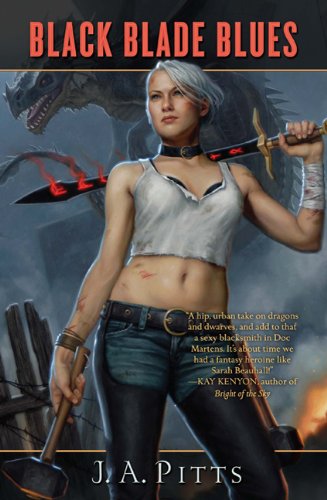
PLOT SUMMARY: Sarah Beauhall has more on her plate than most adults in their twenties: day job as a blacksmith, night job as a props manager for a low-budget movie, and her free time is spent fighting in a medieval re-enactment group.
When the lead actor breaks Sarah’s favorite one-of-a-kind sword, it sends the director into fits. Sarah agrees to repair the blade to avoid reshooting previously filmed scenes. One of the extras claims to be a dwarf and offers to help her at the forge. That’s when things start to get weird. Could the sword really be magic, as he claims? Why does he want her to kill a Portland investment banker? And what is it about that homeless guy that has her on edge?
As if things weren’t surreal enough at that point, Sarah’s girlfriend Katie breaks out the dreaded phrase… “I love you.” Black Blade Blues is about forging an existence in a world that is much different than one expects. Oh, and there are dragons too!
FORMAT/INFO: Black Blade Blues is 397 pages long divided into Seventy-five chapters. It marries Norse mythology with the contemporary settings. Narration is in the first person for Sarah Beauhall. This book has a self-contained plot line, but is the first book in a new series which has been contracted for a total of three books.
April 27, 2010 marks the North American Hardcover publication of Black Blade Blues via Tor.
OVERVIEW/ANALYSIS: Black Blade Blues is the debut novel of John Pitts, it features a world where Norse mythology has come alive in the Seattle area. Sarah Beauhall is the main protagonist of the story and is an amateur blacksmith who’s trying to earn extra money by serving as a prop manager for various movies. As prop manager her creations get a chance to be featured in the movies. Sarah has an interesting life; she’s from a small town and is into medieval warfare role play and heavy metal. She's also in love with Katie but appears to be in a bit of denial over it.
The story begins when J.J. the main actor breaks an ebony blade and Sarah has to re-forge it for the shooting requirements. This small act begins a new chapter in her life and also kicks off this story. She meets Rolph an extra on the set who share more than a passing interest in Sarah’s smithy skills and the ebony blade which she re-forges. He informs her about its Nordic origins and how the re-forging heralds her as a warrior. Katie begins to hint that maybe he is really a dwarf from legends.
The tale then kicks off as various elements of Norse mythology start appearing in Sarah’s world. Sarah also gets upheavals in her personal life when Katie tells her she loves her. Also at the same time others start taking interest in the blade (which has been named Gram by Rolph) these others include Dragons in mortal forms that see the re-forging as threat to themselves. The story then veers off as Sarah’s façade begins to crumble and she faces choices about her sexuality, her life as a simple blacksmith and destiny as the wielder of Gram. Sarah manages to upset everyone with her behavior but still manages to hold on to her blade which then leads to a climatic showdown with the perceived antagonists. The showdown leads to various events of which most are Pyrrhic and further set into motion events which I’m sure will be explored in further books
John Pitts has created a fascinating character in Sarah. The use of the first person point of view gives readers a more intimate look into Sarah's thoughts which help gain a clearer understanding of the story and settings. However this form of writing also served as a double edged sword because it didn't really endure me to the character of Sarah. The reason being is while I could understand Sarah's struggles and find them admirable, as a person I found her to be a bit immature.
The writing is clear and gives us a fair view of the world and characters that inhabit it. The story is not something entirely new and has been done before, the twist here being that the main character is a woman blacksmith and a lesbian with identity issues.The pacing slows down when Pitt shows us Sarah's troubles and the ending is a bit drawn out. Although the ending is drawn out it does contain a slight twist that might spruce up the reading for veteran readers. There is complete plot resolution by the end of this book and the stage is set for the further (mis)adventures of Sarah.
This book was a highly anticipated book for myself and it could be that this played with my experience of this book. My expectations might have been a bit to high for what was essentially delivered. Black Blade Blues is a good debut but does have some plotting issues, which I hope the author can overcome. I'd recommend this book to those urban fantasy fans that are looking for a different kind of protagonist. Overall a good debut which promises to bring a nice read involving questions of life, identity and love with a bit of off kilter sense of humor.
 Official Ryk Spoor Website
Order "Grand Central Arena" HERE or HERE (as a drm-free ebook)
Read Many Chapters HERE
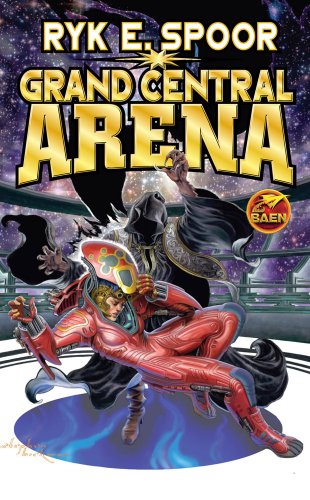
INTRODUCTION: "It was supposed to be a simple test flight, one that pilot Ariane Austin was on only as a last-ditch backup; intelligent, superhumanly fast automation would handle the test activation and flight of humanity's first faster-than-light vessel. But when the
Before "Grand Central Arena" I have not read anything by Ryk Spoor, though for several years I had a copy of "Boundary", his 2006 collaboration with Eric Flint which has a sequel Threshold to be published in June 2010. I started Boundary several times but the story of archaeology and long gone aliens in a near future setting never hooked me, so when I heard of "Grand Central Arena", I was not sure how much priority to give it. The blurb above was very, very tempting and when the author started posting chapters on Baen's Bar - chapters collated in the link above - I got hooked and bought an e-arc from Baen several months ago despite it being almost twice the price of the original print mmpb that has been released recently.
And I have to say that I never regretted the decision since Grand Central Arena was an excellent read, fast and entertaining and I hope it will get the sequels it richly deserves. After I finished it, I finally read "Boundary" which was quite entertaining too, though much more predictable in some ways and less exciting than "Grand Central Arena", but it is very hard for near future sf to compete with space opera as my interest goes. I plan to read Threshold too at some point in the future, though it is less of a priority for now, but any sequel to Grand Central Arena would be an asap.
FORMAT/CLASSIFICATION: "Grand Central Arena" is a long book - Amazon has it listed at 688 pages but since I have only an e-arc I cannot guarantee that, just that it seems reasonable - however it reads so fast that you do not really notice when the pages go; the novel is divided into 74 chapters of which you can read quite a few for free as linked above and there are several points of view, most notably main heroine, Ariane Austin top race pilot in the Solar System 's "Unlimited Space Obstacle Racing" championship tour.
Then there is her team's chief engineer Carl Edlund who happens to know genius physicist Simon Sandrisson, the discoverer of "hyperspace" some 10 years ago, from which discovery the possibility of ftl travel followed; after extensive drone testing and with the approval of the humanity's Space Security Council, Dr. Sandrisson is ready to take the first manned human ftl spaceships Holy Grail on a test ride. The leader of the Combined Space Force sends mysterious power engineer Marc DuQuesne as both crew and representative of the powers to be and at Marc's insistence, Simon Sandrisson decides to include a human backup pilot despite everything running on pseudo-AI's - AISage - guidance, so much so that human pilots are generally used fully only in competition racing. There are several more crew members of the Holy Grail and of course when the Holy Grail finds the Arena of the title instead of the stars, there are several important aliens, most notably one called suggestively and for reasons to be found in the book Orphan.
"Grand Central Arena" is space opera in the grand old tradition - "costume" aliens, heroic and plucky humans - but with modern sensibilities and awareness of current speculations in cutting edge physics.
ANALYSIS: "Grand Central Arena" introduces an Earth several centuries hence where advances in nanotech and AI development allowed the expansion of humanity in the Solar System, wealth and relative peace and stability in a sort of libertarian way, though the same decentralization allowed by tech and global wealth led occasionally to trouble when groups of single minded people used such for nefarious purposes, or even sometimes in thoughtless ways that turned to disaster.
All in all though, the Solar System of the novel is a prosperous place and on the verge of attaining the stars due to Simon Sandrisson's revolutionary extension of the latest unified field theory, extension that allowed the first ftl drive to be built and now to be tested for the first time in a manned spaceship. However the drone tests of the Sandrisson Drive, while mostly successful and with a reasonably low rate of non-return revealed a glitch - all AI powered systems on the drones - eg sensors, recording devices - seemed not to work properly in ftl mode, though the "dumb" 2oth century like mechanical/electronic ones worked.
So "just as a backup" Ariane is co-opted in the crew of the Holy Grail with Carl as support engineer and of course when things go completely awry and instead of the stars, the spaceship finds itself in a huge but considerably scaled down enclosed reproduction of the Solar System with all major bodies in proper orbits, all AI's - including guidance, piloting and personal ones - down - with the Holy Grail heading fast towards an inevitable crash with the looming walls of the enclosure, it's up to Ariane's reflexes to save the day and of course the surprises start immediately after...
Grand Central Arena of the title which the crew of the Holy Grail discovers instead of the stars is a very, very old place, wondrous and awesome but dangerous and "ritualistic" too, with many alien races at various privilege and development states mingling under some rules strictly enforced by ultra-powerful beings. And since the minimal achievement a race needs to get into the Arena is the Sandrisson Drive - known of course under various names by each alien species - and since each new race discovering that and using it, represents an opportunity for the more nefarious Arena species, while having itself an opportunity to "establish" itself under the rules above, it is up to the crew of the Holy Grail to make sure humanity is among the "winners" and not the "losers", with Ariane appointed by default leader, while Simon and Marc are her main "side kicks" and mysterious alien Orphan who encounters them first as "guide" and mentor of a sort.
The whole setup, rules and such are described in loving detail and the author put a lot of thought into them, so while the whole Arena and its paraphernalia are quite outlandish, I never lost for a moment my suspension of disbelief. The various alien races encountered are reasonably distinct and vary from ultra-mercantilistic, to seemingly benevolent but with maybe hidden agendas, to dark, mysterious, powerful and with unclear motives and of course to obvious enemies either out for plunder or for subtler reasons...
While the first part of the book including the early Solar System chapters, the introduction to what will become known as "humanity's sphere" and then to the Arena and its wonders/dangers is just awesome, the novel sags a little in the middle when all the aliens playing a role in a story appear, diplomatic relations and more generally Arena "adjustment" occurs; we also have the "blatant" costume-aliens part including stereotyping and representing a race by a few characteristics that is the pulp-sf legacy to the book; the novel keeps a brisk pace but I found it losing a lot of its luster and inventiveness and reverting to the old-style space opera of yore.
Fortunately "Grand Central Arena" picks up momentum and heads into some interesting and unexpected directions and the last third or so of the novel is excellent again with lots of intense action and it kept me turning fast the pages to see how our plucky heroine and her sidekicks elbow humanity into "its proper" place in the Arena's social structure. The ending is very good and completes the main thread of the novel so "Grand Central Arena" stands well on its own, but I so want more novels since both the whole setup and the heroes of the story are excellent. A very strong A, almost an A+ and a novel that manages to bridge golden age space opera tropes to their modern expressions in a way other similar recent tries did not.
**************************************

The Thousand Autumns of Jacob De Zoet-David Mitchell
"Imagine a nation banishing the outside world for two centuries, crushing all vestiges of Christianity, forbidding its subjects to leave its shores on pain of death, and harbouring a deep mistrust of European ideas. The narrow window onto this nation-fortress is a walled, artificial island attached to the mainland port and manned by a handful of traders. Locked as the land-gate may be, however, it cannot prevent the meeting of minds – or hearts. The nation was
Set in 1799-early 1800's mostly on the artificial island of Dejima that was Japan's only window to the West from the 1640's to the 1850's and which was connected to the city of Nagasaki by a simple "land gate", gate that metaphorically connects two worlds, though there is a lot of action both in Nagasaki and in its surroundings, the novel has three main interweaving threads:
the life and fate of Jacob de Zoet, the isolation of Japan as expressed through its one window to the European world, the artificial island of Dejima and finally a story of cross lovers, murders, abductions, secret mystical and very dark cults that gives the novel both a tinge of the fantastic and powers its action and emotional content.
There is a lot to explore in this book and it's really worth spending the time to do it; an A++ and a novel to savor at length and probably my best of the year at least so far, though The Folding Knife still is in competition there. Full Review to come soon.
**************************************

The Last Page by Anthony Huso (cover may change for publication)
"The city of Isca is set like a dark jewel in the crown of the Duchy of Stonehold. In this sprawling landscape, the monsters one sees are nothing compared to what’s living in the city’s sewers.Twenty-three-year-old Caliph Howl is Stonehold’s reluctant High King. Thrust onto the throne, Caliph has inherited Stonehold’s dirtiest court secrets. He also faces a brewing civil war that he is unprepared to fight. After months alone amid a swirl of gossip and political machinations, the sudden reappearance of his old lover, Sena, is a welcome bit of relief. But Sena has her own legacy to claim: she has been trained from birth by the Shradnae witchocracy — adept in espionage and the art of magical equations writ in blood — and she has been sent to spy on the High King."
The blurb above does not do justice to this awesome novel that is the "pure" genre debut of the year so far for me and one of three 2010 "debuts" in a more extended sense that astounded me so far.
I have not encountered the inventiveness, sense of wonder and the "many goodies" of The Last Page in a debut, all packed in a reasonable 400 odd pages, since John C Wright's Golden Age and Gary Gibson's Angel Stations, though this one is fantasy with blood magic, necromancy, mysterious and ultra-powerful beings, but also airships, guns, newspapers and a "steampunk" like setting with an early industrial flavor.
The main characters Caliph and Sena are just superb with a great supporting cast of witches, spies, former college friends, devoted servants and mysterious personages, while the meaning of the title remains somewhat ambiguous to the end ("page" as in book, or as in a young servant?); while the main thread of the novel is solved, the stunning ending promises a sequel for the ages too. A++ and full review in late July/early August.

Looking at the 2001-10 winners below, if Perdido Street Station, Quicksilver and Iron Council are considered sf for the purposes of the award, City & City is sf by all means. Personally I think that Perdido Street Station is fantasy and moreover an essential genre fantasy novel that opened new vistas and considering it as sf is a little overreach, though Iron Council is closer to sf while still mostly fantasy. Quicksilver can be thought as a sort of alt-history, so as sf by the accepted convention that most alt-history is sf and anyway it is very sfnal in themes.
So moving to the content of City & City, I would say that if you want to pigeonhole it in a genre, it is *crime sf* more than anything else. Now these days with the popularity and ubiquity of Urban Fantasy that combines crime, technological modern setting and supernatural creatures/powers, there is a clear argument for City & City as such, but personally I think that Urban Fantasy is quite sf-nal anyway and I would have no qualms about a novel that has crime, modern society and "magic" instead of "unseeing" and The Breach considered for a sf award, though of course the crux of the matter is who writes it and how it is written...
"Unseeing" and The Breach are as "credible" as magic, vampires and such and they all need a different universe than the one we believe we live in as of today's boundaries of science, but the same is true with many staples of sf, so in itself the fact that a novel has what we perceive as "fantasy elements" is not that relevant imho. For myself and roughly speaking, the boundaries between sf and fantasy in a novel are defined more by how society is organized, the role science and technology play, the way humanity's - or whatever sentient beings are around - collective perception of the Universe is and such than by magic swords or ftl spaceships since after all you can have both of those cohabit a fictional universe quite well.
**************************************************************
The 2001 - 2010 Arthur Clarke award winners with short comments/ratings from me
2001: Perdido Street Station by China Mieville (read, my rating A++, defining work of modern fantasy)
2002: Bold as Love by Gwyneth Jones (very little interest for me)
2003: The Separation by Christopher Priest (read, my rating B, beautiful writing and mind bending plot but very nationalistic book that seemed to be more wish fulfillment in keeping the UK as a "great power" at any cost, than anything else and left me disappointed)
2004: Quicksilver by Neal Stephenson (read, my rating A++, excellent historical fiction with a sfnal bent; the whole Baroque trilogy is a masterpiece of epic fiction)
2005: Iron Council by China Mieville (read, my rating D, very disappointing novel which brought nothing new to the New Crobuzon universe)
2006: Air by Geoff Ryman (very little interest)
2007: Nova Swing by M John Harrison (read, my rating A, not as good as Light though)
2008: Black Man by Richard Morgan (read, my rating B, RK Morgan in repetition mode, so much so that you can guess almost everything that happens if you are very familiar with his Takeshi Kovacs series)
2009: Song of Time by Ian R MacLeod (started to finish later)
2010: The City & The City by China Mieville (read, my rating C, an A+ first half and a big letdown F second half which is generic crime fiction with all its paraphernalia and I just do not like that genre)


