
Official Peter F. Hamilton Site
Timeline of Events Between Judas Unchained and The Dreaming Void
Read FBC Review of The Dreaming Void
Read FBC Review of The Temporal Void
About ten days ago I have received a review copy of The Evolutionary Void which concludes the Void trilogy of Peter F. Hamilton. After three days of intense reading I have to say that I was so impressed by this novel that instead of reading some of the interesting books I have in my pile, I spent the last week on a careful re-read of The Dreaming Void, The Temporal Void, The Evolutionary Void (again) and then a somewhat faster reread of Pandora's Star and Judas Unchained which take place some 1200 years earlier and form the Commonwealth Saga.
While we know from the first two Void volumes that many characters from the Commonwealth Saga appear in the Void trilogy - some as cameos but some like Justine Burnelli, Gore Burnelli, Paula Myo, The Cat and Oscar Monroe as main characters - The Evolutionary Void ties the Void trilogy even deeper into the Commonwealth Saga and the two can be considered one extended series that forms another pinnacle of contemporary sf alongside the author' superb The Night's Dawn trilogy; these two series: Commonwealth/Void and The Night's Dawn are my co-#1 finished series in science fiction and fantasy and they represent modern sff at its best - "extreme" sense of wonder, multi-threaded panoramic epics with great characters, optimistic and believing in human ingenuity while not avoiding the darker sides of humanity and post-humanity in the Void case.
In my reread of the three Void novels one after another and *knowing* how things end, I realized once again what a masterful plotter Mr. Hamilton is. While The Dreaming Void is still mostly a setup novel both in the Greater Commonwealth thread and in the Edeard/Void thread, there is a lot of foreshadowing that will not be full appreciated till the end. The Temporal Void kicks events into high gear in both threads and The Evolutionary Void finishes with panache in an ending that is among the best of any series I have ever read. While they stand together at over 2000 pages, the three Void novels can be considered one huge book since the events flow from one into another and there is no lag between the novels, each picking up after the other ends.
I will review The Evolutionary Void closer to its August US publication date but in the meantime I want to urge any sf lover to take a look at the series until now so you are ready to appreciate the magnificent achievement of the author when the concluding Void novel appears on bookshelves everywhere!
 12:01 AM |
  Posted by
Liviu |
Posted by
Liviu |


Friday, May 21, 2010
"The Stuff of Legend: Book 1 The Dark" by Mike Raicht and Brian Smith Illustrations by Charles Paul Wilson III (Reviewed by Cindy Hannikman)
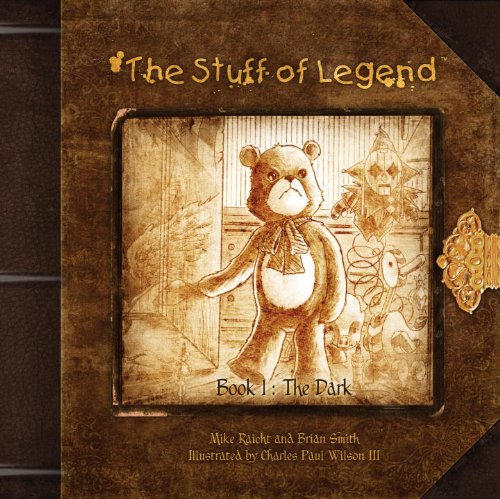
Order The Stuff of Legend: The Dark from Amazon Here
Overview: As the Allied forces are fighting over in Europe, a different battle of sorts is starting over in Brooklyn. In a little boy's bedroom, the evil Boogeyman kidnaps the boy and pulls him into a darkish, terrible realm known as The Dark.
It is up to the child's toys, a bear, a soldier, a duck, etc., to try and find and free the boy before it is too late. What is assumed to be an easy mission turns into something a lot more intricate and detailed.
All the young boy's forgotten and used toys appear to have banded together in The Dark and might be working with the Boogeyman. Those on the mission are facing tough choices and may even face betrayal amongst their ranks, they must fight against those forgotten toys to get the little boy back.
Format: The Stuff of Legend: Book 1 The Dark is a Graphic Novel, it stands at 112 pages. It was released by Del Rey on April 27, 2010.
Analysis: When I first heard about the idea of toys fighting amongst themselves to free their owner from the claws of the Boogeyman, I immediately knew this was a book that I needed to look into. In a heart warming, sometimes scary at times way, The Stuff of Legend: The Dark is a wonderful novel with some amazing illustrations.
As this is a first novel the storyline and characters are all introduced to readers. There are various characters that really stick with readers and others that have yet to truly shine but this is definitely a great start to all of the characters. Another area that is really developed is that of the land and world of The Dark. The combination of the description/storyline and the beautifully drawn pictures the world really is mapped out for the reader.
Although I don't want to compare it to Toy Story, it really is a bit of a wicked toy story feel to it. Imagine Toy Story for adults. This novel has an innocence to it, but at the same time has a few scary parts, and the characters are all facing tough decisions regarding loyalty to each other and their owner, and what they should do when it comes to fighting other toys.
Those readers that like a full resolution to plots won't find it in this novel. This is very much a first installment and the story is definitely deeper then what is presented. While this makes the next installment a must read, if it isn't expected it could leave readers a bit disappointed. However, when all these graphic novels can be read back to back it will be a real treat.
The strongest aspect of The Stuff of Legend is truly the illustrations that are present. While some graphic novels choose to go with the vibrant colors, this one goes with sepia and brownish tones. This choice of colors fits with the setting and the whole novel. The time period of the novel is 1940s, and the representation of the toys coming to battle in the Dark really stands out with this color choice. Beyond the color choice is the details of the illustrations, every time I read this novel I found something else outstanding about the illustrations.
While the illustrations are amazing, don't think that it will overshadow the story because it doesn't. The story and writing is just as lovely and will really pull at the strings of readers hearts while they start on this journey.
In the end, I loved this graphic novel. I cannot wait to get my hands on the next installment to see what will happen. It's a wonderful start of what looks like a great series. The Stuff of Legend: The Dark is truly a story that is heartwarming with a powerful message. It's sure to be one of my favorite novels/graphic novels of 2010!
Thursday, May 20, 2010
Anthology Story Review: A Rich Full Week by KJ Parker (Reviewed by Liviu Suciu)

Order Swords & Dark Magic HERE:
Read FBC Review of Purple & Black
Read FBC Review of The Folding Knife
INTRODUCTION: When the anthology Swords & Dark Magic was announced with its stellar table of contents - anthology that is the only non-novel in my Anticipated 2010 Books Post - the one story I wanted to read the most was "A Rich Full Week" by KJ Parker. While I plan to review the whole anthology sometime in mid-June for its official publication date, "A Rich Full Week" was very impressive and deserves a separate longer review of its own. Of intermediate length, the story is episodic and takes place in an original milieu different from any of the KJ Parker's 11 novels and 2 novellas to date though of course you will recognize some of the author's favorite themes and their expression from earlier work.
While the two Subterranean novellas (the superb Purple and Black (FBC Rv) and the upcoming Blue and Gold which I have recently read and it blew me away with its superb twists and turns, while the roguish unreliable narrator alchemist Saloninus is one of the most memorable characters in recent times - I will review it here closer to its December publication date) are in reality short novels and complete in themselves, "A Rich Full Week" deals precisely with what the title implies: a week in the life of a "wizard" investigator of un-natural happenings and especially with two seemingly unrelated jobs - the investigation and elimination of a possible "restless dead" that kills sheep in a village in the middle of nowhere and then the mind-recovery of a child who is catatonic after a traumatic fall in another obscure village, a night mailcoach traveling away...
ANALYSIS: ... "You don't look like a wizard," he said.
I owed myself two nomismata. "I'm not a wizard," I said.
I always say that.
"But we sent to the Fathers for a - "
"I'm not a wizard," I repeated, "I'm a philosopher. There's no such thing as wizards."
He frowned. "We sent to the Fathers for a wizard," he said.
I have this little speech. I can say it with my eyes shut, or thinking about something else. It comes out better if I'm not thinking about what I'm saying. I tell them, we're not wizards, we don't do magic, there's no such thing as magic. Rather, we're students of natural philosophy, specializing in mental energies, telepathy, telekinesis, indirect vision. Not magic; just science where we haven't quite figured out how it works yet."
The above lines which essentially open "A Rich Full Week" give a very good idea of both the tone of the story and of its setting. The unnamed narrator, a field investigator of the Order is sent by his boss Father Prior on a weeklong duty tour that starts with the two missions described above. While a restless dead infestation is rare and potentially dangerous, the "Statutes and Procedures" of the Order describe precisely how it is to be eradicated and with appropriate care and a reasonably skillful field agent, it is routine.
However there is a twist here: the dead man in cause is a wandering teacher Anthemius who may have had a lot in common with our hero. Narrated in the matter-of-fact style that made the author such a favorite of mine, the "dialogue" between the two is just for the ages and the resolution is pitch-perfect.
"Indeed," I said. "There could be a paper for the journals in this."
"Your chance to escape from obscurity," he said solemnly. "Under different circumstances, I'd wish you well. Unfortunately, I really don't want you cutting off my head. It's a miserable existence, but - "
The second mission which involves recovering a lost mind seems even more routine and the narrator tells us that he is especially skillful in such, so imagine his surprise when after making an entrance in the child's mind, he cannot find the boy's "imago".
"Odd, I thought, and touched base with theory. The boy must still be alive, or else there would be no room. If he's alive, he must be in here somewhere. He can't be invisible, not inside his own head. He can, of course, be anything he likes, so long as it's animate and alive. A cockroach, for example, or a flea.
I sighed. I get all the rotten jobs."
And of course soon comes the kicker which left me stunned - though this being KJ Parker I expected something odd and twisty but not that...
While "A Rich Full Week" does not really have swords, it has fights though of a different but no less lethal type and sorcery galore, but again not the usual kind as you can see from the excerpts above. Original, surprising and a great introduction to the style of the author, "A Rich Full Week" was the highlight of an overall excellent anthology for me.
Wednesday, May 19, 2010
"A Handful of Pearls & Other Stories" by Beth Bernobich (Reviewed by Liviu Suciu)

Official Beth Bernobich Website
Order "A Handful of Pearls & Other Stories" HERE
Read two stories from the collection: Poison HERE and Marsdog HERE
INTRODUCTION: Beth Bernobich has recently been mentioned as one of the next fantasy stars and the quality of prose in the ambitious novella Ars Memoriae confirmed that potential for me. I was eager to read her debut collection "A Handful of Pearls & Other Stories" and it fulfilled my expectations and more, so much so that her novelistic debut "Passion Play" has become my most awaited debut for the second half of 2010 and an overall top five awaited novel.
FORMAT/CLASSIFICATION: "A Handful of Pearls & Other Stories" stands at about 250 pages and consists of nine stories and a superb introduction by James Patrick Kelly suggestively titled "Telling Secrets". The cover is beautiful and expressive of the collection's theme. The stories range in time, space and genre from historical fantasy and alt-history to near-future sf to alien planets and beings.
Lyrical, touching and imaginative short fiction of the highest caliber.
ANALYSIS: "A Handful of Pearls & Other Stories" stands out by its wonderful prose. If it has a theme, it is about strong people who are in a less than privileged position - mostly women in male dominated societies, but not only - it is also about regrets and (sometimes) second chances, with sense of wonder and great characters; the occasional lighter touches work well too.
I will present a short discussion story by story while I strongly suggest to try the free online stories linked above or head to Ms. Bernobich's website for more stories available online.
Chrysalide (A+)
The opening of the collection gives its tone and showcases its theme with a beautiful story about a painter who has to balance her family duties - her son whose attempts at being gentleman farmer are not quite successful and needs money all the time - her unique artistic gift that comes at a high cost, her secret high nobility lover and the intrigues that come with her fragile court position, all expressed in the process of her painting the portrait of a young beautiful duchess that is the new "star" of the court. The one failing of this story is that it is too short - though it has some 15 pages - for its content which is excellent but would have been awesome with maybe another 15 pages.
Poison (A++)
One of my two super-favorites from the collection; the story of two siblings who are not quite regular humans; touching, suspenseful and introducing a milieu that is extremely imaginative and interesting and in which I would love a novel or more short stories; the 40 pages of this tale allow the scope for an almost perfect story with a great ending that illustrates the power of fiction at shorter length.
Remembrance (A+)
A story about two near-future women who are lovers separated by the Mars assignment of one of them who is a security operative, while the other works as a scientist on Earth; new technology allows a much more intimate communication over long distances than usual - at a price - the story is quite predictable as ending and it also reminded me of one of my all time favorite short stories "Life on the Moon" by Tony Daniel; haunting and powerful.
Marsdog (A)
The lightest story of the collection featuring the friendship between an alien boy and a robot probe on Mars; imaginative and thought provoking.
A Handful of Pearls (A+)
The darkest story of the collection with a very troubled main character who has big issues in his personal relationships with women and tries to immerse himself in work on a distant archipelago; when a strange mute girl is found, his past comes back to life; this is a "sleeper" story that starts pretty conventionally and then it takes a shocking u-turn that I did not see beforehand; dark and disturbing.
Watercolors in the Rain (A)
A husband and wife get a second chance late in life when an accident sends them in a magical realm; poetic and imaginative, a story that could find itself in any "mainstream" fiction venue.
Medusa at Morning (A-)
The shortest story of the collection makes a good point - "freedom is a painful gift" - but it's too short at 3 pages or so to be fully formed.
Jump to Zion (A-)
Slavery, revolution, compromises, freedom... A substantive story that tries to use a different style which is appropriate for the theme but did not work that well for me.
Air and Angels (A++)
The other super-favorite and another story that starts making you think it will go one way, only to turn in a very unexpected direction, while the ending is just great with one of the best lines that celebrate "freedom" that I've read recently; a young man of scientific promise - a bit wasted in parties rather than studies abroad - returns to a steampunk alt-London around the early 1900's and meets a seemingly shy retiring girl with an interest in science; this story is probably the best representative of the collection's theme and I utterly loved it.
In conclusion I would say that "A Handful of Pearls & Other Stories" (A+ overall) shows why Ms. Bernobich's announced five or so upcoming novels from Tor are not to be missed, while also celebrating the power of fiction at short length to enchant and inspire.

AUTHOR INFORMATION: Phillip Margolin is an ex-criminal defense attorney from the New York School of Law. He has had nearly a quarter century of experience working as defense attorney in Portland, Oregon and has all sorts of criminal cases appear before the United States Supreme Court, the United States Court of Appeals for the Ninth Circuit, The Oregon Supreme Court and The Oregon Court of Appeals. He was the first Oregon attorney to use the Battered Women's Syndrome to defend a abused woman. Two of his books and a short story have been made into movies.
PLOT SUMMARY: Brad Miller, Keith Evans, and Dana Cutler (previously seen in Executive Privilege) are called to untangle a five-year-old case involving a ghost ship and the President’s nominee to the US Supreme Court. At the same time Sarah Woodruff is on death row in Oregon for murdering her lover, John Finley. Woodruff was tried for Finley’s murder once before but the case was dismissed mid-trial when the judge was slipped irrefutable proof that Finley was still alive! Meanwhile in the Justice Chambers, Justice Ronald Chalmers resigns, creating a vacancy that Dennis Masterson, former head of the CIA, is seeking to fill. Things take a more ominous turn when another Justice is attacked for no apparent reason.
These suspicious instances call for outside help, which is where private detective Dana Cutler and FBI Agent Keith Evans come in. Together with Brad Miller, they try to find out if the incidents are linked with the Woodruff appeal and a shoot-out which occurred years ago on a small freighter docked upriver in Shelby, Oregon, containing a dead crew and oil drums filled with drugs. The only survivor on the ship was John Finley! Brad, Keith, and Dana’s investigations lead them to a plot by a rogue element in the American intelligence community that involves the Presidents nominee to the Supreme Court, putting them back in the grips of a deadly, executive danger.
FORMAT/INFO: Supreme Justice is 312 pages long divided into Sixty-five chapters over seven different time periods/parts and an epilogue. Narration is via Third person for Brad Miller, Keith Evans, Sarah Woodruff, Dennis Masterson, Tom Oswald, Daphne Haggard, Max Dietz, Mary Garrett and Dana Cutler. This book has a self-contained plot line, but also contains characters who were in a previous book.
May 18, 2010 marks the North American Hardcover publication of Supreme Justice via Harper Collins.
OVERVIEW/ANALYSIS: Phillip Margolin has been a favorite of mine since I read Wild Justice back in 2001, since then he has written more books featuring the characters of Frank and Amanda Jaffe (From Wild Justice) and several other solo books as well. The thing to note over here is that Margolin doesn’t write sequels unless of course his characters fit the plot[Twisted plots are trademark of his] so with every other Amanda Jaffe book we get a solo book which feature a different storyline. One such book was Executive Privilege, which was released in 2008 and featured both Brad Miller, Keith Evans, and Dana Cutler. So when Phillip Margolin found a plot which could expand on these characters, he wrote Supreme Justice and here we are.
This book like other Margolin books is divided into several parts which are set in different time periods, for example the first part opens in 2006, the 2nd part in 2012, the third part in 2006, the 4th in 2007, the 5th again jumps to 2012 and the last two continue in the same vein. Each chapter begins with a different POV character and the characters are mentioned above. The story begins with John Finley surviving an attack on his ship, the next chapter then introduces us to Tom Oswald who happens upon an empty ship which has dead bodies and drugs. They are told to keep a lid on it by agents of Homeland security who abruptly confiscate the case. The narrative then shifts to Brad Miller in the year 2012 as he’s preparing for his Clerkship with Supreme Court Justice Felicia Moss. The Supreme court is in a bit of upheaval as one of the Judges retires suddenly and the vacant spot causes an issue as people from various factions try to fill it with their candidate. There’s also an attack on Felicia Moss which Brad foils. To gain more ideas about this he enlist the help of Dana Cutler.
The next part moves on to a previous murder trial which was dismissed the first time but now Sarah Woodruff has been indicted again for the murder of the same individual. Plus the prosecutor Max Dietz was never convinced of Sarah’s innocence the first time around. It’s from these varied plots that Phillip Margolin spins his web for the reader to decipher. The tale and the multi character cast might seem a bit daunting but it’s to Margolin’s forte that he pulls it off with aplomb. The reader will be sucked into this tale as clues and misdirections are presented and the saga unfolds exquisitely.
Phillip Margolin is quite a storyteller. This can be gleaned easily from this book as he presents three dimensional characters and gives each chapter from a different POV. This allows the reader to have a very omniscient view into the story but at the same time not everything is as it seems. It also allows the reader to race right along side the characters as they uncover the actual mystery and not feel as if it's happened in the past and told to them later.
Even though this book contains characters from a previous book, this story is a standalone and can be read as such. There are very few spoilers for the previous book and so readers who like this book’s characters can also check out their previous appearance in Executive Privilege. Phillip Margolin once again deftly shows how mystery/thriller writers can keep their books fresh for long time readers with enticing plots and mesmerizing characters. A very good thriller for those who like reading plots in the vein of those by Agatha Christie, Arthur C., Doyle and recent greats such as Jefffrey Deaver.

Official Alex Bell Website
Order "Lex Trent Versus The Gods" HERE
Read FBC Review of The Ninth Circle
Read FBC Review of Jasmyn
INTRODUCTION: "Law student Lex Trent’s world is inhabited by fearsome magicians, aging crones and a menagerie of Gods and Goddesses. And while Lex is seemingly dedicated to his legal studies he’s always enjoyed a challenge – which is why he leads a double life as the notorious cat burglar ‘The Shadowman’ who has been (luckily) evading capture for years. But Lex’s luck is about to run out because the Goddess of Fortune has selected him to be her player in the highly dangerous Games. Losing is not an option for Lex (particularly as it so often involves dying) but can he really win each of the perilous rounds? Given that the reward for doing so is money, fame and glory – all things that Lex is quite keen on – he’s going to do whatever it takes to make sure he will... and he’s certainly got good experience of cheating."
I have become a big time fan of Alex Bell's novels since her debut with The Ninth Circle two years ago, debut that I ordered from The Book Depository based on an excerpt that hooked me. Her second novel in the same vein, Jasmyn was an asap and I remember reading it the moment I got my copy soon after publication and reviewing it immediately which is relatively rare for me since I prefer leaving a little space between reading and reviewing to achieve some perspective.
When I heard about "Lex Trent Versus The Gods", I was not sure if I would be interested since overall I tend to read little YA and little fantasy humor/superheroes and since the book has no US edition so far, I could not browse it in store to decide. However the early reviews intrigued me enough to consider ordering a copy from the U.K. and I have to say that while lighter and not as big a favorite as the previous two novels, Lex Trent Versus The Gods was still great fun and a read that entertained me and made me laugh out loud quite a few times. As long as you do not take it very seriously of course but just let go and enjoy the ride the author offers here with the flying magical ship on the superb cover as a literal instance.
FORMAT/CLASSIFICATION: "Lex Trent Versus The Gods" stands at about 350 pages and after starting with a prologue that sets up the universe of "The Lands Above" and "The Lands Below", continues with nineteen named chapters and an epilogue that "foresees" more adventures in this quirky and imaginative world, adventures that this time will be a "get and read asap for me", no more hesitation.
The opening lines of the novel that describe its setting are of the "I want to read this now" kind:
"No one knew the precise date when the Globe had split in half. For many hundreds of years the Lands Above and the Lands Beneath had been nothing more than a metaphorical, symbolical divide. But then, one day, the Gods decided that they had had enough - more than enough, in fact - of their subjects complaining and pestering and whining at them day and night. Being the focus of so much worship can be a tiring business. The Gods needed somewhere that would be quiet - a place they could call their own. And thus, one fateful day, the earth shook and trembled and a great split appeared right across the center and then the two halves cracked apart like a giant, cosmic, galactic Easter egg. No one alive today could remember the Great Divide, of course, for it had happened many millenniums ago now. One might think the planet had never split in half at all had it not been for the ladders . . ."
A standalone fantasy adventure with YA and comic overtones
ANALYSIS: The blurb presented in the Introduction is reasonably accurate except for the "many years" part since Lex has been in Wither City- the legal capital of the Globe - only for about a year after a farm (where else?) upbringing and another year of let's say wandering...
Hungering for adventure and the wide-world, Lex fled the farm in circumstances that are explored later in the novel and when down to his last penny which he decided to gamble in a Game of the Gods, he discovered that it is quite easy to part owners and fat purses in a stadium's excitement.
Lex started his career as conman, gambler and adventurer as a follower of Jezra the God of Wit and Daring, but chance (!) made him switch to Lady Luck when a con gone wrong, some angry marks chasing him, a rundown building refuge and a Goddess in misery at being abandoned by her last follower and in danger to have all her churches closed who offered him a deal he could not refuse, all led to this change of allegiance.
This little summation of events that occur in the first several pages of the novel show how the description above fails to capture the amazing inventiveness and sense of wonder of the novel. The Gods love interfering in humanity's affairs, magic is real though the magicians - "enchanters" - tend to be a nasty lot with peculiar habits and of course there are the celebrated Games which have quite an interesting format.
Three Gods with his/her own human contestant, each offering a challenge in whatever environment they chose, all recorded live by the mysterious powers of the Gods and shown after suitable editing on crystal globes in stadiums throughout The Lands Above - though increasing lethality led to a little tweak of having a substitute also to backup the main contestant and of course a crazy method to select this substitute and insure his/her willingness to participate, while the contestant usually has a choice of participating or becoming a literal wooden chess piece(!).
"Lex Trent Versus The Gods" is unabashedly a romp which strongly depends on our willingness to suspend disbelief and go with the flow while marveling at the combination of familiar and weirdness the author throws in.
Portraying Lex as supremely self-confident, charming but very selfish and with a "pull from the hat" solution for each challenge he encounters was a gamble, since if the authorial magic does not work to enchant you, the chances are you will dislike Lex and would love nothing more than to whack his arrogant bottom and wipe out his oh-so superior smirk and the book will fail. However at least for me, this gamble worked out very well and I found myself very entertained by Lex's antiques and by the contrast with his companions' earnestness, while I would turn the pages impatiently to see what new zaniness will be next.
Overall "Lex Trent Versus The Gods" ranks an A from me for its inventiveness and zany fun and I am in for more Lex Trent fun and games as hinted in the epilogue.

Official Jo Graham Website
Order "Stealing Fire" HERE
Read FBC Review of "Black Ships"
Read FBC Capsule Review of "Hand of Isis"
INTRODUCTION: "Alexander the Great's soldier, Lydias of Miletus, has survived the final campaigns of the king's life. He now has to deal with the chaos surrounding his death. Lydias throws his lot in with Ptolemy, one of Alexander's generals who has grabbed Egypt as his personal territory. Aided by the eunuch Bagoas, the Persian archer Artashir, and the Athenian courtesan Thais, Ptolemy and Lydias must take on all the contenders in a desperate adventure whose prize is the fate of a white city by the sea, and Alexander's legacy."
Two years ago I was very impressed by Ms. Graham's debut Black Ships (FBC Rv by Robert who did not like it as much as I did) - a recreation of Aeneas' tale though not quite as the Aeneid tells it. I enjoyed her second effort Hand of Isis (FBC Capsule Rv) a bit less, mostly because I read way too many books - fiction and non-fiction- about Cleopatra. "Hand of Isis" is a very good retelling situated within the "numinous" reinterpretation of history that Ms. Graham is continuing in "Stealing Fire", but it did not bring anything new for me; however I would strongly recommend it as a first novel about Cleopatra.
Since "Stealing Fire" deals mostly with the immediate post-Alexander world about which I have read some but not as much as about Cleopatra, I was able to enjoy it a lot more as being "fresh" for me as well as being a great adventure read.
Ideologically "Stealing Fire" sits in the "Alexander great hero and Hephaistion his almost as heroic bosom companion" camp and makes a great contrast with another historical fiction series I have been enjoying recently, Tyrant by Christian Cameron whose Alexander and Hephaistion form a "power mad leader/cowardly arrogant second" pair to remember too. Though Ptolemy who is a main character of Stealing Fire and Tyrant 3: Funeral Games gets a positive press in both series...
FORMAT/CLASSIFICATION: "Stealing Fire" stands at about 300 pages and is narrated by former stable boy Lydias of Miletus, half Carian, half Greek by blood, who later becomes a cavalry officer in Alexander's army. The novel starts with a map of the Alexandrian Empire and ends with a glossary of things, persons, places, a further reading list, an interview with the author and an excerpt from "Black Ships".
From the starting point of "Stealing Fire" at the death of Alexander in Babylon 323 BC, the novel has a main thread going forward in time and following Lydias and his new "chief" Ptolemy as they try to establish themselves in Egypt and build Alexandria into the great city intended by its founder, interspersed with snippets from Lydias' earlier life and adventures from his unpromising beginning as a slave boy that gets sold by his father to a horse dealer to his current relative eminence as cavalry commander.
Other main characters are Bagoas the famously beautiful eunuch companion of Darius and then Alexander, Artashir a Persian noble and officer in Alexander's army, Thais the (in)famous Athenian hetaira of the Susa Palace torching fame and long time companion of Ptolemy and of course Alexander and Hephaistion as above.
"Stealing Fire" is "as good as it gets" historical fantasy which reasonably respects the events of its time as far as we know them, but also contains elements of the fantastic in Gods and Goddesses, avatars of the dead and other supernatural beings as well as in reincarnated persons. A standalone but clearly connected with both its chronological precursor Black Ships and its successor Hand of Isis.
ANALYSIS: Stealing Fire showed somewhat unexpectedly in the mail and when I opened it, I just got hooked from the first page and I stayed way too late that night to finish it, though I reread it the following day to both savor it at leisure and get its finer points I may have missed on my first "need to find out what happens even if my eyes are closing" read.
The main strength of the novel is the first person narration of Lydias. He is a character you cannot help but root for and both his actions in the present of the novel and his reminiscences of the past show a "honorable" person who essentially worships his benefactor and later commander Hephaistion and by extension Alexander too, while being respectful as half-Greek/half-"barbarian" of Alexander's new companions of the East like Bagoas or his comrades in arms like the Persian Artashir.
Lydias' short-lived marriage with the young Indian widow Sati that ended in tragedy on the terrible desert retreat from India in 326 BC and which keeps haunting him illustrates Alexander's vision - whether pragmatic or idealistic or both - of an "universal" world not divided into West or East, European or Oriental, Greek or Barbarian and adds to Lydias' depth as a human who finds himself also attracting the attentions of the Gods.
The supporting characters from Ptolemy to Thais, Bagoas and Artashir are also very well done and quite believable and the novel shines everywhere in the characterization aspect. But there is action galore, from a desperate ride to secure a fortress ahead of the news, to ambushes, cavalry battles and even crocodile encounters so "Stealing Fire" fits comfortably in the adventure mode of storytelling.
The "numinous" aspect that involves reincarnation and mystic dreams, encounters with Gods, prophecies and foretelling puts Stealing Fire firmly in the fantasy camp but the relative faithfulness to historical record as the big picture goes, grounds also the novel in "reality". The fusion of "fantastic" and "real" in almost perfect balance is another superb achievement of the author.
Stealing Fire (A+) is the best of Ms. Graham's work to date and a novel I strongly recommend to both lovers of historical fiction and fantasy adventures as the "perfect crossover".

Author Information: Carlos Ruiz Zafon is the author of six novels, one of those most notably The Shadow of the Wind. His work has been published in over 40 countries, and translated into 30 different languages. He is the recipient of numerous awards, including the Edebe Award, Spain's most prestigious award for Young Adult fiction.
Overview: During wartime, Max and Alicia Carver's father has decided to move his clock repair shop from the busy central city to a more remote location. The family has been uprooted to live in a coastal town. The house that the father has chosen is the city's mysterious house where a young boy Jacob is believed to still be haunting it. Jacob died a few years before from drowning in the ocean one afternoon.
As the children become used to the household, mysterious events start to happen. It appears as if the clock in the train station moves backwards instead of forwards. There is a mysterious cemetery with unique statues. As Max and Alicia start to investigate these and other events it appears as if they are linked in some way to the young boy Jacob. Until one day, the kid's along with their friend Roland start to uncover a mysterious story of a man known as The Prince of Mist.
As the mystery of The Prince of Mist is unveiled, the children embark on an adventure of mystery, self discovery, and a learn a bit about growing up.
Format: The Prince of Mist is a YA mystery adventure that has a bit of old world gothic feel to it. It stands at 224 pages. The English version was released in the US by Little, Brown Books for Young Readers on May 4, 2010 and in the UK by Orion Children's Books on 27 May, 2010.
Analysis: The Prince of Mist takes fans of Carlos Ruiz Zafon on a bit of a different course.
The thing that stands out about The Prince of Mist is the writing style. While it is very well written and very detailed, fans of Carlos Ruiz Zafon's previous works will notice it does not contain the poetic feeling that the previous novels such as Shadow of the Wind had. Instead while the events are described in long detailed paragraphs, the characters and life styles aren't.
In many ways this reads as a very YA book in terms of writing and development. The characters while present and described aren't overly detailed, think of it as a picture that comes out blurry. The image is there but it's not fully developed. For this reason it's hard to really generate any real attachment to the characters or form any emotions over the events they were going through. Though it should be noted this book is 200 pages, so given the amount of space that the book takes up the character development is alright. Those expecting great lovable characters probably won't find it here.
The plot and suspense are detailed enough for readers to follow. The story line really does take a long time to unfold, almost 100 pages or so, but it is well worth the read if one sticks it out. Veteran readers of fantasy or mystery novels might not find this book so much creepy and scary but a decent quick read. For younger readers, in which is this books intended audience, they will surely enjoy the read and love every detail of the suspense.
Overall this book was a nice read, it brought about a bit of suspense and mystery that kept readers captivated. Those that aren't looking for an overly detailed novel, or ones that can appreciate a good "Young Adult" novel will love this type of story. While the characters may be a bit vague, the details of the plot and writing style are what really make this novel a nice YA novel.
Overview: During wartime, Max and Alicia Carver's father has decided to move his clock repair shop from the busy central city to a more remote location. The family has been uprooted to live in a coastal town. The house that the father has chosen is the city's mysterious house where a young boy Jacob is believed to still be haunting it. Jacob died a few years before from drowning in the ocean one afternoon.
As the children become used to the household, mysterious events start to happen. It appears as if the clock in the train station moves backwards instead of forwards. There is a mysterious cemetery with unique statues. As Max and Alicia start to investigate these and other events it appears as if they are linked in some way to the young boy Jacob. Until one day, the kid's along with their friend Roland start to uncover a mysterious story of a man known as The Prince of Mist.
As the mystery of The Prince of Mist is unveiled, the children embark on an adventure of mystery, self discovery, and a learn a bit about growing up.
Format: The Prince of Mist is a YA mystery adventure that has a bit of old world gothic feel to it. It stands at 224 pages. The English version was released in the US by Little, Brown Books for Young Readers on May 4, 2010 and in the UK by Orion Children's Books on 27 May, 2010.
Analysis: The Prince of Mist takes fans of Carlos Ruiz Zafon on a bit of a different course.
The thing that stands out about The Prince of Mist is the writing style. While it is very well written and very detailed, fans of Carlos Ruiz Zafon's previous works will notice it does not contain the poetic feeling that the previous novels such as Shadow of the Wind had. Instead while the events are described in long detailed paragraphs, the characters and life styles aren't.
In many ways this reads as a very YA book in terms of writing and development. The characters while present and described aren't overly detailed, think of it as a picture that comes out blurry. The image is there but it's not fully developed. For this reason it's hard to really generate any real attachment to the characters or form any emotions over the events they were going through. Though it should be noted this book is 200 pages, so given the amount of space that the book takes up the character development is alright. Those expecting great lovable characters probably won't find it here.
The plot and suspense are detailed enough for readers to follow. The story line really does take a long time to unfold, almost 100 pages or so, but it is well worth the read if one sticks it out. Veteran readers of fantasy or mystery novels might not find this book so much creepy and scary but a decent quick read. For younger readers, in which is this books intended audience, they will surely enjoy the read and love every detail of the suspense.
Overall this book was a nice read, it brought about a bit of suspense and mystery that kept readers captivated. Those that aren't looking for an overly detailed novel, or ones that can appreciate a good "Young Adult" novel will love this type of story. While the characters may be a bit vague, the details of the plot and writing style are what really make this novel a nice YA novel.

(Pre) Order Speculative Horizons HERE
Official Subteranean Press Website
INTRODUCTION: Here is the blurb from the editor Patrick St. Denis:
"Speculative fiction is wide in scope and styles, and Speculative Horizons showcases the talent and storytelling skills of five of the genre’s most imaginative voices:
In C. S. Friedman’s “Soul Mate,” it’s love at first sight for Josie at the arts and crafts festival when she meets the handsome Stephan Mayeaux. It all sounds too good to be true until her newfound boyfriend starts to act strangely and unexplained occurrences begin to take place around her.
In Tobias S. Buckell’s “The Eve of the Fall of Habesh,” contragnartii Jazim must carry out one final assignment before the armies of the Sea People lay waste to the city he loves.
L. E. Modesitt, Jr. returns to the universe of his bestselling Recluce saga in “The Stranger.” A young herder’s existence will be forever changed by the unexpected arrival of the black-clad man recounting tales of angels living on the summit of the Roof of the World.
In “Flint,” Brian Ruckley introduces us to a young and inexperienced shaman who must venture into the spirit world to discover the source of the sickness which afflicts his tribe before they are all wiped out.
Talk to any cop working for Homicide, Narcotics, or Vice, and they’ll tell you that they get the worst cases imaginable. But in Hal Duncan’s “The Death of a Love,” you realize that they have nothing on Erocide."
Since there has been a lot of talk about the anthology, I decided to read the review copy I had got several days ago and somewhat to my surprise it hooked me, so "Speculative Horizons" became the first anthology I have read end-to-end and quite liked so far in 2010 since Shine left me a bit underwhelmed especially considering the hype it came with.
ANALYSIS: "Speculative Horizons" has a striking and superb cover while on the inside page there is another illustration that is beautiful and adds to the theme of "strangeness" that is the only one I could think of after reading the five very diverse stories inside. Each story has a short introduction by its author talking a bit about its genesis, while the anthology ends with a note from the editor discussing how it came to be.
*******************************************************
Soul Mate by CS Friedman
In a contemporary urban setting, a young woman writer with a designer friend meets a striking man who owns an upscale gallery in their resort town and soon believes she has been very lucky to find a perfect "soul-mate" for her.
The story is exquisitely done and it flows inexorably toward the relatively familiar twist ending; despite that I could see very early where the story goes, it did not matter since the execution was perfect (A+)
*******************************************************
The Eve of the Fall of Habesh by Tobias Buckell
In a slightly ironic twist, this story uses a magic system quite similar to the one employed by CS Friedman in her latest mostly superb Magister series, where magic is paid by life shortening.
The overall thrust is quite different since in the settled cities of the coast who are under attack by the "sea people", magic is rationed by the state so to speak - partly due to its cost as above, partly due to the possible consequences if anyone gets too powerful - so everyone granted magical ability, is allowed only one "type" of such and teaching/sharing is heresy punishable by death.
The narrator is a special agent - contragnartii - of the government who has as his own power the ability to snuff the magic of others; while his city of Habesh prepares for siege, he is sent to "de-magic" a beggar who has unseemly abused his "air blast" ability. When some runaway children intervene, unexpected things start happening.
This is the best and most powerful story of the anthology both in content and in style and an A++ while I would love a novel based on its world.
*******************************************************
The Stranger by LE Modesitt
Set in the world of the Recluce Saga - on Candar at around the time the "Angels" came and defeated the might of Lornth and later destroyed Cyador - this is the familiar story of a mysterious stranger passing by and changing the lives of the local people who meet him.
A knowledge of the Recluce saga is not really necessary to enjoy The Stranger since after all we have seen its type both in various literary genres as well as on screen; since as usual execution matters considerably more than "originality", I quite liked this instance of the familiar story since it is very well done in LE Modesitt's clear prose.
For readers unfamiliar with Recluce, The Stranger may be the hook needed to try and discover why that fantasy series is so popular that so far it got some 15+ novels in various sub-arcs covering a span of 1800+ years (A)
*******************************************************
Flint by Brian Ruckley
A sort of Stone Age with magic story, I have to say I did not really care that much for Flint, but if you like its premise, it may work better for you. Both the naming conventions (Flint, Hare, Fifth Moon) and the style of the story did not quite work for me since I am not that big a fan of "natural state humanity" as opposed to "settled humanity" stories though it definitely makes for a change of pace and subject in the anthology (C)
*******************************************************
The Death of a Love by Hal Duncan
This short but dense piece reads more like one of the author's famous rants, profanities and all, than a story, though it's a kind of detective tale in an unusual context. I cannot say I cared that much for The Death of a Love as a story, but it made for an interesting 18 pages nonetheless since the author has quite an unique style. (B)
*******************************************************
Overall "Speculative Horizons" achieves a sense of "strangeness" and by mixing styles and subjects it offers quite a variety despite its relatively short 5 stories/120 odd pages. For me the first three stories - especially the superb first and awesome second - made it a worthwhile reading experience which ranks an A.
Wednesday, May 12, 2010
Odds and Ends: My New Top 10 Anticipated Novels From the Rest of 2010 - Updated with Comments 1
From my original Top Ten Anticipated Books of 2010, I have read 7 so far (3A++, 1 A+, 2 A, 1 A-, no major disappointments) and the 8th (The Evolutionary Void/PF Hamilton) has just made its way to my house to be read asap; there is also more information available - including confirmation of publication for 2010 or of moving to 2011 - for some of the books in the extended Anticipated Books post, so I thought of doing a new post with the New Top 10 Expected Books which *I do not yet have* and which *are confirmed for 2010.*
While there are several debuts I am very interested in, I will not list them here since my record so far with predicting my degree of interest in such is mixed (see Tome of the Undergates vs The Last Page).
However since I loved Ms. Bernobich's collection "A Handful of Pearls" (FBC rv soon), I will make an exception for her debut which intrigues me a lot by its association with the Jacqueline Carey Kushiel series which is still my number one completed fantasy series of the 00's. I will cheat a bit and mention 14 novels since I cannot stop myself...
***************************************************************

1. The Horns of Ruin by Tim Akers (utterly loved Heart of Veridon, so Horns of Ruin is the one novel I give best odds to top The Folding Knife as #1 sff of the year for me now that the new IM Banks Culture is confirmed for 2011 as is the new Mary Gentle novel)
This turned out to be very "not for me". Great narrative energy that kept me reading but a comic book plot with the 100 repetitions of "in the name of Morgan I smite you" incantation of superwoman on steroids Eva Forge made me thankful it was short enough so I could finish it. Well, Dead of Veridon comes out in 2011 and hopefully the subtlety missing here, will come back since the author writes too well for comics.
2. The Half Made World by Felix Gilman (now that the blurb is available in the Tor catalog(pdf file), this one is even more intriguing and I give it second best odds for #1)
A++ and top 10 fantasy; only half a duology though which lessened a bit its impact; full review soon;
3. Passion Play by Beth Bernobich (see above why)
A+ and great debut with extraordinary promise; full review soon
4. Empire of Light by Gary Gibson (end of series and a dark horse for #1)
A+ and good ending of the series, but I still think the series could have been awesome and stalled slightly after the excellent first volume. FBC Review
5. The Scarab Path by Adrian Tchaikovsky (beginning of new sub-arc in the Kinden series; hard to believe it will top the awesome Salute the Dark, but one can hope)
A++ and top fantasy (as a combo with Salute the Dark) of 2010; FBC review
6. The Black Prism by Brent Weeks (still of great interest and very curious if Mr. Weeks can keep the freshness and exuberance of his debut trilogy)
A++ and #3 fantasy of the year; FBC review
7. Wintertide by Michael Sullivan (another #5 in a series like the Tchaikovsky novel above that will be hard pressed to top the awesome #4, in this case The Emerald Storm)
A++ and #5 fantasy of the year (as a combo with The Emerald Storm which yes, it tops) FBC review soon
8. Empire by Steven Saylor (now confirmed for August; my favorite living non-sff author is always a must; I may do a dual review with its precursor Roma)
A++ and #4 mainstream novel of the year; FBC review
***************************************************************

9 (tie). Absorption by John Meaney (early reviews were somewhat mixed; on preorder from BD)
B- and disappointing; hope the next novel brings the scattered stuff here together; FBC Review
Black Lung Captain by Chris Wooding (loved Retribution Falls, let's see if the author can keep the freshness and the pace)
B and somewhat disappointing; has some great stuff, but a lot of farcical stuff too which worked in Retribution Falls sometimes because it was new, sometimes because it was just slightly on the other side of the farce, while here it tips over; I may do a full review or not depending on how other novels line up; I am in for Iron Jackal
Transformation Space by Marianne de Pierres (another end of series and a book that can get very high in my end of year lists)
the only 2010 one I am missing so far; hopefully will get it soon
The Immorality Engine by George Mann (cannot wait to see how the first arc of the Newbury/Hobbes series ends)
2011
Skywatcher by Jon Connington (loved the author's debut quite unexpectedly a lot and I really, really want to see what's next)
reading it now; seems as good as the first one
The Blood of Alexandria by Richard Blake (same as above, except that this is book three in a pretty anachronistic series that nonetheless managed to hook me by the narration of its irrepressible and cynical (anti)hero and which I plan to review soon - for fantasy lovers, this series is what I imagine Joe Abercrombie would write as historical fiction)
still unread, but will get to it sooner rather than later
Edit 6/30/2010 - a little update
The new IMB Culture novel has been brought forward to October 2010 so Surface Detail should be #1 there
Yes, Surface Detail should have been #1 since as expected it became my #1 sff and sf of the year and #2 overall. FBC Review soon
Absorption (FBC Rv, B-) was somewhat disappointing though i have high hopes for the sequel because its main fault was too many threads, too little pages
Passion Play (A+, first impressions here) was not quite what I expected and the Kushiel's comparisons area bit misleading since this one is almost pure romantic fantasy; loved it once I realized the way it goes and the series has great potential but the sequels will decide how great it will be.
Got Blood of Alexandria which is the same cynical fun of #1/#2 and will read soon and got Black Prism too which starts very well, also to be read soon
Subscribe to:
Posts (Atom)


