
Official Kate Morton Website
Order The Distant Hours HERE
INTRODUCTION: Last year more or less by chance, I opened the author's 2008 (UK/US) debut The House at Riverton originally published in Australia as The Shifting Fog (2006). I was hooked from the first page and the novel has become a big time favorite. Her somewhat similar second novel The Forgotten Garden made a bit less of an impression on me - I read it back to back with The House at Riverton and I should have left some time to pass in-between so maybe a reread is in order, but any new Kate Morton novel has become a big asap and of course I ordered "The Distant Hours" for its UK publication date last month, though I decided to have the review for its publication here in the US.
"Edie Burchill and her mother have never been close, but when a long lost letter arrives one Sunday afternoon with the return address of Millderhurst Castle, Kent, printed on its envelope, Edie begins to suspect that her mother’s emotional distance masks an old secret.
Evacuated from London as a thirteen year old girl, Edie’s mother is chosen by the mysterious Juniper Blythe, and taken to live at Millderhurst Castle with the Blythe family: Juniper, her twin sisters and their father, Raymond. In the grand and glorious Millderhurst Castle, a new world opens up for Edie’s mother. She discovers the joys of books and fantasy and writing, but also, ultimately, the dangers.
Fifty years later, as Edie chases the answers to her mother’s riddle, she, too, is drawn to Millderhurst Castle and the eccentric Sisters Blythe. Old ladies now, the three still live together, the twins nursing Juniper, whose abandonment by her fiancé in 1941 plunged her into madness.
Inside the decaying castle, Edie begins to unravel her mother’s past. But there are other secrets hidden in the stones of Millderhurst Castle, and Edie is about to learn more than she expected. The truth of what happened in the distant hours has been waiting a long time for someone to find it . . . "
FORMAT/CLASSIFICATION: "The Distant Hours" stands at about 575 pages divided into five named parts, a prologue from The True History of the Mud Man and an epilogue. The action alternates between Eddie's narration in 1992 and the events of 1941 narrated in third person from the three Bltyhe' sisters POV's, while the even more distant past of their father's fateful actions and decisions is slowly peeled apart too.
So as a ghostly shadow hovering over the novel, there is the celebrated writer Raymond Blythe whose dark children's book The True History of the Mud Man excerpted in the prologue, has appeared out of nowhere towards the end of the Great War in 1918 to propel him to fame and wealth after he seemingly had forsaken writing following the tragic 1910 fiery death of his first wife, the twins' mother.
"The Distant Hours" is modern literary Gothic and as close to sff as it gets without any element of the supernatural.
OVERVIEW/ANALYSIS: "The Distant Hours" starts innocuously when a fifty year old letter finally makes its way to Meredith Burchill and her daughter is intrigued and banters with her about the war years when the 13 year old working class Meredith, evacuated in 1939 from London to the countryside, is picked up by the imperious 17 year old Juniper Blythe to live with her and her 33 year old twin sisters at the Milderhurst Castle. What Eddie does not know at the time is how important those years have been for her mother...
Because in 1939, Meredith gets so well on with the eccentric and talented Juniper who has been groomed for a literary career by her now recluse and decrepit father, that she refuses to return to London and her parents until Spring 1941. Meredith also sort-of introduces Juniper to her handsome teacher Tom Carvill - her secret first crush - only for the two to fall in love and prepare to marry. Feeling herself abandoned by Juniper when the important missing letter does not arrive in London 1941, Meredith assumes Juniper married Tom and forgot all about her and she puts the past behind... Until now.
Eddie has her problems too - dumped by her well off longtime boyfriend who gave her as a parting gift a six month lease on their expensive London apartment, she now needs to move since she cannot afford it anymore, but as an editor at a cottage publisher she wants to stay close to her work, so she temporarily camps out in her boss and surrogate "old uncle" Herbert's living room, without of course telling a thing to her family... When a countryside job and a chance road sign with "Milderhurst 3 miles" on it happen, Eddie is intrigued but on arriving at the castle's gate she remembers stopping by as a child with her mother, so she realizes that the letter is way more important for her mother than she thought, so she decides to nose around a bit. And so it starts...
"The handle was black and smooth, shaped like a shin bone and cool beneath my palm. Indeed, a general coldness seemed to leach from the other side of the door; though how, I couldn’t tell.
My fingers tightened around the handle, I started to twist, then—
‘We don’t go in there.’
My stomach, I don’t mind saying, just about shot through the roof of my mouth.
I spun on my heel, scanned the gloomy space behind. I could see nothing, yet clearly I wasn’t alone. Someone, the owner of the voice, was in the corridor with me. Even if she hadn’t spoken I’d have known: I could feel another presence, something moving and hiding in the drawing shadows. The rustling was back now, too: louder, closer, definitely not in my head, definitely not mice."
"The Distant Hours" has four main strengths. It is a Kate Morton novel, so nothing is quite as it seems, secrets abound, twists and turns galore and there were one or two that truly surprised me since while I could dimly see where the book goes and have an inkling of its general thrust, the author still managed to smoothly drop a bomb or two...
The atmosphere is pitch perfect - a combination of suspense and waiting for the momentous with little domestic details, present day happenings and other mundane stuff. Alternating between "holding your breath" and relaxing, "The Distant Hours" keeps one turning page after page and while it has a clear and definite conclusion, I strongly regretted that it ended since I could happily have read another 575 pages.
"The Distant Hours" also has the fascinating characters one expects from Kate Morton. The likable, "girl next door" Eddie, her somewhat distant mother of unexpected secrets and of course the three Blythe sisters: strong Percy, delicate Saffy and very talented but highly strung Juniper come out fully alive in the pages of the novel and they are quite unforgettable. Though seen only in the background and through the eyes of others, Raymond Blythe is as important a character as any, though for the why and the how you have to read the book.
Where "The Distant Hours" shows a marked improvement over the first two Kate Morton novels is in the interpersonal-relationships between the characters which are very complex and tangled. With its back and forth in time-line and events, the novel's tapestry takes a while to assemble, but the page turning style of the author hides this so well, that when you start getting the "big picture", you wonder how she sneaked all the details that seemed so innocuous before...
"The Distant Hours" (A++) is a superb novel of literary suspense that delivered all I expected from it and more, fully justifying my very high expectations and huge excitement when I found out about it not that long ago.
 12:01 AM |
 Posted by
Liviu |


“Surrender to the Will of the Night” by Glen Cook (Reviewed by Robert Thompson)

Order “Surrender to the Will of the Night” HERE
Read An Excerpt HERE
Read Fantasy Book Critic’s Review of “Lord of the Silent Kingdom”
AUTHOR INFORMATION: Glen Cook is a contemporary American science fiction and fantasy author, best known for The Black Company fantasy series. His bibliography also includes the Garrett, P.I. paranormal mystery novels, Dread Empire, Starfishers and The Instrumentalities of the Night.
PLOT SUMMARY: Piper Hecht’s first and greatest secret is that he knows how to kill gods. It is knowledge that makes him dangerous, but also puts him in danger—from his enemies, who fear what he might do, or who want revenge for what he has already done; and from his friends, who want to use his knowledge for their own purposes.
For example, Piper’s sister Heris and his living ancestor Cloven Februaren, the Ninth Unknown, have made Hecht part of their fight against the return of the dark god, Kharoulke the Windwalker. At the same time, the half-mad Empress Katrin wants him to lead the armies of the Grail Empire eastward on a crusade into the Holy Lands against his fellow Pramans.
Meanwhile, all around them, the world is changing. The winters are growing longer and harder every year, and the seas are getting shallower. The far north and the high mountain ranges are going under the ice, and fast. The Wells of Power, everywhere, keep getting weaker. And the old evils, the Instrumentalities from the Time Before Time, have begun to ooze back into the world...
FORMAT/INFO: Surrender to the Will of the Night is 496 pages long divided over forty-four numbered chapters. Narration is in the third-person, mostly via the main protagonist, Piper Hecht. Other viewpoints include the Ninth Unknown, Cloven Februaren; the Maysalean Perfect Master, Brother Candle; Nassim Alizarin, the Mountain; Helspeth Ege, Princess Apparent of the Grail Empire; and Piper’s sister, Heris. Considering the scope and complexity of The Instrumentalities of the Night, it’s highly recommended that readers finish The Tyranny of the Night and The Lord of the Silent Kingdom before attempting Surrender to the Will of the Night, the third volume in the series. Expect an ending in Surrender to the Will of the Night that wraps up most of the major plotlines in the book, but also acts as a cliffhanger/tease for the next volume in the series.
November 23, 2010 marks the North American Hardcover publication of Surrender to the Will of the Night via Tor. Like the previous Instrumentalities of the Night novels, cover art is provided by Raymond Swanland.
ANALYSIS: After reading The Tyranny of the Night and The Lord of the Silent Kingdom, I felt The Instrumentalities of the Night was developing into some of Glen Cook’s best work yet, and Surrender to the Will of the Night only confirms that thought...
Once again marrying the no-nonsense characterization, military action and dark humor of the author’s Black Company novels with the epic scope and inventive magic of Steven Erikson’s Malazan Book of the Fallen, as well as the complex medieval European/Middle Ages-influenced religion and politics of George R. R. Martin’s A Song of Ice & Fire and Kate Elliot’s Crown of Stars, Surrender to the Will of the Night is another hugely rewarding entry in The Instrumentalities of the Night series.
Plot-wise, politics remain front and center, this time revolving around the Grail Empress’ desire to launch a crusade to purge the Holy Lands of the Praman infestation with Piper Hecht leading the charge as the Commander of the Righteous army; Bronte Doneto’s ascension to Patriarch; secret documents declaring the surprising heir to the End of Connec; and Indala al-Sul Halaladin’s attempt to unify the kaifates of al-Minphet and Qasr al-Zed in order to undertake his own crusade. But overshadowing all of the world’s political matters is the looming threat of the powerful Instrumentality, Kharoulke the Windwalker.
Of these numerous storylines, I most enjoyed the one with Kharoulke the Windwalker and those tasked with defeating the Instrumentality, including the Ninth Unknown, Cloven Februaren, Piper Hecht’s sister, Heris, the Aelen Kofer (dwarves), and the ascendant, Asgrimmur Grimmsson, who was largely responsible for freeing the Windwalker in the first place. Mostly taking place in the magical Realm of the Gods where the Old Ones were imprisoned by Asgrimmur in The Tyranny of the Night, this particular storyline felt similar to reading a Tad Williams fantasy novel. However, true to form, Glen Cook provides his own unique spin on such familiar epic fantasy trappings as magical worlds and mythical races, while keeping the reader unbalanced with unexpected twists & turns, like the surprising way Kharoulke the Windwalker is handled. For most of this storyline, narratives are provided by the entertaining Cloven Februaren and the resourceful Heris, who are highlights of the novel.
That said, Piper Hecht remains my favorite character in the series, and once again is awarded center stage in the third volume of The Instrumentalities of the Night. What I love most about Piper is his grounded, no-nonsense approach to everything in his life—his job, family, friends, co-workers, enemies, the Instrumentalities, et cetera—which, more than any other character in the series, embodies the spirit of Glen Cook’s timeless Black Company novels. More than that though, Piper Hecht is just an incredibly interesting individual who has to deal with a ton of intriguing complications in his life from leading a double life as Piper Hecht—complete with a fake wife, fake children and a fake history—that feels more real than his actual life; to enduring the burden of being the Godslayer; harboring a dangerous attraction to Helspeth Ege, the Princess Apparent of the Grail Empire; and being related to a family of powerful magic-users; while new complications include Piper finding a way to prevent Empress Katrin—who becomes more insane over the course of the novel—from launching a crusade into the Holy Lands; Krulik & Sneigon selling godshot and falcons (the weapons used to kill Instrumentalities) to anyone who can afford it; and even more assassination attempts.
Of the other main characters, Brother Candle is once again mainly an observer, resulting in the most boring chapters in the novel, but thankfully the Maysalean Perfect Master is not given very much face time. Nassim Alizarin’s narrative meanwhile, is somewhat similar to Brother Candle’s, as his chapters act primarily as a window for what’s happening in the Holy Lands, including setting up what could be future confrontations with Gordimer the Lion and the sorcerer, er-Rashal al-Dhulquarnen. Disappointingly, the novel only dedicates a few short chapters to Helspeth Ege, but considering what happens to her sister Katrin, the Princess Apparent is primed for a much larger role in forthcoming sequels.
Comparatively, Surrender to the Will of the Night possesses many of the same strengths that are present in The Tyranny of the Night and The Lord of the Silent Kingdom, including a rewardingly elaborate story, unforgivingly complex politics, a huge & diverse cast of characters, and epic action sequences. Unfortunately, Surrender to the Will of the Night also possesses many of the same weaknesses, including a noticeable lack of a map or glossary to help readers process the immense amount of information that is available, a writing style that occasionally does too much telling rather than showing, and prose that is sometimes too sparse for it’s own good: “The children smirked and giggled at breakfast. Hecht ignored them. It was a fine day. He had no obligations. He planned to stay right here and do nothing.” However, because of the increased roles of Cloven Februaren and Heris; the entertaining Windwalker storyline; and a number of exciting developments involving the discovery of Ferris Renfrow’s secret identity, the deaths of five powerful rulers, and the revelation that Piper Hecht/Else Tage might not be the Godslayer after all; Surrender to the Will of the Night is the best Instrumentalities of the Night novel yet.
In the end, Surrender to the Will of the Night and The Instrumentalities of the Night series is required reading for anyone who loves Glen Cook or considers themselves a true fan of fantasy literature...

Recently Amazon UK's Top 10 SFF Books of 2010 came out
- Towers of Midnight by Robert Jordan and Brandon Sanderson (FBC Rv DC)
- Surface Detail by Iain M. Banks (FBC Rv LS)
- Against All Things Ending by Stephen Donaldson
- The Evolutionary Void by Peter F. Hamilton (Goodreads minireview LS)
- The Ambassador's Mission by Trudi Canavan
- Kraken by China Mieville
- The Passage by Justin Cronin (FBC Rv LS)
- The Technician by Neal Asher (FBC Rv LS)
- The Black Lung Captain by Chris Wooding (FBC capsule Rv LS)
- The Tree of Seasons by Stephen Gately
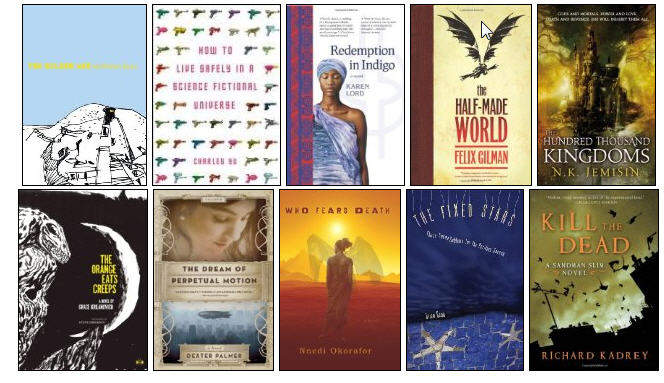 The Amazon U.S. version is here, while the Amazon Top 100 Books has quite a different selection of sff with only few overlaps.
- The Golden Age by Michal Ajvaz
- How to Live Safely in A Science Fictional Universe by Charles Yu
- Redemption in Indigo by Karen Lord
- The Half-Made World by Felix Gilman [FBC rv LS]
- The Hundred Thousand Kingdoms by N.K. Jemisin [FBC rv RT, FBC rv sequel The Broken Kingdoms LS]
- The Orange Eats Creeps by Grace Krilanovich
- The Dream of Perpetual Motion by Dexter Palmer [FBC Rv RT]
- Who Fears Death by Nnedi Okorafor
- The Fixed Stars: Thirty-Seven Emblems for the Perilous Season by Brian Conn
- Kill the Dead by Richard Kadrey (FBC Rv RT soon)
Looking at the two lists and their disjointness, one reason is of course that very few of the Amazon US list books have been published in the UK so far, while conversely I think that at least 7 novels from the UK list have been published in the US.
I actually like both lists a lot - the UK list is core-genre, while the US list is more of fringe genre though there are some core genre ones on it like the Gilman, Jemisin and Kadrey books - so in a way it is not surprising I read more from the UK list, but I think that offering exposure to less well known and more offbeat books in such a popular venue as Amazon is great too.
From the UK list I read #2,4,7,8,9 and Surface Detail is the uncontested top sff of 2010 for me, while The Technician and The Evolutionary Void are also in my (provisional) top 20 sff. I am still stuck around page 200 in Kraken, while of the rest I have no interest in 1,3,5 and have not heard of 10, though seeing that is portal fantasy, it has a very low priority for me since I dislike the sub-genre in its fantasy incarnation, though surprisingly I like it to a large extent in its sfnal incarnation as alt-history with time travelers from the present - whether both ways or stuck there...
From the US list and keeping in mind its more taste-specific flavor, I read #4, #5, #7, fast read #10, decided I have no interest in #2, #3, #8, while I would try #1, #6 or #9 if a copy comes into my hands but I am not sure if I would buy them based on the small samples I saw.
Overall, I think that both Amazon US and UK did a great job with these two lists - of course with the caveat of being limited to books published only till early November.
****************************************************


On the Literature and Fiction side, the UK top ten has also five books read by me, with three of them in my provisional Top 5 non-sff novels of 2010 (and provisional Top 25 overall which has 20 sff)
Sister by Rosamund Lupton
The Finkler Question by Howard Jacobson (Goodreads minireview LS)
Fall of Giants (Century Trilogy 1) by Ken Follett (Goodreads minireview LS)
Freedom by Jonathan Franzen
Room by Emma Donoghue (FBC Rv LS)
The Distant Hours by Kate Morton (FBC Rv LS soon)
The Slap by Christos Tsiolkas
Sunset Park by Paul Auster
The Thousand Autumns of Jacob De Zoet by David Mitchell (FBC Rv LS)
The Good Man Jesus and the Scoundrel Christ (Myths) by Philip Pullman
While in the Amazon US Top Ten Fiction/Literature there is no book of clear interest to me and I browsed many of them, in the Amazon US 100 extended list there are 7 novels read by me and again three of my top 5 non-sff (Invisible Bridge - FBC Rv LS, De Zoet and Room), while The Distant Hours will be released in the US only on Nov 9, so it could not have been there.
Here the clear UK-list bias of mine is also not of a surprise since as exemplified in the list of 15 awesome literary fiction novels (series) I recommended for the sff reader where there is no US author, but 3 Japanese/UK (including an Anglo-Japanese one)/Russian, 2 German and 1 French, Romanian, Chilean and Canadian each, I tend to overwhelmingly prefer international literary fiction over US literary fiction as I do in music and movies for that matter, though of course I much prefer the US in politics, organization of society and not surprisingly the fiction that deals with that, namely sff.
 (cover may change)
The Last Four Things by Paul Hoffman
Death, Judgement, Heaven and Hell
These are the Last Four Things
Now there are Five
Meet Thomas Cale
Returning to the Sanctuary of the Redeemers, Thomas Cale is told by the Lord Militant that the destruction of mankind is necessary; the only way to undo God's greatest mistake.
Cale seemingly accepts his role in the ending of the world: fate has painted him as the Left Hand of God, the Angel of Death. Absolute power is within his grasp, the terrifying zeal and military might of the Redeemers a weapon for him to handle as simply as he once used a knife.
But perhaps not even the grim power that the Redeemers hold over Cale is enough – the boy who turns from love to poisonous hatred in a heartbeat, the boy who switches between kindness and sheer violence in the blink of an eye. The annihilation that the Redeemers seek may well be in Cale's hands – but his soul is far stranger than they could ever know.
I have loved The Left of Hand of God and I am still astounded that our dual review here (RT + LS) has been the runaway most popular review here - at least before the blockbuster fantasy Towers of Midnight review - as page views go with a bunch of info requests about the sequel.
If "The Last Four Things" keeps the same inventiveness, expectation-confounding and mixture of everything but the kitchen-sink of the first volume - which highly annoyed the purists who want to fit books in metaphorically checked boxes - this one could go very high on my 2011 "best of" list. We'll see, but rejoice, Thomas Cale is back soon!

Julien Gracq at Wikipedia
Order "The Opposing Shore" HERE
Read an Excerpt from The Opposing Shore at Google Books
INTRODUCTION: Several days ago, I discovered this novel utterly by chance. Published in France almost 60 years ago and an instant classic there honored with the Prix Goncourt - which the author refused after publicly railing against literary prizes - The Opposing Shore hooked me from the first page and I could not leave it before doing this review, though usually I leave some time between reading and reviewing for the book to "settle" in my mind. I also plan to get as many books of the author as possible, starting with the few English translations, so do not be surprised to see more reviews of his work here..
"Set in the mythical nation of Orsenna, The Opposing Shore concerns Aldo, a young aristocrat sent to observe the activities of a naval base separating his native land from Farghestan, the power with which Orsenna has been in a state of dormant war for three centuries. The battle has become a complex, tacit game in which no actions are taken and no peace declared. Aldo comes to understand that everything depends upon a boundary, certain but unseen, separating the two sides. He becomes obsessed with this demarcation and each chapter is a further initiation into the possibility of transgression, symbolized by Vanessa, a woman whose complex ties to both sides of the war pull Aldo deeper into the story's web."
FORMAT/CLASSIFICATION: "The Opposing Shore" stands at almost 300 pages divided into 12 named chapters. The narrator, Aldo recounts his days as an "Observer" at the seemingly dormant naval fortress in the sleepy Southern province of Syrtes on "the opposing shore" from the mysterious Farghestan, while both enchanting and misdirecting us at the same time.
Speculative fiction that is hard to classify, though in the same narrative space as the recently acclaimed The City and The City by China Mieville, "The Opposing Shore" is a book to be savored at length, read the first time for atmosphere and for having a rough idea of what happens, the second time for starting to get what was going on and then several times more for pure enjoyment.
Note: The Opposing Shore has been translated from French by Richard Howard.
OVERVIEW/ANALYSIS: "There is great charm in leaving a familiar city at dawn for a novel destination. Nothing was stirring yet in Orsenna's sleepy streets, and the great palm fronds spread all the more broadly above blind walls, the chiming of the cathedral clock wakened a dim yet lingering vibration from the old facades. With all that seemed chosen for me so decisively, we glided along well-known streets already strange, chosen for me so decisively, by their orientation to a distance still indefinite."
The above excerpt sets the atmosphere. Just awesome prose to drown into and it goes that way to the end. The novel is full of subtle nuances and continuous hints of the possible momentous changes, but all as viewed through a veil. The action is very low key and sometimes it is seen only in allusions that raise in intensity as the book goes on, while of course on the second read you will really get their full meaning.
The three main characters are perfectly drawn. Aldo from a stodgy noble family that is a bit on the periphery of power in Orsenna, wants to do his duty, but also wants to expand his and by implication his society's boundaries.
Vanessa Aldobrandi from the most notorious noble family of Orsenna - family involved in all the momentous events in its history, from revolts to conspiracies to wars, both on the side of the government and opposing it as generations and personalities went - and the on and off lover/seducer of Aldo wants change; both for her personally and for her currently exiled father; she is quite an ambiguous character whose motivations and subtle manipulations are slowly revealed.
Captain Marino is the current Orsenna in essence; an older career soldier and not a noble, so viewed alternatively with mild suspicion or with "he is of no real importance" by the Senate and nobility, Marino is the commander of the Admiralty, the fortress that guards the Syrtes shore. Happier as a manager of his soldiers/sailors that are hired off to the local estates for labor - which Orsenna approved long ago so the Admiralty pays for itself and even makes a profit - than as a naval officer, Marino stodgily does his duty and keeps the status quo to the least rule. However Marino likes Aldo and takes him under his wing despite seeing Aldo's disruptive potential.
"Thus the uneasiness was gaining ground, and day after day you could see some new defense collapsing in an unexpected fashion. As if we were troops advancing into fog, a subtle disorientation of the adversary was preparing and precipitating our movements. When I thought of the instructions I had received from Orsenna, and of the complacent echoes I kept hearing from the city, the rumors filling the place with fever, it sometimes seemed to me that Orsenna was growing weary of its slumbrous health, and without daring to admit such a thing to itself, greedily hoped to feel alive, to wake up altogether in the numb anguish that now was reaching its very depths. As if the happy city, which for so long had swarmed over the seas in all directions, and whose inexhaustible heart had electrified so many vital bodies and venturesome minds, now sucked the bad news deep within its sullen dotage like a richer vibration of all its fibers."
The above excerpt shows why the novel works so well; Orsenna as a land forgotten by time and history is made possible only by the vagueness of the setting; we see guns, cars, engines as well as society balls, church services and feasts, but there is no grounding in the external world, no dynamism as our history showed once technology started developing. So here we have both the sfnal - alt-Earth - aspect of "The Opposing Shore" and the reason why it works and we are so ready to suspend disbelief and let the author's wonderful prose enchant us. Despite being written in 1951, "The Opposing Shore" has a timeless aspect to it and never feels dated.
"...and what can still delight an inert stone except to become, once more, the bed of a raging torrent?"
"The Opposing Shore" (A++) is indeed a masterpiece of 20th century literature, a beautifully written novel that immerses the reader and never lets go and proof that speculative fiction can achieve any heights...
"The Guide to Writing Fantasy and Science Fiction" by Philip Athans (Reviewed by David Craddock)
 - Buy The Guide to Writing Fantasy and Science Fiction from Amazon
- Visit Philip Athans' Blog, The Fantasy Author's Handbook
It is my contention that no other genres inspire readers to write more than science fiction and fantasy. The sense of wonderment that accompanies sprawling fantasy worlds unfolding within our imaginations and sci-fi's bold exploration of scientific and evolutionary possibilities have acted as catalysts that spurred many a writer to pick up a pen or peck at their keyboards. But how does one do that? How does one create memorable, interesting characters, then build the world in which they exist, and then chart a course through that world that--if the author is lucky--captivates readers?
New York Times best-selling author Philip Athans knows how. As a fantasy author and the former senior managing editor for book publishing at Wizards of the Coast, Athans has spent years mentoring writers and penning his own adventures. The Guide to Writing Fantasy and Science Fiction: 6 Steps to Writing and Publishing Your Bestseller (henceforth The Guide) is the manifestation of much of Athans' accumulated knowledge, as well as that of many other renowned authors known for charting fantasy and sci-fi epics.
The subtitle to The Guide is, of course, a bit of a misnomer. Before getting into the meat of worldbuilding, character development, and tightening the nuts and bolts of details that breathe life into stories, Athans is straightforward in clarifying that simply following his six steps is not a shortcut to fame, fortune, and midnight book launches. Rather, the steps can be thought of as lessons, critical components necessary to crafting a tale. Starting at the beginning, Athans defines each genre and its subsets (i.e., high fantasy, steampunk), before moving on to meatier subjects such as the nuances of storytelling; protagonists, antagonists, and their supporting cast; building a world from a blank slate to adding flora and fauna; paying attention to the details that will make worlds and their inhabitants stand out; keeping the narrative fresh by sprinkling in action, romance, drama, and humor at just the right places; and the ins and outs of publishing.
However, readers need not take Athans' word on any or all of these topics. Backing up Athans are authors such as R.A. Salvatore, Paul S. Kemp, Terry Brooks, Kevin J. Anderson, and others, as well as various editors and agents--all of whom Athans interviewed in order to pepper The Guide with their words of wisdom. Hearing from such notable names and industry veterans serves to reinforce Athans' many pointers and explanations, showing readers that the advice being dispensed is not just so many words; it has been put into practice, and successfully.
While The Guide is mostly comprehensive, it occasionally lacks the detailed explanations that many readers might hope for, especially regarding subjects as intricate as worldbuilding. There are times--not many, but some--where Athans and his band of writing colleagues will recommend that readers do something, but will not go into detail on how, exactly, that something is done. I didn't expect every subject to be dissected, of course, but there are areas that could have been given more attention.
Fortunately, Athans himself admits that no book is as thorough and authoritative as one might like. As an excellent (and free!) means of expanding The Guide, Athans maintains The Fantasy Author's Handbook, a blog on which he supplies visitors with writing exercises designed to apply principles discussed in The Guide, in-depth interviews with authors and publishing industry representatives, book recommendations, expansions on chapters in The Guide, and more.
Though it's not perfect, The Guide belongs on the desk of all fantasy and sci-fi writers. Whether read cover-to-cover or consulted only when advice on a specific area of writing is needed, The Guide is a great resource for those looking to break into the industry, as well as established authors looking to hone their skills.
 Official N.K. Jemisin Website
Order "The Broken Kingdoms" HERE
Read FBC Review of The Hundred Thousand Kingdoms
Read FBC Interview with N.K. Jemisin
Read Guest Author Kelly Link Interview with N.K. Jemisin on FBC
INTRODUCTION: At the end of February 2010, N.K. Jemisin's debut The Hundred Thousand Kingdoms made a well deserved splash and we got lucky to have its sequel in the same year with the third installment promised for 2011. A highly expected novel we all could preview in the extras of the earlier book, "The Broken Kingdoms" delivered with brio and with quite a few surprises.
"In the city of Shadow, beneath the World Tree, alleyways shimmer with magic and godlings live hidden among mortalkind. Oree Shoth, a blind artist, takes in a strange homeless man on an impulse. This act of kindness engulfs Oree in a nightmarish conspiracy. Someone, somehow, is murdering godlings, leaving their desecrated bodies all over the city. And Oree's guest is at the heart of it. . . "
FORMAT/CLASSIFICATION: 'The Broken Kingdoms" stands at about 400 pages divided into 21 named chapters, a prologue, a glossary and a "historical record", as well as an extract from the third series book "The Kingdom of Gods" which is narrated by Sieh - the well known child-god of the first two novels.
'The Broken Kingdoms" is narrated by the blind Maroneh artist Oree who has a touch of magic and came to the city of Shadow beneath the World Tree some 10 years ago just after the events recollected in The Hundred Thousand Kingdoms had taken place. In a nice touch that adds depth to the novel, each chapter has a sub-heading describing it as what kind of painting its content would inspire Oree to create.
Connecting to the first novel but with a completely different focus and many new characters, 'The Broken Kingdoms" - secondary world fantasy with magic and gods - can be read on its own and it has a definite ending; having first read The Hundred Thousand Kingdoms adds to the enjoyment, while I am quite eager for "The Kingdom of Gods" to see where the tale of the wonderful series created the author goes next.
OVERVIEW/ANALYSIS: "The Broken Kingdoms" is an excellent sequel to The Hundred Thousand Kingdoms because it expands the universe of the series geographically, historically, magically and in the range of characters, while keeping the same superb prose and gripping narrative that made the first one such a memorable debut.
The author makes an interesting narrative choice when she has us - the readers of the first volume at least - know more than Oree for a good part of the novel and we watch Oree's groping towards the true nature of her "guest". In return we know considerably less about the nature of the world - gods and godlings and their interactions with humans as well as magic and its workings - and the novel slowly reveals quite a lot, including some twists that explain more about what has happened in the first volume too. It actually pays off rereading The Hundred Thousand Kingdoms after reading its sequel to see both the little touches that we missed and how skilfully the author managed to weave a great story but reveal far less than the "full picture".
From the beginning we understand that Oree has an added dimension since while blind in normal conditions, she can see magic, emanating both from gods or humans. Her back story that interweaves the main narrative adds more depth and complements well the forward going action. The secondary characters are also very well drawn, from her godling lover Madding, to "Shiny", her unwitting lodger and later companion, not to speak of the main villains who are quite chilling as you will discover.
While the blurb quoted above summarizes well the main thrust of the book, "The Broken Kingdoms" has much more, including some great action scenes, delicious irony in the motivation of the villains versus their unwitting results and quite a few musings on the nature of godhood, power and magic.
The major niggle I had with the novel was the same I had with the first volume, namely the limiting nature of the "laws of the universe" of the series, where gods - and godlings - push humans around and ultimately decide their fate. That is something I tend to rebel against by instinct and while I recognize that the characters have no choice but to live in such a universe - the ultimate authoritarian dictatorship backed by infinite power however disguised or occasionally well intentioned - I still do not like it that much and the last part of "The Broken Kingdoms" illustrate my point clearly.
"The Broken Kingdoms" (A+) is an excellent fantasy with great narrative and emotional power that only its stifling universe - for humans at least, since after all it is the gods and godlings playground - slightly takes away from my appreciation.
"Towers of Midnight" by Robert Jordan and Brandon Sanderson (Reviewed by David Craddock)
 - Visit Brandon Sanderson's Website
- Buy Towers of Midnight from Amazon
- Watch the Towers of Midnight Trailer (SPOILERS)
- Free Towers of Midnight Chapters: Chapter 1 | Chapter 8
- Learn How and Why the Final Wheel of Time Book was Split Into Three
After more than 20 years, the Wheel of Time is drawing to a close. The Last Battle looms on the horizon, but as of the last page of 2009's The Gathering Storm, there was still much to do. As impressed as I was with The Gathering Storm, I admit I closed the book and wondered how in the Light the late Robert Jordan's successor, Brandon Sanderson, could suitably conclude all the dangling storylines in only two more books. Fortunately, Towers of Midnight, the penultimate book in the series, is further evidence that Robert Jordan's opus was left in capable hands.
The Gathering Storm was occasionally riddled with exposition, a means of reminding readers where characters stood in their respective adventures since the release of the previous Wheel of Time book, Knife of Dreams, in 2005. Such reminders were necessary, seeing as four years separated Knife of Dreams and The Gathering Storm. Towers of Midnight, released only 13 months after The Gathering Storm, has no such recaps to wade through. Consequently, the pace Sanderson sets in Towers of Midnight is, by and large, appropriately quick and infused with adrenaline.
Aside from some slight slowdown approximately three-quarters through, there is always something happening. Battles are fought, relationships--romantic and otherwise--are explored, and perhaps most importantly, plot threads that began way back in the first four books come to a close, and beautifully. Towers of Midnight very much has a "full circle" kind of feel. As characters move toward resolving their personal plights, dozens of allusions to The Eye of the World, The Great Hunt, The Dragon Reborn, and The Shadow Rising are made, not only reminding readers of the origins of threads in Robert Jordan's Pattern, but why the characters featured in Towers of Midnight have become so beloved by readers over the last two decades. As character thought back on events, I recalled those circumstances right along with them, which served up a warm dose of nostalgia that instilled the desire to reread the series yet again.
What characters am I referring to? The vast majority. Rand, Mat, Perrin, Thom, Egwene, Nynaeve, Lan, Gawyn, Galad, Faile, Birgitte, Min, Aviendha, Tuon, Cadsuane, Morgase, a few Forsaken, various Aes Sedai and Asha'man... Burn me, but you'll be hard-pressed to find a Wheel of Time book with a more generous spread of characters--and that list only includes characters whose points-of-view are directly explored. Each character receives as much attention as is needed to move things forward, so don't worry that the large volume of plots weaved throughout Towers of Midnight results in any one story or character getting shafted.
The advancements each character makes in Towers of Midnight is by far the most exciting element of the story. Rand, having conquered the darkness inside him, makes moves to right the many wrongs born of his self-imposed emotional numbness. Egwene may be the Amyrlin Seat, but the White Tower is still suffering a schism due to her predecessor's mad machinations that pitted Ajah against Ajah, as well as fear over the encroaching Seanchan. Mat and Perrin, only occasionally mentioned in The Gathering Storm in order to move them into position like stones on a stones board, are given much larger roles in Towers of Midnight. Perrin makes strides to come to grips with leadership and his inner wolf, while Mat, who many fans felt was not quite himself in Brandon Sanderson's hands, steals the show at several intervals with his trademark blend of wit, action, and the Dark One's own bloody luck.
Although I enjoyed spending time with all of my favorite characters, there were two segments of Towers of Midnight that especially stood out. The first is an emotional reunion between two characters that has been a long time coming. The second comes when one character finally voices a question I've asked myself countless times since reading the first book: do Aes Sedai really serve the world, or do they only purport to serve others while serving themselves? As much as I like many Aes Sedai characters in the series, they have all too often come across as bullies, using magic to bend others to their will in order to see their own schemes bear fruit, the rest of the world be damned. The fact that these questions are (finally) voiced, and voiced by a significant character, will hopefully bring about a change in the way the women of the White Tower view themselves and others. Such a change likely won't be seen by readers, given that only one book remains in the series. But I would be satisfied with Aes Sedai (especially their Amyrlin) resolving to analyze and adjust their attitudes as the characters continue to exist in their world long after readers have read the final page of the final book.
If Towers of Midnight has any failing, it is that some storylines are wrapped up quick as a blink, which may leave some readers with whiplash. This very problem also occurred infrequently in The Gathering Storm, such as when the wife of one character murdered one of the series' main antagonists--one who had risen to power over the course of approximately nine books, only to die in little more than three pages. However, the sheer magnitude of plot that had to be resolved over the final three books in the series dictated that some stories would simply have to end more abruptly than others. In this writer's opinion, Sanderson was prudent in determining which loose ends to tie up posthaste, and which to draw out to appropriate and satisfying lengths.
With its emphasis on character development, exciting pace, and large cast of characters, Towers of Midnight is the Wheel of Time book fans have been waiting for since The Shadow Rising. The amount of ground covered in a single novel is staggering, and if Towers of Midnight is any indication as to what awaits us in the forthcoming A Memory of Light, the end, while bittersweet, is sure to be incredible.


