
- Read our reviews of Plague of Spells and City of Torment
- Buy Key of Stars from Amazon
- Visit Bruce R. Cordell's Blog
--- Buy Key of Stars from Amazon
- Visit Bruce R. Cordell's Blog
City of Torment, the second book in Bruce R. Cordell's excellent Abolethic Sovereignty trilogy, ended as all penultimate installments tend to: with the bad guys poised to obliterate life, and the good guys reeling from near-total defeat. In Key of Stars, the final book, readers travel the final stretch on a road that leads to either ruin or salvation, and they do so in the company of characters that Cordell has once again brought to vivid life.
As in Plague of Spells and City of Torment, the characters in Key of Stars are nuanced and realistic. Raidon, Japheth, and the rest of the gang are all present and accounted for, as are a few new faces along with old ones that haven't gotten as much screen time as the main roster. Cordell keeps things interesting by pairing up characters who have not spent much time in each others' company, which allows light to be shed on previously unexplored facets of a character's composition.
It is because the story and characters are so excellent that the change of pace near the middle of the book, which inches forward like gridlocked traffic after speeding along in the beginning, felt so abrupt. Upon closer examination of why the pace so drastically changed, I've determined the source to be Cordell's increased focus on some characters with whom we haven't spent much time in the past. Multiple perspectives are to be expected in fantasy series, which tend to features casts of dozens or even hundreds. But in the third book of a trilogy, readers have spent the bulk of their time following the exploits of certain characters, good and bad, to whom they've become attached.
It's not that the characters in question aren't interesting; it's that I find others to be more interesting because I've spent two books getting to know them. Therefore, this should be considered more of a subjective dislike rather than an objective one that affects the book negatively.
Despite my personal qualm, Key of Stars--the first and third segments in particular--is a cornucopia of battle, intrigue, romance, and character advancement; all the ingredients that make a good fantasy novel. The middle might seem slower than the rest depending on your reception to new and infrequently visited perspectives, but if you're reading Key of Stars, you've likely experienced the first two books and will not be disappointed with the time you've invested in the story.
 12:01 AM |
 Posted by
Fantasy Book Critic |


Official Orson Scott Card Website
Order “The Lost Gate” HERE
Read An Excerpt HERE
Watch the Book Trailer HERE
AUTHOR INFORMATION: Orson Scott Card is an international bestselling author of science fiction and fantasy best known for the beloved classic, Ender’s Game. Card is the only author ever to win back-to-back Hugo and Nebula Awards with Ender’s Game and Speaker for the Dead. He’s also won four Locus Awards and a Nebula for the short story “Eye for an Eye”, and was recently awarded the 2008 YALSA Margaret A. Edwards Award for Lifetime Contribution to Young Adult Literature. Card has also written numerous other books including the acclaimed Tales of Alvin Maker fantasy series, as well as assorted plays, comic books, essays and newspaper columns.
PLOT SUMMARY: Danny North grew up in a family of gods—or at least the poor remnants of the mages who once went by names like Odin, Thor, and Freya. When the gates that led to their home world of Westil were closed by Loki in 632 a.d., the Families lost much of their power. Despite this loss of power, the Families still consider themselves far superior to drowthers, the name they use for humans.
Drekka—mages that possess no magical talent—are considered little better than drowthers, and Danny North fears he is one. But when Danny finally does manifest his ability, it is unfortunately not a cause for celebration. For Danny is a gatemage, which is considered even worse than drekka, and if any of the Families were to learn of him, then he would be immediately killed. So Danny flees the family compound to make his own way in the world, at least until he learns to control his rare gift and hopefully reopen a gate between Mittlegard (Earth) and Westil.
It won’t be easy though. Not only does he face the ordinary dangers of a teenager trying to survive on his own in America, while hiding from mages who would kill him on sight, but there is also the mysterious Gate Thief, who seems determined to keep all gates to Westil closed by stripping gatemages of all their power...
FORMAT/INFO: The Lost Gate is 384 pages long divided over twenty-three titled/numbered chapters and an Afterword. For two-thirds of the novel, narration is in the third-person via the teenage gatemage, Danny North. For the rest of the novel, narration is in the third-person omniscient, mostly following the adventures of the mysterious Wad. The Lost Gate comes to a satisfying stopping point, but is the first volume in the Mither Mages series. January 4, 2011 marks the North American Hardcover publication of The Lost Gate via Tor.
ANALYSIS: The last—and only—time I read an Orson Scott Card novel, was Ender’s Game over ten years ago. Since then, I haven’t been interested in reading any more of the author’s work, until I heard about “Stonefather”—a short story that first appeared in the Wizards anthology edited by Jack Dann & Gardner Dozois, and then published in limited edition format by Subterranean Press—which acted as a preview to Orson Scott Card’s upcoming Mither Mages fantasy saga. Intrigued by the brief, yet enticing taste that “Stonefather” had to offer, I’ve been looking forward to starting the Mither Mages series for a couple of years now, which finally begins with The Lost Gate...
The Lost Gate introduces readers to a magic system that is over thirty years in the making and, in the author’s own words, would explain everything:
“Elves and fairies, ancient mythical gods of every Indo-European culture, ghosts and poltergeists, werewolves and trolls and golems, seven-league boots and mountains that move, talking trees and invisible people—all would be contained within it.”
The concept behind the magic system is fairly simple. There is Earth, or Mittlegard as it is called by the mages, and then there is the planet Westil, home of the mages, which includes mages of every kind: beastmages, plantmages, stonemages, seamages, firemages, et cetera. Connecting the two worlds are what are known as Great Gates. By passing through a Great Gate, a mage’s power was “magnified a hundred times” turning the mages of Westil into gods when they came to Mittlegard. Unfortunately, Loki sealed off all of the Great Gates in 632 a.d., and because of his actions, gate magic became forbidden. And without gate magic, no more Great Gates could be created. So now, over thirteen and a half centuries later, the ‘gods’ of Mittlegard have become a faint shadow of their former selves.
From this setup, readers are treated to two storylines in The Lost Gate. The first concerns Danny North, a thirteen-year-old boy who believes he is a drekka—a mage with no magical talent—only to discover that he is actually a powerful, but forbidden gatemage. From here, the novel follows Danny as he attempts to make it on his own in the drowther—human—world, which includes begging and stealing, all the while trying to avoid the Families who would either kill him or use him, learning to live among the drowthers without arousing suspicion, and figuring out how to control his gate making abilities. Along the way, Danny meets his supporting cast—Eric, Stone, Marion & Leslie Silverman, Victoria Von Roth (Veevee), Hermia—including a Keyfriend and Lockfriend who help him with his powers...
For the most part, the Danny North portion of The Lost Gate—which reminded me of a Charles de Lint urban fantasy novel crossed with Harry Potter, Neil Gaiman’s American Gods, and Stephen Gould’s Jumper—was a lot of fun to read. Granted, the author utilizes a number of familiar YA/coming-of-age elements in the book, and there were times I felt too much talking was going on, but Orson Scott Card has a real knack for writing a young protagonist, which is evident by Danny’s likable personality and the way that he talks, acts and thinks like a real teenager. Plus, the chapters move along at a fast pace, the dialogue, despite my feelings, was entertaining, and I just loved the whole gate magic concept and had a blast learning about gate magic as Danny does, including its rules, its benefits (healing, power magnification, etc.), and its dangers like the mysterious Gate Thief.
The second storyline takes place in the kingdom of Iceway, and focuses on another gatemage, a strange boy who can’t remember his past and is named Wad by the castle’s night cook. This portion of the novel has a fairy tale meets medieval fantasy vibe going on, complete with a king, queen, competing heirs, a concubine, royal bastards, assassinations and assassination attempts, betrayals, court intrigue, and wondrous magic. The themes and subject matter contained in this storyline are a bit darker and weightier than those found in the Danny North one, but as a whole, The Lost Gate is the kind of book that I wouldn’t hesitate in recommending to both teens and older readers alike.
Of these two storylines, I actually enjoyed reading about Wad more than I did Danny North and wish the author had spent more time on the strange gatemage—the majority of The Lost Gate focuses on Danny North—but I really liked the way the two storylines overlap at the end of the book, resulting in some interesting revelations, while setting the stage for exciting developments to be explored in the next Mither Mages novel.
CONCLUSION: Because of familiar ideas and themes, not to mention shallow supporting characters and world-building, I’m not sure Orson Scott Card’s The Lost Gate has what it takes to become another classic like Ender’s Game. That said, The Lost Gate is without question a fun and entertaining journey that readers will definitely want to continue. I for one, can’t wait to read more about Danny, Wad, gate magic, and the Mither Mages...

KJ Parker at Wikipedia
Read KJ Parker' story Amor Vincit Omnia HERE
Order Blue and Gold HERE
Read FBC Rv of The Folding Knife
Read FBC Rv of Purple & Black
Read FBC Rv of A Rich Full Week
Read FBC Rv of The Scavenger Trilogy
INTRODUCTION:Pseudonymous author KJ Parker has made a name in fantasy with 12 novels, 2 long novellas/short novels and 2 short stories of which you can read Amor Vincit Omnia free online at the Subterranean site and get a flavor of the author's work.
I have talked about The Scavenger trilogy, while the standalone The Folding Knife is one of my top novels of 2010 and the upcoming The Hammer will be very hard to top in 2011.
The author's books share some characteristics: military setting in a generic pre-industrial society with Roman/Byzantine overtones and naming conventions, dark humor, detached narration, love of details especially about metal working, sword fighting and pre-industrial engineering, themes of betrayal, civilization versus "barbarians", group of extraordinary friends and family feuds that spill into the larger picture.
OVERVIEW/ANALYSIS:"...In the morning I discovered the secret of changing base metal into gold. In the afternoon I murdered my wife"
The first lines of "Blue and Gold" should be enough to hook you upon it since they are pitch perfect and anticipate what comes in the roughly 100 pages that follow. Of course Saloninus is a self-confessed unreliable narrator, so you may take the above with a little pinch of salt so to speak.
Like Purple and Black, "Blue and Gold" has a feeling of completeness, while for example the excellent A Rich Full Week from the Swords/Dark Magic anthology has the episodic feeling of the shorter prose form.
"Blue and Gold" is packed with stuff whose true meaning becomes apparent only gradually, so I actually read it several times to get all its nuances. In a departure for the author whose novels prefer the detachment of 3rd person, "Blue and Gold" is narrated by self-confessed liar, philosopher, writer, criminal and genius alchemist Saloninus aka Nino, former college chum and current court alchemist and brother-in-law to prince Phocas who rules the country where the action is set.
The prince wants to find the secret of transmutation - base metals in gold -, while his ambitious, beautiful and vain sister Eudoxia wants the elixir of immortality Saloninus hinted at in one of his famous works. Of course Saloninus wants only to get away, preferably with some money but at least with his life, or so we are led to believe...
Things are much more complicated and there are layers of meaning and past happenings that are only slowly and exquisitely unraveled; the significance of the title for example is partly obvious, but partly revealed slowly with little hints thrown in here and there.
Combining action from the present with back story and ending on a superb note, "Blue and Gold" is one of the most "personal" works of the author, where everything is immediate and as seen through the eyes of Saloninus, though of course there are quite a few implications as the larger picture goes. Just awesome!!
And to end with one more quote to remember from the narrator:
'I've never lied to you so,' I said. So, don't ask me that, or I'll have to spoil a perfect score."
 Order The Athena Project from Amazon Here
Read a Recent Interview with Brad Thor on the Athena Project Here
AUTHOR INFORMATION: Brad Thor is the author of nine previous novels featuring a series character. He is a graduate of the University of Southern California wherein he did his degree in creative writing, film and television production. He was also the producer and host of the “Traveling Lite” TV series. He was also invited to be a member as a member of the Department of Homeland Security's Analytic Red Cell Program which is a think tank initiative which tries to divine all future methods of attack on the United States, His previous books have featured on the New York Times bestsellers list. He has also appeared as an analyst/pundit for various TV channels.
CLASSIFICATION/FORMAT/INFO: The Athena Project is 322 pages long divided over sixty numbered chapters, with a Prologue. Narration is set in the third person perspective and features many characters namely Gretchen Casey, Megan Rhodes, Vicki Suffolk, Ben Matthews, Alex Cooper and many others. The Athena Project is the first volume in a new series which will feature the Athena team members. This book can be read as a standalone novel, but The Athena Team was first introduced in this year’s Scot Harvath book called “Foreign Influence” and the plot in this book has some vital connection to that book as well.
November 23, 2010 marked the North American Hardcover and trade paperback publication of The Athena Project via Atria Books.
The Athena Project is set in various locations in Europe and across the American continents.
ANALYSIS: I have encountered Brad Thor's books in the past. My experiences with his works was a bit of a mixed bag. Some I thought were good, some average and some not-so-good ones. Throughout his works Thor has established a series character by the name of Scot Haryath who is an ex-navy seal. The various books cataloged his adventures, pitfalls and overall geo-political world scenario. The Athena Project was what I believed to be a nice departure from Thor's previous signature style plots, however I was to be proven wrong on that count.
Please note that I will be doing a bit of an overview of this year's release Foreign Influence as well because of its close link the The Athena Project.
Foreign Influence starts with Scot’s fre-nemy “The Troll” being attacked and then framed for a terrorist attack. This leads Scot to meet with the Troll and then have to figure out why he was being framed and also make sense of certain other things which have happened previously. On a parallel storyline John Vaughn a cop moonlighting as a detective takes on a case which involves tracking down a hit-and –run driver. Both plots race along as the reader will try to figure out their point of convergence which comes at a predictable point. Along the former plot thread, Scot Harvath is assisted by the Athena Team members at a crucial point in his mission but not without some losses to themselves as well. Foreign Influence was a good thriller which began a very enticing plot arc and the book ends on a nice cliffhanger as well which begets the question as to how much of the story would be carried forward in the The Athena Project which is a spin-off series of the main Scot Harvath books.
The Athena Project begins with a prologue set in WWII and gives us a small precursor to the idea which is behind the team’s formation. The first chapter shows us the starting point of the plot of this book and from the second chapter we are re-introduced to the four heroic gals who are a part of a covert group of female athletes who have been selected for some serious black-ops work. Megan Rhodes, Alex Cooper, Gretchen Casey and Julie Ericsson are the members of this group who come from differing backgrounds however they share a common trait of being specialized athletes and who have successfully negotiated the course of becoming a part of the ATHENA group. Their mission is to nab Nino Bianchi who helped cause some of the events in Foreign Influence. Their mission is to take him and find the next link which will aid Scot Harvath in his mission as well [Scot also makes a cameo in this book]. Once their mission is over the Athena members are instantaneously ordered to partake in another mission whose roots lie in Nazi experiments and are therefore have to go to the Czech Republic to secure a few objects. This however turns out to be a trap and the girls have to think as they run and regroup.
On a yet different plotline is the clandestine love story of Ben Matthews and Vicki Suffolk though both seem highly motivated in each other; their reasons for doing so are veiled partly from the reader. This plotline is set in Denver, Colorado and has to do with a certain query regarding the Denver International airport.
Brad Thor has set enough action, political and historical intrigue in this tale to make the reader feel as if they are really reading a page turner. Along with all the political and historical intrigue there is enough technological applications which the plot hinges upon and which has to be found and countered otherwise it could have catastrophic complications. This book is very much within the range demonstrated by Brad Thor in his previous books and is an exciting direction taken by the author whose primary series might have gotten a bit stagnant.
With this year’s Foreign Influence and Athena Project, Thor has written some real winners and his fans will do very well to read both books back to back as this adds on to the reading experience envisioned by Thor.
Now onto the drawbacks of this book, primarily The Athena Project is very action-heavy and there is very little focus upon the character development aspect of the novel. Each character is very black or white and not overly three dimensional. Readers are presenting with their reasons for doing whatever they are doing and occasionally the heroes flirt with the gray nature of their jobs by having to debate about doing activities that might cross the line from good to bad. However, there isn't much development beyond that.
A second drawback is that there isn't much to differentiate the four characters from each other despite the fact that they were given different backgrounds. They often seem to be clones of each other and not much is given to separate them from each other This might be a bit unfair on my part as this is the first book in a series and there might be more surprises planned in the future books but in this book the plot and characters are a bit cliché ridden and little else is done to dispel that from the reader’s minds.
CONCLUSION: In the end I would say I enjoyed the premise and this action packed novel, however it didn’t entice me as much as I thought it would. I will be checking out next year’s dual offering of Scot Harvath and the Athena gals as Brad seems to have a grand climax planned and based on this indications it does seem to be a great thriller read.

One of the first books that I reviewed for Fantasy Book Critic included a book out of Henry Neff's Tapestry series. Because of my level of nostalgia, this book holds a very special place in my fantasy reading. So when Fantasy Book Critic was asked to host a blog tour spot with Henry Neff I couldn't resist.
Henry Neff recently published the third book in the Tapestry series, The Fiend and the Forge and is currently working on the fourth book.
Without further ado, here is Henry Neff discussing what he writes best about, fantasy.
*******************************************************************************
 Photo Caption: Max McDaniels arrives in Blys, one of the four demonic kingdoms that have come to replace human cities.
What differentiates fantasy and science fiction from other genres is that its authors choose to create entire worlds. For many, I suspect that’s the core attraction - the opportunity to concoct a reality whose rules, institutions, or denizens diverge from our own. But while both create worlds, fantasy and science fiction writers often choose different tools for the job.
A number of fantasy authors such as J.R.R. Tolkien, Ursula Le Guin, and Robert E. Howard construct worlds that are rooted in a forgotten period prior to recorded history or take place in some alternate reality. Whether it’s Middle Earth, Earthsea, or Hyboria, we recognize elements of the landscape and can often connect the dots from these mythic pasts to our own time and place. Others – J.K. Rowling, C.S. Lewis, and Susan Cooper among them – splice their fantasy worlds into contemporary life. When one boards the Hogwarts Express or steals though the wardrobe, one enters a world where magic and fantasy predominate.
While many fantasy writers choose to operate in the past or present, science fiction writers often prefer to operate in the future. Authors such as Frank Herbert, Gene Roddenberry, and Orson Scott Card construct vast universes in which our world and Earthly antecedents are distant memories.
But what if Middle Earth existed not in our past, but in our future? That’s a fun dynamic to ponder and one I’ve chosen to explore in my own work. When creating The Tapestry, I’ve tried to combine the techniques employed by fantasy and science fiction writers and construct a fantasy future that’s rooted firmly in our own past and present.
The Tapestry’s very first book, The Hound of Rowan, begins on a Chicago train. The names, surroundings, and conventions are familiar to us as Max McDaniels is invited to attend a school of magic that’s been engaged in an ancient, secret war. While some readers initially thought I was simply creating an American version of Harry Potter, those with a bit of patience have seen the story venture into new and unexpected places. Throughout The Second Siege, the world we know is in turmoil – its major cities overrun by creatures while entire governments topple to enemies from without and within. During Max’s adventures in The Fiend and the Forge – few people even remember that those very cities and governments ever existed. Their environment has become one where myth and magic predominate…and humans no longer rule the roost.
As I embark upon The Tapestry’s fourth and final volume, I’ll continue to use techniques found in both fantasy and science fiction to reshape a world in which a fantasy future is built on our past and present. Doing so gives me the flexibility to introduce new countries, economies, and creatures while linking them to a world with which my reader is familiar. It’s a fun landscape in which to operate and all a writer can ask for.
For more information about Henry H. Neff and The Tapestry, please visit www.henryhneff.com

John Berger at Wikipedia
Order G HERE or read an excerpt
INTRODUCTION: Sometime ago I stumbled by chance upon a remark that "G" by John Berger is the strangest book to have won the Man Booker prize (in 1972), not to speak of the author's acceptance speech that became notorious. I was curious and after I checked and liked the excerpt from "Amazon read inside" above, I finally got the book.
"Winner of Britain's prestigious Booker Prize, John Berger's "G". relates the story of a young man forging an energetic sexual career in Europe during the early years of this century. Berger sets his novel against the turbulent backdrop of Garibaldi and the failed revolution of Milanese workers in 1898, the Boer War, and the first flight across the Alps, making "G". a brilliant novel about the search for intimacy in history's private moments."
ANALYSIS: As storyline goes, G is a modern interpretation of the classical Don Juan story but from the perspective of several of the women involved. G. himself - the illegitimate son of a rich but strange English girl and a conventional Italian businessman - is seen through the eyes of the women, the narrator who inserts his comments here and there and only sometimes directly, this last especially in the midst of violent events at which he is essentially a bystander until they engulf him.
Hypnotic and quite un-intelligible either by the men in his circle who mostly dislike and even hate him, or by the women who are mostly fascinated despite themselves, G remains a mystery to the end with his actions confounding everyone expectations. The book is worth reading for this unexpected moments, though of course it has more strengths. The prose is just beautiful and on many occasions mesmerizing and the introspective descriptions of people in a romantic and erotic context are among the best I've ever read.
"G" focuses on several key moments: Garibaldi's Italian saga and the early years of the modern Italian state are interlinked with G's conception and childhood, The Boer War coincides with G's sexual awakening, a 1910 aviation first with some of G's conquests as a young man and the Great War with G's apotheosis so to speak... G himself looks for the strange, in women and events, so for example one of his "conquests" is interesting for him only as long as her husband is threatening to shoot him...
The novel has an unusual structure with paragraphs linked in a whole as well as authorial insertions about this or that; overall the structure works well despite the seeming scattering in places, though it requires constant attention to detail. The combination of personal and historical, story and authorial musings give the novel its "interesting-ness" flavor that I appreciate a lot and I am highly recommending it for a very rewarding and entertaining reading experience.
Tuesday, December 7, 2010
"Lovers and Beloveds - An Intimate History of the Greater Kingdom" by MeiLin Miranda (Reviewed by Liviu Suciu)

Official MeiLin Miranda Website
Order "Lovers and Beloveds" HERE or HERE(Kindle) or HERE(Smashwords)
Read 50% from "Lovers and Beloveds" HERE (either online or download various formats)
INTRODUCTION: "The Tremont family has conquered kingdom after kingdom, and rules its continent. Now, Tremont stands on the cusp of an industrial revolution; trains and steam engines are new, and the Scholar Priests of Eddin's Temple make exciting discoveries daily. Magic is long forgotten, but the Gods are not. Prince Temmin must now leave his childhood home to live with his father--Harsin the Fourth, by the Grace of Pagg, King of the Greater Kingdom of Tremont and Litta, Emperor of Inchar. Harsin expects his son to become the kind of ruthless, pragmatic man he is. But his immortal advisor Teacher has other plans, involving the seductive human avatars of the Gods called the Lovers. Teacher intends to bind Temmin to the Lovers' Temple, bring him closer to his people, and set him on a path that will lead to ultimate glory for Tremont--or its end."
"Lovers and Beloveds" is an indie title I have discovery from a review inquiry. The Jacqueline Carey comparison the author used attracted my attention, while the excerpt linked above convinced me to read the book and I am really glad I did. I would note that indeed Lovers and Beloveds has "Kushiel vibes"; while it is more explicit though in the same tasteful vein as there, it posits a world where the Gods' embodiments - including the erotic one in dual male/female manifestation - play an important role in society.
FORMAT/CLASSIFICATION:"Lovers and Beloveds" stands at about 400 pages divided into 17 chapters with an Appendix about Tremontine Calendar and Measurements and one about Pronunciations.
The main POV of the novel, Temmin is the only son of King Harsin and for reasons we discover as the novel goes on, he has been raised far away from the capital in his mother's stronghold, very sheltered and with limited possibilities of female companionship. To the scorn of the capital's young bloods, he is still virgin when the king summons him to assume his responsibilities as heir. That factoid is very important since it is provable in a conclusive way in a special magic ritual which is fatal otherwise. But that magic ritual involves subtle issues about the power distribution in the Kingdom, so having the heir undergo it is not in the King's interest and the novel's main motive driver follows from here.
The mysterious Teacher who seems to be a long-lived magician advising the King and who is both in the King's power to command but who can also try subtly to influence things starts training Temmin as well as dropping hints about important events from his family's past that somehow never made it into the official histories. One such event is the subject of the secondary thread of the novel which starts interspersing with the main narrative after a while.
"Lovers and Beloveds" is secondary world fantasy in the Legacy of Kushiel vein with quite a lot of explicitness which is integrated well into the main story. The first volume in a series, "Lovers and Beloveds" stops at a good "to be continued" point and offers a complete and satisfying reading experience. I am very interested in the sequel which is tentatively expected in the second part of 2011.
OVERVIEW/ANALYSIS: The novel starts slow and a bit on the raw side but it picks up considerably after a while; I liked the writing and was intrigued by the premise so I persevered beyond the clumsy descriptions in the first several pages, where things seem just out of kilt somehow, not quite making sense in the "pseudo-medieval" setting we are introduced to.
The later events and world building will make sense of that part, but here we encounter one of the common problems in secondary fantasies that contain "unhistorical elements", whether in social mores or in how political power distributes, namely that the author knows much more than us, but fails to convey the reasons for the 'way things are' against our empirical knowledge of the human nature.
"Lovers and Beloveds" ultimately depends on the character of Temmin and while he becomes quite interesting by the end of the novel, readers have to put up with a lot of silliness and even dullness before; not a bad prince as they go, but still spoiled and naive which makes for the worst combination sometimes.
The emotional distance of 3rd person narration works against the book to some extent - one big reason the Kushiel books are so good is the immediacy of first person narration - and since we essentially follow Temmin's path with few outside events recounted, I think that a first person narration would have made the book better.
The secondary story that Temmin sees in the magic book of the subtitle (Intimate Story of the Greater Kingdom) is somewhat cliched and predictable, so a bit overlong as a subthread but it works as a morality tale/history lesson and I guess it may play a role in later world building expansion.
The huge strength of the novel is the writing style which is excellent and helps smooth some of the issues mentioned above, while keeping one turning the pages and accepting at least temporarily what the author "sells"; once getting going, the world building is pretty good, still a little bit sketchy to the end but not with great flaws and I expect continuing volumes to expand it. The characters develop and show a lot of nuance after a while, so I urge everyone to give this book a little time to develop as story and hero go.
All in all the series has extremely great promise so I am very interested in the sequel, while Lovers and Beloveds (A+) is one of the best indies - more or less a debut since the book has been expanded a lot from its first edition - I've read this year. If you are a fan of Jacqueline Carey I would definitely urge you to try this one and as mentioned give it a bit to settle down and of course I would highly recommend it to anyone interested in beautifully written fantasy of intrigue and eroticism and who is not afraid of some explicitness.
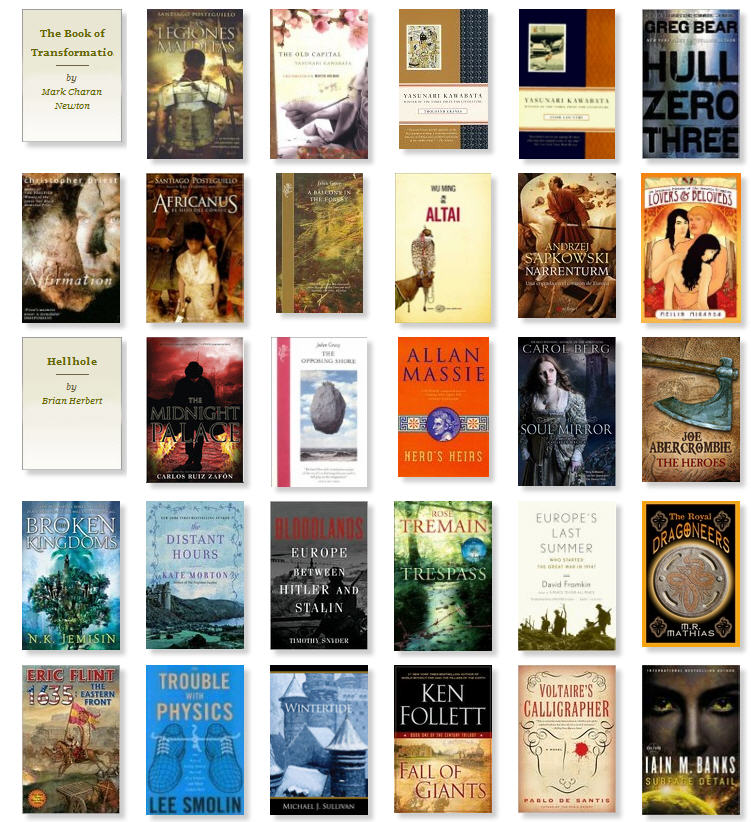
In the spirit of showing more books in covers using the wonderful capabilities of Goodreads, an image grabber and a little picture editing, here is the list of 13 books I am focusing now on and some more 40 books I started and could get into main focus at any time, with 30 more books I do not have but would at least start if not read end-to-end on getting them.
Of course I am open to new books too, but they better have something to wow me considering that the 53 books below that I have - and some sequels/related books I may read on completing the appropriate book from the 53 - not to speak of the 30 wanted below and others I may have forgotten from 2011 - are material for months of reading...
All three lists of titles are linked in the corresponding descriptions below.
************************************************************
Currently reading:
 (click through for larger picture)
************************************************************
Started and can get back to anytime - I have lots more books I started and put on the reading pile but these are all recent revisits.
************************************************************
Wanted and most would be asap reads, the rest at least try on receive:
 (click through for larger picture)
Of course I am open to new books too, but they better have something to wow me considering that the 53 books below that I have - and some sequels/related books I may read on completing the appropriate book from the 53 - not to speak of the 30 wanted below and others I may have forgotten from 2011 - are material for months of reading...
All three lists of titles are linked in the corresponding descriptions below.
************************************************************
Currently reading:
 (click through for larger picture)
Started and can get back to anytime - I have lots more books I started and put on the reading pile but these are all recent revisits.
************************************************************

Wanted and most would be asap reads, the rest at least try on receive:
 (click through for larger picture)
Using the marvelous Goodreads and it's sorting/display capabilities plus an image grabber, I decided to do a collage of the 244 books I've read this year sorted by rating.
*****************************************************************
A's or better in chronological order of listing them by me on Goodreads from recent on
 (click through for larger picture)
*****************************************************************
A's or better in chronological order of listing from recent on
 (click through for larger picture)
*****************************************************************
A's or better in chronological order of listing from recent on
 (click through for larger picture)
*****************************************************************
A's or better in chronological order of listing from recent on
 (click through for larger picture)
*****************************************************************
A's or better in chronological order of listing from recent on
 (click through for larger picture)
*****************************************************************
5 A's and then 25 B's in chronological order of listing from recent on
 (click through for larger picture)
*****************************************************************
3 lines of B's and 2 lines of C's in chronological order of listing from recent on
 (click through for larger picture)
*****************************************************************
10 C's, 19 D's and the 5 F's I've had the (dis)pleasure to read in 2010 in chronological order of listing from recent on
 (click through for larger picture)
*****************************************************************
A's or better in chronological order of listing them by me on Goodreads from recent on
 (click through for larger picture)
A's or better in chronological order of listing from recent on
 (click through for larger picture)
A's or better in chronological order of listing from recent on
 (click through for larger picture)
A's or better in chronological order of listing from recent on
 (click through for larger picture)
A's or better in chronological order of listing from recent on
 (click through for larger picture)
5 A's and then 25 B's in chronological order of listing from recent on
 (click through for larger picture)
*****************************************************************
3 lines of B's and 2 lines of C's in chronological order of listing from recent on
 (click through for larger picture)
10 C's, 19 D's and the 5 F's I've had the (dis)pleasure to read in 2010 in chronological order of listing from recent on
 (click through for larger picture)
This month Robert Thompson provided most of the book titles with additions by Cindy Hannikman, Liviu Suciu and Mihir Wanchoo. We are featuring 30 books. This month there were considerably more new sff releases but we tried to limit ourselves to a reasonable number and we chose the books most in tune with what's reviewed here.
The release dates are US unless marked otherwise and the books are first edition unless noted differently. The dates are on a best known basis so they are not guaranteed; same about the edition information. Since information sometimes is out of date even in the Amazon/Book Depository links we use for listings, books get delayed or sometimes even released earlier, we would truly appreciate if you would send us an email about any listing with incorrect information.
"Yarn” by Jon Armstrong. Release Date: December 1, 2010.
“Alcatraz Versus the Shattered Lens” by Brandon Sanderson. December 1, 2010.
“Transformation Space” by Marianne De Pierres. UK Release Date: December 2, 2010.
“Hawkmoon: The Runestaff” by Michael Moorcock. Release Date: December 7, 2010.
“Atlantis and Other Places” by Harry Turtledove. Release Date: December 7, 2010.
“The Bards of Bone Plain” by Patricia A. McKillip. Release Date: December 7, 2010.
“Seer of Sevenwaters” by Juliet Marillier. Release Date: December 7, 2010.
“On the Banks of the River of Heaven” by Richard Parks. December 7, 2010.
“The Lion of Cairo” by Scott Oden. Release Date: December 7, 2010.
"Alien Tango” by Gini Koch. Release Date: December 7, 2010.
“Witch & Wizard: The Gift” by James Patterson & Ned Rust. Release Date: December 13, 2010.
“People of the Book: A Decade of Jewish Science Fiction & Fantasy” edited by Rachel Swirsky & Sean Wallace. Release Date: December 14, 2010.
“Shadowheart” by James Barclay. Release Date: December 14, 2010.
“What the Night Knows” by Dean Koontz. Release Date: December 28, 2010.
“Elric: Swords and Roses” by Michael Moorcock. Release Date: December 28, 2010.
“Engineering Infinity” edited by Jonathan Strahan. Release Date: December 28, 2010.
“The Age of Odin” by James Lovegrove. Release Date: December 28, 2010.
“The Dark Griffin” by K.J. Taylor. Release Date: December 28, 2010.
“Walking the Tree” by Kaaron Warren. Release Date: December 28, 2010 (US Debut).
“Zoo City” by Lauren Beukes. Release Date: December 28, 2010 (US Debut).
“Mad Skills” by Walter Greatshell. Release Date: December 28, 2010.
“Star Wars: Red Harvest” by Joe Schreiber. Release Date: December 28, 2010.
“The Radleys” by Matt Haig. Release Date: December 28, 2010.
“Ruthless Game” by Christine Feehan. Release Date: December 28, 2010.
“The Iron Palace” by Morgan Howell. Release Date: December 28, 2010.
“Ascension” by Caris Roane. Release Date: December 28, 2010.
“Sapphique” by Catherine Fisher. Release Date: December 28, 2010.
“The Doomsday Box” by Herbie Brennan. Release Date: December 28, 2010.
“Blue & Gold” by K.J. Parker. Release Date: December 31, 2010.
“The White City” by Elizabeth Bear. Release Date: December 31, 2010.
The release dates are US unless marked otherwise and the books are first edition unless noted differently. The dates are on a best known basis so they are not guaranteed; same about the edition information. Since information sometimes is out of date even in the Amazon/Book Depository links we use for listings, books get delayed or sometimes even released earlier, we would truly appreciate if you would send us an email about any listing with incorrect information.
Sometimes a cover image is not available at the time of the post and also sometimes covers change unexpectedly so while we generally use the Amazon one when available and cross check with Google Images, the ultimate bookstore cover may be different.
***************************************************************** (click through for bigger image)
 (click through for bigger image)
"Yarn” by Jon Armstrong. Release Date: December 1, 2010.
“Alcatraz Versus the Shattered Lens” by Brandon Sanderson. December 1, 2010.
“Transformation Space” by Marianne De Pierres. UK Release Date: December 2, 2010.
“Hawkmoon: The Runestaff” by Michael Moorcock. Release Date: December 7, 2010.
“Atlantis and Other Places” by Harry Turtledove. Release Date: December 7, 2010.
“The Bards of Bone Plain” by Patricia A. McKillip. Release Date: December 7, 2010.
***************************************************************** (click through for bigger image)
 (click through for bigger image)
“Seer of Sevenwaters” by Juliet Marillier. Release Date: December 7, 2010.
“On the Banks of the River of Heaven” by Richard Parks. December 7, 2010.
“The Lion of Cairo” by Scott Oden. Release Date: December 7, 2010.
"Alien Tango” by Gini Koch. Release Date: December 7, 2010.
“Witch & Wizard: The Gift” by James Patterson & Ned Rust. Release Date: December 13, 2010.
“People of the Book: A Decade of Jewish Science Fiction & Fantasy” edited by Rachel Swirsky & Sean Wallace. Release Date: December 14, 2010.
***************************************************************** (click through for bigger image)
 (click through for bigger image)
“Shadowheart” by James Barclay. Release Date: December 14, 2010.
“What the Night Knows” by Dean Koontz. Release Date: December 28, 2010.
“Elric: Swords and Roses” by Michael Moorcock. Release Date: December 28, 2010.
“Engineering Infinity” edited by Jonathan Strahan. Release Date: December 28, 2010.
“The Age of Odin” by James Lovegrove. Release Date: December 28, 2010.
“The Dark Griffin” by K.J. Taylor. Release Date: December 28, 2010.
***************************************************************** (click through for bigger image)
 (click through for bigger image)
“Walking the Tree” by Kaaron Warren. Release Date: December 28, 2010 (US Debut).
“Zoo City” by Lauren Beukes. Release Date: December 28, 2010 (US Debut).
“Mad Skills” by Walter Greatshell. Release Date: December 28, 2010.
“Star Wars: Red Harvest” by Joe Schreiber. Release Date: December 28, 2010.
“The Radleys” by Matt Haig. Release Date: December 28, 2010.
“Ruthless Game” by Christine Feehan. Release Date: December 28, 2010.
***************************************************************** (click through for bigger image)
 (click through for bigger image)
“The Iron Palace” by Morgan Howell. Release Date: December 28, 2010.
“Ascension” by Caris Roane. Release Date: December 28, 2010.
“Sapphique” by Catherine Fisher. Release Date: December 28, 2010.
“The Doomsday Box” by Herbie Brennan. Release Date: December 28, 2010.
“Blue & Gold” by K.J. Parker. Release Date: December 31, 2010.
“The White City” by Elizabeth Bear. Release Date: December 31, 2010.
Subscribe to:
Posts (Atom)


