
Official C.C. Humphreys Website
Order "A Place Called Armageddon" HERE
Read FBC Review of "Vlad: the Last Confession"
Order "A Place Called Armageddon" HERE
Read FBC Review of "Vlad: the Last Confession"
INTRODUCTION: C.C. Humphreys came to my attention with “Vlad: The Last Confession”; despite my deep misgivings about it being another stupid rehashing of the myth of Dracula, the novel was actually very well researched and offered maybe the best English language portrait of the real-life Vlad the Impaler and his lifelong fight against the Turks without glossing over his darker impulses, but without any Dracula nonsense either.
So when not that long ago, I found out about Mr. Humphreys' new offering "A Place Called Armageddon" about the siege of Constantinople in 1453, the novel became the number one expected non-sff of mine in 2011 and I bought it the first moment I could and read it asap. Ultra high expectations and what can I say: the author not only delivered but surpassed them and I will explain why next.
Before continuing, I would add two things: despite being a very well researched and reasonably accurate historical novel, "A Place Called Armageddon" is also brimming with the fantastic - there are prophecies, mystic books, alchemists and fortune tellers and while it is a stretch to call the novel speculative fiction, it should greatly appeal to sff lovers for those elements and the superb world building the authors manages in the book's almost 500 pages.
There a lot of nice touches in the novel that tie-in with “Vlad: The Last Confession” including recounting of some earlier events there and a prophecy about one of the main characters here that we know how it will be fulfilled in the earlier book. Of course the structure of the two books is very different since "A Place Called Armageddon" is about a moment in historical time, so it essentially takes place over some weeks with a prologue a year before and an epilogue years later, while “Vlad: The Last Confession” takes place over decades, so there is no particular order in which to read the two novels.
OVERVIEW/ANALYSIS: "To the Greeks who love it, it is Constantinople. To the Turks who covet it, the Red Apple. Safe behind its magnificent walls, the city was once the heart of the vast Byzantine empire."
When looking at a novel like "A Place Called Armageddon" that is about a pivotal moment in world history, moment that has been studied intensively across time and has been fictionalized in many novels of which in English, Dark Angel by Mika Waltari remains my big favorite, there are several aspects to consider.
Paramount remains reasonable historical accuracy, meaning being accurate about all main events of the siege and getting right the atmosphere of the time since I have never understood why someone writing historical fiction alters major events and says: "well you know, it's fiction"; why bother writing about event "x" rather than write a fantasy/alt-history in which you can modify what happened to your own heart's content?
And here "A Place Called Armageddon" delivers in spades with an impressive recreation of the major moments of the siege; as one of many such examples, the naval battle between the four big Genoese vessels trying to break the blockade and the couple hundred strong Ottoman fleet and the reactions of both the besiegers and Mehmed and his entourage, as the fight turned literally with the wind is done in such a manner that despite knowing very well how things ended, it still felt like reading it for the first time. And I could go on and on, from the firing of the huge siege gun, to the Galata crossing, to the various wall battles, everything is memorable and true to the numerous accounts we have of the siege.
The world building and the little details are pitch perfect: weapons, buildings, ships, armies, historical characters and their psychological makeup - the untried, moody and easily angered but brilliant young Sultan Mehmet whose determination to become Fatih aka "The Conqueror" and practical ideas keep the siege going despite the early reverses and the long history of failed sieges across almost 1000 years, the last major one being led by none other than his father, the late Sultan Murat a warrior of much higher repute than Mehmet at the time, Hamza Bey, the tanner's son from the middle of nowhere who became the Sultan's falconer and confidant and who knows that the siege will make or break Mehmet and his "new men" like himself so he does his utmost to "manage" the Sultan, intrigue with possible Byzantine turncoats and lead soldiers when it comes to crunch time, or the relatively new emperor Constantine who wears the same name as the founder of the city - a bad omen as the last (western) emperor of Rome was Romulus Augustulus after all - a notable soldier but untried as politician and leader of a state and whose continual defiance and determination in face of the steadily worsening odds is also unforgettable.
But "A Place Called Armageddon" is also a human story with four major fictional characters at its center. The twin Lascari brothers with vastly different personalities and destinies: Theon, the smart diplomat, confidant of Constantine and Gregoras, the formerly handsome and valiant soldier, exiled as a mutilated cut-nose traitor, now moonlighting as the Ragusan mercenary "Zoran" in the famous' Genoese condotierre Giovanni Giustiniani Longo's army and who wants nothing to do with his erstwhile native city.
And the women in their lives: Gregoras' former fiance and secret lover Sophia, now (un)happily married with Theon, mother of boy Thakos and girl Minerva who is turning to God for solace and hope amid despair and fortune teller Leilah, a former slave who tries to make her own way in a harsh man's world and whose prophecies inspire Mehmet among others, though of course there is a huge risk in fortune telling for the mighty.
In addition, there are two more important characters: Johannes Grant a Scotland alchemist who is badly wanted by the Sultan (dead) and by Longo and the Byzantines (alive) for his presumed knowledge of how to recreate the famous Greek Fire recipe and Achmed, a huge but gentle poor Anatolian peasant whose much loved daughter Abal's death at 5 mostly due to poverty, leads him to enroll in the "canon fodder" troops recruited for the siege and whose pov shows the siege from the rank and file Ottoman side.
Each of the characters is very distinctive and the interaction between them ranges from the expected to quite a few twists and turns. All these personal threads mix in various ways and produce a lot of emotional moments, sometimes in quite unexpected places. Despite the different and often opposite interests and goals, the author is very skilled at making us care for all his main characters, including the ones who would have been so easy to depict as "evil", like Theon Lascari or the Sultan Mehmet.
Of course by the same token, not everyone can succeed, so there is heartbreak galore, but there is joy too and the ending is just superb with an epilogue 7 years later, followed by one just three weeks after the end of the siege. This offers a chance at a great twist which actually surprised me though I have seen it before in a G.G. Kay novel.So when not that long ago, I found out about Mr. Humphreys' new offering "A Place Called Armageddon" about the siege of Constantinople in 1453, the novel became the number one expected non-sff of mine in 2011 and I bought it the first moment I could and read it asap. Ultra high expectations and what can I say: the author not only delivered but surpassed them and I will explain why next.
Before continuing, I would add two things: despite being a very well researched and reasonably accurate historical novel, "A Place Called Armageddon" is also brimming with the fantastic - there are prophecies, mystic books, alchemists and fortune tellers and while it is a stretch to call the novel speculative fiction, it should greatly appeal to sff lovers for those elements and the superb world building the authors manages in the book's almost 500 pages.
There a lot of nice touches in the novel that tie-in with “Vlad: The Last Confession” including recounting of some earlier events there and a prophecy about one of the main characters here that we know how it will be fulfilled in the earlier book. Of course the structure of the two books is very different since "A Place Called Armageddon" is about a moment in historical time, so it essentially takes place over some weeks with a prologue a year before and an epilogue years later, while “Vlad: The Last Confession” takes place over decades, so there is no particular order in which to read the two novels.
OVERVIEW/ANALYSIS: "To the Greeks who love it, it is Constantinople. To the Turks who covet it, the Red Apple. Safe behind its magnificent walls, the city was once the heart of the vast Byzantine empire."
When looking at a novel like "A Place Called Armageddon" that is about a pivotal moment in world history, moment that has been studied intensively across time and has been fictionalized in many novels of which in English, Dark Angel by Mika Waltari remains my big favorite, there are several aspects to consider.
Paramount remains reasonable historical accuracy, meaning being accurate about all main events of the siege and getting right the atmosphere of the time since I have never understood why someone writing historical fiction alters major events and says: "well you know, it's fiction"; why bother writing about event "x" rather than write a fantasy/alt-history in which you can modify what happened to your own heart's content?
And here "A Place Called Armageddon" delivers in spades with an impressive recreation of the major moments of the siege; as one of many such examples, the naval battle between the four big Genoese vessels trying to break the blockade and the couple hundred strong Ottoman fleet and the reactions of both the besiegers and Mehmed and his entourage, as the fight turned literally with the wind is done in such a manner that despite knowing very well how things ended, it still felt like reading it for the first time. And I could go on and on, from the firing of the huge siege gun, to the Galata crossing, to the various wall battles, everything is memorable and true to the numerous accounts we have of the siege.
The world building and the little details are pitch perfect: weapons, buildings, ships, armies, historical characters and their psychological makeup - the untried, moody and easily angered but brilliant young Sultan Mehmet whose determination to become Fatih aka "The Conqueror" and practical ideas keep the siege going despite the early reverses and the long history of failed sieges across almost 1000 years, the last major one being led by none other than his father, the late Sultan Murat a warrior of much higher repute than Mehmet at the time, Hamza Bey, the tanner's son from the middle of nowhere who became the Sultan's falconer and confidant and who knows that the siege will make or break Mehmet and his "new men" like himself so he does his utmost to "manage" the Sultan, intrigue with possible Byzantine turncoats and lead soldiers when it comes to crunch time, or the relatively new emperor Constantine who wears the same name as the founder of the city - a bad omen as the last (western) emperor of Rome was Romulus Augustulus after all - a notable soldier but untried as politician and leader of a state and whose continual defiance and determination in face of the steadily worsening odds is also unforgettable.
But "A Place Called Armageddon" is also a human story with four major fictional characters at its center. The twin Lascari brothers with vastly different personalities and destinies: Theon, the smart diplomat, confidant of Constantine and Gregoras, the formerly handsome and valiant soldier, exiled as a mutilated cut-nose traitor, now moonlighting as the Ragusan mercenary "Zoran" in the famous' Genoese condotierre Giovanni Giustiniani Longo's army and who wants nothing to do with his erstwhile native city.
And the women in their lives: Gregoras' former fiance and secret lover Sophia, now (un)happily married with Theon, mother of boy Thakos and girl Minerva who is turning to God for solace and hope amid despair and fortune teller Leilah, a former slave who tries to make her own way in a harsh man's world and whose prophecies inspire Mehmet among others, though of course there is a huge risk in fortune telling for the mighty.
In addition, there are two more important characters: Johannes Grant a Scotland alchemist who is badly wanted by the Sultan (dead) and by Longo and the Byzantines (alive) for his presumed knowledge of how to recreate the famous Greek Fire recipe and Achmed, a huge but gentle poor Anatolian peasant whose much loved daughter Abal's death at 5 mostly due to poverty, leads him to enroll in the "canon fodder" troops recruited for the siege and whose pov shows the siege from the rank and file Ottoman side.
Each of the characters is very distinctive and the interaction between them ranges from the expected to quite a few twists and turns. All these personal threads mix in various ways and produce a lot of emotional moments, sometimes in quite unexpected places. Despite the different and often opposite interests and goals, the author is very skilled at making us care for all his main characters, including the ones who would have been so easy to depict as "evil", like Theon Lascari or the Sultan Mehmet.
Overall "A Place Called Armageddon" (A++) is a magnificent accomplishment, a novel that is both a recreation of a pivotal moment in history and a tale of interesting characters we get to care and root for.
 12:01 AM |
  Posted by
Liviu |
Posted by
Liviu |


Order “The Whitefire Crossing” HERE
Read An Excerpt HERE (PDF)
AUTHOR INFORMATION: Courtney Schafer attended college at Caltech where she obtained a B.S. in Electrical Engineering and also learned how to rock climb, backpack, ski and scuba dive. She then earned her Masters at the University of Colorado. Courtney now works in the aerospace industry and is married to an Australian scientist who shares her love for speculative fiction and mountain climbing. The Whitefire Crossing is her first novel.
PLOT SUMMARY: Dev is a smuggler with the perfect cover. He's in high demand as a guide for the caravans that carry legitimate goods from the city of Ninavel into the country of Alathia. The route through the Whitefire Mountains is treacherous, and Dev is one of the few climbers who knows how to cross them safely. With his skill and connections, it's easy enough to slip contraband charms from Ninavel—where any magic is fair game, no matter how dark—into Alathia, where most magic is outlawed.
But smuggling a few charms is one thing; smuggling a person through the warded Alathian border is near suicidal. Having made a promise to a dying friend, Dev is forced to take on a singularly dangerous cargo: Kiran. A young apprentice on the run from one of the most powerful mages in Ninavel, Kiran is desperate enough to pay a fortune to sneak into a country where discovery means certain execution—and he'll do whatever it takes to prevent Dev from finding out the terrible truth behind his getaway.
Yet the young mage is not the only one harboring a deadly secret. Caught up in a web of subterfuge and dark magic, Dev and Kiran must find a way to trust each other—or face not only their own destruction, but that of the entire city of Ninavel...
FORMAT/INFO: The Whitefire Crossing is 353 pages long divided over twenty-four numbered chapters. Narration alternates between Dev’s first-person POV and Kiran’s third-person POV. The Whitefire Crossing ends at a satisfying stopping point, but is clearly the first book in a series as numerous threads are left unresolved. The Tainted City, volume two of The Shattered Sigil, is scheduled for publication in 2012. August 2011 marks the Trade Paperback publication of The Whitefire Crossing via Night Shade Books. Cover art is provided by David Palumbo.
ANALYSIS: The Whitefire Crossing by Courtney Schafer is the tenth fantasy debut I’ve read in 2011. Four of these debuts are published by Night Shade Books including Teresa Frohock’s Miserere: An Autumn Tale, Of Blood & Honey by Stina Leicht, and Bradley P. Beaulieu’s The Winds of Khalakovo. Of these four, Of Blood & Honey and The Winds of Khalakovo are immediate standouts, while Miserere: An Autumn Tale showcased tremendous potential. The Whitefire Crossing however, is the best of them. In fact, when all is said and done, The Whitefire Crossing could be the fantasy debut of 2011.
So what’s so special about The Whitefire Crossing? In a word . . . everything. Characterization. World-building. Prose. Plot. Storytelling... The Whitefire Crossing succeeds in all of these areas, and does so with flying colors.
Take for example, Courtney Schafer’s characterization which is highlighted by Dev and Kiran, charming three-dimensional protagonists blessed with believable personalities, strengths and weaknesses. What makes Dev and Kiran so interesting is that neither one of them are prototypical ‘heroes’. Dev is a former Taint thief and current smuggler who takes on the job involving Kiran because he needs the money, while Kiran is secretly running away from his life as a blood mage apprentice. Both harbor convincing motivations for their actions—some are even honorable—and are willing to do whatever it takes to accomplish their goals, including sacrificing the lives of innocent people. At the same time, Dev and Kiran are also willing to sacrifice their own lives, not for fame or glory, but because they feel it’s the right thing to do. The supporting cast meanwhile, is quite strong and features Cara, an outrider and Dev’s friend; Pello, a dangerous shadow man—spy—whose allegiance remains in question throughout the book; and a couple of very powerful and very deadly villains in Ruslan Khaveirin and Simon Levanian.
Writing-wise, The Whitefire Crossing is very well-written. Courtney Schafer’s prose is polished and confident, and her writing style is highly accessible. Most impressive was the author’s ability to write compelling narratives in both first-person and third-person point-of-views:
“For several years now, I'd run packages across the mountains and over the Alathian border to the city of Kost for him. The Alathians were strict as hell on magic, piling on all kinds of laws and regulations to try and stop people from using it except in the tame little ways approved by their Council. Human nature being what it is, that makes for a thriving trade in certain specialty items. And since they'd outlawed all the darker, more powerful kinds of magic, it wasn't too hard to get around the poor bastard of an Alathian mage stuck with border inspection duty. Easy money as far as I was concerned, but smuggling a few illegal charms and wards was one thing. Smuggling a person was a whole different story.” —Dev
“Ever since he’d taken the hennanwort, Kiran felt trapped in a nightmare. A terrible smothering numbness engulfed his mind, his inner senses vanished as completely as a severed limb. Wavering colored haloes shimmered in disorienting array over his sight, and the distances between objects grew and shrank with no discernible pattern, as in some bizarre dreamscape. Every time he reached for power, he felt nothing but a sickening void, and his thoughts scattered and skipped like striderbugs in magelight.” —Kiran
World-building is not very detailed, providing only the barest amount of information necessary to understand concepts introduced in the book—the founding of Ninavel, Alathia’s restrictions against magic, Tainted children—but it is extensive. So not only has Courtney Schafer created a secondary world populated with different races, cultures and geography, but the world also has its own gods (Khalmet, Suliyya, Noshet), currency, slang (highsiders, streetsiders), food/drinks, illegal substances (taphtha, lionclaw), and flora/fauna (bristlebark pines, knotweed, fiddlenecks, sandcats, banehawks, snaprats), all of which is seamlessly integrated into the similes/metaphors used by the novel’s characters: “the mage’s face stayed as serenely calm as a Varkevian idol’s.” Certain concepts may take a while before they are properly explained, but that’s by design. Dev and Kiran come from two very different worlds, neither with much knowledge about the other, so the reader will learn things about blood magic, channelers/focus, ikilhia, Tainted children, the Change, the Well of the World and so on whenever information is shared between the two protagonists.
Magic includes different kinds of mages (blood, bone, sand, wind, earth, metal, crystal, song) and charms/wards used for just about everything imaginable including healing (bonemender, pains-ease, skinseal), sending messages, starting fires, dispelling vermin, adding a sniper feature to crossbows, tracking a person, discerning the truth, etc. Not very groundbreaking as far as magic systems go, but it’s interesting, well-developed, and is the primary source for pretty much all of the conflicts & challenges that Dev and Kiran have to face in the novel.
Rock climbing is an important element in The Whitefire Crossing. It helps define Dev as a character, brings a unique ingredient to the table that I’ve never read in a fantasy novel before, and establishes a sense of authenticity—obviously a result of the author’s own experiences—that is translated to the rest of the novel. Thematically, it’s quite interesting to see the vivid contrast between Ninavel and the cities of Alathia with all of their restrictions, while the author also explores issues of trust, sacrifice and different kinds of prejudice (highsiders/streetsiders, mages/nathahlen).
Storytelling in The Whitefire Crossing is superb. Right from the start, I was hooked by the book’s plot and remained fully engaged throughout thanks to excellent pacing and a story that is easy to follow, yet full of unexpected surprises and nonstop thrills. Basically, every time a question was answered, a problem solved or a crisis averted, new problems and revelations would arise, propelling Dev & Kiran into ever greater danger and adventure. Yet for all of the excitement offered by The Whitefire Crossing, it was the personal nature of the story that I admired most. Most epic fantasy these days features some sort of grand struggle between good and evil that threatens the entire land. The Whitefire Crossing is different. The stakes in Courtney Schafer’s novel are much more personal. Intimate. Dev repaying a debt to an old friend. Kiran running away because of what was stolen from him. The relationship that develops between the two. Even though a subplot emerges that threatens the city of Ninavel, The Whitefire Crossing remains personal, driven by Dev and Kiran’s thoughts, feelings and morals. Personally, I loved it. The story felt different from a lot of epic fantasy that I’ve read. Refreshing. The ending is a bit slow and anticlimactic, but it sets up a number of interesting developments for the sequel.
Negatively, there’s very little to complain about in The Whitefire Crossing. Dev’s narrative voice seemed familiar to me, bringing to mind numerous first-person POVs that I’ve read recently in urban fantasy and books featuring thieves, while the novel’s magic system, themes and world-building could have been fleshed out in greater detail. However, these issues are rather insignificant since they hardly impacted my enjoyment of the novel.
CONCLUSION: It’s not very often that I get to say this, but Courtney Schafer’s The Whitefire Crossing is the complete package. Fully developed characters. Across the board world-building. Intriguing magic. Accomplished writing. Engaging storytelling. Thrilling adventure... Add it all up and there's no doubt in my mind that The Whitefire Crossing is not only one of the best fantasy debuts of 2011, but it’s also one of the year’s best fantasy novels period...

Fantasy Book Critic is excited to host a giveaway of Catherine Fisher's complete Relic Master series. One lucky person will receive the complete series of books including The Dark City, The Lost Heiress, The Hidden Coronet and The Margrave.
Catherine Fisher is known for penning the New York Times bestselling duology, Incarceron and Sapphique.
About the Relic Series
Welcome to Anara, a world mysteriously crumbling to devastation, where nothing is what it seems: Ancient relics emit technologically advanced powers, members of the old Order are hunted by the governing Watch yet revered by the people, and the great energy that connects all seems to also be destroying all. The only hope for the world lies in Galen, a man of the old Order and a Keeper of relics, and his sixteen-year-old apprentice, Raffi. They know of a secret relic with great power that has been hidden for centuries. As they search for it, they will be tested beyond their limits. For there are monsters-some human, some not-that also want the relic's power and will stop at nothing to get it.
Rules for the Giveaway
- Open to US Residents Only
- Only One Entry Per Household (multiple entries will be deleted!)
- To be entered include your name, email address, mailing address in an email to fbcgiveaway@gmail.com with the subject "Relic Master Series"
- Giveaway will end July 31, 2011 at 11:59 AM PST.
- Winner will be randomly selected and notified by email.
- Personal information will only be used for this contest only and not for any other contest or other purposes.
Saturday, July 23, 2011
Three SF Novels to Watch for in the Fall and Winter: Stephenson, Priest and Wright (by Liviu Suciu)

Reamde by Neal Stephenson.
Why? Well, it's a (doorstop) novel by Neal Stephenson!
 The Islanders by Christopher Priest
Why? Well it's Christopher Priest so expect the mind-boggling unexpected!

Count to a Trillion by John C. Wright
Why? Well, it's sense of wonder sf by JC Wright and his Golden Age series debut is still the most memorable sf debut of the 00's.
Why? Well, it's a (doorstop) novel by Neal Stephenson!
 The Islanders by Christopher Priest
Why? Well it's Christopher Priest so expect the mind-boggling unexpected!

Count to a Trillion by John C. Wright
Why? Well, it's sense of wonder sf by JC Wright and his Golden Age series debut is still the most memorable sf debut of the 00's.
Friday, July 22, 2011
“The Devil Colony” by James Rollins w/Bonus Review of “Skeleton Key” (Reviewed by Mihir Wanchoo)

Read An Excerpt HERE
Watch James Rollins Discuss “The Devil Colony” HERE
AUTHOR INFORMATION: James Rollins is a pseudonym for Jim Czajkowski and is the New York Times, USA Today and Publishers Weekly bestselling author of sixteen novels including the SIGMA Force series which was optioned for film adaptation by Dino De Laurentis, the Indiana Jones and the Kingdom of the Crystal Skull novelization, and the Jake Ransom YA books. He also writes fantasy—The Banned and the Banished, the Godslayer Chronicles—under the pen name James Clemens. Besides writing, Jim holds a doctorate in veterinary medicine and is an avid spelunker and certified scuba enthusiast.
PLOT SUMMARY: Could the founding of America be based on a fundamental lie, one coded in secrets that stretch back to before the birth of Christ, to a mystery buried in the prehistoric past? The truth lies hidden within the ruins of a cursed lost colony of the Americas. A place known only as: THE DEVIL COLONY.
During a sweat lodge ceremony in an Indian cave in the Rocky Mountains, a horrible massacre ensues. Bodies are found blistered and burned and purposefully positioned to form two shapes: a five-pointed star and a sickle-shaped moon. One man recognizes the warning behind the gruesome murders: Painter Crowe, director of Sigma. He has seen these two symbols before and knows the deaths were a personal threat—one of the dead is his beloved cousin.
From the frozen volcanic peaks of Iceland to the blistering deserts of the American Southwest, from the tombs of dead presidents to the gold vaults of Fort Knox, Painter Crowe joins forces with Commander Grayson Pierce and an unlikely ally—a woman who may have had a hand in the murders—to penetrate the shadowy heart of a dark cabal that has been manipulating American history since the founding of the thirteen colonies. But can he discover the truth—one that could topple governments—before it destroys all he holds dear? Including the woman he loves...
FORMAT/INFO: The Devil Colony is 480 pages long divided over four titled Parts and forty-four numbered chapters. Also includes Acknowledgments, a map, Notes from the Historical/Scientific Record, and an Author’s Note to Readers: Truth or Fiction. Narration is in the third person via various characters, namely Grayson Pierce, Painter Crowe, Professor Henry Kanosh, Kai, Rafael Saint Germaine and a few minor POVs. The Devil Colony is mostly self-contained, but leaves a small thread unresolved, to be continued in the next SIGMA book.
June 21, 2011 marked the North American Hardcover publication of The Devil Colony via William Morrow. The UK edition (see below) will be published on December 29, 2011 via Orion.

There is a traditional structure to James Rollins’ novels with the prologue occurring in the past—either decades or centuries ago—with the timeframe shifting to the present day for the rest of the book, followed by multiple plot threads and a crackerjack story. The Devil Colony is no different. Here, the prologue takes place in Kentucky territory in the year 1779, and involves a terrific discovery and a brutal fight. The action then shifts to the present day and a cave in the Rocky Mountains where there has been a new discovery. This discovery involves Professor Henry Kanosh, a Shoshone historian and naturalist, Painter Crowe’s niece Kai, and a focal event which literally and figuratively kicks the book off in explosive fashion.
Elsewhere, Grayson Pierce continues to deal with family problems including his dad’s dementia. Quickly complicating matters is the appearance of Seichan, who reveals potentially exciting information that has a strange tie-in to the Utah anomaly. Also thrown into the mix are returning characters Monk and Kowalski who aid Gray and Painter in their respective missions. Lastly, there’s the secretive Rafael Saint Germaine who has his own plans for the SIGMA team and is the main mystery of the book.
Another tradition found in James Rollins’ novels is the way scientific facts/mysteries are combined with rollicking action sequences. In this case, the scientific facts/mysteries include the appearance of gold tablets in an ancient Indian burial site, Mormonism, and a third factor that I will let readers discover on their own.
There are many reasons why I’m such a huge James Rollins fan and they can be found in The Devil Colony. For starters, the pacing is once again electric with events happening so quickly that the book will leave readers breathless. Secondly, the action sequences are awesome. From the poisonous piranha-frog mutant scene in Amazonia to the thrilling desert duel in Sandstorm, Jim has never disappointed, and that trend continues in The Devil Colony in the form of volcanic activity, cavern fights, and much more. Lastly, characterization is pretty solid, giving readers a deeper understanding of the SIGMA Force team, while the twists he has planned for the characters are shocking.
Negatively, The Devil Colony can be predictable, especially if you are a long-time reader of James Rollins. This predictability is due to using basically the same formula and plot structure in every book, including the combination of science & historical facts/mysteries, cinematic action/adventure, and a story that is wrapped up by the end of the novel. This doesn’t mean The Devil Colony is boring to read. On the contrary, it’s always fun and interesting to see what new science/history James Rollins decides to explore in his latest book, but it would be nice if he would change things up a little. Another negative is the near invincibility of the main character cast. After seven SIGMA Force novels, it’s becoming harder and harder to believe that the members of SIGMA are able to survive everything that’s been thrown their way. In the past, Jim has shown a cruel streak with his characters and I believe he needs to find a better balance in the SIGMA Force series.
CONCLUSION: Even with all of the negatives to consider, The Devil Colony still does a terrific job entertaining and intriguing the reader. In fact, James Rollins is one of the best writers of his genre. So dive into The Devil Colony as James Rollins once again amazes and thrills readers all over the world...
BONUS REVIEW — “The Skeleton Key”:

Read An Excerpt HERE
The Skeleton Key is the second SIGMA Force short story to be released by James Rollins. However, it’s the first one to be released exlusively as an e-book. The short story is told from Seichan’s perspective and is set in Paris among its subterranean catacombs. The timeline is set after the events of 2009’s The Doomsday Key, but before the events in The Devil Colony.
The short story opens with Seichan waking up in a hotel room with a transmitter implanted on her body and instructions to find a certain individual in the Parisian catacombs. In the same room is another person who shares a similar fate, but his instructions are just to aid Seichan. Seichan has no recollection of who did this to her, but she has a faint idea and agrees to the search, thus beginning this exciting short story...
The Skeleton Key is a very fast-paced story, quickly proceeding to an exciting climax, while providing welcome insight into Seichan, a fan-favorite character. There’s also a very nice twist. In short, The Skeleton Key is a worthwhile addition to the SIGMA universe and recommended reading for fans of James Rollins...
NOTE: The Skeleton Key short story will be included in the paperback release of The Devil Colony as bonus material.
Thursday, July 21, 2011
Two Recent Pyr Novels - Discussion: "Sword of Fire and Sea" by Erin Hoffman and "The Falling Machine" by Andrew Mayer (reviews by Liviu Suciu)
Since I am trying to showcase as many 2011 interesting books of various kinds as I can, but the number of full reviews I can do is limited and with the month and a half posting hiatus to consider too, it is inevitable that some books won't receive as complete coverage as I wish. I keep the continually updated post with 2011 books read HERE, and from time to time I will have shorter discussions of various books.
Here I will talk about two recent books that have several things in common: they are debuts, both authorial and of a series and they have been published by Pyr which seems to have started putting out its own brand of "fast and furious fun" novels, brand perfectly exemplified by Erin Hoffman's Sword of Fire and Sea and by Andrew Mayer's The Falling Machine.
********************************************************
Sword of Fire and Sea by Erin Hoffman is a high magic adventure with relentless action, exuberance and occasional over the top scenes that work well here. The blurb below represents well enough the main storyline of the novel at least to start with.
"Three generations ago Captain Vidarian Rulorat's great-grandfather gave up an imperial commission to commit social catastrophe by marrying a fire priestess. For love, he unwittingly doomed his family to generations of a rare genetic disease that follows families who cross elemental boundaries. Now Vidarian, the last surviving member of the Rulorat family, struggles to uphold his family legacy, and finds himself chained to a task as a result of the bride price his great-grandfather paid: the Breakwater Agreement, a seventy-year-old alliance between his family and the High Temple of Kara'zul, domain of the fire priestesses.
The priestess Endera has called upon Vidarian to fulfill his family's obligation by transporting a young fire priestess named Ariadel to a water temple far to the south, through dangerous pirate-controlled territory. A journey perilous in the best of conditions is made more so by their pursuers: rogue telepathic magic-users called the Vkortha who will stop at nothing to recover Ariadel, who has witnessed their forbidden rites."

Sword of Fire and Sea flows very well despite that it changes its balance and focus at least twice; the transitions are done so well, you really do not notice until you think a little and say "but the book was supposed (and started) to be about *** and look now it's actually ***"
The novel is packed with stuff; in its short under 300 pages length, it has more goings on than quite a few recent books double its size or more. No superfluous details here, no detailed world building, but you pick up the details as you are compelled to turn the pages and see what happens next and there is a good enough sketch of the series universe to have a sense of reality and of coherence.
There is a clear outside world and quite a few secondary characters that shine and occasional steal spotlight, especially some non-human ones I will leave you to read about, though of course the main focus is still on Vidarian and Ariadel. I never felt the book in danger of descending into farce or incoherence - which are the main pitfalls for books with its structure, where you just hang onto your seat end to end so to speak.
Sword of Fire and Sea (A+ and highly recommend to anyone looking for a fun adventure with lots of magic and a little romance added in the mix) also offers a reasonably full package so while there is ample scope for more - in which I am definitely interested - the novel stands well on its own. Prepare to enjoy the ride!
********************************************************
The Falling Machine by Andrew P. Mayer is a fun book in the spirit of George Mann's Ghosts of Manhattan, though lighter at least in tone if not in events which turn darker in the second half. The blurb below gives a good idea about the main storyline of the novel:
"In 1880 women aren't allowed to vote, much less dress up in a costume and fight crime...
But twenty-year-old socialite Sarah Stanton still dreams of becoming a hero. Her opportunity arrives in tragedy when the leader of the Society of Paragons, New York's greatest team of gentlemen adventurers, is murdered right before her eyes. To uncover the truth behind the assassination, Sarah joins forces with the amazing mechanical man known as The Automaton. Together they unmask a conspiracy at the heart of the Paragons that reveals the world of heroes and high-society is built on a crumbling foundation of greed and lies. When Sarah comes face to face with the megalomaniacal villain behind the murder, she must discover if she has the courage to sacrifice her life of privilege and save her clockwork friend."

Superheroes and steampunk in a true age of steam and in New York rather than London at about the time the Brooklyn Bridge was being built, The Falling Machine starts with a superb action sequence on its construction site. After the breathless beginning, the book keeps moving fast and furious and it delivers what I expected of it quite well with only one niggle, namely it's a little too short and it ends when things become the most interesting with not quite a cliffhanger, but not even a partial resolution either, though the good news is that the second series' installment comes up later this year and of course this sequel has become an asap for me since I really want to know what happens next.
The other thing I liked about the book beside the setting and author's narrative flow that does not let go, were the characters since despite starting as more-or-less stock - the genius professor, the rich industrialist playing at superhero, the young up and coming blade , "the girl" aka the daughter of the industrialist, the mechanical man and the famous detective superhero, plus the assorted villains, all with funny names but in the spirit of the tale told here - they develop in sometimes unexpected directions and acquire distinctive personalities, most notably the main heroine Sarah Stanton and Tom the mechanical man with a secret.
Overall The Falling Machine (A+, highly recommended for any steampunk lover) is a very entertaining debut which succeeds delivering what it promises.
Here I will talk about two recent books that have several things in common: they are debuts, both authorial and of a series and they have been published by Pyr which seems to have started putting out its own brand of "fast and furious fun" novels, brand perfectly exemplified by Erin Hoffman's Sword of Fire and Sea and by Andrew Mayer's The Falling Machine.
********************************************************
Sword of Fire and Sea by Erin Hoffman is a high magic adventure with relentless action, exuberance and occasional over the top scenes that work well here. The blurb below represents well enough the main storyline of the novel at least to start with.
"Three generations ago Captain Vidarian Rulorat's great-grandfather gave up an imperial commission to commit social catastrophe by marrying a fire priestess. For love, he unwittingly doomed his family to generations of a rare genetic disease that follows families who cross elemental boundaries. Now Vidarian, the last surviving member of the Rulorat family, struggles to uphold his family legacy, and finds himself chained to a task as a result of the bride price his great-grandfather paid: the Breakwater Agreement, a seventy-year-old alliance between his family and the High Temple of Kara'zul, domain of the fire priestesses.
The priestess Endera has called upon Vidarian to fulfill his family's obligation by transporting a young fire priestess named Ariadel to a water temple far to the south, through dangerous pirate-controlled territory. A journey perilous in the best of conditions is made more so by their pursuers: rogue telepathic magic-users called the Vkortha who will stop at nothing to recover Ariadel, who has witnessed their forbidden rites."

Sword of Fire and Sea flows very well despite that it changes its balance and focus at least twice; the transitions are done so well, you really do not notice until you think a little and say "but the book was supposed (and started) to be about *** and look now it's actually ***"
The novel is packed with stuff; in its short under 300 pages length, it has more goings on than quite a few recent books double its size or more. No superfluous details here, no detailed world building, but you pick up the details as you are compelled to turn the pages and see what happens next and there is a good enough sketch of the series universe to have a sense of reality and of coherence.
There is a clear outside world and quite a few secondary characters that shine and occasional steal spotlight, especially some non-human ones I will leave you to read about, though of course the main focus is still on Vidarian and Ariadel. I never felt the book in danger of descending into farce or incoherence - which are the main pitfalls for books with its structure, where you just hang onto your seat end to end so to speak.
Sword of Fire and Sea (A+ and highly recommend to anyone looking for a fun adventure with lots of magic and a little romance added in the mix) also offers a reasonably full package so while there is ample scope for more - in which I am definitely interested - the novel stands well on its own. Prepare to enjoy the ride!
********************************************************
The Falling Machine by Andrew P. Mayer is a fun book in the spirit of George Mann's Ghosts of Manhattan, though lighter at least in tone if not in events which turn darker in the second half. The blurb below gives a good idea about the main storyline of the novel:
"In 1880 women aren't allowed to vote, much less dress up in a costume and fight crime...
But twenty-year-old socialite Sarah Stanton still dreams of becoming a hero. Her opportunity arrives in tragedy when the leader of the Society of Paragons, New York's greatest team of gentlemen adventurers, is murdered right before her eyes. To uncover the truth behind the assassination, Sarah joins forces with the amazing mechanical man known as The Automaton. Together they unmask a conspiracy at the heart of the Paragons that reveals the world of heroes and high-society is built on a crumbling foundation of greed and lies. When Sarah comes face to face with the megalomaniacal villain behind the murder, she must discover if she has the courage to sacrifice her life of privilege and save her clockwork friend."
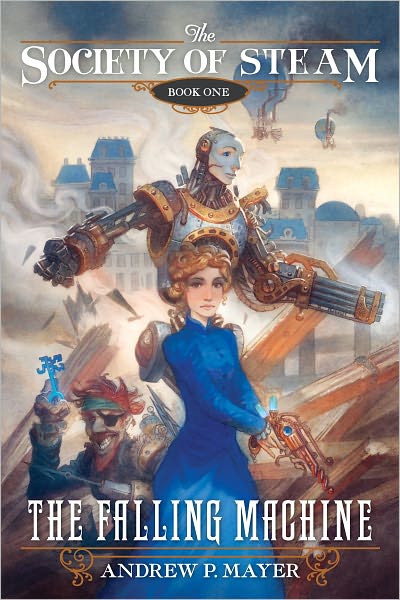
Superheroes and steampunk in a true age of steam and in New York rather than London at about the time the Brooklyn Bridge was being built, The Falling Machine starts with a superb action sequence on its construction site. After the breathless beginning, the book keeps moving fast and furious and it delivers what I expected of it quite well with only one niggle, namely it's a little too short and it ends when things become the most interesting with not quite a cliffhanger, but not even a partial resolution either, though the good news is that the second series' installment comes up later this year and of course this sequel has become an asap for me since I really want to know what happens next.
The other thing I liked about the book beside the setting and author's narrative flow that does not let go, were the characters since despite starting as more-or-less stock - the genius professor, the rich industrialist playing at superhero, the young up and coming blade , "the girl" aka the daughter of the industrialist, the mechanical man and the famous detective superhero, plus the assorted villains, all with funny names but in the spirit of the tale told here - they develop in sometimes unexpected directions and acquire distinctive personalities, most notably the main heroine Sarah Stanton and Tom the mechanical man with a secret.
Overall The Falling Machine (A+, highly recommended for any steampunk lover) is a very entertaining debut which succeeds delivering what it promises.

Read An Extract HERE
AUTHOR INFORMATION: Mark Lawrence is a research scientist working on artificial intelligence. He lives in England with his wife and four children. Prince of Thorns is his first novel.
PLOT SUMMARY: When he was nine years old, Prince Honorous Jorg Ancrath saw his mother and younger brother murdered before his eyes. By thirteen, he commanded a band of bloodthirsty mercenaries. By the time he is fifteen, he intends to be king.
First though, Jorg must return to the life he turned his back on, to take what is rightfully his. Since the day he was hung on the thorns of a briar patch and forced to watch Count Renar's men slaughter his mother and brother, Jorg has been driven by a burning need for vengeance. Life and death are no more than a game to him—and he has nothing left to lose.
But treachery and dark magic awaits him in his father’s castle. No matter how fierce, can the will of one young man conquer enemies with power beyond his imagining?
CLASSIFICATION: Prince of Thorns is R-rated epic fantasy that combines Robert E. Howard/Glen Cook-like sword-and-sorcery action with George R. R. Martin-inspired court intrigue and a revenge-driven plot that would make Joe Abercrombie proud. Because of a young protagonist whose accomplishments defy his age and abilities, and a fantasy world that seems to be a different version of Earth, I was also reminded of Paul Hoffman’s The Left Hand of God, while the novel’s dark tone and gritty atmosphere evoked thoughts of David Keck and Richard K. Morgan’s The Steel Remains...
FORMAT/INFO: Prince of Thorns is 336 pages long divided over forty-nine numbered chapters. Narration is in the first-person, exclusively via Prince Honorous Jorg Ancrath. Prince of Thorns ends at a satisfying stopping point, but is the first volume in The Broken Empire trilogy. August 2, 2011 marks the North American Hardcover publication of Prince of Thorns via Ace Books. The UK version (see below) will be published on August 4, 2011 via Harper Voyager. Cover art is provided by Jason Chan. More information, including a Map and a Cast of Characters, can be found at Mark Lawrence’s Official Website.

Speaking of first impressions, Prince of Thorns had me worried initially because of a young protagonist who acts and performs feats that seem impossible for his years—the novel features Jorg at ages nine and fourteen. More troubling however, was the world of Prince of Thorns which is like an alternate version of Earth, or a post-apocalyptic future where civilization has evolved back to medievalism. Personally, I prefer fantasy that is as far removed from the real world as possible—there are exceptions, as long as the names are changed and a creative effort is made—so it was disappointing to see God, Jesus, the Devil, Euclid, Plato, Sun Tsu, Socrates, Aristotle, Robin Hood, Nietzsche, Gog/Magog, Hercules and Shakespeare all make appearances in a novel that I consider epic fantasy. Fortunately, compared to how much I enjoyed the rest of the book, the setting and Jorg’s young age are minor complaints.
Surprisingly, Prince of Thorns’ greatest asset is Prince Honorous Jorg Ancrath himself. Jorg may be ruthless, immoral, and way too young to be accomplishing the things that he does in Prince of Thorns—requiring a strong suspension of disbelief—but he’s also incredibly fascinating. A tragic past, supporting characters that are even more ruthless than Jorg—King Olidan, Sageous, Corion, Rike, etc.—and contemporary fantasy novels that celebrate antiheroes (Monument, The Sad Tale of the Brothers Grossbart, Malazan Book of the Fallen, ASOIAF, The Steel Remains, anything by Joe Abercrombie) all contribute to the prince’s appeal, but the main reason Jorg captured my sympathy is because of a compelling first-person narrative rife with revealing insights, interesting observations about his ‘brothers’, and amusing words of wisdom:
“The pain became my enemy. More than the Count Renar, more than my father’s bartering with lives he should have held more precious than crown, or glory, or Jesu on the cross. And, because in some hard core of me, in some stubborn trench of selfish refusal, I could not, even at ten years of age, surrender to anything or anyone. I fought that pain. I analysed its offensive, and found its lines of attack. It festered, like the corruption in a wound turned sour, drawing strength from me. I knew enough to know the remedy. Hot iron for infection, cauterize, burn, make it pure. I cut from myself all the weakness of care. The love for my dead, I put aside, secure in a casket, an object of study, a dry exhibit, no longer bleeding, cut loose, set free. The capacity for new love, I burned out. I watered it with acid until the ground lay barren and nothing there would sprout, no flower take root.”
“Most men have at least one redeeming feature. Finding one for Brother Rike requires a stretch. Is ‘big’ a redeeming feature?”
“War, my friends, is a thing of beauty. Those as says otherwise are losing.”
“You got responsibilities when you’re a leader. You got a responsibility not to kill too many of your men. Or who’re you going to lead?”
“Hangings, beheadings, impalement, oh my!”
“You soon learn there’s no elegance or dignity in death if you spend time in the castle kitchens. You learn how ugly it is, and how good it tastes.”
“On the road, shit has the decency to stink.”
Concise storytelling is the second best attribute in Prince of Thorns, with brisk pacing, short chapters and a slim page count highlights of the novel. Factor in a story that boils down to an age-old tale of bloody revenge, and it’s no surprise that Prince of Thorns is a remarkably fast and intense read, especially compared to most epic fantasy. Of course, there’s more to Prince of Thorns than simple vengeance. Well-timed flashbacks—the assassination of Jorg’s mother and brother, his recovery, meeting the Nuban and his ‘brothers’ for the first time, etc.—court intrigue that references GRRM’s A Song of Ice & Fire (“a sacrifice to the iron will I needed to win the game of thrones”), and dark magic all work together to flesh out the book’s content, while keeping readers on their toes. The novel’s ending is a bit predictable because of Jorg’s first-person POV and the nature of the book, but Prince of Thorns will leave readers hungering for more.
World-building may be sparse—Builders, the Day of a Thousand Suns, the Broken Empire—but this works to the novel’s advantage, keeping the page count lean, while providing a sense of mystery. This is also true with the characterization, which is minimal apart from Jorg, although the camaraderie between the prince and his ‘brothers’ is skillfully executed. Magic meanwhile, which includes lich, dream-witches, leucrota, an oracle, necromancers, etc., is not very original, but it does add various layers of danger and intrigue to the book.
CONCLUSION: In a year teeming with fantasy debuts—Among Thieves, Den of Thieves, Miserere: An Autumn Tale, Of Blood & Honey, Songs of the Earth, The Desert of Souls, The Unremembered, The Whitefire Crossing, The Winds of Khalakovo—Mark Lawrence’s Prince of Thorns is one of the year’s best thanks to a captivating antihero in Prince Jorg, Jorg’s compelling first-person narrative, and a story full of brutal sword-and-sorcery action, treacherous court intrigue, and cold-blooded revenge...
 Labels:
Subscribe to:
Posts (Atom)


