
Fantasy’s Quality Conundrum
When No Rules Apply, How Do You Judge Quality In Fantasy Books?
By Jessica Bennett
I think a lot of people
assume that fantasy is easy to write. After all, the author gets to make
everything up. There are no rules, no boundaries, no limits. I agree to some
extent. Bad fantasy is really easy to write.
Good fantasy, on the
other hand, is extremely challenging to write — at least in my humble opinion.
Fantasy authors don’t get to work within the established confines of a known
world. They have to create a completely unique world where the sky might not be
blue, a young peasant girl can grow up to be a powerful sorceress and the dead
may not stay in the ground to accommodate the worms. One of the most well-known
maxims of the writing world is “write what you know”. Fantasy authors chuck
this bit o knowledge out the window, by writing about all sorts of things they
don’t know like what the talons of a griffin feel like or how to weave a love
spell.
The fact that fantasy is so
difficult to write is — again, just my humble opinion — why great fantasy is so
hard to come by and why you could probably trip over a dozen mediocre fantasy
books in just one short stroll through Amazon.
Here’s the part where you
wonder who exactly I am and where I get off making broad statements about good
and bad fantasy. After all, how in the heck can I or anyone else judge what’s a
good fantasy book when there are virtually no rules or limits to what can
happen within a fantasy story?
Let me start out by
introducing myself. My name is Jessica
Bennett. I’m an indie author and passionate reader. Fantasy is one of my
favorite genres to read, and the one I always go to when I really need to get
away from life for a while.

I am also the co-owner of
a company called Grub Street
Reads, which evaluates and endorses quality indie books. My business
partner, Leslie Ramey, and I created
our company, because we truly believe that the rapidly-growing indie book
market is in need of a quality standard.
Leslie and I spent a lot of
time developing an endorsement standard that could be applied objectively and
consistently to any fiction or creative nonfiction manuscript regardless of
genre or specific plot points, including fantasy.
We’ve gotten questions
from readers about how we can possibly apply a single standard to so many
different kinds of books, especially fantasy.
As it turns out, even though
the rules within a fantasy verse are as flexible as Play-Doh, the components of
good writing are as solid as ever. These components include things like
well-developed characters, a consistent plot, strong pacing and few (if any)
grammatical mistakes.
For instance, a fantasy
book may feature a fearsome troupe of trolls called Gruesome, Bone Cruncher and
Todd. This is all well and good, but if Gruesome, Bone Cruncher and Todd don’t
each have distinct personalities, strong motivations and believable reactions
to plot twists, then readers aren’t going to develop an emotional bond to them.
Good pacing is also critical. If the prince gets lost on his way to rescue the
princess or decides he needs to get a workout in at the gym first, then readers
are going to put down the book faster than a dragon can belch fire.
Grub Street Reads is just
getting off the ground (we officially launched in July), but we’ve already
gotten to add some great fantasy novels to our endorsed book library. If you’ve
been burned by poor quality fantasy books in the past, come on over to the Grub Street Reads Endorsed Library.
Our library includes only those books that have passed our quality standard.
These books are low on cost and high on quality. And don’t forget to check back
— our library grows each week.
What do you think of our idea? Could the indie book market,
fantasy novels included, use a quality standard? Leave a comment and let us
know your thoughts.
ABOUT GRUB STREET READS:

Grub Street Reads’
mission statement is simple: Support the indie book movement. Support good
books. Give readers the excuse they need to try a new indie author.
To do that, Grub
Street Reads has developed a clean and simple endorsement protocol, meant to shine the spotlight on good self-published books and protect readers
from those that are not yet ready for the marketplace.
In short, Grub
Street Reads wants to be the quality standard for the indie book market,
and believes their company can be a very good thing for indie authors and the
readers who want to buy their books…
 12:01 AM |
  Posted by
Robert |
Posted by
Robert |


Tuesday, August 7, 2012
Three Mini Reviews: His Own Good Sword, Black Scars and The Skeleton King (Reviewed by Mihir Wanchoo)
It’s that time again when I’m a bit behind on my TBR pile and since I am unable to fully review all the books, which I read. Hence I’m taking a page from Liviu's book reviews and will be doing three ‘mini-reviews’. The common factor uniting these three titles is that all of them are Indie/small press titles and showcase different genres of the fantasy spectrum.
****************************************************************************

OVERVIEW/ANALYSIS: I received a review request for this book from the author and was instantly hooked on to it by its blurb. Focusing the story in an alternate Roman empire-like world wherein the Vareno people have conquered the Cesino tribes and built a massive empire. Their occupation hasn’t been a smooth one and the outlands have always been troublesome a la Scotland for the Roman Empire. In this exciting setup the story promptly opens up with Tyren Risto, a Vareno noble who has to explain to his family as to why he has gotten his posting orders in the Cesino Outlands. His explanation aside, his family doesn’t quite understand his actions on behalf of a slave and is quite unhappy with the situation.
Tyren however is intent upon doing right by his country and his military orders. Setting out on his journey to the outlands, his family drops a Cesino slave on him and the slave’s behavior is a bit strange and gives Tyren doubts about his intentions. Tyren on reaching the outpost discovers that there’s much more to doing than just holding it. He has to contend with his difficult subjects, the indifference of his men and also the worry of doing the right thing by everyone.
Amanda McCrina’s debut shows quite some flair to her writing style, her prose while far from being economical is a bit reminiscent of K.J. Parker in its inquisitive style. The story begins slowly however there are many secrets and observations packed along the way for the reader to grasp and if they do, they will be rewarded in the latter half of the story. The pace is on the slower side in the first half of the book however it does pick up quite nicely during the second half to give the readers a good climax. The best part of the story is the characterization from Tyren to its other characters; the author gives us a well-rounded view into their thought process and viewpoints. This helps in understanding the conflict quite precisely and also gives us an insightful look into the main character.
The only drawbacks for me in this story were the spartan world-building and its pace, the world building is something which leaves a lot to be deserved as the author while focusing on the characters and the plot keeps the world building to a tad minimum, and this perhaps is the big factor going against the story. The pacing while on the slower side does pick up and only might be a niggling factor if the readers expect action from the first few pages.
His Own Good Sword is a quiet debut but it’s a significant one, Amanda McCrina is an author with a lot of potential and with her understated but smooth writing style marks herself out as a writer to look out for. Book one of the Cymeria series is a good historical fantasy and I’m eagerly waiting to see where the author takes the story next in The Sword Unsheathed.

OVERVIEW/ANALYSIS: After reading Blood Skies, Steven Montano’s debut, I was very much intrigued by his post-apocalyptic, horror tinged, thriller style. The first book titled the same as the series was definitely something that I enjoyed and so I was very much looking forward to Black Scars and the continuation of Eric Cross's story. The story begins is its usual confusing fashion where a myriad series of events occur and seem to have no connection with each other. The story opens with a creature escaping from its prison not knowing entirely where it is and what it’s supposed to do.
We find Eric Cross along with a new team trying to fit in after the events of the past and still trying to gel with his new magical spirit. Eric is a young veteran who has faced horrors beyond the human imagination in the preceding title, he also has become the first mage to lose his spirit but also gain a new one as well. These events however cannot prepare the reader for the mayhem that is yet to come and the author does his absolute best to outdo the first book in the gore factor as well as the plot twists.
The book’s biggest strength is the author’s prose, it is stylistic like John Connolly when it comes to descriptions of the world and its inhabitants, however while John does it in a bit of a restrained manner, Steven Montano goes out blazing on all his cylinders. His prose and descriptions paint a bleak and brutal picture but its beauty is no less stark. The pace and plot twists are ratcheted up further if that was even possible. The author’s imagination has to be lauded for the world he has created as well as the horrors that inhabit it. This is his trademark, his vivid imagination and to use it to fuel his high-octane stories that mix more genres than possible as well give the readers a story unlike they have read before.
There are a few niggles to this tale as well, firstly the action sequences sometimes overwhelm the storyline. The action events are definitely long drawn out and sometimes detract from the happenings of the story. This might not be such a big point for the action lovers among the readers however for those looking for a little less action, this might not be the book for you. Secondly the world is still not revealed in its entirety, the events called the Black are explained to a certain extent but not to its entirety. I’m hoping we get more reveals in the next book.
Black Scars is a visible improvement on its predecessor and sets up the next book SoulRazor quite emphatically. Black Scars is an eclectic mix of horror, SF, Military fantasy as well as dark fantasy genres. With such a mix, it becomes more than the sum of its components, it’s a Steven Montano book that manages to give the readers a read that will surprise, thrill and scare them. Dive into the world of the Black and be prepared to read a tale quite unlike you have read anything so far.

Read an extract here (Includes spoilers for the first & second book)
OVERVIEW/ANALYSIS: This is the third book in the Silk and Steel saga by Karen Azinger, The first two books showcased a high fantasy world and a large cast of characters that have filled the pages so far. At the end of the second book, unrest and evil have spread to almost every corner of the lands of Erdhe. This book opens with war threatening to erupt in several kingdoms of Erdhe. The action now focuses on the northern part of the country shown on the map, and is symbolic as the start of the saga originated from there as well.
In this book, Kath the Imp and her group are travelling to a region, which is not only dangerous but also has been known to be quite morbid. The Mordant has taken a new soul for his entertainment and his plans to bring pain and suffering further bear fruition. The plot features Kath, the Knight Marshal and the Mordant for a majority of the tale and this pretty much gives the reader an indication of the events in the book.
The book again showcases Karen Azinger’s strengths, which is a fast paced storyline, plot twists and characterization. The story of course is a grim one and the author doesn’t shy away from the violence or dark nature of the events. The author has been hinting at certain things in the past two books and it’s in this middle volume of the series that many character and plot arcs are finally being revealed to the reader. This highlights some serious plotting on the author’s part and kudos to her on it. The characterization is top notch as ever as this time we get more than an intense look into the mind of the Mordant who is as evil as they come but fascinating and equally gruesome to read about. The author has to be lauded for not making him a two-dimensional villain.
The Skeleton King’s biggest fallacy is its predictability and its inability to separate itself from its genre setting. The predictability factor comes in the direction of the story, which for most fantasy fans is not hard to guess and therefore does not hold anything new for them. Most fantasy stories always have some of the genre’s underpinnings but every author tries their best to give the plot his/her own twist. This however doesn't work quite so well in this case as the storyline while exciting doesn't gain much points for originality.
The Skeleton King is a good book and it’s a good continuation of the Silk and Steel saga. For fans of the previous two books, this is a terrific third volume and they will definitely enjoy its plot and scope. For general fantasy fans, this might not be the place to start, begin with the Steel Queen to enjoy a high classical fantasy quest book.

Both Liviu and I were thoroughly surprised by the excellence showcased in Blood Song, even more so since it was a debut and an Indie one at that. Anthony Ryan is a pseudonym used by the author as his day job prevents him from using his real identity or his real picture (Cover picture is not of the author). This particular pseudonym was selected by the author for the following reasons: "It was the name of a character from a best forgotten (and deserveredly unpublished) crime novel that I wrote in my early twenties. I just liked the sound of it, and it has fewer syllables than my real name". However we do know certain facts such as the author has a background in history and lives in London. So here on we will get to know more about Anthony's book, his thoughts on writing and among many things Dejah Thoris as well, read on...
Q] Welcome to Fantasy Book Critic. For starters, could you please introduce yourself, tell us what inspired you to write in the first place, and describe your journey to becoming a published author.
AR: I can't remember a time when I didn't want to write. It was always one of the few things I could claim to be good at in school, and I remember the other kids used to cluster around me when I told ghost stories during break. My influences are so many and varied it's hard to pin down a moment of inspiration, though I do remember being enthralled by a dramatised reading of The Hobbit which the BBC broadcast on its Jackanory kids programme sometime around the mid-70s. Star Wars was a huge deal as well. But it's fair to say I was pretty much lost in books for most of my adolescence and early adulthood, reading many different genres, my love of fantasy really beginning in earnest with the discovery of Lloyd Alexander's Prydain Chronicles when I was about twelve.
As far as getting published goes, it's a familiar story for several recently picked up authors: self-publish an e-book, sell a few thousand copies, receive an approach from a publisher. However, any hopeful new authors shouldn't conclude that the big six publishers have an army of interns scouring the Kindle listings for the next big thing. They don't. They were swamped with submissions before ebooks came along, and they still are.
Q] Could you explain how the genesis of the Raven’s Shadow books occurred? How long have you been working on it and whether it has evolved from its original idea (if any)?
AR: The story kicked around my head in various forms for several years before I sat down to write it. I often find the longer an idea has to gestate the better it is. In the case of Raven’s Shadow I’d begun a part-time history degree before I started the novel and a lot of the inspiration for the plot and world came from that. The initial idea revolved around the character of Vaelin. I knew he was some kind of warrior in a militant religious order, but I didn’t really have a clear idea of the world he lived in. The story didn’t really click until I came up with the notion of the Faith and its different Orders and how they related to the state. Only six and a half years later I had a finished novel.
Q] What did you think was the most challenging part about writing your debut novel? What about the easiest or most rewarding parts?
AR: Due to work and academic commitments, Blood Song took the better part of six and a half years to complete. So the biggest challenge was producing a coherent narrative despite continual interruptions in work-flow. The easiest parts for me are fights and battles, though they take a lot of editing to get right and I did a fair amount of research into medieval warfare. Adding a few details on the practicalities of how armies moved around and people tried to kill each other with swords, gives an authentic feel to the combat scenes, although I wouldn't go so far as to claim they're truly realistic. Real medieval warfare was probably too horrific for the modern mind to easily comprehend. The most rewarding part was, predictably, the ending. Not in so much as I'd actually finished it, but that I managed to weave the threads of the narrative into, I hope, a satisfying conclusion.
Q] You have a SF novella series called the Slab City Blues of which three volumes are out so far. Can you tell us about them and the series in general?
AR: I’ve always been a fan of crime stories - one of my favourite authors is James Ellroy. I also spent a lot of time reading Ed McBain as a teenager and will still happily watch Colombo whenever it’s on, especially the one with Donald Pleasance as the vineyard owner. Slab City Blues is really an attempt to marry the crime story with science fiction, as well as giving me an opportunity to have fun and experiment with writing the most spare prose I can whilst conveying the plot and the character to the reader. The stories are set on an orbiting habitat in a future where Earth has become dependent on the mineral resources mined from the asteroid belt.
History is full of examples of the negative social consequences of exploiting new-found resources in a rush, you can see some of them in China and South America right now. So I envisaged the orbiting population as an exploited underclass who fought a war to secure their independence. My detective, Alex McLeod, is a widowed war veteran with a raft of mental scars and a new face, having lost his old one at the end of the war. The habitat he lives on is referred to as the Slab, hence the title, and is split between the affluent Yin Side and the slum-like crime ridden Yang Side.
The first two stories, Slab City Blues and A Song for Madame Choi, were first written over a decade ago and show significant cyberpunk influence despite some extensive recent rewriting. They're basically murder-mystery stories drawing on sci-fi elements like gene-splicing and virtual reality. The most recent, A Hymn to Gods Long Dead, is less cyberpunky in tone and more akin to a contemporary serial killer thriller. For the next one, tentatively entitled The Ballad of Bad Jack, I’ll probably be opening it out a little to take a look at the wider orbiting world via a heist driven narrative, if I ever get time to write it.

Q] Can you tell us more about the world that Blood Song is set in and some of the series’ major characters?
AR: Blood Song takes place in a world roughly analogous to Europe and North Africa in the late-medieval/early renaissance era. People know the world is round, they know stars are distant suns, metallurgy has become fairly sophisticated and artists have discovered perspective. However, religion is still dominant in all societies and often gives rise to conflict and oppression. Most of the action takes place in the Unified Realm, a land of four separate fiefdoms forced into uneasy union by a series of wars orchestrated by the brilliant but ruthless King Janus.
At the start of the book, the main character, Vaelin Al Sorna, is placed in a militant religious order at a young age and we follow him from that point on into adolescence and adulthood, with plenty of war and intrigue along the way. The other principal characters are his tutor in the order, Master Sollis, and the brothers he grows up with, Caenis, Barkus, Nortah and Dentos, later joined by thieving urchin Frentis. We also get to meet King Janus along the way along with his equally brilliant daughter, Princess Lyrna.
Q] Your debut novel is the first volume in a series. Could you give us a progress report on the next book, offer any details about the sequel “Tower Lord”, and outline your plans for the series as a whole?
AR: I began work on Tower Lord in late March and I'm already well past the half-way point for the first draft. You'll understand that I won't be revealing any plot details, but I can say there will be a structural shift between the books, in that Tower Lord will feature four point-of-view characters rather than just one as in Blood Song. I know a lot of readers liked the fact that Blood Song was seen almost entirely through Vaelin's eyes, but for Tower Lord I needed to open out the narrative to do justice to the story I wanted to tell, something I had always planned to do if Blood Song generated enough interest to justify writing a sequel. As for the third book, let's just say I know how it all ends, getting there is another story.
Q] For some authors, it’s easier writing their second novel. For others, it’s more difficult. What has it been like for you compared to writing your debut? Have you done anything differently the second time around?
AR: The big difference is the speed at which I'm getting through the second book - I'm managing to hit my target of 2000 words a day and I'm optimistic it'll be finished by the end of the year, something I wouldn't have thought possible when working on Blood Song. I also produced a much more extensive outline for Tower Lord than the one page summary I did for Blood Song, mainly because I wanted to be sure I had an ending. Also, juggling four characters and writing to a deadline means the luxury of plotting as I went had to be abandoned.

Q] You had mentioned Princess of Mars by E. R. Burroughs in your top 10 SF novels post. So what were your thoughts about the John Carter movie? Did you see it and if so what was your reaction to it?
AR:
I thought it was visually stunning, some scenes looked like a Frazzetta painting come to life, and I really liked that they kept so close to the Burroughs vision, especially with the Green Martians, although I’d have preferred it if they’d included Burrough’s concept of their society being basically communistic. To read the reviews when it came out you’d be forgiven for thinking it the worst film ever, which it certainly isn’t, and I noted a lot of reviews went on at length about the huge budget rather than the film itself.
That being said I did think the script could’ve done with some trimming and there were a few gaping plot holes (John Carter can jump around for miles thanks to Martian gravity but how does he manage to breath on a planet with sparse vegetation and little water? A question Burroughs answered in the original. And who are these Therns anyway?). It was also pretty humourless, a bit like Flash Gordon without the jokes. Lynn Collins made a great Deja Thoris though.
Q] Nowadays there has been a heady discussion involving self-publishing and many of my favorites such as Blake Crouch and David Dalglish have also espoused e-books and self releases, What was your reasoning in going the Indie way for your Raven’s Shadow book, did you make an attempt for the traditional publishing?
AR: The reasoning by choosing to self-publish was pretty straightforward: I sent Blood Song to every agent in the UK listed as dealing in fantasy and, without exception, they rejected it. Prior to the advent of e-book self-publishing it would have languished in a neglected corner of my hard-drive. Granted, self-publishing does open the doors to a large amount of unreadable books, but it also allows access to a potential readership for works that might never have seen the light of day otherwise.
I see self-publishing as a meritocracy, good books sell, bad ones don't and authors no longer have to engage with the whole lottery of sending manuscripts to agents in the hope that whoever's stuck with the slush pile this week might like it. The reading public are becoming the gatekeepers, at least those with e-readers who are willing to take a chance on a self-published book.
Q] As a follow up to that question, you also recently signed on with Ace and Roc Books to publish the Raven’s Shadow trilogy, can you expound on that decision?
AR: All I can say is that it was the right decision for me, and I did think about it long and hard. My editor at Ace & Roc clearly has strong belief in the potential of the trilogy which helps. Also, I want my work to reach as many readers as possible and traditional publishing is still the best way of achieving that; I'm not in a position to have my books translated into multiple languages or persuade book-store chains to stock them, but
Ace & Roc can do all that, and much more...

Q] One of your idols is David Gemmell, an author that I admire as well. As a reader I’m deeply saddened that there will be no more tales from him and so I’m always on the lookout for the next author whose books will be similar to DG’s style. In that regard your book reminded me a lot of his earlier work, what do you feel?
AR: Reading Wolf in Shadow was a real sunburst moment for me, as visitors to my blog will attest. The action, pace and imagination David Gemmell brought to fantasy writing was a real breath of fresh air and I, and many others, owe him a huge debt. It's of course a great shame he passed away with so many more stories to tell, but I'll be content if I come anywhere close to matching the quality of his body of work. I'm continually amazed none of his books have ever been filmed - Christopher Nolan, if you're out there, now Batman's in the can, how about taking a look at Druss the Legend or Jon Shannow?
Q] While we are on the subject of David Gemmell, its interesting to know that he had a certain take on his beloved characters. He labeled them as "Rick's Bar characters" and described them in the following way:
"When authors talk of great characters, what they really mean is easy. Some characters are tough to write. The author has to constantly stop and work out what they will say or do. With the great characters, this problem disappears. Their dialogue flows instantly, their actions likewise. A friend of mine calls them "Rick's Bar characters," from the film Casablanca. Some characters you have to build, like a sculptor carving them from rock. Others just walk out of Rick's bar fully formed and needing no work at all."
What is your opinion about it & was this the case for you with any of your character/s
AR: Some characters are definitely easier to write than others. Of the four living in my head at the moment, Vaelin is the hardest to write, mainly because he has the biggest back-story and I'm sure readers will be quick to spot any inconsistencies. At the same time he, and all the other characters, need to change as the story progresses - if they're basically the same people on page 600 as they were on page 1, then I haven't done my job. I also find villains difficult to write, even when seen from the point of view of a non-villain. You have to be careful not to fall into the trap of "oh, they did that terrible thing just because they're evil", which is a huge cop out. I have a mantra when writing villains: Remember, Hitler thought he was the good guy.
Q] After finishing your respective series, whenever that might be, what do you hope to write next? Do you see yourself trying out different genres? Different formats?
AR: Like most writers, I have a head full of ideas, mostly nebulous but some starting to achieve solidity. Of the more solid ones, I have an idea for a horror / history mash-up series. There's also a stand-alone space opera that's been hanging around my head for a while now, plus a graphic novel. I've also been working on a non-fiction historical book which I had to put to one side to concentrate on Raven's Shadow but hope to return to when it's done. Like I said, head full of ideas and I don't think I'll run out anytime soon.
Q] In closing, do you have any last thoughts or comments you’d like to share with our readers?
AR: Just to say thanks for letting me ramble on and express my deep appreciation to anyone who has taken the time to read my work. Updates about my work and random musings on stuff I like can be found on my blog: , where text and audio versions of the first two Slab City Blues stories are also available as a free download. The third story is available as a ten part podcast novel on iTunes or Podiobooks.
NOTE: Silhouette picture courtesy of Life Tints blog. Deja Thoris picture courtesy of All Movie Photo website. Raven's Shadow World map provided by the author.

"Ella is a 15-yeal old girl crippled by polio, a genius taking
graduate courses in biology and demonstrating a strong talent for
working with ectoplasm. She journeys beyond death in Michael Cisco's
visionary novel 'The Tyrant'. Taken as an assistant to the famed Dr.
Belhoria, she'll be helping Doctor Belhoria in her study of a
talented young epileptic man as he descends into a trance which will
take him to the Underworld"
OVERVIEW/ANALYSIS: As noted in the post linked above, I
have recently started reading seriously Michael Cisco's work. I read a little from all the 5 novels I
had at the time - The Tyrant, The Traitor, The Narrator, The Great Lover, Celebrant - and Tyrant
really absorbed me and while it took a few days of reading, I could not
really read anything new in the meantime, while for good measure I got his earlier two novels collected together in the San Veneficio Canon and from now on I plan to have a review of one of the above books once every two-three months.
Here is a picture quote that gives a first view of the author's style:

The
Tyrant follows the saga of Ella, a precocious 15 year old girl, whose
legs are not functional due to polio, but who is an almost genius level
researcher in "bio-aetherics" - what the book calls "ectoplasm" and is a
sort of manifestation of the soul, the interface between the living and
the dead.
Note that despite the familiar trappings that the novel presents from the first page - trains, phones, subways, cars, TV, newspapers - we are in a sff-nal world from the start.
Getting her application to study under famous Dr. Belhoria, "the" expert in her field, Ella starts living at her mansion/research house and becomes involved in the observation, interaction and care of an unnamed patient - later becoming the title character of course - who hovers in-between the living and the dead world and whose vitality is so extraordinary that it allows him to straddle both worlds - at a price.
Here is another picture quote detailing the Tyrant's fanciful descriptions of himself to Ella when the two start interacting through the "magic" of technology:
Note that despite the familiar trappings that the novel presents from the first page - trains, phones, subways, cars, TV, newspapers - we are in a sff-nal world from the start.
Getting her application to study under famous Dr. Belhoria, "the" expert in her field, Ella starts living at her mansion/research house and becomes involved in the observation, interaction and care of an unnamed patient - later becoming the title character of course - who hovers in-between the living and the dead world and whose vitality is so extraordinary that it allows him to straddle both worlds - at a price.
Here is another picture quote detailing the Tyrant's fanciful descriptions of himself to Ella when the two start interacting through the "magic" of technology:

While the novel seems to have a somewhat passive viewpoint for a while, there is an abrupt change of pace and things starts happening both in the "real", living world and in the world glimpsed through the consciousness of the patient.
And in another change of focus we start following Ella on a journey - which again combines the mundane
and the fantastic as she has to manage to get grant money, get a
driver/helper etc in addition to the fantastika part - that is just as
engrossing and imaginative as I've ever read such.
The prose is mesmeric and while it takes a while to start understanding its rhythms, once you do I think there is no stopping in reading the novel to the end.
With its blend of real and fantastic and with a great character in Ella, The Tyrant is a masterpiece of fantasy and also a very good place to start exploring the author's work as it is probably his "most accessible" book to date - I tend to dislike this last formulation but I think it is appropriate here as his other books tend to plunge you into the "deep end" from the start or are a little drier as in The Traitor's case, so some familiarity with M. Cisco's style helps there.
The prose is mesmeric and while it takes a while to start understanding its rhythms, once you do I think there is no stopping in reading the novel to the end.
With its blend of real and fantastic and with a great character in Ella, The Tyrant is a masterpiece of fantasy and also a very good place to start exploring the author's work as it is probably his "most accessible" book to date - I tend to dislike this last formulation but I think it is appropriate here as his other books tend to plunge you into the "deep end" from the start or are a little drier as in The Traitor's case, so some familiarity with M. Cisco's style helps there.

Read An Excerpt
HERE
Watch a Video
Interview with Tom Pollock HERE
INTRODUCTION: Earlier this year, I had a chance to read The City’s Son by Tom
Pollock as I was working as a literary scout for Quercus, and this book is definitely one of the highlights of Jo Fletcher’s 2012 catalog. As for Tom Pollock,
he is for me one of the year’s debut authors worth discovering…
AUTHOR INFORMATION: Tom Pollock is a graduate of
the Sussex University Creative Writing
Programme, and a member of the London-based writers' group The T-Party. He has lived everywhere from
Scotland to Sumatra, but the peculiar magic of London has always drawn him
back. The City’s Son is his first
novel.
FORMAT/INFO: The City’s Son is 422 pages long and is the first volume
of The Skyscraper Throne YA series. August 2, 2012 marks the UK Hardcover
publication of The City’s Son via Jo Fletcher Books. The US version (see
below) will be published on September 8,
2012 via Flux.

When a devastating betrayal drives her from her home,
graffiti artist Beth Bradley stumbles
into the secret city, where she finds Filius
Viae, London's ragged crown prince, just when he needs someone most. An
ancient enemy has returned to the darkness under St Paul's Cathedral, bent on
reigniting a centuries-old war, and Beth
and Fil find themselves in a
desperate race through a bizarre urban wonderland, searching for a way to save
the city they both love.
The City's Son is the first book of The
Skyscraper Throne trilogy: a story about family, friends and monsters, and
how you can't always tell which is which…
ANALYSIS: The City’s Son is a dark,
compelling urban fantasy highlighted by very rich prose—especially for a YA
novel—and mythology that is sophisticated and well thought through. For
instance, the metaphorical fight against the expansion of capitalism without a
conscience is subtle enough not to be sanctimonious, yet is coherent and gives the
book a wide impact—I personally like fantasy literature that possesses a strong
symbolic meaning, such as the books by J.R.R.
Tolkien or China Mieville, and
from that perspective I was delighted by The
City’s Son.
Of the story, The
City’s Son reminded me of Un Lun Dun
by China Mieville—an ordinary girl
finding herself entangled with a not so ordinary boy, in a parallel urban world
made out of rubbish, fighting against the effects of capitalism, etc.—yet no
simple answers are provided. The plot is cleverly set up and carefully
constructed, with an exciting twist in the ending that made this reader very
keen to see volume two of the trilogy. Pollock’s
world also works well, with a number of creative, well thought out fantasy
characters, such as Glas, a spirit
who can reassemble his body from any available rubbish.
Characterization is good in general. The male
protagonist, Filius Viae, is cheeky
yet touching, noble but not too self-sufficient, and overall is a really good
hero aided by a first-person narrative that conveys the book’s reflection on
death and sacrifice. I found Beth
Bradley slightly annoying at first, even though she evolves well enough and
is credible in her role—it takes a strong-headed character to survive through
this kind of an adventure. Unfortunately, the relationship between Flilius & Beth is clumsy—what is I presume an attempt to represent the
turmoil of first teenage love simply does not work, as it happens too fast and
seems somehow irrelevant and predictable at the same time!
CONCLUSION: As a (fairly) new Londoner myself, I must say that I have been stricken
by the brilliant, original, and poetic vision of London captured in The City’s Son by Tom Pollock. As every good urban fantasy should, this book transforms
London into a magical experience, where you will find yourselves looking out for
Whiteys and Railwraiths and so on… I won’t reveal more, but I strongly
recommend you go run to your favourite bookshop and pick up a copy of The City’s Son…
This
month we are featuring 36 books. There are more than twice as
many new sff and related releases this month in traditional
publishing not to speak of the countless indies from Amazon and
Smashwords but we are limiting ourselves to books that will be
reviewed here or are similar with such. For the full schedule of August 2012 titles known to us, you can consult the Upcoming Releases page.
The
release dates are US unless marked otherwise, though for books
released in the UK and US in the same month but on different dates
we generally use the US date and they are first
edition unless noted differently. The dates are on a best known
basis so they are not guaranteed; same about the edition
information.
Since information sometimes is out of date even in
the Amazon links we use for listings, books get delayed or
sometimes even released earlier, we would truly appreciate if you
would send us an email about any listing with incorrect
information.
*********************************************************************

“Wildcatter” by Dave Duncan, August 1, 2012.
Published by Edge. (SF).
“The Air War” by Adrian Tchaikovsky, UK, August 2, 2012. Published by
Tor UK. (FAN).
“Zero Point” by Neal Asher, UK, August 2, 2012. Published by Tor UK.
(SF).
“The Heretic Land” by Tim Lebbon, UK, August 2, 2012. Published by Orbit. (FAN).
“The Heretic Land” by Tim Lebbon, UK, August 2, 2012. Published by Orbit. (FAN).
“The City's Son” by Tom Pollock, UK, August 2, 2012. Published by Jo
Fletcher Books. (FAN).
“Bryant & May and the Invisible Code” by Christopher Fowler, UK, August
2, 2012. Published by Doubleday UK. (MISC).
*********************************************************************

“Monster”
by Dave Zeltserman, August 2, 2012. Published by Overlook. (HF).
“King of Thorns” by Mark Lawrence, August 7, 2012. Published by Ace.
(FAN).
“The Constantine Affliction” by T. Aaron Payton, August 7, 2012.
Published by Night Shade Books. (Steampunk)
“When Diplomacy Fails” by Michael Z. Williamson, August 7, 2012.
Published by Baen. (SF).
“Containment” by Christian Cantrell, August 7, 2012. Published by 47North. (SF).
“Sherlock Holmes: The Army of Doctor Moreau” by Guy Adams, August 7, 2012. Published by Titan Books. (MISC).
“Containment” by Christian Cantrell, August 7, 2012. Published by 47North. (SF).
“Sherlock Holmes: The Army of Doctor Moreau” by Guy Adams, August 7, 2012. Published by Titan Books. (MISC).
*********************************************************************

“Silver” by Andrew Motion, August 7, 2012. Published by Crown. (MISC).
“The Black Isle” by Sandi Tan, August 7, 2012. Published by Grand
Central. (MISC).
“Queen of Wands” by John Ringo, August 7, 2012. Published by Baen. (UF).
“A Wolf At The Door” by K.A. Stewart, August 7, 2012. Published by
Roc. (UF).
“Wake”
by Amanda Hocking, August 7, 2012. Published by St. Martin’s
Press. (YA).
“Crackpot Palace” by Jeffrey Ford, August 14, 2012. Published by William
Morrow. (Collection).
*********************************************************************
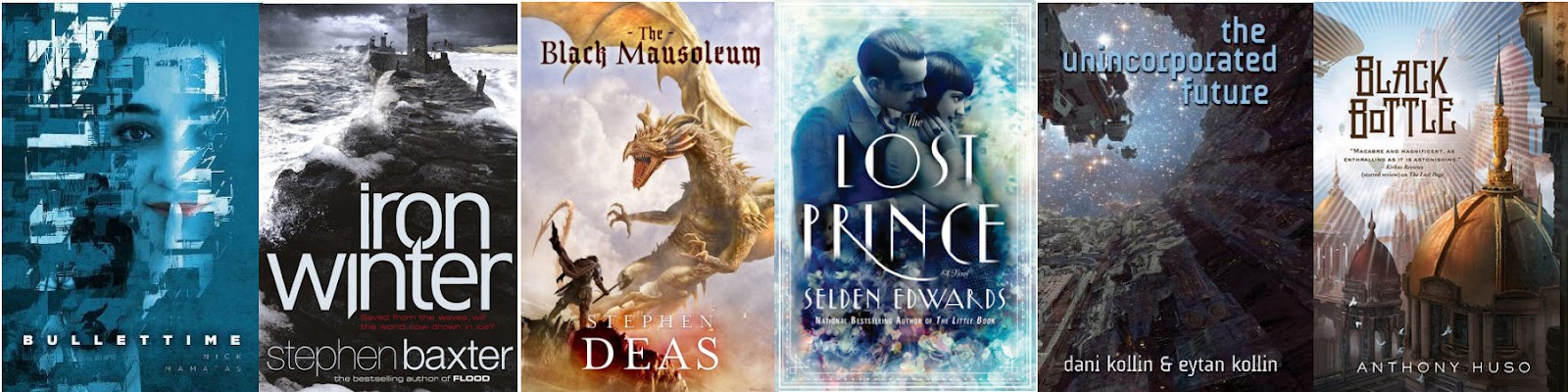
“Bullettime”
by Nick Mamatas, August 14, 2012. Published by ChiZine. (MISC).
“Iron Winter” by Stephen Baxter, UK, August 16, 2012. Published by
Gollancz. (SF).
“The Black Mausoleum” by Stephen Deas, UK, August 16, 2012. Published by
Gollancz. (FAN).
“The Lost Prince” by Selden Edwards, August 16, 2012. Published by
Dutton. (MISC).
“The Unincorporated Future” by Dani Kollin & Eytan Kollin, August
21, 2012. Published by Tor. (SF).
“Black Bottle” by Anthony Huso, August 21, 2012. Published by Tor.
(FAN).
*********************************************************************

“The Devil In Silver” by Victor LaValle, August 21, 2012. Published by
Spiegel & Grau. (HF).
“Widow's Web” by Jennifer Estep, August 21, 2012. Published by Pocket.
(UF).
“A Guile of Dragons” by James Enge, August 24, 2012. Published by
Pyr. (FAN).
“The Dusk Watchman” by Tom Lloyd, August 24, 2012. Published by Pyr.
(FAN / US Debut).
“Sanctuary: The Outcast Chronicles Volume 3” by Rowena Cory Daniells, August
28, 2012. Published by Solaris. (FAN).
“The Corpse-Rat King” by Lee Battersby, August 28, 2012. Published by
Angry Robot. (FAN).
*********************************************************************

“Taken” by Benedict Jacka, August 28, 2012. Published by Ace. (UF).
“Seven Wonders” by Adam Christopher, August 28, 2012. Published by Angry
Robot. (Superhero).
“Blades of Winter” by G. T. Almasi, August 28, 2012. Published by Del
Rey. (Alt-Hist).
“Blood Eye” by Giles Kristian, August 28, 2012. Published by Bantam.
(MISC / US Debut).
"Lady of the Shades” by Darren Shan, UK, August 30, 2012. Published by
Orion. (MISC).
“Zeuglodon”
by James P. Blaylock, August 31, 2012. Published by Subterranean
Press. (MISC).

Order “A Wolf At The Door” HERE
Read FBC’s Review of “A Devil In The Details”
Read FBC’s Review of “A Shot In The Dark”
Read FBC’s Interview with K.A. Stewart
AUTHOR INFORMATION: Kari A. Stewart has a BA in English with an emphasis in Literature from William Jewell College. She lives in Missouri with her family and is the author of the Jesse James Dawson series.
OFFICIAL BOOK BLURB: Jesse James Dawson was once an ordinary man until he discovered that demons were real, and fighting them meant putting his own soul on the line. His new case is a beauty: Gretchen Keene, a Hollywood starlet who's become an unwitting catalyst in an all-out demon war. It's not her soul Jesse needs to protect, but the two-hundred-and-seventy-six others she's carting around--all the souls sold to spend just one night with the blonde bombshell. That's a lot of baggage, although it might explain her meteoric rise to fame. And it's all up for grabs by the demon world.
All Jesse has to do is keep her safe until New Years. Sounds easy. But darkness is casting a nasty shadow in the California sun--a new unseen enemy is closing in and leaving Jesse to wonder, how do you fight something you can't see coming?
FORMAT/INFO: A Wolf At the Door is 304 pages long divided over twenty chapters. Narration is in the first-person, exclusively via Jesse James Dawson. The plot is self-contained, but contains a few significant spoilers for anyone who has not read the first two books.
August 7, 2012 marks the North American Mass Market Paperback publication of A Wolf At the Door via Roc.
ANALYSIS: The Jesse James Dawson series is one of my favorite urban fantasy series since its start in 2010. The series features a world wherein human champions must fight demons for the souls of errant humans; Jesse James Dawson is one such champion who thinks much less of his role and more of his family. In the previous two books, the reader learns more about the world and the role of champions. Arguably the readers have also gotten a look into Jesse’s life and the issues that have cropped up due to him being a champion and a good guy who will not stand back and let evil run its course. The review ahead will contain minor spoilers for the preceding titles so readers be warned, if you haven’t read beyond book I, this is where we say good bye.
Welcome back those of you that have read the previous two titles. The story opens up after the horrific events of A Shot In The Dark (book II), Jesse James was able to save himself, his friends and defeat the demon that had haunted his dreams for a long time. Though he was victorious, the cost of victory has been too high for him, his friends have been exposed to his lifestyle and are now reticent around him, his so-called Champion mentor (of sorts) was found to be hiding certain important facts from him and lastly the demon Axel who has been tailing him so far might not be all that bad. All of the events of the previous book have left Jesse unsettled about what he truly needs to do. To add to that, he’s approached by Axel to repay him for the favor done to save his friends. So Jesse has to pack his bags and move to Hollywood to protect a star, who has got quite a soul contract to her name. Trouble starts soon enough and Jesse will have to draw upon all his deductive skills together to figure out who is screwing whom and what’s truly Axel’s angle.
After the horror-induced events of the second book, it was a welcome back to the procedural feel of the story. Even thought the location was once again is a new one, in this case Los Angeles. The story draws upon the first book’s roots to give us a mystery plot wherein the main protagonist has to deduce and find out the villains as well as save his own skin and that of the damsel. The twist being the hero’s married, not really a detective and the damsel is no damsel and demands no rescue as well. The plot quickly introduces us to this myriad setup wherein Jesse is as uncomfortable as he could be and possibly more clueless about the wants of the demons than he usually is. The deciding factor is also that while he’s sure that Axel’s withholding information from him, his usual font of wisdom, Ivan is also closed to him by Jesse’s own choice. His target Gretchen Keene seems to be a person from whom he could care less, however he has to protect her and thus wither her scorn as well the Hollywood way of life that befits Gretchen.
The plot pace once again is a striking feature as the author quickly lays out a mystery laced storyline and then gives the reader a strong plot-thread to follow while surprising the reader with her twists and world secret revelations. The story also is liberally laced with humor following on from the previous two books and has a running joke about Jesse being confused for one of the breakout stars from the TV show LOST. The mystery thread falters in the climax to a certain degree as many readers will be able to figure out who might be behind some of the happenings but the author does her level best to lay up some zingers in relation to the future of the books to keep readers from being too bored.
Characterization is sharp as ever and with Jesse being the smart mouth that he is, the readers get quite a mid-western outlook on the happenings of Los Angeles. The narrative strength of the books is what raises the bar for this series and elevates it from the mundane crowd. Jesse isn’t just a guy with a mean streak, he might be curmudgeonly from time to time, but the reader knows that at heart he’s one of the good guys. In first person narratives, the character voice has to be strong, unique and evocative for the readers to be attached and similar to most of the successful ones like Harry Dresden, Kate Daniels and Atticus O’Sullivan, Jesse James Dawson makes this cut with more than enough room to spare. I can’t get enough of his dry wit, old school appearance and honor; this distinct narrative voice is one that will surely resonate with many lovers of the Urban Fantasy sub genre.
The only drawback in this entire book for me was the predictability about the villain’s identity in the climax but inspite of its predictability factor the author does good on the climax that has a quite a twist to it. For regular mystery-thriller readers, it might be easy to figure out the twist regarding the villain’s identity but not the reasons behind the villain’s presence. This was the only thing, which I thought pulled the book back a bit and mostly shouldn't be a big turn-off factor for most readers.
CONCLUSION: Jeese James Dawson is a character literally and figuratively and one that is admirably sketched out by Kari Stewart. Drawing on certain parallels from her hero Jim Butcher, she infuses the story with enough, charm, humor and action to keep the readers entertained while charting her own path in this crowded subgenre. If you enjoy reading the Dresden files this you might like to read this book, if you like a witty protagonist then this book won’t disappoint, if you like urban fantasy procedurals then you can’t wrong over here. Simply put this is a well-written book for readers who are looking to be entertained and on the lookout for the next best author to follow.
NOTE: The author has also written a short story set in Jesse James Dawson universe that will be published on 7th August (Tuesday) at Tynga's Reviews as part of their Paranormal Summer Camp multi-author event. The story will not feature Jesse as its narrator but someone else and is set between Books II & III. So keep an eye out for it next week.
Subscribe to:
Posts (Atom)


