Wednesday, July 15, 2015
"Rump: The True Story of Rumpelstiltskin" by Liesl Shurtliff (Reviewed by Cindy Hannikman)

Visit Liesl Shurtliff's Official Site Here
OVERVIEW: In a magic kingdom where your name is your
destiny, 12-year-old Rump is the butt of everyone's joke. But when he
finds an old spinning wheel, his luck seems to change. Rump discovers he has a
gift for spinning straw into gold. His best friend, Red Riding Hood, warns him
that magic is dangerous, and she’s right. With each thread he spins, he weaves
himself deeper into a curse.
To break the spell, Rump must go on a perilous quest, fighting off pixies, trolls, poison apples, and a wickedly foolish queen. The odds are against him, but with courage and friendship—and a cheeky sense of humor—he just might triumph in the end.
To break the spell, Rump must go on a perilous quest, fighting off pixies, trolls, poison apples, and a wickedly foolish queen. The odds are against him, but with courage and friendship—and a cheeky sense of humor—he just might triumph in the end.
FORMAT: Rump:
The True Story of Rumpelstiltskin is a children/middle grade novel and
stands at 272 pages. It is a retelling of the beloved tale of Rumpelstiltskin.
It is a coming of age story with magic, adventure, and a handful of mystical
creatures. The entire tale is a standalone story.
Rump: The True Story of Rumpelstiltskin was published April 9,
2013 by Alfred A. Knopf Books for Young Readers.
ANALYSIS: The
fairy tales we grew up with as children never really had detailed characters.
The characters, at best, were one-dimensional and a bit predictable. There were
the ones that were inherently good, the ones that were super-evil, and those
that were bad but didn't really want to be and would someday change. But did
you ever wonder what the story was behind those characters?
Liesl Shurtliff's
tale Rump:
The True Story of Rumpelstiltskin takes us on that journey. A behind
the scenes look at the enigmatic, mysterious fairy tale creature who could spin
straw into gold and who seemed a tad bit obsessed with people guessing his
name.
Rump: The True Story
of Rumpelstiltskin tells the story of a 12-year old Rump. Rump's mother
passed away during childbirth, but right before she died she left him with a
parting gift – his name. Unfortunately, the only part of the name people
understood was 'Rump'. Even though everyone believed that was his name, Rump
knew in his heart that there was more to his name and made it his quest to
someday find his real name.
That quest to find his real name begins when Rump discovers
an old spinning wheel in his backyard, which once belonged to his mother. After
dragging it into the home he shares with his grandma, he discovers something
amazing. The spinning wheel is magical and can spin straw into gold, but all
magic comes at a price.
Ignoring the warning of his good friend, Red (yes the Little
Red Riding Hood), Rump continues to use the magical spinning wheel. This lands
him into trouble that is all but impossible to fix.
Liesl Shurtliff does
an amazing job making readers root for a character that has a literary stigma
of being 'not so nice'. I'm pretty certain most people wouldn't say they cared
for Rumpelstiltskin based off of his one-sided fairy tale, but this retelling
really made you stop, think, and develop an emotional attachment to Rump. I
found myself feeling bad for him and by the end of the story; I was rooting for
him to come out as a winner.
Considering this is a fairly short middle grade story, I
found the world building and character development amazing. There are a few
nods to other fairy tales, but the entire focus wasn't to make a cutesy spinoff
of a fairy tale, but really focus on telling Rump's story. Many times authors
go overboard on the 'cute factor', but Shurtliff knows just how to toe the
line.
Overall, I absolutely loved Rump: The True Story of
Rumpelstiltskin. I could hardly put it down. Considering it was Shurtliff's
debut novel, I am impressed. There is a whole lot of talent here and I look
forward to seeing where she takes other fairy tales as there are plans to tell
the tales of Red and Jack (from Jack and the Beanstalk).
This is a true 'must read' for anyone who loves fairy tales
or anyone looking for a good fast read. Shurtliff won't disappoint.
 12:00 AM |
  Posted by
Cindy |
Posted by
Cindy |


I have two novels coming out this summer -- different series, different publishers, different pen names. DEAD MAN’S REACH, the fourth installment in the Thieftaker Chronicles, a historical urban fantasy series, which I write under the name D.B. Jackson, comes out from Tor Books on July 21. HIS FATHER’S EYES, the second novel in my contemporary urban fantasy series, The Case Files of Justis Fearsson, will be published by Baen Books on August 4. I write the Fearsson books under my own name, David B. Coe.
At first glance, the two series would seem to have a lot in common, and in some respects they do. Both feature magic-wielding investigators as their primary point-of-view characters, both consist of stand-alone novels that are linked by developing character arcs. Both are written in the noir tone for which urban fantasies are known. And there are other similarities as well, relating to some of my secondary characters and the details of my magic systems.
These similarities don’t bother me, and though some readers of both projects have commented on the shared qualities of the books, they don’t seem to be bothered by them either. Because despite all that they have in common, the Thieftaker novels and the Fearsson books are quite distinct in terms of tone, voice, and setting. And it should come as no surprise to anyone who knows me that I attribute their unique qualities to the point of view from which each story is told.
At first glance, the two series would seem to have a lot in common, and in some respects they do. Both feature magic-wielding investigators as their primary point-of-view characters, both consist of stand-alone novels that are linked by developing character arcs. Both are written in the noir tone for which urban fantasies are known. And there are other similarities as well, relating to some of my secondary characters and the details of my magic systems.
These similarities don’t bother me, and though some readers of both projects have commented on the shared qualities of the books, they don’t seem to be bothered by them either. Because despite all that they have in common, the Thieftaker novels and the Fearsson books are quite distinct in terms of tone, voice, and setting. And it should come as no surprise to anyone who knows me that I attribute their unique qualities to the point of view from which each story is told.
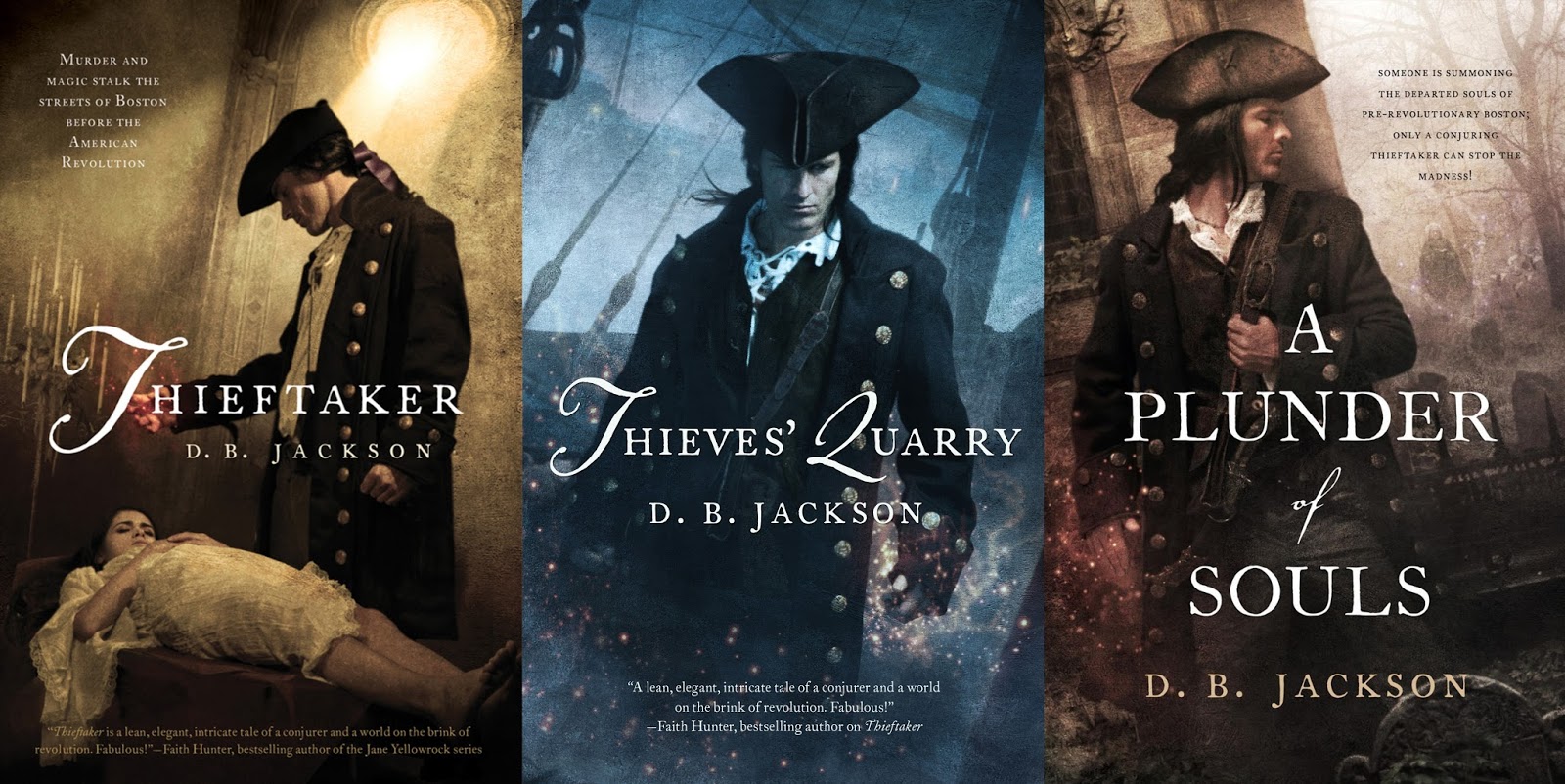
The Thieftaker serie (THIEFTAKER, THIEVES’ QUARRY, and A PLUNDER OF SOULS) are set in pre-Revolutionary Boston, and I have gone to great lengths in each book to make my recreation of that city and that time as authentic and historically accurate as possible. The setting plays a key role in each narrative, as I tie my fictional plot lines to actual historical events. I have my fictional characters interact with historical figures (Samuel Adams, Thomas Hutchinson, Joseph Warren, and others) and I do my best to write my dialogue as well as my internal monologue in something that approximates the Colonial vernacular. (I can’t make the language of the characters too representative of 18th century speech, because to do so would render my books almost unreadable for a twenty-first century audience.)
Readers of the Thieftaker series experience the books through the perceptions, emotions, and intellect of Ethan Kaille, my conjuring thieftaker -- the 18th century equivalent of a private detective. His point of view, honed by a difficult life of imprisonment, forced labor, and an injury that left him partially lame, is dark, serious, but also tinged with a wry humor. But all of his narration is done in close third-person point of view. Close third places just a bit of distance between my character and my readers, allowing me to insert brief and hopefully unobtrusive explanations of key historical events and circumstances. The narrative voice is unmistakably Ethan’s, but it also leaves room for just a touch of exposition.
The volumes of the Case Files of Justis Fearsson (SPELL BLIND was the first novel; the third, SHADOW’S BLADE, will be out next year) take place in modern-day Phoenix, Arizona, a city in which I’ve spent a good deal of time, within a region I have visited often. Again, I have made every effort to portray the city as accurately as possible, but for obvious reasons that is a much simpler task with contemporary Phoenix than with 1760s Boston. I don’t have to research modern culture and technology the way I did Colonial industry and society. In writing the Fearsson books, I can paint images for my readers in broader strokes. That doesn’t mean, though, that my setting is any less important than it is in the Thieftaker novels. Quite the contrary. The desert setting -- the heat, the aridity, the striking landscape, flora, and fauna -- provides me with recurring visual themes, imagery I can use again and again to reinforce my narrative twists and turns.
Readers of the Thieftaker series experience the books through the perceptions, emotions, and intellect of Ethan Kaille, my conjuring thieftaker -- the 18th century equivalent of a private detective. His point of view, honed by a difficult life of imprisonment, forced labor, and an injury that left him partially lame, is dark, serious, but also tinged with a wry humor. But all of his narration is done in close third-person point of view. Close third places just a bit of distance between my character and my readers, allowing me to insert brief and hopefully unobtrusive explanations of key historical events and circumstances. The narrative voice is unmistakably Ethan’s, but it also leaves room for just a touch of exposition.
The volumes of the Case Files of Justis Fearsson (SPELL BLIND was the first novel; the third, SHADOW’S BLADE, will be out next year) take place in modern-day Phoenix, Arizona, a city in which I’ve spent a good deal of time, within a region I have visited often. Again, I have made every effort to portray the city as accurately as possible, but for obvious reasons that is a much simpler task with contemporary Phoenix than with 1760s Boston. I don’t have to research modern culture and technology the way I did Colonial industry and society. In writing the Fearsson books, I can paint images for my readers in broader strokes. That doesn’t mean, though, that my setting is any less important than it is in the Thieftaker novels. Quite the contrary. The desert setting -- the heat, the aridity, the striking landscape, flora, and fauna -- provides me with recurring visual themes, imagery I can use again and again to reinforce my narrative twists and turns.

And in Justis “Jay” Fearsson, my magic-wielding private detective hero, I have a powerful point of view character. Jay is a weremyste. Every month, around the full moon, he loses his mind, while at the same time the power of his magic is enhanced. Think Jekyll and Hyde meets the Wolfman, with spell magic and murder mysteries thrown in. The moon phasings, as these periods of lunacy are known, cost Jay his job as a cop and eventually will cost him his sanity, just as they have his father. Because there is less to explain in the Fearsson books, and because I wanted to make the power of the phasings a visceral experience for my readers, I have written the Fearsson books in first person point of view. The distance between my protagonist and my readers is almost non-existent. His emotions, thoughts, and sensations color everything my audience experiences. And that voice, that intimacy, is part of what makes the series work. It’s also what makes the books so much fun to write.
Two series, two settings, two protagonists, two very different reading experiences. Various elements of narrative come to bear on each of the novels we write. Character, plot, and setting are always important, but they shape our books in distinct ways. For the Thieftaker books, my setting dictates the voice by pushing me toward that close third-person point of view, and it shapes the plotting, by combining historical events with my fictional storylines. With the Fearsson books, my character and the unique magical circumstances of his life create the overriding imperatives, steering me to first person point of view and an intense psychological subplot that forms my narrative core.
Two series, two settings, two protagonists, two very different reading experiences. Various elements of narrative come to bear on each of the novels we write. Character, plot, and setting are always important, but they shape our books in distinct ways. For the Thieftaker books, my setting dictates the voice by pushing me toward that close third-person point of view, and it shapes the plotting, by combining historical events with my fictional storylines. With the Fearsson books, my character and the unique magical circumstances of his life create the overriding imperatives, steering me to first person point of view and an intense psychological subplot that forms my narrative core.
Working on the two projects simultaneously is both challenging and fun. Challenging because shifting between two such different voices can be a bit jarring at times; fun because it keeps me from ever growing bored.
*---------------*---------------*---------------*

Official D. B. Jackson Author Website
Official David B. Coe Author Website
Pre-Order Dead Man's Reach HERE
Order The Thieftaker Chronicles HERE
Order The Case Files Of Justis Fearsson HERE
GUEST AUTHOR INFORMATION: David B. Coe/D.B. Jackson is the award-winning author of eighteen fantasy novels. Under the name D.B. Jackson, he writes the Thieftaker Chronicles, a historical urban fantasy from Tor Books that includes Thieftaker, Thieves’ Quarry, A Plunder of Souls, and, the newest volume, Dead Man’s Reach, which will be released on July 21. Under his own name, he writes The Case Files of Justis Fearsson, a contemporary urban fantasy from Baen Books. The first volume, Spell Blind, debuted in January 2015. The newest book in the series, His Father’s Eyes, comes out on August 4.
He lives on the Cumberland Plateau with his wife and two daughters. They’re all smarter and prettier than he is, but they keep him around because he makes a mean vegetarian fajita. When he’s not writing he likes to hike, play guitar, and stalk the perfect image with his camera.
Official David B. Coe Author Website
Pre-Order Dead Man's Reach HERE
Order The Thieftaker Chronicles HERE
Order The Case Files Of Justis Fearsson HERE
GUEST AUTHOR INFORMATION: David B. Coe/D.B. Jackson is the award-winning author of eighteen fantasy novels. Under the name D.B. Jackson, he writes the Thieftaker Chronicles, a historical urban fantasy from Tor Books that includes Thieftaker, Thieves’ Quarry, A Plunder of Souls, and, the newest volume, Dead Man’s Reach, which will be released on July 21. Under his own name, he writes The Case Files of Justis Fearsson, a contemporary urban fantasy from Baen Books. The first volume, Spell Blind, debuted in January 2015. The newest book in the series, His Father’s Eyes, comes out on August 4.
He lives on the Cumberland Plateau with his wife and two daughters. They’re all smarter and prettier than he is, but they keep him around because he makes a mean vegetarian fajita. When he’s not writing he likes to hike, play guitar, and stalk the perfect image with his camera.

Sometime last month, Fantasy Book Critic reached a
milestone. We surpassed six million visitors to our blog (according to Google
tracker).
We would like to take this moment to thank everyone who has
stopped by, commented, and helped spread the word about our blog. Without you,
this blog would not be what it is today. You give up the opportunity to share
our passion and love for all things related to reading.
From the Fantasy Book Critic Team, we thank you for your
support! We look forward to providing you with more reviews, interviews, and
author spotlights.
Here's to looking ahead to another six million visitors!
Thank You!
The FBC Team
Friday, July 10, 2015
Guest Post: The Mythological Roots of The Library at Mount Char by Scott Hawkins

The stories that you loved as a child are absolute gold for novelists. It doesn’t matter whether you read it at church, the comic book store, or in a book of Greek myths you got for Christmas one year. If a writer can identify a once-beloved trope that has been banished to the “kid’s stuff” bin of the adult mind, it can be dusted off, tweaked a little, and used as a tunnel straight into the adult reader’s subconscious. The technique has been in fashion for centuries because it’s one of the best. As one example, Mary Shelley drew explicitly from Ovid, more or less universally taught in English schools at the time of her education, in writing “Frankenstein: The Modern Prometheus.”
My problem when I set out to write The Library At Mount Char was that most of the iconic characters of classical mythology and religion had already been staked out by other writers. To pick just a few, in 2011 Rick Riordan was going strong on the Greek gods with his Percy Jackson series, The Immortals was in theaters—some nice visuals in that one—and Liam Neeson was releasing the Kraken.
Similarly, the Christian tradition has been tapped pretty hard by western fiction. I remember reading “The Devil and Daniel Webster,” first published in 1937, when I was around ten years old. More recently, Alan Moore and Neil Gaiman have done lovely work with angels, fallen and otherwise. The two of them cast a long shadow—you can see their influence in shows like Supernatural, the Prophecy movies, and any number of novels, graphic and otherwise.
A third aspect of the same problem is that it’s tough to find a new angle on those classic monsters that have entered the public domain. Dracula has been explored pretty thoroughly. The wolf man less so, but there’s still quite a bit out there. In recent years there’s been some excellent work done on Cthulhu and the other Lovecraft mythos.
My problem when I set out to write The Library At Mount Char was that most of the iconic characters of classical mythology and religion had already been staked out by other writers. To pick just a few, in 2011 Rick Riordan was going strong on the Greek gods with his Percy Jackson series, The Immortals was in theaters—some nice visuals in that one—and Liam Neeson was releasing the Kraken.
Similarly, the Christian tradition has been tapped pretty hard by western fiction. I remember reading “The Devil and Daniel Webster,” first published in 1937, when I was around ten years old. More recently, Alan Moore and Neil Gaiman have done lovely work with angels, fallen and otherwise. The two of them cast a long shadow—you can see their influence in shows like Supernatural, the Prophecy movies, and any number of novels, graphic and otherwise.
A third aspect of the same problem is that it’s tough to find a new angle on those classic monsters that have entered the public domain. Dracula has been explored pretty thoroughly. The wolf man less so, but there’s still quite a bit out there. In recent years there’s been some excellent work done on Cthulhu and the other Lovecraft mythos.

I decided that the best approach as a first-time novelist would be to try to capture the spirit of the classic myths and monsters without pulling too much from the specifics. For instance, I thought I saw a similarity between Neil Gaiman’s approach to Endless and Shakespeare’s use of royal characters. For those not familiar with Gaiman’s work, The Sandman books gossip about family conflicts between Dream, Death, the perennial troublemaker Desire (and so on) in much the same way that Shakespeare lent gravitas to family squabbles by projecting them onto the likes of Hamlet and Lady Macbeth.
It’s also true that conflict is story. For whatever reason, the human mind is just naturally drawn to treachery, pettiness and betrayal, the more gossipy and mean-spirited the better. People gripe about reality TV—hell, I gripe about reality TV—but the Greek gods would have been right at home on Big Brother. Tell me that “wait until you see what Hera does when she finds out Echo slept with Zeus!” isn’t a suitable story line for Days of Our Lives or some other afternoon soap opera. For that matter, you could substitute Mr. Fantastic and Invisible Girl for Zeus and Hera to much the same effect.
My thinking was that the specifics of myths vary widely, but because they are all scratching the same itch they tend to resemble each other in fundamental ways. When I was researching a previous (unpublished) book, I read a lot about angels. There are only five of them mentioned in the Bible, but medieval Christians invented hundreds more. Young monks would argue about things like whether Metatron could beat up the Archangel Michael in terms that were strikingly similar to Batman-vs.-Superman debates I had as a kid. The angels had superpowers and, often, D&D-esque weapons. The archangel Uriel, the Fire of God, was often depicted with a flaming sword. Abbadon had an army of locusts. The monks would draw pictures of them in prayer books, often frozen in the middle of a good smiting. In the 1800s a guy named Gustav Dore’s did a bunch of engravings for Dante’s Inferno that would look right at home in on the rack in a comic book store.
And so on.
What I tried to do was invent a family that touched most of the mythological bases, without actually drawing from any particular mythology. My librarians can do stuff—raise the dead, talk to animals—that looks a lot like superpowers, or maybe miracles. Does it really matter whether the person doing these things was blessed by Zeus or zapped with gamma rays or, in my case, a student of a very exotic library? It seems to me that all audiences really care about is that some normal-looking guy can lift a boulder, or fly, or whatever.
It’s also true that conflict is story. For whatever reason, the human mind is just naturally drawn to treachery, pettiness and betrayal, the more gossipy and mean-spirited the better. People gripe about reality TV—hell, I gripe about reality TV—but the Greek gods would have been right at home on Big Brother. Tell me that “wait until you see what Hera does when she finds out Echo slept with Zeus!” isn’t a suitable story line for Days of Our Lives or some other afternoon soap opera. For that matter, you could substitute Mr. Fantastic and Invisible Girl for Zeus and Hera to much the same effect.
My thinking was that the specifics of myths vary widely, but because they are all scratching the same itch they tend to resemble each other in fundamental ways. When I was researching a previous (unpublished) book, I read a lot about angels. There are only five of them mentioned in the Bible, but medieval Christians invented hundreds more. Young monks would argue about things like whether Metatron could beat up the Archangel Michael in terms that were strikingly similar to Batman-vs.-Superman debates I had as a kid. The angels had superpowers and, often, D&D-esque weapons. The archangel Uriel, the Fire of God, was often depicted with a flaming sword. Abbadon had an army of locusts. The monks would draw pictures of them in prayer books, often frozen in the middle of a good smiting. In the 1800s a guy named Gustav Dore’s did a bunch of engravings for Dante’s Inferno that would look right at home in on the rack in a comic book store.
And so on.
What I tried to do was invent a family that touched most of the mythological bases, without actually drawing from any particular mythology. My librarians can do stuff—raise the dead, talk to animals—that looks a lot like superpowers, or maybe miracles. Does it really matter whether the person doing these things was blessed by Zeus or zapped with gamma rays or, in my case, a student of a very exotic library? It seems to me that all audiences really care about is that some normal-looking guy can lift a boulder, or fly, or whatever.

I did put in a couple of explicit nods to other mythologies here and there. The character Steve Hodgson is named for William Hope Hodgson, who wrote a brilliant book called The Night Land in the early 1900s. The “Monstruwaken” and “Silent Ones” mentioned in Mount Char were both from The Night Land. Lovecraft’s Deep Ones get a mention. There’s some stuff straight out of the Old Testament. The astute reader may notice suspicious similarities between J. Maarten Troost’s account of the Pacific god Nareau plucking out his eye and casting it into the sky and some events of the third act of Library at Mount Char. One of the librarians reminds a Hindu character of the very scary goddess Kali. And so on.
Finally, and perhaps most important, each of these overpowered boulder-hefters was kind of a jerk in his or her own way, and for the most part they didn’t really get along. At first, I wasted a lot of time approaching Mount Char as a story about a bunch of buddies united by a struggle against a common enemy, led by their benevolent brother David. I have about seventy thousand words in that vein, none of it very good.
It was only when I realized that David was a homicidal maniac and they all more or less hated one another that the story took off. In the form that got published, the librarians are mean-spirited, dysfunctional superhuman jerks, in the classic Greco-Roman tradition which should also be familiar to all viewers of the show Survivor.
The librarians are just like us. Only bigger....

Finally, and perhaps most important, each of these overpowered boulder-hefters was kind of a jerk in his or her own way, and for the most part they didn’t really get along. At first, I wasted a lot of time approaching Mount Char as a story about a bunch of buddies united by a struggle against a common enemy, led by their benevolent brother David. I have about seventy thousand words in that vein, none of it very good.
It was only when I realized that David was a homicidal maniac and they all more or less hated one another that the story took off. In the form that got published, the librarians are mean-spirited, dysfunctional superhuman jerks, in the classic Greco-Roman tradition which should also be familiar to all viewers of the show Survivor.
The librarians are just like us. Only bigger....
*---------------*---------------*---------------*

Official Author Website
Order The Library At Mount Char HERE
GUEST AUTHOR INFORMATION: Scott Hawkins was born and brought up in South Carolina. He graduated with an MS in computer science and has worked in the field of computers since then. He has a soft spot for rescue dogs and often has multiple dogs living in his household. He lives with his family in the south.
NOTE: Neil Gaiman picture courtesy of Wired and Jason Cranfordteague.
Order The Library At Mount Char HERE
GUEST AUTHOR INFORMATION: Scott Hawkins was born and brought up in South Carolina. He graduated with an MS in computer science and has worked in the field of computers since then. He has a soft spot for rescue dogs and often has multiple dogs living in his household. He lives with his family in the south.
NOTE: Neil Gaiman picture courtesy of Wired and Jason Cranfordteague.

Visit Victoria Aveyard's Official Website Here
OVERVIEW: Graceling meets The Selection in debut novelist Victoria Aveyard's sweeping tale
of seventeen-year-old Mare, a common girl whose once-latent magical power draws
her into the dangerous intrigue of the king's palace. Will her power save her
or condemn her?
Mare Barrow's world is divided by blood—those with common, Red blood serve the Silver- blooded elite, who are gifted with superhuman abilities. Mare is a Red, scraping by as a thief in a poor, rural village, until a twist of fate throws her in front of the Silver court. Before the king, princes, and all the nobles, she discovers she has an ability of her own.
To cover up this impossibility, the king forces her to play the role of a lost Silver princess and betroths her to one of his own sons. As Mare is drawn further into the Silver world, she risks everything and uses her new position to help the Scarlet Guard—a growing Red rebellion—even as her heart tugs her in an impossible direction. One wrong move can lead to her death, but in the dangerous game she plays, the only certainty is betrayal.
Mare Barrow's world is divided by blood—those with common, Red blood serve the Silver- blooded elite, who are gifted with superhuman abilities. Mare is a Red, scraping by as a thief in a poor, rural village, until a twist of fate throws her in front of the Silver court. Before the king, princes, and all the nobles, she discovers she has an ability of her own.
To cover up this impossibility, the king forces her to play the role of a lost Silver princess and betroths her to one of his own sons. As Mare is drawn further into the Silver world, she risks everything and uses her new position to help the Scarlet Guard—a growing Red rebellion—even as her heart tugs her in an impossible direction. One wrong move can lead to her death, but in the dangerous game she plays, the only certainty is betrayal.
FORMAT: Red Queen
is the first in a trilogy. It is a YA novel with dystopian, government
politics, superpowers, and romance.
Red Queen stands at 388 pages and was published February 10,
2015 by HarperTeen.
ANALYSIS: Imagine
a mixing bowl in which you throw in X-Men mutants, a Game of Thrones cut-throat
political scene, and a Hunger Games dystopian setting. What would you get? The
answer to that would be the fast paced, addictive YA novel, Red
Queen by Victoria Aveyard.
Red Queen tells the tale of a Mare, a 17-year-old Red girl who
lives in the poor section of the country. She has resigned herself to the fact
that her future isn't that bright and in just a few months she will be shipped
off to serve her required time in the army. After all, she is just a red and
not a silver – which is an elite warrior with god-like powers. All was going as
planned, until a chance encounter with an individual winds up changing her
life.
One morning, she is unexpectedly summoned to start a new job
in the Silver Palace where she serves the elite members of society – and those
individuals whom she has hated her entire life. It is while working in the
Silver Palace that she discovers a secret that may change everything. She
appears to have the powers of a silver, but still bleeds like a red. This could
be what is needed to change society, but the silvers will do everything in
their power to keep this secret hidden.
If you are thinking to yourself, 'wow all of this sounds
familiar', that is because in many ways it has been done. And this pains me to
say – but Red Queen is just one of the many novels of this genre.
Red Queen is pretty much your run-of-the-mill YA
supernatural/dystopian romance fantasy. It has the oppressive society, the
downtrodden young woman who finds herself a pivotal member of society, and of
course romance – lots and lots of romance. It is well-written, fast paced, but
sadly it is predictable in many aspects. It just didn't have a lot to set it apart
from the dozens of other books in the genre.
I do want to note that if you are looking for a lot of
magic/supernatural aspect to the novel, it really is more of an undertone and
foreshadowing for future books. This first novel is mainly focused on Mare
working her way through the political courts, discovering what she can do, and
establishing the world/situation.
There is also a lot of time spent on the romance – love triangle
of sorts. While it is necessary, it can give some readers a sense of false hope
as it feels like a romance novel disguised as a supernatural/fantasy book.
I'm conflicted because it is very clear Victoria Aveyard is
a strong, passionate writer with major talent, but the cardboard cutout feel of
the book just made it difficult to really love, love the book. It is the first
book of a trilogy, so there is plenty of room left for Aveyard to spread her
wings show her talent and really shine. I will say for a debut author, she was amazing I just wish there was a bit more to the novel.
Now, if you are a fan of this genre (liked books like The
Selection and Throne of Glass), I think you will ultimately love this novel. If
this is your first introduction to this genre, you'll love it. However, if you
are looking for something new and different, this first book just doesn't have
that.

With this series of books, there's one question I've been asked over and over—Why Portugal? And every time I'm asked that, my first thought is "Why not Portugal?"
The first version of what later became The Golden City was a short story, "Of Ambergris, Blood, and Brandy", only about 15,000 words long. The initial draft was set in Venice. I wasn't far into that draft before I realized I wanted to change the setting. I didn't want Venice for this, but I needed oceanfront property to support my water folk. I looked at a map of Europe and said to myself…Hey, Portugal has a lot of coastline.
That was it. That's how I ended up in Portugal. Because I was, at that time, writing a short story, I didn't worry overmuch about the setting. A short story doesn't require that much research. 500,000 words later, I'm not regretting that choice, but I now know why people ask me, "Why Portugal?"
It's almost like Portugal is a foreign country with a different language and a history that we English-speaking peoples don't study much in grade school. It's that narrow country next to Spain. They play soccer there (although they call it football). They use the metric system. They had an explorer or two that we must have covered in fifth grade. Or was that Spain? Where did Columbus come from?
That was about the sum of my knowledge of Portugal.
The first version of what later became The Golden City was a short story, "Of Ambergris, Blood, and Brandy", only about 15,000 words long. The initial draft was set in Venice. I wasn't far into that draft before I realized I wanted to change the setting. I didn't want Venice for this, but I needed oceanfront property to support my water folk. I looked at a map of Europe and said to myself…Hey, Portugal has a lot of coastline.
That was it. That's how I ended up in Portugal. Because I was, at that time, writing a short story, I didn't worry overmuch about the setting. A short story doesn't require that much research. 500,000 words later, I'm not regretting that choice, but I now know why people ask me, "Why Portugal?"
It's almost like Portugal is a foreign country with a different language and a history that we English-speaking peoples don't study much in grade school. It's that narrow country next to Spain. They play soccer there (although they call it football). They use the metric system. They had an explorer or two that we must have covered in fifth grade. Or was that Spain? Where did Columbus come from?
That was about the sum of my knowledge of Portugal.

So I had to research.
I was starting from square one. I tried to find history books, culture books, fairy tale books, cook books, period novels, and travel videos, and learned quickly that many of the resources I needed had never been translated. Some of Portugal's best known authors have no works available in English. Given that my setting was Porto in 1900, I wanted to read the works of Júlio Dinis, Camilo Castelo Branco, and Ana Plácido, all of whom wrote near that time and were authors my characters might have read. None are available in English.
But I managed to find some histories. I found translations of the work of Luís Camões, José Maria de Eça de Queirós, and Fernando Pessoa. I started to learn some Portuguese. Not enough to read novels or poetry, but enough that I could read Wikipedia entries. Vagaries of the language continued to block me (ask me some time about department stores), but I had a lot of willing help from people who spoke it far better than I did. I watched movies in Portuguese to hear the cadence of the language. I even went to Portugal for a couple of amazing weeks, trying to get the little setting details right.
I still made a lot of mistakes. A couple of them were egregious. I left the original four character names in Italian. I was so busy researching other things that I never even noticed that. (For three of the four main characters in that first version, it wasn't too noticeable since the Portuguese spelling isn't all that different, but the fourth is clearly not a Portuguese spelling. Oops!) Other things I ended up changing to a more English mode to make the story more accessible for American readers. In Portugal, for example, you don't necessarily take your father's surname. I had most of my characters do that, though, to save confusion. A Portuguese reader would also find Oriana being addressed as Miss Paredes strange; women in Portugal are addressed by their given names, as in Miss Oriana. But again, I thought American readers would be more comfortable with the English style of address.
Looking back, I bit off far more than I could chew, the day I blithely settled on Portugal. There are things I might change if I had it all to do again. But I'm still glad I did it, and I'm looking forward to the next time I get to visit the country. I've definitely enjoyed writing on the road less traveled.
But I managed to find some histories. I found translations of the work of Luís Camões, José Maria de Eça de Queirós, and Fernando Pessoa. I started to learn some Portuguese. Not enough to read novels or poetry, but enough that I could read Wikipedia entries. Vagaries of the language continued to block me (ask me some time about department stores), but I had a lot of willing help from people who spoke it far better than I did. I watched movies in Portuguese to hear the cadence of the language. I even went to Portugal for a couple of amazing weeks, trying to get the little setting details right.
I still made a lot of mistakes. A couple of them were egregious. I left the original four character names in Italian. I was so busy researching other things that I never even noticed that. (For three of the four main characters in that first version, it wasn't too noticeable since the Portuguese spelling isn't all that different, but the fourth is clearly not a Portuguese spelling. Oops!) Other things I ended up changing to a more English mode to make the story more accessible for American readers. In Portugal, for example, you don't necessarily take your father's surname. I had most of my characters do that, though, to save confusion. A Portuguese reader would also find Oriana being addressed as Miss Paredes strange; women in Portugal are addressed by their given names, as in Miss Oriana. But again, I thought American readers would be more comfortable with the English style of address.
Looking back, I bit off far more than I could chew, the day I blithely settled on Portugal. There are things I might change if I had it all to do again. But I'm still glad I did it, and I'm looking forward to the next time I get to visit the country. I've definitely enjoyed writing on the road less traveled.
*---------------*---------------*---------------*

Official Author Website
Order The Shores Of Spain HERE
GUEST AUTHOR INFORMATION: J. Kathleen Cheney is a former teacher and has taught mathematics ranging from 7th grade to Calculus, with a brief stint as a Gifted and Talented Specialist. Her short fiction has been published in Jim Baen's Universe, Writers of the Future, and Fantasy Magazine, among others, and her novella "Iron Shoes" was a 2010 Nebula Award Finalist. Her novel, "The Golden City" was a Finalist for the 2014 Locus Awards (Best First Novel). The sequel, "The Seat of Magic" came out in 2014, and the final book in the series, "The Shores of Spain" will come out July 2015.

ABOUT THE SHORES OF SPAIN: Even as the branches of peace are being offered, there are some who still believe those who are not human should be used as chattel. And they are willing to go to great lengths to retain their power.
Newlywed siren Oriana Paredes has been appointed Ambassador to her home islands now that communication between Northern Portugual and the magical races has been restored. But convincing her people that the new Portuguese Prince’s intentions are honorable after years of persecution is difficult. And her husband, Duilio, faces his own obstacles among the sirens where males are a rare and valuable commodity with few rights.
In addition to their diplomatic mission, the two hope to uncover the truth behind Oriana's mother's death. Evidence suggests that Spain—a country that has been known to enslave magical beings—may have infiltrated the siren authority.
Unable to leave their post, Oriana and Duilio must call on Inspector Joaquim Tavares to root out the truth. But even his seer’s gift cannot prepare him for what he will discover.
For all those interested, up for grabs are copies of the first two books in her series, THE GOLDEN CITY and THE SEAT OF MAGIC, so enter the giveaway (USA ONLY) below and best of luck to everyone.
Rafflecopter giveaway .
Newlywed siren Oriana Paredes has been appointed Ambassador to her home islands now that communication between Northern Portugual and the magical races has been restored. But convincing her people that the new Portuguese Prince’s intentions are honorable after years of persecution is difficult. And her husband, Duilio, faces his own obstacles among the sirens where males are a rare and valuable commodity with few rights.
In addition to their diplomatic mission, the two hope to uncover the truth behind Oriana's mother's death. Evidence suggests that Spain—a country that has been known to enslave magical beings—may have infiltrated the siren authority.
Unable to leave their post, Oriana and Duilio must call on Inspector Joaquim Tavares to root out the truth. But even his seer’s gift cannot prepare him for what he will discover.
For all those interested, up for grabs are copies of the first two books in her series, THE GOLDEN CITY and THE SEAT OF MAGIC, so enter the giveaway (USA ONLY) below and best of luck to everyone.
Rafflecopter giveaway .
Subscribe to:
Posts (Atom)


