Sunday, August 9, 2015
"Hopper's Destiny: Mouseheart 2" by Lisa Fiedler (Reviewed by Cindy Hannikman)

Read Fantasy Book Critic's Review of Mouseheart: Vol 1 Here
OVERVIEW: Hopper now knows that he is definitely not
an ordinary pet shop mouse. With the underground rat civilization of Atlantia
all but destroyed and Titus dethroned, Hopper, Zucker, Firren, and a spattering
of Rangers are now working to rebuild. But it's difficult. REALLY difficult.
Queen Felina, the evil feral royal, has begun amassing a new band of street
cats. And without the sinister 'peace accord' in place, it is open season on
the rodents.
Meanwhile, Hopper's siblings are on quests of their own: Pinkie has led a coup and is ruling the Mus with an iron paw, and Pup is no longer the sweet, innocent brother Hopper once knew.
With the support of some new upland allies, including a funky cat named Ace, can Hopper make the tunnels safe again and fulfill a destiny he never imagined?
FORMAT: Hopper's Destiny is the second book
in the Mouseheart series. It is a children's fantasy book with lots of
adventure elements. It stands at 352 pages and was published March 17, 2015 by
Margaret K. McElderry Books.
ANALYSIS: Mouseheart was a delightful random
read that I came across last year. It wasn't perfect, but it reminded me of my
days reading Redwall and had a solid, well-written plot. I really enjoyed
reading it and looked forward to other book in the series. Hopper's Destiny is the
recently released sequel to Mouseheart.
Hopper's Destiny picks up
almost where Mouseheart left off. Hopper, our hero, is struggling to figure
out how he is going to help the citizens of Atlantia. The battle that occurred
in the first book may be over, but peace may not last forever and the citizens
of the city are not prepared to fight. Hopper believes that the only way to
succeed is to work with the outcast Mus encampment that is currently being run
by his sister, Pinkie. Unfortunately, things do not go as planned.
Somehow, upon returning from his meeting with Pinkie, Hopper
is transported to the Upland, where he meets new friends who will prove helpful
in the upcoming final battle against Queen Felina.
Overall, I felt Hopper's Destiny was just as strong
as Mouseheart. It had solid writing, it was fast paced, and the characters were
evolving from the first book. The battle scenes were detailed and didn't border
on the grotesque. I really enjoyed seeing how the characters drew out some of
the battle strategies and planned for certain events.
I was really glad to see that the author took the time to
make sure that not all cats were portrayed in a mean or evil way. As the story
progressed, there were cats that were good, cats that were indifferent. It was
a little disheartening to see that every cat in the first book was mean.
Most of the loose ends from the first book are tied up
nicely in Hopper's Destiny. The whole La Rocha aspect of the series is
explored and explained (fairly) satisfactory. There are some aspects of Hopper's
Destiny that are left unresolved and we have to wait for the next
installment, but the ending was satisfactory. It felt complete and not a huge
cliffhanger.
Even though Hopper's Destiny was a strong book,
it wasn't without its flaws. One of the biggest issues I had, which was similar
to Mouseheart, was the way the mice/characters would do certain things. It
didn't make sense to me, unless they were mutant mice.
For example, Hopper is a mouse. He isn't a giant rat; he is
a normal, regular mouse. There is a scene in which he flings an extension cord
up and over his head. The cord flies through a mail slot and he uses it to
climb up and out of the mail slot. I struggle to see how a mouse could pick up
an extension cord (used by humans) and toss it unless it was a mutant.
The scene above is in direct contrast to the other
references to the animals/characters size. There is a beautifully drawn photo
of a mouse in a small bed and behind it are human earrings used as wall
hangings. It seemed the sizes were disproportionate to what was going on. If earrings
were used as wall hangings, how was an extension cord so easily used?
I don't think the size issue is something children would
notice, but I think older readers would definitely question it. Sure, we are
talking about talking animals and animals with human-like behaviors, but I just
think the portrayal could have been a little more realistic.
Another issue I ran into, and this is purely personal
preference, was Pup (the younger brother of Pinkie and Hopper). He was so mean
and damaged throughout the novel, but I didn't understand his anger. It seemed
a bit of a forced element to the book, as he just seemed angry or damaged for
the sake of plot progression.
Essentially Hopper's Destiny is a solid second
book in a series. Younger readers, who may not be as critical of the character
portrayal or somewhat predictable nature of some of the plot elements, will
certainly enjoy it. Older readers, especially those that loved Redwall and
Warriors, will still continue to enjoy the series.
 12:00 AM |
 Posted by
Cindy |


So after reading all the six titles that were selected. I was able to select a winner for round 1 of the SFPBO. I wish to thank Mark Lawrence and all the authors for conceptualizing this contest and for their participation.
I wasn’t quite able to review the books entirely to my plan as we had a recent addition to our family. But all things considered, I’m hoping to review my winning pick next week. And so without further adieu, here are my top 3 choices:


1) Under A Colder Sun by Greg James
So the title that will be going forward into SPFBO round 2 is Greg James’ Under A Colder Sun. Many congratulations to Greg James and my thanks to all the other authors for entering this contest and thereby giving me the chance to consider their works.
So the title that will be going forward into SPFBO round 2 is Greg James’ Under A Colder Sun. Many congratulations to Greg James and my thanks to all the other authors for entering this contest and thereby giving me the chance to consider their works.
Friday, August 7, 2015
"Invasion of the Tearling: Queen of the Tearling 2" by Erika Johansen (Reviewed by Cindy Hannikman and Joshua Redlich)

Read Fantasy Book Critic's Review of Queen of the Tearling Here
OVERVIEW: With each
passing day, Kelsea Glynn is growing into her new responsibilities as Queen of
the Tearling. By stopping the shipments of slaves to the neighboring kingdom of
Mortmesne, she crossed the Red Queen, a brutal ruler whose power derives from
dark magic, who is sending her fearsome army into the Tearling to take what is
hers. And nothing can stop the invasion.
But as the Mort army draws ever closer, Kelsea develops a mysterious connection to a time before the Crossing, and she finds herself relying on a strange and possibly dangerous ally: a woman named Lily, fighting for her life in a world where being female can feel like a crime. The fate of the Tearling —and that of Kelsea’s own soul—may rest with Lily and her story, but Kelsea may not have enough time to find out
But as the Mort army draws ever closer, Kelsea develops a mysterious connection to a time before the Crossing, and she finds herself relying on a strange and possibly dangerous ally: a woman named Lily, fighting for her life in a world where being female can feel like a crime. The fate of the Tearling —and that of Kelsea’s own soul—may rest with Lily and her story, but Kelsea may not have enough time to find out
FORMAT: Invasion of the Tearling is the second book in The
Queen of the Tearling Series. It is an adult fantasy/dystopian novel. Trigger
warnings should be given for scenes of self-mutilation, rape, spousal abuse,
anti-homosexuality themes, genital mutilation, and spousal rape.
The novel was published June 9, 2015 by Harper. It stands at
515 pages.
ANALYSIS: (Cindy) It is a rare book that makes me feel so
many conflicting emotions. Upon completion of Invasion of the Tearling, my emotions
were all over the place. I was angry, upset, confused, yet I struggled with
happy emotions too, as I realized I read a well-thought out, imaginative second
novel in a series that was, in some parts, enjoyable and a quick read.
Queen of the Tearling, the first novel in the series, was dark.
It certainly wasn't a light, fluffy read, but there wasn't a whole lot of
graphic detail of the darkness that was going on. It was mostly 'there were
rapes and killings in the town over there' type descriptions. Invasion of
Tearling unexpectedly upped the ante in regards to darkness and grittiness.
Invasion of the Tearling goes into fairly graphic detail on some
pretty heavy subjects. Everything from self-mutilation/cutting and genital
mutilation of homosexuals to spousal rape and the views of women as
property/breeding grounds, was thrown into this novel. While I am not opposed
to grittiness and darkness in novels, it almost felt as if everything was being
thrown in to make the book more dramatic, more adult and not really done with a
reason. There were many people who kept comparing the first book to YA books,
so I almost feel as if this was added to make it distinctively 'adult'.
A huge example of this is the introduction of Lily's
husband. Lily's husband is evil. He is bad, rotten to the core. In order to
portray just how bad he is, readers are given a graphic and a bit uncomfortable
rape scene of his wife. This was in addition to the multiple lengthy
descriptions of his previous spousal abuse/rapes.
Again, my issue was not with the subject content as I
realize every individual will have his or her own opinion on whether or not the
use of rape/spousal abuse was necessary to make Lily's husband bad. My issue
was with the fact that literally no warning was given at all that the book
would have this type of turn. It was a complete turn from the first book in
which things were dark, yet not graphic.
Another issue I had was with the sudden and unexpected
introduction of Lily's scenes. One moment readers are in the Tearling, the next
and with no warning we are transported to Manhattan. Who is Lily? What is her
role in it? It was very jarring and very unexpected. Lily's scenes eventually
even out and sort-of mesh with the story, but it was a struggle there for a
while when it first was introduced. For a while, it really felt like I was
reading some sort of weird mix up of two books because they were that
disconnected.
Despite my rather dislike for some parts of the book, I will
say I didn't hate The Invasion of the Tearling. There were obvious parts that
disappointed me and made me a bit sad that the series would take a turn like
this, but I did enjoy the fantasy aspect of the Tearling thus the conflicting
emotions that I felt when I completed the book. There were parts I enjoyed, but
the parts I didn't enjoy I really, really did not enjoy them.
I struggle with what to expect in the third book. I am not
looking forward to it as much as I was this second book. However, I do think I
would continue with the series only to see where the series is taken.This is a novel that people will love or they will hate, I am not sure there is much room for a middle ground here.

ANALYSIS: (Joshua) I enjoyed The Queen of the Tearling, but I loved The Invasion of the Tearling.
Invasion changes
all of that, upping the series’ ante significantly.
While the war itself takes a turn for the better (for the
reader if not for Kelsea), the most exciting part of the book was still the
Crossing. In The Queen of the Tearling,
Johansen offered little tidbits of information that made it clear that the
events of the series take place sometime in the future, and the Tearling was
settled by Americans and Europeans after they made their way there in what has
since become known as The Crossing. But what The Crossing actually was, how
magic suddenly became a reality, and many other questions remained a mystery.
While Invasion still leaves many
questions unanswered—and adds some new ones to the mix as well—a great deal of
the book is actually spent on exploring the events of The Crossing through
visions of a pre-Crossing girl named Lily that Kelsea has unexplainable visions
of. While there is so much happening throughout the novel, from confrontations
between Kelsea and the church to the rapidly advancing army of the Red Queen, it
was always the next scene with Lily that I found myself looking forward to
most.
I will warn readers
that while this is generally considered a YA novel, there are many scenes that
contain adult content that is quite dark, all of which could easily occur in
George R. R. Martin’s The Song of Ice and
Fire series and still cause
readers to cringe. Yet for me, these scenes never seemed out of place, and
based on the situation and characters involved in each of these episodes, their
occurrence was quite realistic.
The Invasion of the Tearling is one of those rare sequels that are even
better than the first, and readers who found it difficult to wait for this
installment in the series will find it impossible to wait for the next.
Read Fantasy Book Critic’s review of “Magic Bites” & “Magic Burns”
Read Fantasy Book Critic’s review of “Magic Strikes” & “Magic Mourns”
Read Fantasy Book Critic’s review of “Magic Bleeds” & “A Questionable Client”
Read Fantasy Book Critic’s review of “Magic Slays” & “Magic Dreams”
Read Fantasy Book Critic's review of "Magic Rises"
Read Fantasy Book Critic’s review of "Retribution Clause" & "Magic Tests"
Read Fantasy Book Critic's review of "Gunmetal Magic" & "Magic Gifts"
Read Fantasy Book Critic's review of "Magic Breaks"
Read Fantasy Book Critic's review of "Magic Rises"
Read Fantasy Book Critic’s review of "Retribution Clause" & "Magic Tests"
Read Fantasy Book Critic's review of "Gunmetal Magic" & "Magic Gifts"
Read Fantasy Book Critic's review of "Magic Breaks"
Read Fantasy Book Critic’s Interview with Ilona Andrews
AUTHOR INFORMATION: Ilona Andrews is the pseudonym for the husband-and-wife writing team of Ilona Gordon & Andrew Gordon. Together, Andrew and Ilona are the co-authors of the New York Times bestselling Kate Daniels urban fantasy series and the romantic urban fantasy novels of The Edge. They live in Texas with their children.
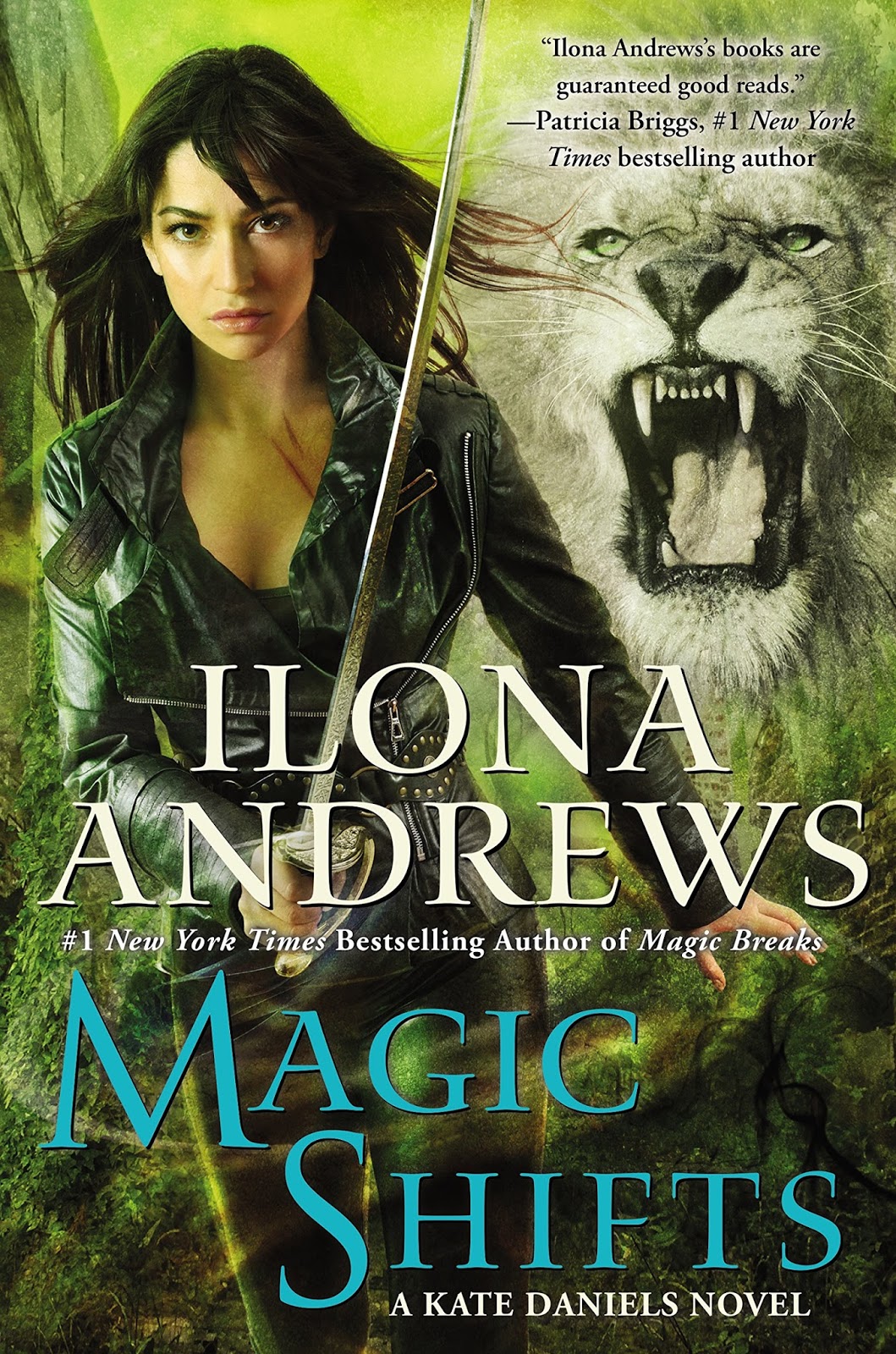
OFFICIAL BOOK BLURB: After breaking from life with the Pack, mercenary Kate Daniels and her mate—former Beast Lord Curran Lennart—are adjusting to a very different pace. While they’re thrilled to escape all the infighting, Kate and Curran know that separating from the Pack completely is a process that will take time.
But when they learn that their friend Eduardo has gone missing, Kate and Curran shift their focus to investigate his disappearance. Eduardo was a fellow member of the Mercenary Guild, so Kate knows the best place to start looking is his most recent jobs. As Kate and Curran dig further into the merc’s business, they discover that the Guild has gone to hell and that Eduardo’s assignments are connected in the most sinister way…
An ancient enemy has arisen, and Kate and Curran are the only ones who can stop it—before it takes their city apart piece by piece.
FORMAT/INFO: Magic Shifts is 352 pages long divided over twenty-two chapters, and an epilogue. In this book, narration is in the first-person, exclusively via Kate Daniels. Magic Shifts is the eighth volume of the series, therefore it would be very inadvisable to jump in to the series from this point.
August 4, 2015 marks the North American hardback and e-book publication of Magic Shifts via Ace Books. Cover art provided by Juliana Kolesova.
ANALYSIS: The Kate Daniels series has slowly and surely gained a cult following of sorts and I happen to be one of those fans that eagerly await each new adventure that Kate, Curran and the rest face. This book was one of my must-read titles for 2015 and I was very eager to see where the authors would take the series. Especially after the events of Magic Breaks and with Roland's reappearance, things are never going to be the same in Atlanta. There will be mild spoilers for the previous title/s in the review below so please be careful and avoid the following review if you don't wish to be spoiled.
The plot begins with Kate and Curran having taken a step up in their relationship and a step down from their official status of the Pack. Things are slowly turning a little less crazy now that they no longer are the Beast Lord & the Consort. Their lives are settling down and Kate is going back to her mercenary status while Curran is trying to figure out what new project he wants to pick up next. However readers of the series know that things are never sane in the Lennart-Daniels household and lo and behold, Kate is forced to take an extra interest in the Mercenary Guild which seems to be falling apart due to politics and internal bickering.
Already pissed off at political machinations which seem to have crippled its functioning, Kate & Curran however have to try to hold it together and also are beseeched to find out Eduardo the werebuffalo by his beloved. Taking up this task as Kate values Eduardo’s quiet nature and his assistance in the past. Kate and Curran find that there’s more to Eduardo’s disappearance than just his last few jobs with the mercenary guild. There's also the mighty displeased father of his girlfriend. There’s also the mysterious past and not to mention something strange afoot in the city of Atlanta.
As with any Kate Daniels story, this one also has bunch of action, terrific plot twists and an streamlined plot that will have readers racing all the way till the end. This book is kind of a new beginning of sorts, especially with all that happened in Magic Breaks. Primarily with the return of Roland, his recognizing Kate as his daughter and Kate’s owning of Atlanta as her own. That ended the first arc of Kate’s story and with this book; we get the second arc wherein readers know all about Kate, Curran and what is at stake with Roland’s reappearance. This time around, the plot is more of a strong mystery unlike the last few books, which were more thriller-oriented.
The central plotline deals with Eduardo’s disappearance and Kate’s mission to find him. I enjoyed this turn and also the fact a completely new mythology is introduced in this storyline. This is an absolutely fascinating way wherein many different mythologies co-exist within the world a la the real world. The authors are pioneering their way with this, sure there have been a couple of other authors like Kevin Hearne, and Liz Williams who have done so. But with Ilona Andrews, they take things to whole new level and their world and magic systems are so much more enmeshed. This book explores Islamic mythos from the Middle Eastern nations and overall it fits nicely within this post-apocalyptic world.
One more fascinating thing is the scientific explanations that the authors endorse towards certain magic happenings. Previously they explained the were-changing in a fascinating way and here they do the same with the Djinn-Afrit type of creatures. Overall I’m simply enamored as to how they also manage to explain these magic systems so convincingly. Sure there’s a pattern to be found but because the story is so enthusiastically written and the characterization so terrific, one doesn’t mind reading about them. There’s a whole new angle explored and we get to see a new couple in the making. This is what makes this series fresh, no characters stay the same, even those couples that have been through it all such Kate-Curran, Andrea-Ralph, and there’s newer shades of characters that are revealed such as my favorite Saiman who finally shows some sense but takes a decision that will set him on to a horrid path.
CONCLUSION: Magic Shifts is a tremendous shift in the status quo of this fantastic series. It was already awesome and yet the authors found a way to keep it refreshing and once again prove why they and not Jim Butcher deserve the title of champions of the urban fantasy sub-genre.

Official Author Website
Read Fantasy Book Critic's review of Winter's Reach
Read Fantasy Book Critic's review of The Instruments Of Control
Craig Schaefer is an indie author who has burst onto the scene with his dark, pulpy urban fantasy thrillers titled the Daniel Faust series. I however got introduced to him via his Revanche Cycle books which are no less dark and have lots of political intrigue, fantastic characters and a tight, twisted plot. All in all, it was something that I feel in love with immediately and devoured both volumes (of a possible four) ASAP. I wanted to know more about Craig and his thoughts on his self-published roots, his snazzy book covers and few other things about his work. So read on to find out all that and what readers should look out for in his books...
Q] Welcome to Fantasy Book Critic. To start with, could you tell us what inspired you to be a writer in the first place, and anything else you’d like to share about yourself and your past?
CS: Why become a writer? It's the only job that can make you a god. I'm joking, of course, but there's a core of truth to it: the act of storytelling is a beautiful, sublime thing. We create places that don’t exist, and breathe life into people who -- if we're doing our job well -- could be just as real as your next-door neighbor. We craft stories to make you think, make you feel, to take you on a journey and back again without having to leave your chair. With the combined power of my keyboard and a reader's imagination, a world is born.
Once I got my first taste of that magic as a child, both as an avid reader and taking my first clumsy attempts at storytelling (some might say I'm still making clumsy attempts…), I was hooked for life. I couldn't be anything else, not really.
Q] I read that you thought of giving writing a serious crack around your 40th birthday. Can you talk to us of this momentous decision and how you arrived at it?
CS: I've always written as a personal pursuit. The Long Way Down was actually my seventh completed novel; the first six are locked in a trunk, and when I die, hopefully they will be doused in gasoline and set on fire before they can hurt anybody. Writing professionally, however, always fell by the wayside due to career obligations and…I suppose you could call it a general failure to ignite.
Everyone knows you need a staggering amount of luck to get into the traditional publishing system. What people might not know is that, even if you're able to land that agent, land that publisher, land that contract, there's no guarantee you'll make any kind of decent living off your work (and odds are, you won't). You'd be amazed how many people with best-selling books have to work a day job to put food on the table. So while I dreamed of being a successful novelist and occasionally made the query rounds, that was more of a "buy a winning lottery ticket" fantasy than a realistic plan.
Then a friend took me aside and said "So have you done any reading on this self-publishing thing? It's not like it used to be, with vanity presses -- there are some real, serious, good writers doing this." This was right around the time I hit 40, and found myself confronting my mortality. I went to Vegas to celebrate my birthday, alone, and sat down to work out what the hell I was doing with my life. I told myself, "The decisions I make now, here in this hotel room, today, are going to shape the rest of my life. I always tell people to go for their passions. What am I passionate about? What do I want more than anything?"

Hotel 32 has these rain-shower faucets. They're these big squares on the shower ceiling, and they gush torrents of water down and it feels like standing in a thunderstorm. I stepped into the water, and I knew what I wanted. It was a baptism. When I got out of the shower, I sat down and wrote out a business plan. I had found my way.
Q] Since you began to publish your work, you have put out 6 books in a 12-month period. Could you kindly elaborate on why you choose to go with self-publishing and what advantages it afforded?
CS: I had a head start, which helped. When my first book launched, the second one had already been completed and edited, and the third was almost done. I wanted to get at least that much of a lead, to make sure the series had legs and that I'd be happy writing it for the long haul.
I'd never tell another writer what they should do, but for me, self-publishing is the only route that makes sense. My background is in business, and I enjoy entrepreneurial work, so that part of the job is fun for me. Storytelling-wise? Freedom. Complete freedom. The book I imagine is the book that gets delivered to you (for better or for worse, but the risks are mine to take), and I've assembled a great team that helps me to deliver the best work I can.
Q] Speaking about your books, all of them have such striking covers and are very eye-catching. Please talk to us about how they came to be? What input did you have for them?
CS: Quite a bit; James T. Egan does all of my covers, and we talk about themes, emotions -- essentially, what we want the reader to feel when they see my books. Trying to sell the same tone that you'll get from the story inside. Once he shows me the preliminary version, I either request alterations or we press on ahead to the final cover (and considering how skilled James is, changes are a very, very rare request).
Q] So for someone who hasn't read any of your novels, how would you describe the type of stories that you write, what would be your pitch for the Daniel Faust Series and The Revanche Cycle?
CS: The Daniel Faust series is low-magic urban fantasy that owes its roots to the hard-boiled crime genre. The protagonist is an unapologetic con artist and thief, equally comfortable with sorcery and gunplay, who tries to make a (dis)honest living in a shadowy occult underworld. They're fast, pulpy, roller-coaster reads.
A friend described one of the later books as "like the TV show Leverage, but they keep the money they steal, and a whole lot of people end up dead." This may or may not be an endorsement, depending on your tastes.
The Revanche Cycle is a different beast. It's a sweeping epic fantasy with multiple viewpoint characters, set in a fantasy world vaguely reminiscent of the Italian Renaissance. It's about a lot of things. It's about conspiracies, political intrigue, and poison. It's about the relationship between church and state, and how religion is used (and abused) to shape policy. It's about faith, and culture, and overcoming the obstacles society throws in your path. It's a story about women.
It is also, as the title hints, a story about revenge. And how a single violent act, buried in the past, can have devastating, global consequences.

Q] With both your series, the urban fantasy as well the epic fantasy one, you have created some note-worthy characters (Mari, Livia, Harmony, etc.). Please talk to us about your thought process for creating and writing about them?
CS: I want to know everything about my characters, even – maybe especially – the things that don’t make it explicitly to the page. What they love, what they hate, what they’re afraid of. As a writer, I think you have to know your characters and more importantly, you have to care about them. You have to fall in love with them a little, even the bastards. Because if you don’t care, you can’t make your readers care.
Q: All four titles in the Daniel Faust series are written in the first-person, which is very common for urban fantasy novels. While your fantasy series is set in the third person. Why do you choose to delineate the POVs this way and what do you feel are the differences between first-person and third-person narratives?
CS: One could imagine that the Daniel Faust books are basically you riding along with Faust -- or him telling you the story over drinks at the Tiger’s Garden -- and getting the whole adventure (down to his thoughts and emotions) firsthand. The idea is to get you as close to the action as possible, and hopefully forge an emotional connection.
The Revanche Cycle books had to be multiple-viewpoint, because the size of the story -- and the nature of how each character is ultimately connected -- demanded it. Now, I could have done it first-person and written each scene in a different character's internal voice, but that really risks reader confusion ("Wait, who's narrating this chapter again?") and I don’t think I'm a skilled enough writer to make that work.
The takeaway here is that neither first nor third person is inherently superior; it's a question of what method is the best fit for the story you're trying to tell.
Q] You recently signed on with 47 North for a spinoff series set in the Daniel Faust world. Please tell us about the Harmony Black series and how many books do you have planned?
CS: Harmony was originally introduced as a foil for Daniel Faust: a spell-slinging FBI agent who knows all of his tricks, and is determined to see him behind bars. Her spinoff series will follow her adventures with her new team, working to take down occult criminals and supernatural threats all over the United States. Since the Faust books are almost all rooted in Las Vegas, it's a neat opportunity to broaden the setting and show all the weird, scary stuff happening everywhere else.
And in Faust's world, trust me: no matter where you live, there's some weird, scary stuff going on.
There will definitely be at least two books in the series, which makes its debut in January 2016; beyond that, we'd love to put out many more, but renewal will depend (of course) on how well they sell.

Q] Let’s talk a bit about your Daniel Faust series, there seems to be a grand design at work there. How many books do you have planned? What does your endgame look like?
CS: There is indeed. Right now I project the series will be about twenty books long, give or take. My notes are a rough, blocky road map: I have some stories almost completely outlined, while others are a paragraph or two of notes, and some just a title and a sentence sketch. I'm basically trying to have a clear picture of where I'm going, while leaving enough wriggle room so that if I come up with what I think is a fantastic new idea for a plot, I can make it happen.
The final paragraphs of the final scene of the series have already been written. I know where it all ends. Getting you there someday, and making sure that scene leaves the mark it should, is the hard part.
Q] You currently have two vastly different series ongoing, how do you go about writing them [do you delineate different time periods for writing them or do you write depending on how you feel each day] could you explain your writing methods? And particularly about the discipline required to produce 6 books a year!
CS: One book at a time. The tones between my two series are so different, along with the moods I try to create, jumping between them would cause total whiplash. I try to write 2,000 words a day, every day. Not all of that makes it to the final page: I always end up cutting great chunks of it, and my editor’s pen is crueler than mine.
It’s all about the discipline. Writing is just like going the gym: it’s hard until you make it a habit, but even then it’s never easy. And just like the gym, when you skip a day, it becomes that much easier to skip the next day. And the next.
Q] Many writers have a muse, who directs their writing, and others do not seem to be affected the same way. Which group do you fall into? What is your main motivation and source of inspiration?
CS: Writing is my drug of choice. Piecing together a story, learning and honing my craft, the rush of drawing scenes and words from the air…my motivation is the joy of it. It's hard work, often frustrating work, but the rewards make it all worthwhile.
I suppose my muse is my readership, in a way. When I know people are excited about an upcoming book, it gets me excited to make it the very best I can and try to deliver a great experience for them to enjoy.

Q] Can you tell us more about the world that the Revanche Cycle is set in and some of the series’ major characters? What are the curiosities (geographical, mystical, etc.) of this world?
CS: The world of the Revanche Cycle is a delicate net of power, a dance between the banks and the masters of commerce, the keepers of a vast and unified church, and an expansionist empire with dreams of a grand crusade. And, as the story begins, it's all falling apart. The banks are collapsing, a beloved pope is on his deathbed, and the empire is on the verge of spending itself into bankruptcy.
For some, it's a time of great peril. For the power-hungry, it's a time of opportunity. Conspiracies and strange alliances are in motion, aimed at taking advantage of the coming chaos -- and for one man, to enact an apocalyptic plan of revenge twenty years in the making.
And there is magic, in the shadows, though you'd be wise not to go looking for it. Walk through the wilds alone and you might stumble upon the reveling witches of the Pallid Masque, or the swampy haunts of the Sisterhood of the Noose. And you would witness wonders, then…wonders paid for in pain and blood.
Q] Themes of PTSD, patriarchy, racism & cultural disparities seem to play an important role throughout the Revanche Cycle. How much of this was gleaned from history? And how much of it was from other sources?
CS: Civilizations rise and fall, but people don't change so much, and today's problems look a lot like yesterday's problems. Bringing up PTSD is a great example. A modern-day Marine and a fourteenth-century Condottiere have a lot in common, from bearing the scars of battle (physical and mental), enduring survivor's guilt, and trying to reintegrate into a civilian world that doesn't understand what they've been through.
I use history as a jumping-off point, but I try to evoke historical issues that we're still dealing with today, and that readers might personally relate to. It's an interesting way of thinking about problems and challenges (without turning it into "message fiction," which is no fun for anybody. A good story is a discussion, not a lecture).
Q] You have released Winter’s Reach & The Instruments Of Control within 6 months. Could you give us a progress report on the next book, and outline your plans for the series as a whole?
CS: Right now we’re on track to release book three, titled Terms of Surrender in December and, tentatively, the fourth and final volume in mid-2016.
Q] In Winter’s Reach, Felix has quite a traumatic sea experience and the description you have used for the sound that precedes the sequence was quite something. Do you have any examples of what that sounded like in your mind?
CS: Imagine a massive pipe organ at the bottom of the sea, twenty stories tall. A mottled finger reaches out and presses down on a single key. The organ plays a sound that could shatter the earth, sending it roaring up to the ocean's surface. It's a message, just for you.
Letting you know that you're about to see the organ-player.
Q] Who are your literary idols and which books are your favorites amongst some of the genres that you read in?
CS: Raymond Chandler and Dashiell Hammett. Masters of noir. Chandler dragged you through worlds of corruption, and Hammett made language dance. Ernest Hemingway: stripped-down, brutally sparse prose like a boxer's punch. I love Clive Barker's erotic grotesqueries, and the bleeding-edge futurescapes of early William Gibson.
Q] In closing, do you have any last thoughts or comments you’d like to share with our readers?
CS: What do you love? Find it, go for it, and take your life by the horns. Don't wait as long as I did. We only get so many summers.
Also? You need more books.

DBC: Today, we are fortunate to have with us Mister Justis Fearsson, a private detective here in Phoenix. Mister Fearsson served for six years on the Phoenix police force before going into business for himself. He is here to speak with us about a few of his recent cases, and also, perhaps more intriguingly, about his magical abilities. Mister Fearsson, welcome.
JF: Thank you. And you can call me Jay.
DBC: All right. Jay it is. You’re a weremyste, aren’t you, Jay? Can you tell us what that means?
JF: [Shifting in his chair.] I suppose. Weremystes are sorcerers -- wizards, if you will, though that’s a term few of us use. I guess you could say that the magic comes from the “myste” part of the word. The “were” part refers to the phasings. Every month, on the night of the full moon, and the nights immediately before and after, we . . . well, we go a little crazy. And our magic gets stronger.
DBC: I see. And by crazy, you mean . . .
JF: Just that. Delusions, hallucinations, only the vaguest sense of who and what we are. We basically go temporarily insane.
DBC: That sounds terrible.
JF: It’s no picnic.
DBC: But it’s temporary.
JF: Yes . . . But not surprisingly, putting our minds in a cosmic blender every month has long-term consequences as well. Almost all weremystes wind up permanently nuts.
DBC: Like your father.
JF: [Bristling.] I’m not talking about my father. And I’ll thank you not to either.
DBC: I meant no offense. But he was a weremyste, wasn’t he? And now--
JF: First of all, he’s still a weremyste. Second, yes, he has psychological problems now. Just like I probably will when I’m his age. And that’s all I’m going to say about him.
DBC: Very well. Tell me about the magic you do.
JF: What about it?
DBC: What kind of spells can you cast?
JF: How much time do you have? I can craft all sorts of spells. I can heal wounds, move things and even people from one place to another. I can throw a punch with a thought and catch glimpses of the future. I could light your hair on fire or tip over that chair you’re sitting in. Namid would tell you that the number of spells available to a skilled runecrafter is limited only by his or her imagination.

DBC: Namid?
JF: Namid’skemu. He’s a runemyste, the spiritual reincarnation of an ancient runecrafter, who, along with the rest of his kind, helps to protect our world from practitioners of dark magic. He was once a shaman of the K’ya’na-Kwe clan, the water people of the Zuni nation.
DBC: The water people are extinct. Their line died out centuries ago.
JF: Yeah, go figure.
DBC: [After a brief pause] Okay. What is dark magic?
JF: I cast spells using whatever power I carry within me, and I tend to try to do good with my spells, helping people in need, solving and stopping crimes, that sort of thing. But some other weremystes are more concerned with helping themselves, even if their good fortune carries costs for other people. And a few of them use blood, their own, blood from animals, sometimes even blood taken from innocent people, to enhance their magic, make it stronger. Those of us who follow the teachings of the Runeclave, oppose them. And Namid helps us with that, by teaching us, training us.
DBC: you ever done dark magic?
JF: I haven’t. Until recently, I haven’t been as diligent as I should be in learning the rudiments of runecrafting. I’m learning, thanks to Namid, and I’m getting stronger all the time. But I’ve stayed away from the dark stuff, not only because it’s wrong, but also because it always seemed to be more than I could handle. I suppose I could see myself using it in an emergency, if I ever found myself up against a dark conjurer I couldn’t defeat any other way. But I hope that never happens.
DBC: Let’s talk a bit about your history. Why did you quit the police force?
JF: It’s not something I like to talk about really. The truth is, I had to quit. The phasings were taking a toll on me, keeping me from doing my job effectively. My old partner on the force, Kona Shaw, who’s a great cop -- she tried to protect me, to cover for me. But there was only so much she could so. And some of the higher-ups on the force remembered my father, and figured I must be just like him. I suppose they were right to a degree. Anyway, in the end I had no real choice. Either I could quit, or they would fire me. My resignation seemed like the best thing for all concerned.
DBC: Do you miss being a detective?
JF: Every day. But Kona still comes to me when cases crop up that involved magic and spells, which is more often than you might think.
DBC: Can you tell us about those cases?
JF: Well, there was the Blind Angel serial murder case, which you might have read about. And more recently a case involving a possible terrorist plot and some ritual killings here in Phoenix. We’re still working that one, so I can’t say much about it. But perhaps before long you’ll be able to read about those events, too . . .
DBC: Wait, that’s all you’re going to tell us?
JF: I’m afraid so. [Standing] It’s time I got back to work. As I say, if you’re curious, read about the cases.
DBC: Well, there you have it, readers. Justis Fearsson, weremyste and private detective. If you wish to know more, it seems you’ll need to read about the man on your own.
*---------------*---------------*---------------*

Official D. B. Jackson Author Website
Official David B. Coe Author Website
Pre-order His Father's Eyes HERE
Order The Thieftaker Chronicles HERE
Order The Case Files Of Justis Fearsson HERE
GUEST AUTHOR INFORMATION: David B. Coe/D.B. Jackson is the award-winning author of eighteen fantasy novels. Under the name D.B. Jackson, he writes the Thieftaker Chronicles, a historical urban fantasy from Tor Books that includes Thieftaker, Thieves’ Quarry, A Plunder of Souls, and, the newest volume, Dead Man’s Reach, which will be released on July 21. Under his own name, he writes The Case Files of Justis Fearsson, a contemporary urban fantasy from Baen Books. The first volume, Spell Blind, debuted in January 2015. The newest book in the series, His Father’s Eyes, comes out on August 4.
He lives on the Cumberland Plateau with his wife and two daughters. They’re all smarter and prettier than he is, but they keep him around because he makes a mean vegetarian fajita. When he’s not writing he likes to hike, play guitar, and stalk the perfect image with his camera.

Fantasy Book Critic is celebrating the recent release of The
Unnoticeables by Robert Brockway
by offering a giveaway of this new fantasy/horror book! We have three copies to give away to three
lucky winners!
If you haven't stopped by to see Robert Brockway's guest
blog post last week at Fantasy Book Critic, you can do so by clicking here!
About The Unnoticeables
There are angels, and
they are not beneficent or loving. But they do watch over us. They watch
our lives unfold, analyzing us for repeating patterns and redundancies.
When they find them, the angels simplify those patterns, they remove
the redundancies, and the problem that is you gets solved.
Carey doesn’t much like that idea. As a punk living in New York City, 1977, Carey is sick and tired of watching the strange kids with the unnoticeable faces abduct his friends. He doesn’t care about the rumors of tarmonsters in the sewers, or unkillable psychopaths invading the punk scene—all he wants is drink cheap beer and dispense asskickings.
Kaitlyn isn’t sure what she’s doing with her life. She came to Hollywood in 2013 to be a stunt woman, but last night a former teen heartthrob tried to eat her, her best friend has just gone missing, and there’s an angel outside her apartment.
Whatever she plans on doing with her life, it should probably happen in the few remaining minutes she has left of it.
There are angels. There are demons. They are the same thing. It’s up to Carey and Kaitlyn to stop them. The survival of the human race is in their hands.
We are, all of us, well and truly screwed.
******************************************************
Rules for Entry into the Giveaway
- This giveaway is open to US and Canada addresses only.
- Three winners will be chosen at random.
- Contest starts August 1, 2015 at midnight PST and runs until August 8, 2015 at 11:59 p.m. PST.
- To enter please send an email with the subject UNNOTICEABLES to FBCgiveaway@gmail.com. Please include your name and address.
- Only one entry per person! Duplicate entries will be deleted.
- All entries will be deleted upon completion of the giveaway.
- Winners will be notified via email.
Subscribe to:
Posts (Atom)


