
Jane Rogers at Wikipedia
Order "The Testament of Jessie Lamb" HERE
INTRODUCTION: As noted in the recent post discussing novels by Alison Pick, Julian Barnes and Patrick McGuiness, the annual Booker longlist is one the most important sources of books I would probably not hear about otherwise.
So when The Testament of Jessie Lamb appeared on the 2011 list, I became very intrigued by the novel and I decided to read it as soon as possible. The blurb below while generally accurate, is a little misleading in that the novel is a very personal one where Jessie Lamb's tale is more gripping than the world's reaction to the devastating maternal death syndrome aka MDS.
"Women are dying in their millions. Some blame scientists, some see the hand of God, some see human arrogance reaping the punishment it deserves. Jessie Lamb is an ordinary girl living in extraordinary times: as her world collapses, her idealism and courage drive her towards the ultimate act of heroism. If the human race is to survive, it’s up to her.But is Jessie heroic? Or is she, as her father fears, impressionable, innocent, incapable of understanding where her actions will lead? Set just a month or two in the future, in a world irreparably altered by an act of biological terrorism, The Testament of Jessie Lamb explores a young woman’s determination to make her life count for something, as the certainties of her childhood are ripped apart."
OVERVIEW/ANALYSIS: The Testament of Jessie Lamb is a novel advertised as literary dystopia though first and foremost it is a voice novel which kept me hooked me from the first to the last page with its poignant and emotional style.
Looking at the science fictional aspect of the novel, I had several quibbles with the ideas presented in the book - I believe that the whole setup of the MDS does not really hold water since humanity is way too diverse for something of this finesse to work, but I was fine with it as a thought experiment.
The more serious issue for me was the societal reaction to the MDS, which seemed way too rational and moderate; yes there is panic and hardship in the book, but society still stands and science still gets done, while personally I have doubts that a singularity event like MDS would not cause the total collapse of civilization.
Similarly the way science deals with MDS seemed quite simplistic if you accept the original sophistication of the virus that induced it, so basically these three issues made The Testament of Jessie Lamb more of a "scary tale" for adults rather than "serious sf".
These being said though, the novel is really compelling and its narrator Jessie Lamb of the title comes out as very plausible; a determined girl which is set on making a difference - whether her choices are stupid, courageous, right, wrong, etc is for the reader to determine and I thought her father's arguments quite grounded, so I inclined more towards his position, but not that strongly so to speak.
After a prologue which gives a hint of the future direction of the book and to which we will return in due time, the first paragraph of the novel introduces the heroine:
"I used to be as aimless as a feather in the wind. I thought stuff on the news and in the papers was for grownups. It was part of their stupid miserable complicated world, it didn’t touch me."
Compare the above with Jessie of the future as seen in the prologue:
"The logical thing is to do as he’s asked; to think about it. Indeed. Write it down. Remember it, re-imagine it, gather it together. Because it’ll be proof – won’t it? – proof that you really are doing what you want. Proof that I, Jessie Lamb, being of sound mind and good health, take full responsibility for my decision, and intend to pursue it to its rightful end."
So in a sense the huge change in the world that MDS induces - a real and much more plausible singularity if you want rather than the tech nirvana of the geeks that usually comes under that heading - radically transforms our heroine and you can read the novel as her personal odyssey, though of course there is much more.
The supporting characters - especially her father and her school friends Baz and Sal are also superbly drawn and the world building is excellent assuming you accept the assumptions above.
The combination of normality and madness in the MDS world is finely balanced in the novel and while a lot of the ideology of the book is the expected one, I was surprised a little by the nuanced portrait of science which is the usual culprit with/or religion in such dystopias; sure enough the religious fanatics are there, but there are fanatic environmentalists too, ready to bomb left and right, while Jessie ultimately renounces her "activism" as pointless.
All in all, The Testament of Jessie Lamb (A+) is a worthy Booker addition and a very well written book I would wholly recommend and which I hope will make the shortlist to show that science fiction - however not that original as sf per se - has a place on any literary prize list if the writing style is there.
Order "The Testament of Jessie Lamb" HERE
INTRODUCTION: As noted in the recent post discussing novels by Alison Pick, Julian Barnes and Patrick McGuiness, the annual Booker longlist is one the most important sources of books I would probably not hear about otherwise.
So when The Testament of Jessie Lamb appeared on the 2011 list, I became very intrigued by the novel and I decided to read it as soon as possible. The blurb below while generally accurate, is a little misleading in that the novel is a very personal one where Jessie Lamb's tale is more gripping than the world's reaction to the devastating maternal death syndrome aka MDS.
"Women are dying in their millions. Some blame scientists, some see the hand of God, some see human arrogance reaping the punishment it deserves. Jessie Lamb is an ordinary girl living in extraordinary times: as her world collapses, her idealism and courage drive her towards the ultimate act of heroism. If the human race is to survive, it’s up to her.But is Jessie heroic? Or is she, as her father fears, impressionable, innocent, incapable of understanding where her actions will lead? Set just a month or two in the future, in a world irreparably altered by an act of biological terrorism, The Testament of Jessie Lamb explores a young woman’s determination to make her life count for something, as the certainties of her childhood are ripped apart."
OVERVIEW/ANALYSIS: The Testament of Jessie Lamb is a novel advertised as literary dystopia though first and foremost it is a voice novel which kept me hooked me from the first to the last page with its poignant and emotional style.
Looking at the science fictional aspect of the novel, I had several quibbles with the ideas presented in the book - I believe that the whole setup of the MDS does not really hold water since humanity is way too diverse for something of this finesse to work, but I was fine with it as a thought experiment.
The more serious issue for me was the societal reaction to the MDS, which seemed way too rational and moderate; yes there is panic and hardship in the book, but society still stands and science still gets done, while personally I have doubts that a singularity event like MDS would not cause the total collapse of civilization.
Similarly the way science deals with MDS seemed quite simplistic if you accept the original sophistication of the virus that induced it, so basically these three issues made The Testament of Jessie Lamb more of a "scary tale" for adults rather than "serious sf".
These being said though, the novel is really compelling and its narrator Jessie Lamb of the title comes out as very plausible; a determined girl which is set on making a difference - whether her choices are stupid, courageous, right, wrong, etc is for the reader to determine and I thought her father's arguments quite grounded, so I inclined more towards his position, but not that strongly so to speak.
After a prologue which gives a hint of the future direction of the book and to which we will return in due time, the first paragraph of the novel introduces the heroine:
"I used to be as aimless as a feather in the wind. I thought stuff on the news and in the papers was for grownups. It was part of their stupid miserable complicated world, it didn’t touch me."
Compare the above with Jessie of the future as seen in the prologue:
"The logical thing is to do as he’s asked; to think about it. Indeed. Write it down. Remember it, re-imagine it, gather it together. Because it’ll be proof – won’t it? – proof that you really are doing what you want. Proof that I, Jessie Lamb, being of sound mind and good health, take full responsibility for my decision, and intend to pursue it to its rightful end."
So in a sense the huge change in the world that MDS induces - a real and much more plausible singularity if you want rather than the tech nirvana of the geeks that usually comes under that heading - radically transforms our heroine and you can read the novel as her personal odyssey, though of course there is much more.
The supporting characters - especially her father and her school friends Baz and Sal are also superbly drawn and the world building is excellent assuming you accept the assumptions above.
The combination of normality and madness in the MDS world is finely balanced in the novel and while a lot of the ideology of the book is the expected one, I was surprised a little by the nuanced portrait of science which is the usual culprit with/or religion in such dystopias; sure enough the religious fanatics are there, but there are fanatic environmentalists too, ready to bomb left and right, while Jessie ultimately renounces her "activism" as pointless.
All in all, The Testament of Jessie Lamb (A+) is a worthy Booker addition and a very well written book I would wholly recommend and which I hope will make the shortlist to show that science fiction - however not that original as sf per se - has a place on any literary prize list if the writing style is there.
 12:01 AM |
  Posted by
Liviu |
Posted by
Liviu |


Official Adam Roberts Website
Read FBC Review of Yellow Blue Tibia
Read FBC Review of New Model Army
Read FBC Review of Anticopernicus
Order "By Light Alone" HERE
INTRODUCTION: After recently reading and enjoying Adam Roberts first experiment in independent publishing, the "dwarf novel" Anticopernicus, his main 2011 novel By Light Alone became even a bigger expectation book than before and I got it on its publishing day on August 18. I will present its blurb below though I want to note that while generally accurate, it does not convey the power and richness of By Light Alone which turned out to be the best of the author's more literary offerings and climbed to my top three overall of his generally superb body of work alongside Land of the Headless and Stone which are both huge favorites of mine.
"In a world where we have been genetically engineered so that we can photosynthesise sunlight with our hair hunger is a thing of the past, food an indulgence. The poor grow their hair, the rich affect baldness and flaunt their wealth by still eating. But other hungers remain ...The young daughter of an affluent New York family is kidnapped. The ransom demands are refused. Years later a young women arrives at the family home claiming to be their long lost daughter. She has changed so much, she has lived on light, can anyone be sure that she has come home? Adam Roberts' new novel is yet another amazing melding of startling ideas and beautiful prose. Set in a New York of the future it nevertheless has echoes of a Fitzgeraldesque affluence and art-deco style. It charts his further progress as one of the most important writers of his generation."

OVERVIEW/ANALYSIS: By Light Alone is a difficult novel to review because most of its power resides in the main characters and their interactions between themselves and the interesting but weird world the author postulates once a genius geneticist had offered humanity the gift of the "hair bug", allowing people to grow special hair which synthesizes food from sunlight, gift which turned out to be a mixed blessing to say the least.
"Preacher said: ‘Hair’s made all men preachers, now. Made all men preachers or else lazy dogs in the sun. Hair took our work, which had sustained us for millennial generations. It took our power over women and our power over the things of the Earth. These things were ours, and the Hair took them away.’"
So the book strongly depends on style and your enjoyment will correlate with how much you will appreciate the rich and luxuriant prose of the author. In the first part of the book that takes roughly a third of the total number of pages, we meet George Denoone, an aimless and bored member of the super wealthy class that regards Earth as its playground even more than usually in the past, disdaining both what has remained of the middle classes aka the "jobsuckers" and the poor aka "the longhairs".
"He swept out, past his upended and absorbed daughter. A flash of Arsinée’s aghast face. And, in the elevator going back up to the penthouse bar, he did feel a little better. These footling little humps of up-and-down emotion. Demeaning really. Not for the first time in his life he was aware of the sense that he needed some project. It didn’t really matter what, of course; only to find something purposeful to help elevate him, keep him on a more noble emotional level."
Married with a rich woman on her own, Marie Lewinsky and having two kids, 11 year old Leah and five year old Ezra, George is drifting through life, occasionally seducing the wives of his wealthy companions while paying scant attention to his wife or children. Until on a skiing vacation on Mount Ararat's slopes, the incredible happens and Leah is kidnapped, crime that is the only one authorities cannot solve however much money George throws at them, for the reasons explained below, reasons that have a lot to do with the way the world has rearranged itself once most people starting feeding on light:
"Dot nodded, as if this were fair comment. ‘Now, the bosses aren’t stupid,’ she went on. ‘And women aren’t stupid. Easier to grab a child than carry it two thirds of a year in your womb. The women get a kid; the bosses get their population of serfs renewed. That’s why they’re so reluctant to intervene. If a Turk or Iranian had stolen your gold-plated Fwn, then the police would’ve run the news round the local villages, a boss would have shaved a couple of heads, pocketed the reward and the trinket would have come back to you. But the bosses make a point of not getting involved where child theft is concerned.’"
In the second part of the book, we follow the retrieved Leah adjusting to her life back in New York, while then the novel continues for some time with Marie's tale only to end in the fourth revelatory part with the tale of Issa, a strange girl from the underclass with a true odyssey of her own.
So By Light Alone is structured as the consecutive tales of four characters where pov follows pov and illuminates what happens before while also moving the story forward, and once this structure is understood everything falls into place and the novel comes together perfectly well in a very powerful ending that first threw me off a bit since I did not expect it...
Of course as an Adam Roberts novel you get a lot of musings through the characters voices and there is a lot of interesting stuff thrown almost casually in there, stuff about the nature of historical inquiry, the whys and how the world works in addition to sfnal speculation and ideas.
And there is action too since from about half on, the novel changes pace somewhat starting with Marie's tale, only to accelerate with Issa's pov in a crescendo till the powerful finale. There is romance, revolution, brutality, joy and sorrow, all in a superb weave it truly pays to reread at least once.
Overall By Light Alone (A++, top 25 novel of 2011) is a masterpiece of literary sf and a book that could stand proudly alongside any literary novel of 2011. The novel's pieces fit perfectly together and I strongly recommend to reread it once you finish it since you will appreciate it in a different way once you understand everything that has been going on.
Read FBC Review of Yellow Blue Tibia
Read FBC Review of New Model Army
Read FBC Review of Anticopernicus
Order "By Light Alone" HERE
INTRODUCTION: After recently reading and enjoying Adam Roberts first experiment in independent publishing, the "dwarf novel" Anticopernicus, his main 2011 novel By Light Alone became even a bigger expectation book than before and I got it on its publishing day on August 18. I will present its blurb below though I want to note that while generally accurate, it does not convey the power and richness of By Light Alone which turned out to be the best of the author's more literary offerings and climbed to my top three overall of his generally superb body of work alongside Land of the Headless and Stone which are both huge favorites of mine.
"In a world where we have been genetically engineered so that we can photosynthesise sunlight with our hair hunger is a thing of the past, food an indulgence. The poor grow their hair, the rich affect baldness and flaunt their wealth by still eating. But other hungers remain ...The young daughter of an affluent New York family is kidnapped. The ransom demands are refused. Years later a young women arrives at the family home claiming to be their long lost daughter. She has changed so much, she has lived on light, can anyone be sure that she has come home? Adam Roberts' new novel is yet another amazing melding of startling ideas and beautiful prose. Set in a New York of the future it nevertheless has echoes of a Fitzgeraldesque affluence and art-deco style. It charts his further progress as one of the most important writers of his generation."

OVERVIEW/ANALYSIS: By Light Alone is a difficult novel to review because most of its power resides in the main characters and their interactions between themselves and the interesting but weird world the author postulates once a genius geneticist had offered humanity the gift of the "hair bug", allowing people to grow special hair which synthesizes food from sunlight, gift which turned out to be a mixed blessing to say the least.
"Preacher said: ‘Hair’s made all men preachers, now. Made all men preachers or else lazy dogs in the sun. Hair took our work, which had sustained us for millennial generations. It took our power over women and our power over the things of the Earth. These things were ours, and the Hair took them away.’"
So the book strongly depends on style and your enjoyment will correlate with how much you will appreciate the rich and luxuriant prose of the author. In the first part of the book that takes roughly a third of the total number of pages, we meet George Denoone, an aimless and bored member of the super wealthy class that regards Earth as its playground even more than usually in the past, disdaining both what has remained of the middle classes aka the "jobsuckers" and the poor aka "the longhairs".
"He swept out, past his upended and absorbed daughter. A flash of Arsinée’s aghast face. And, in the elevator going back up to the penthouse bar, he did feel a little better. These footling little humps of up-and-down emotion. Demeaning really. Not for the first time in his life he was aware of the sense that he needed some project. It didn’t really matter what, of course; only to find something purposeful to help elevate him, keep him on a more noble emotional level."
Married with a rich woman on her own, Marie Lewinsky and having two kids, 11 year old Leah and five year old Ezra, George is drifting through life, occasionally seducing the wives of his wealthy companions while paying scant attention to his wife or children. Until on a skiing vacation on Mount Ararat's slopes, the incredible happens and Leah is kidnapped, crime that is the only one authorities cannot solve however much money George throws at them, for the reasons explained below, reasons that have a lot to do with the way the world has rearranged itself once most people starting feeding on light:
"Dot nodded, as if this were fair comment. ‘Now, the bosses aren’t stupid,’ she went on. ‘And women aren’t stupid. Easier to grab a child than carry it two thirds of a year in your womb. The women get a kid; the bosses get their population of serfs renewed. That’s why they’re so reluctant to intervene. If a Turk or Iranian had stolen your gold-plated Fwn, then the police would’ve run the news round the local villages, a boss would have shaved a couple of heads, pocketed the reward and the trinket would have come back to you. But the bosses make a point of not getting involved where child theft is concerned.’"
In the second part of the book, we follow the retrieved Leah adjusting to her life back in New York, while then the novel continues for some time with Marie's tale only to end in the fourth revelatory part with the tale of Issa, a strange girl from the underclass with a true odyssey of her own.
So By Light Alone is structured as the consecutive tales of four characters where pov follows pov and illuminates what happens before while also moving the story forward, and once this structure is understood everything falls into place and the novel comes together perfectly well in a very powerful ending that first threw me off a bit since I did not expect it...
Of course as an Adam Roberts novel you get a lot of musings through the characters voices and there is a lot of interesting stuff thrown almost casually in there, stuff about the nature of historical inquiry, the whys and how the world works in addition to sfnal speculation and ideas.
And there is action too since from about half on, the novel changes pace somewhat starting with Marie's tale, only to accelerate with Issa's pov in a crescendo till the powerful finale. There is romance, revolution, brutality, joy and sorrow, all in a superb weave it truly pays to reread at least once.
Overall By Light Alone (A++, top 25 novel of 2011) is a masterpiece of literary sf and a book that could stand proudly alongside any literary novel of 2011. The novel's pieces fit perfectly together and I strongly recommend to reread it once you finish it since you will appreciate it in a different way once you understand everything that has been going on.

Order “Devil’s Cape” HERE
AUTHOR INFORMATION: Rob Rogers lives in Texas. He is a writer, editor, and communications project manager by trade. Devil’s Cape is his first novel.
BOOK BLURB: Devil's Cape, Louisiana. Founded by pirates. Ruled by villains. Desperate for heroes.
In 1727, the masked pirate St. Diable created the city of Devil's Cape as a haven for his men and a place to begin his empire. Pirates gave way to outlaws, who gave way to gangsters, who gave way to gangs and organized crime. But the city has never escaped from its shroud of violence and corruption.
And now a stunning, murderous act has made Devil's Cape more dangerous than ever. Someone needs to protect the city.
Three people are willing to try. Jason Kale, part of a nefarious family, who hides his own abilities. Cain Ducett, a psychiatrist and former gang member, who finds that he is turning into something improbable. Kate Brauer, genius engineer, daughter of a slain superhero, who has lost more than most to the city and its criminals. But they're outnumbered and overpowered. Can they possibly make a difference?
If New Orleans has earned its “Sin City” nickname for its debauchery, then its nearby sister Devil's Cape has earned its “Pirate Town” moniker for the violence and blatant corruption that have marred the city since its founding. A city where corruption and heroism walk hand-in-hand, and justice and mercy are bought and paid-for in blood, Devil's Cape is a city like no other...
CLASSIFICATION: Devil’s Cape is a dark urban fantasy tale featuring an alternate Earth where heroes and villains co-exist with normal people akin to the TV series Heroes and J. Michael Straczynski’s Rising Stars.
FORMAT/INFO: Devil’s Cape is 409 pages long divided over forty-seven numbered chapters and an Epilogue. Also includes an Acknowledgements page and a Map of Devil’s Cape along with a “sites of interest” listing. There are about 48 observational tales, anecdotes and various Devil’s Cape minutiae to go along with the start of each chapter. Narration is in the third-person via many main POVs: Kate Brauer, Cain Ducett, Jason Kale, Jessica “Jazz” Rydland, Warren Sims, Joe Gaines Julian Kalodimos, Hector Nelson Poteete, Costas and Pericles Kalodimos. Devil’s Cape is largely self-contained, but leaves a thread open for a future sequel.
April 1, 2008 marked the US Trade Paperback Publication of Devil’s Cape via the now defunct Wizards of the Coast Discoveries.
ANALYSIS: I first noticed Devil’s Cape when it was released more than three years ago, but never got around to reading the book. Recently, I came across a signed copy in a bookstore and decided to buy it and see how the novel was. The cover blurb didn’t give a clear picture of the story, so I thought Devil’s Cape would turn out to be an average novel. Boy was I wrong on that count and on multiple levels.
The story in Devil’s Cape is spread over a vast period of thirty-five years and twenty days with the narrative switching between the past and the present with each chapter timestamped. For the first few chapters of the book, the author introduces the three main characters—Kate Brauer, Cain Ducett and Jason Kale—and their backstories: Jason Kale is trying to distance himself from his family’s past; Kate Brauer came to Devil’s Cape to regain something which she lost and possibly carry on her family legacy; and Doctor Cain Ducett is targeted by someone from his violent past. In the first 150 pages, the author also introduces various secondary characters and the city’s history, which might be a bit confusing, but proves to be important in terms of the story. The novel’s main event is a large-scale murder that propels the three protagonists in different ways. Overall, the story has multiple threads that slowly start to coalesce into a fine tapestry, which helps make this book so special and exciting to read. To top it off, after the action-packed climax, the author one-ups himself by dropping a huge twist, which sets the stage for round II.
Besides the story, the novel also succeeds due to excellent characterization with every single character presented in Devil’s Cape wholly three-dimensional. This includes the three main protagonists, the secondary POVs, both good and evil, and even the characters who reside in the background . . . each get their chance to differentiate themselves in the reader’s mind. Simply put, characterization was the MAIN reason why the plot was brought to life so vividly.
Another major plus point of the novel is the city itself which is its own character thanks to the author slowly building up the image, history & geography of Devil’s Cape by providing random and specific tidbits here and there, including intriguing vignettes, quotations or recaps that open each chapter. Not only does this help make the city feel real, but it allows readers to become acclimatized with Devil’s Cape, while also adding various layers to the story. Like the origins of Devil’s Cape which is an important part of the novel.
I also liked how the novel is grounded in reality. Yes, Devil’s Cape is full of super-powered people, but the world presented is dark, gritty and violent, while the physics and limitations of each superhero and supervillain is realistic, bringing to mind the kind of realism found in Christopher Nolan’s Batman Begins and The Dark Knight. In other words, nothing is off limits. Everyone has a weakness and even heroes can be killed, which makes it fun to see who survives and who doesn’t.
Lastly, Devil’s Cape is brimming with terrific symbolism. For instance, the novel can be construed as a parable of the corruption, avarice and basic human nature we live with in our lives today. On the other hand, Devil’s Cape can be looked at as an origin story where legends are made and epic events occur. Finally, readers can view the book as an odyssey where characters must go through various trials and tribulations in order to get whereever it is they want to go in life. In short, Devil’s Cape is a multi-faceted gem that offers a unique reading experience that can vary depending on the reader.
Negatively, there were only a few drawbacks in Devil’s Cape. The first is the pacing, which can be a bit languid for the first 100-150 pages as characters are introduced and the story is being set up, but it’s not a major issue since things steadily pick up afterwards and stay that way until the terrific climax. Secondly, the large cast of characters can be a bit troublesome to remember, but the author does his best to make sure the reader doesn’t get confused. Lastly, the author has a tendency to repeat certain facts and aspects about the city which can get repetitive after awhile.
CONCLUSION: Random chance gave me another opportunity to read Devil’s Cape, and I’m very glad it did. Rob Rogers’ debut is a fantastic gem, the kind of novel that one fervently searches for, but rarely finds. In fact, Devil’s Cape has now become one of my favorite UF books of all time and I find it a cruel shame that the book is not more popular amongst SFF readers. After all, it’s one of the best superhero fiction novels in the current market. So do yourself a favor and grab a copy of Rob Rogers’ vastly underappreciated debut, Devil’s Cape...
Thursday, August 25, 2011
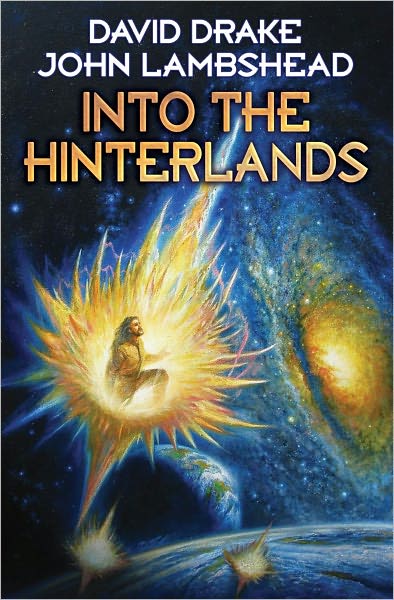
"Into the Hinterlands" by David Drake and John Lambshead (Reviewed by Liviu Suciu)
Official David Drake Website
Order "Into the Hinterlands" HERE or HERE (drm free ebook)
Read the First 15 Chapters of Into the Hinterlands HERE
INTRODUCTION: David Drake is a very well known author of military science fiction and traditional fantasy in the Robert Jordan style and while I have read around 15 of his books, his drier style kept most of them from being the highly favorite novels that I expected based on the content.
Still, the retelling of the Jason and the Argonauts story in the sfnal context of his Hammer universe, The Voyage, his space steward hero and mildly controversial standalone Starliner and his subgenre defining planet with monsters Redliners are big favorites of mine.
John Lambshead came to my attention when he wrote Lucy's Blade, an Elizabethan fantasy for Baen some years ago. While the subject left me meh as there are a dime a dozen Elizabethan fantasies around, I kind of liked his style so Into the Hinterlands as a presumed combination of the second author's writing and the first author world building and plotting was a highly expected novel.
OVERVIEW/ANALYSIS: Into the Hinterlands is the start of a new series that could be described as "Young Washington in a space opera context". The social setup is pre-revolutionary America with the main powers Brasilia as England, Terra as France and the proto-human Riders who ride continuum crystal living beings as the Indians, while the colonies are, well you got it and the Hinterlands are, well, you also got it... There is even tea as a highly regulated and sought after commodity.
Getting to the specifics of the novel: the universe of the novel is a four dimensional membrane inside the continuum and the humans navigate it by "frames" aka glorified bikes/wagons though there are interesting details as to how this works and what limitations ensue - the hyperspace drag is determined at the subatomic level so what you can carry efficiently on frames is dependent on its molecular properties rather than on mass/volume, so for example metals are hard to carry but ceramics are easy.
The political setup is the Fourth Civilization that spread across the stars when the nature of the universe was understood after the fall of (our) Third Civilization due to resource scarcity and biowars. Humanity now has the expected - lords of land at the top at least nominally, aggressive traders and merchants, while indentured servants take place of slaves in the Brasilian society and convicts in the Terran one, with the usual corruption, inefficiencies, class distinctions and pettiness. In other words, the socio-economic world of the 18th century in a space opera context and I happen to agree with the strong believability of such in the timeline presented by the authors as there is nothing inevitable about democracy and "rights of men" even in a technological world.
The story starts with Allen Allenson, young and promising colonial gentry and in-law to a secondary branch of a powerful Brasilian family, branch that decided to make its fortune in the colonies and married into the rising local families. Allen is leading a survey expedition into the Hinterlands under the nominal leadership of his learned but impractical in-law Destry, while Hawthorn, his childhood friend and dashing ladies man, another gentry but a bit lower in the social standing, is his aide.
This part is awesome and hooked me on the story while it introduces both the universe and our heroes perfectly; later, visiting his dying elder brother Todd - of a gene wasting disease that no medical tech can cure- Allen is convinced by his sister-in-law the ambitious Lynsie Destry to get Todd's position as Inspector General of the colonial militia. After the usual corrupt patronage deals, Allen gets the position conditionally from the executive Governor, contingent of investigating reports of Terran penetrations into the Hinterlands and of renewing the treaty with some of the Riders tribes that have a representative at one of the few trading posts into the wild.
From here the big-picture story starts and there is generally a predictable tone to what happens based on the events of the colonial wars of the 1750-1760's, but I really enjoyed the story and the space opera milieu gives a great canvas to retell it. There is much more including romance, seductive but dangerous women, politics and of course battles, fights, treacherous allies and incompetent generals. Into the Hinterlands packs quite a lot despite not being that long at less than 400 pages.
Overall, Into the Hinterlands (A+) is a great series debut and a complete package with a great ending but of course I want more and I really hope it "has legs", so the story of our heroes and their universe continues. Highly recommended and a book that shows clearly why Baen has been the leading publisher in military sf for so many years by putting out compelling novels that combine an interesting new space based milieu with traditional stories inspired from history.
Order "Into the Hinterlands" HERE or HERE (drm free ebook)
Read the First 15 Chapters of Into the Hinterlands HERE
INTRODUCTION: David Drake is a very well known author of military science fiction and traditional fantasy in the Robert Jordan style and while I have read around 15 of his books, his drier style kept most of them from being the highly favorite novels that I expected based on the content.
Still, the retelling of the Jason and the Argonauts story in the sfnal context of his Hammer universe, The Voyage, his space steward hero and mildly controversial standalone Starliner and his subgenre defining planet with monsters Redliners are big favorites of mine.
John Lambshead came to my attention when he wrote Lucy's Blade, an Elizabethan fantasy for Baen some years ago. While the subject left me meh as there are a dime a dozen Elizabethan fantasies around, I kind of liked his style so Into the Hinterlands as a presumed combination of the second author's writing and the first author world building and plotting was a highly expected novel.
OVERVIEW/ANALYSIS: Into the Hinterlands is the start of a new series that could be described as "Young Washington in a space opera context". The social setup is pre-revolutionary America with the main powers Brasilia as England, Terra as France and the proto-human Riders who ride continuum crystal living beings as the Indians, while the colonies are, well you got it and the Hinterlands are, well, you also got it... There is even tea as a highly regulated and sought after commodity.
Getting to the specifics of the novel: the universe of the novel is a four dimensional membrane inside the continuum and the humans navigate it by "frames" aka glorified bikes/wagons though there are interesting details as to how this works and what limitations ensue - the hyperspace drag is determined at the subatomic level so what you can carry efficiently on frames is dependent on its molecular properties rather than on mass/volume, so for example metals are hard to carry but ceramics are easy.
The political setup is the Fourth Civilization that spread across the stars when the nature of the universe was understood after the fall of (our) Third Civilization due to resource scarcity and biowars. Humanity now has the expected - lords of land at the top at least nominally, aggressive traders and merchants, while indentured servants take place of slaves in the Brasilian society and convicts in the Terran one, with the usual corruption, inefficiencies, class distinctions and pettiness. In other words, the socio-economic world of the 18th century in a space opera context and I happen to agree with the strong believability of such in the timeline presented by the authors as there is nothing inevitable about democracy and "rights of men" even in a technological world.
The story starts with Allen Allenson, young and promising colonial gentry and in-law to a secondary branch of a powerful Brasilian family, branch that decided to make its fortune in the colonies and married into the rising local families. Allen is leading a survey expedition into the Hinterlands under the nominal leadership of his learned but impractical in-law Destry, while Hawthorn, his childhood friend and dashing ladies man, another gentry but a bit lower in the social standing, is his aide.
This part is awesome and hooked me on the story while it introduces both the universe and our heroes perfectly; later, visiting his dying elder brother Todd - of a gene wasting disease that no medical tech can cure- Allen is convinced by his sister-in-law the ambitious Lynsie Destry to get Todd's position as Inspector General of the colonial militia. After the usual corrupt patronage deals, Allen gets the position conditionally from the executive Governor, contingent of investigating reports of Terran penetrations into the Hinterlands and of renewing the treaty with some of the Riders tribes that have a representative at one of the few trading posts into the wild.
From here the big-picture story starts and there is generally a predictable tone to what happens based on the events of the colonial wars of the 1750-1760's, but I really enjoyed the story and the space opera milieu gives a great canvas to retell it. There is much more including romance, seductive but dangerous women, politics and of course battles, fights, treacherous allies and incompetent generals. Into the Hinterlands packs quite a lot despite not being that long at less than 400 pages.
Overall, Into the Hinterlands (A+) is a great series debut and a complete package with a great ending but of course I want more and I really hope it "has legs", so the story of our heroes and their universe continues. Highly recommended and a book that shows clearly why Baen has been the leading publisher in military sf for so many years by putting out compelling novels that combine an interesting new space based milieu with traditional stories inspired from history.
The Black Prism by Brent Weeks has been one of my top ten novels of 2010 and I reviewed it HERE as well as having a short video interview with Brent Weeks HERE, so when I saw this recent release of a new book trailer to mark the mmpb publication of the novel I was very intrigued.
There is an excerpt from The Blinding Knife, the sequel to The Black Prism and one of my top ten awaited novels of 2012 but sadly it is on Facebook, so I cannot access it as I have no account and do not plan to open one there.
Anyway, the trailer is superb and I watched it and enjoyed it several times already. While I like book trailers in general, there are occasional ones that really transcend their short format and make one wish there would be a real movie instead. Anathem's book trailer was one such and this one is another.
There is an excerpt from The Blinding Knife, the sequel to The Black Prism and one of my top ten awaited novels of 2012 but sadly it is on Facebook, so I cannot access it as I have no account and do not plan to open one there.
Anyway, the trailer is superb and I watched it and enjoyed it several times already. While I like book trailers in general, there are occasional ones that really transcend their short format and make one wish there would be a real movie instead. Anathem's book trailer was one such and this one is another.

This past weekend, Robert V.S. Redick unveiled the UK cover art (see above) to The Night of the Swarm, the fourth and final volume in The Chathrand Voyage. The artwork is once again provided by award-winning artist Edward Miller, and like the author, it’s my favorite cover out of the four, although The River of Shadows by Edward Miller is a close second. As an added bonus, Robert V.S. Redick provided a short excerpt (see below) from The Night of the Swarm featuring the demon—or more properly, maukslar—depicted on the cover:
Thasha snapped awake. The raft was not moving. ‘What happened? Did we wreck?’
‘Softly!’ whispered Hercól. ‘We are not wrecked, but beached in the shallows, and we are all of us blind. Ramachni’s vision-spell has ended. There was a strange sound from behind us. Like thunder, or a monstrous drum.’
Thasha groped along the edge of the raft. Perfect blackness; every one of them blind except Ramachni. ‘Where’s he gone?’ she asked.
‘Up a tree, with Ensyl,’ said Bolutu. ‘We couldn’t talk him out of it – or very well prevent his going. Hark!’
This time she heard it: a deep rumbling, far off but furious. The sound seemed to carry through the very fabric of the forest. When it ended the silence was profound.
‘Ramachni’s singing,’ Pazel whispered. ‘I think he’s weaving a new spell. And that wasn’t thunder, Hercól. It was a voice.’
‘A voice.’ Dastu spoke with undisguised scorn. ‘You’re mad as mockingbirds, you know that? What sort of voice?’
Pazel made no answer, and the silence lingered. Then he said, ‘A demon’s?’
Even as he spoke, light appeared, a stabbing red light that made them all recoil. Wincing, Thasha forced herself to look: the glow came from about a quarter-mile away, at the height of the forest roof. Already it was growing, spreading. ‘Tree of Heaven, that’s fire!’ said Corporal Mandric. ‘The mucking forest is on fire!’
‘Do not move!’ said Ramachni suddenly. Thasha heard the mage and Ensyl scrambling aboard, felt Ramachni’s sleek shoulder brush her arm. ‘Be silent, now,’ he said, ‘and whatever happens, do not leave the raft. We are in unspeakable danger.’
The light became a sharp red ring: the leaf-layer, burning outward from a central point, like dry grass around a bonfire. The fire’s glow danced on the river beneath it, and soon the red-rimmed hole was as wide as the river itself. But there it stopped. The blinding light faded, leaving only a fringe of crackling fire, and another light replaced it: pale blue and gentle. It was the Polar Candle, the little Southern moon. The fire had burned through all four leaf-layers and opened a window on a clear night sky.
Oh Gods, it’s true.
In the fiery gap a monstrous head had appeared. A hideous sight: part human, part snake, a head twice the sized of an elephant's. Fire dripped from its jaws, dark runes were etched upon its forehead, and its eyes were two great yellow lamps. A long neck followed, snaking in through the burning hole. The lamp-eyes swung back and forth, casting the trees in a sickly radiance. When they passed over her, Thasha felt a prickling in her mind. She shuddered. Now it was Pazel’s turn to reach for her, pull her close. The lamp-eyes returned. When they touched the raft again they grew still.
Beside her, Ramachni tensed, bearing his tiny teeth, flexing his claws one by one. Then the creature roared: a deafening, complex blast of noise that shook them to their bones. Beside her, Pazel’s face showed a horror unlike that of the others, and suddenly she knew that he was understanding. His Gift had given him the demon’s language. There was meaning in that sound.
According to Amazon.co.uk, The Night of the Swarm is currently slated for a May 17, 2012 publication via its UK publisher Gollancz. Hopefully the book will come out then, but for now I would take the release date with a grain of salt until the US release is confirmed, which will be published by Del Rey. For more information on Robert V.S. Redick and The Chathrand Voyage, please visit the links below:
Read Fantasy Book Critic’s Review of “The Red Wolf Conspiracy”
Read Fantasy Book Critic’s Review of “The Rats and the Ruling Sea”
Read Fantasy Book Critic’s Review of “The River of Shadows”
Read A Conversation Between Robert V.S. Redick & David Anthony Durham

Official Christopher Meyer Website
Order Der Sternvolker HERE
INTRODUCTION: Here at Fantasy Book Critic we get tens of indie review queries a week, some with the full ebook included, some with samples and I dutifully open all that are not UF or YA but very rarely something hits the special combination of content/style I look for in any book I try. Usually the indies fail on content for me since there is so much "ancient evil, destined boys/girls" or their sfnal analogs coming in that I almost stopped opening such, but in the few cases a book has an intriguing blurb, the writing style needs also to hit it with me and that is a very subjective thing.
When Der Sternvolker popped in the inbox, the blurb below proclaimed it a space adventure in an intriguing 24th century Solar System - something of great interest - and when I opened it, the novel grabbed me from the first page so I decided to read it next.
"It’s the year 2305. Earth is gone. Humanity is scattered throughout the solar system. Space is unforgiving, and life is cheap. Peter Drexel is the untried Captain of the Loki. Broke and with an under strength crew he attempts to find a little work to make an honest living. But soon he finds himself in over his head as he fights off Martian Technocrats, city-state militias, privateers, and madmen. In the midst of it all Peter will discover a dark secret about the demons of ancient Earth that will shatter his world."
OVERVIEW/ANALYSIS: Der Sternvolker is a really fun book in the Jack Vance tradition - though it takes place in the Solar System rather than the Galaxy at large - but the societies are varied and strange while the adventure is nonstop and those are the main Vancian sfnal trademarks of classics like Planet of Adventure, The Demon Princes or the Gaean Reach novels.
So we have the usual: Peter Drexel, the independent captain with a complicated past and a need to prove himself, Amelia Krueger, the mysterious pilot with even more of a complicated past, Balder Faltskog, the enhanced mercenary leader out of a job and desperately needing one for him and his team, lord Rickard d'Helion of the Mars Technocracy, and his seductive sister Celeste as the rich manipulators, etc, all set in the year 2305 AD when Earth is a devastated barren land, but the rest of the Solar System is a very intriguing and diverse place, while the Sternvolk, the German speaking space folk of the title, form a very powerful corporatist guild that travels the System to trade, help keep order and link the scattered human polities.
While there is an overall main thread which is slowly revealed, the novel starts in the episodic fashion characteristic of its subgenre, with Peter Drexel and his crew on the Loki zipping around the System on this or that job to make a living and keep the ship in top shape, while taking the occasional vacation in a suitable spot.
Of course said jobs keep being "interesting" with unexpected twists and turns and we meet pirates, mind viruses, treasure hunters, mad emperors, rebels, while the manipulative aristocrats of Mars and the rigid Sternvolk are the main "powers to be". The action is non-stop and there is everything - mystery, romance, fights, battles, cool tech and gadgets, but also the nostalgia of the mad, dead Earth and its "lost super tech" which powers part of the action.
The style of the novel contains the right mix of pulp and modern and while the character interactions are pretty standard and predictable, the book is just an exuberant page turner that is a pleasure to read. In addition to that, there is a lot of backstory sprinkled throughout, in which both Peter's decision to quit the Sternvolk and strike on his own - with everyone predicting failure and his coming back tail between his legs so to speak - and Amelia's rejection of her privileged position there are very well integrated in the story and there are lots of memorable moments, funny but emotional and wrenching too.
Another thing I really liked about Der Sternvolker was the refreshing attitude towards personal relationships of the novel which is very modern, with women and men who speak their minds and know what they want.
While I noticed some typos here and there, the novel was edited reasonably well and I had no real complaints on that score. I really regretted when it ended since I wanted more. In another great touch that reminded me of the sf of yore, Der Sternvolker wraps up nicely its main storyline, while the last two pages provide the hook for more adventures in the really fun universe imagined by the author.
Overall, Der Sternvolker (A+) is a fun space adventure romp and I strongly recommend it for anyone wanting to read one such!
Order Der Sternvolker HERE
INTRODUCTION: Here at Fantasy Book Critic we get tens of indie review queries a week, some with the full ebook included, some with samples and I dutifully open all that are not UF or YA but very rarely something hits the special combination of content/style I look for in any book I try. Usually the indies fail on content for me since there is so much "ancient evil, destined boys/girls" or their sfnal analogs coming in that I almost stopped opening such, but in the few cases a book has an intriguing blurb, the writing style needs also to hit it with me and that is a very subjective thing.
When Der Sternvolker popped in the inbox, the blurb below proclaimed it a space adventure in an intriguing 24th century Solar System - something of great interest - and when I opened it, the novel grabbed me from the first page so I decided to read it next.
"It’s the year 2305. Earth is gone. Humanity is scattered throughout the solar system. Space is unforgiving, and life is cheap. Peter Drexel is the untried Captain of the Loki. Broke and with an under strength crew he attempts to find a little work to make an honest living. But soon he finds himself in over his head as he fights off Martian Technocrats, city-state militias, privateers, and madmen. In the midst of it all Peter will discover a dark secret about the demons of ancient Earth that will shatter his world."
OVERVIEW/ANALYSIS: Der Sternvolker is a really fun book in the Jack Vance tradition - though it takes place in the Solar System rather than the Galaxy at large - but the societies are varied and strange while the adventure is nonstop and those are the main Vancian sfnal trademarks of classics like Planet of Adventure, The Demon Princes or the Gaean Reach novels.
So we have the usual: Peter Drexel, the independent captain with a complicated past and a need to prove himself, Amelia Krueger, the mysterious pilot with even more of a complicated past, Balder Faltskog, the enhanced mercenary leader out of a job and desperately needing one for him and his team, lord Rickard d'Helion of the Mars Technocracy, and his seductive sister Celeste as the rich manipulators, etc, all set in the year 2305 AD when Earth is a devastated barren land, but the rest of the Solar System is a very intriguing and diverse place, while the Sternvolk, the German speaking space folk of the title, form a very powerful corporatist guild that travels the System to trade, help keep order and link the scattered human polities.
While there is an overall main thread which is slowly revealed, the novel starts in the episodic fashion characteristic of its subgenre, with Peter Drexel and his crew on the Loki zipping around the System on this or that job to make a living and keep the ship in top shape, while taking the occasional vacation in a suitable spot.
Of course said jobs keep being "interesting" with unexpected twists and turns and we meet pirates, mind viruses, treasure hunters, mad emperors, rebels, while the manipulative aristocrats of Mars and the rigid Sternvolk are the main "powers to be". The action is non-stop and there is everything - mystery, romance, fights, battles, cool tech and gadgets, but also the nostalgia of the mad, dead Earth and its "lost super tech" which powers part of the action.
The style of the novel contains the right mix of pulp and modern and while the character interactions are pretty standard and predictable, the book is just an exuberant page turner that is a pleasure to read. In addition to that, there is a lot of backstory sprinkled throughout, in which both Peter's decision to quit the Sternvolk and strike on his own - with everyone predicting failure and his coming back tail between his legs so to speak - and Amelia's rejection of her privileged position there are very well integrated in the story and there are lots of memorable moments, funny but emotional and wrenching too.
Another thing I really liked about Der Sternvolker was the refreshing attitude towards personal relationships of the novel which is very modern, with women and men who speak their minds and know what they want.
While I noticed some typos here and there, the novel was edited reasonably well and I had no real complaints on that score. I really regretted when it ended since I wanted more. In another great touch that reminded me of the sf of yore, Der Sternvolker wraps up nicely its main storyline, while the last two pages provide the hook for more adventures in the really fun universe imagined by the author.
Overall, Der Sternvolker (A+) is a fun space adventure romp and I strongly recommend it for anyone wanting to read one such!

Read An Excerpt HERE (PDF)
Watch Videos HERE
AUTHOR INFORMATION: Alma Katsu has a BA in Writing from Brandeis University and an MA from the Johns Hopkins Writing Program. The Taker is her debut novel.
PLOT SUMMARY: On the midnight shift at a hospital in rural Maine, Dr. Luke Findley is expecting another quiet evening of frostbite and the occasional domestic dispute. But the minute Lanore McIlvrae—Lanny—walks into his ER, she changes his life forever. A mysterious woman with a past and plenty of dark secrets, Lanny is unlike anyone Luke has ever met. He is inexplicably drawn to her . . . despite the fact that she is a murder suspect with a police escort. And as she begins to tell her story, a story of enduring love and consummate betrayal that transcends time and mortality, Luke finds himself utterly captivated.
Her impassioned account begins at the turn of the nineteenth century in the same small town of St. Andrew, Maine, back when it was a Puritan settlement. Consumed as a child by her love for the son of the town's founder, Lanny will do anything to be with him forever. But the price she pays is steep—an immortal bond that chains her to a terrible fate for all eternity. And now, two centuries later, the key to her healing and her salvation lies with Dr. Luke Findley.
Part historical novel, part supernatural page-turner, The Taker is an unforgettable tale about the power of unrequited love not only to elevate and sustain, but also to blind and ultimately destroy, and how each of us is responsible for finding our own path to redemption...
FORMAT/INFO: The Taker is 448 pages long divided over four Parts and fifty chapters. Narration switches between Luke Findley’s third-person POV set in the present day, and Lanore McIlvrae’s first-person story which is set in the past and comprises most of the novel. From chapter nineteen through the end of chapter twenty-four, the book features a third-person narrative from Adair. The Taker is largely self-contained, coming to a satisfying conclusion that wraps up the novel’s major plotlines, but two sequels have been contracted. September 6, 2011 marks the North American Hardcover publication of The Taker via Gallery. The UK edition (see below) was published on April 14, 2011 via Century / Random House UK.

The Taker opens in the present day with Dr. Luke Findley—a divorced father of two girls—asked to examine a young woman accused of murder. This woman, Lanore McIlvrae, reveals her secret to Luke in hopes of convincing the doctor to help her escape. Intrigued by the woman, Luke agrees to hear her story, thus establishing the novel’s central premise. As far as opening chapters go, The Taker’s is not very compelling. Luke is a dull, unsympathetic character; his third-person narrative is dry and awkward; and Lanore’s ‘secret’ is hardly a surprise since it is already revealed in the cover blurb. Because of these factors, The Taker completely failed to capture my interest. However, I decided to press on a little further and was rewarded for my perseverance.
After the opening chapter, The Taker switches to a first-person narrative as Lanore begins relating her extraordinary tale to Luke. This tale commences in the year 1809, introducing readers to Jonathan St. Andrew—Lanore’s one true love and the man she is accused of killing. From here, The Taker continues switching between Lanore’s first-person story set in the past, and Luke’s third-person narrative which occurs in the present day as the two of them try to escape from the law. Thankfully, despite the parallel storylines, the novel is mainly comprised of Lanore’s tale. Compared to Luke’s third-person narration, Lanore’s narrative is much more compelling. In fact, it almost seemed like two different people had written the book. Where the third-person narrative is dry and awkward, the chapters told in the first-person are elegant, accessible, and strikingly heartfelt:
“You might ask if I loved Jonathan for his beauty, and I would answer: that is a pointless question, for his great, uncommon beauty was an irreducible part of the whole. It gave him his quiet confidence—which some might have called aloof arrogance—and his easy, disarming way with the fairer sex. And if his beauty drew my eye from the first, I’ll not apologize for it, nor will I apologize for my desire to claim Jonathan for my own. To behold such beauty is to wish to possess it; it’s desire that drives every collector. And I was hardly alone. Nearly every person who came to know Jonathan tried to possess him. This was his curse, and the curse of every person who loved him. But it was like being in love with the sun: brilliant and intoxicating to be near, but impossible to keep to oneself. It was hopeless to love him and yet it was hopeless not to.”
Once I got past the novel’s opening chapter, The Taker became hard to put down. Lanore’s powerful love for Jonathan and the relationship that develops between them; Jonathan’s sexual escapades; the authentic portrayal of Puritan life with all of its propriety, religious beliefs and restrictions against women; and the heartbreaking events surrounding Lanore’s fall from grace . . . it’s very compelling stuff. Unfortunately, after Lanore was exiled to Boston in the year 1817, I became bored with the novel and almost gave up on The Taker a second time. Part of what attracted me to The Taker in the first place was the novel’s claim to be part “supernatural page-turner”. Yet, with over a third of the novel finished, where were all of the supernatural elements? After taking a break to read a different book, I decided to give The Taker one more chance. Once again, I was rewarded.
Shortly after the 150-page mark, Lanore undergoes her ‘change’ at the hands of Adair, a mysterious European noble she fell in with upon her arrival in Boston. Following this event, readers are graced with Adair’s story, which is nearly sixty pages long and narrated in the third-person. Taking place in the 1300s (A.D.) in Hungarian/Romanian territory, Adair’s tale is a fascinating one, chronicling the former peasant’s years as an apprentice to Ivor cel Rau, a physic/alchemist of noble Romanian birth. This includes the rape and abuse suffered at the physic’s hands, uncovering Ivor cel Rau’s dark secrets, and executing a devious plan to free Adair from the physic’s grasp.
At the story’s conclusion, Lanore’s narrative takes over with Lanore adjusting to her new abilities and her new life in Boston as a member of Adair’s court. A life quite different from her days as a Puritan, full of luxury, decadence and seduction, which reminded me a little bit of Jacqueline Carey’s Kushiel novels. From here, the action shifts back to St. Andrew where Lanore tries to convince Jonathan to become like ‘her’, and then back to Boston where the endgame between Lanore and Adair plays out. Completing Lanore’s tale are the recent events between her and Jonathan, which directly lead to Lanore’s current predicament with Luke. The outcome between Lanore and Jonathan—and between Luke and Lanore—is never in question, but reaching these outcomes is a fascinating journey all the same.
Even though The Taker can be a bit predictable at times, the novel boasts a couple of very nice surprises, especially regarding the book’s supernatural elements. Because of comparisons to such novels as Interview with the Vampire, The Passage and Elizabeth Kostova’s The Historian, a reader might assume there are vampires in The Taker. I know I did. That’s not the case however. Adair, Lanore, and the others may possess abilities similar to vampirism, but the differences are unique enough to be refreshing:
“We sleep and wake, eat and drink, go through our day like any other human being. The only difference is that another person might ponder, from time to time, which day will be his last. But you and I, our days will never end. We go on, bearing witness to everything around us.”
Negatively, I already mentioned the problems I had with the opening chapter and the supernatural elements taking too long before making their presence felt. In addition to these drawbacks, I also had issues with the shallow characterization of anyone not named Lanore, Jonathan or Adair; failing to flesh out the unique bond that Adair maintains with those of his court; and 160 years of Lanore’s life reduced to a few paragraphs. Fortunately, Alma Katsu is contracted for at least two sequels to The Taker, so it’s very possible that these issues with Lanore’s history and unexplained abilities will get resolved, although I’m not quite sure how the sequels will work without Jonathan in them.
CONCLUSION: Starting out, I had a difficult time with Alma Katsu’s The Taker, nearly giving up on the book at two separate occasions. Fortunately, once I got past the opening chapter and the supernatural elements kicked in, The Taker became nearly impossible to put down. It’s easy to see why. Take away the novel’s negative issues and what is left? How about a beautifully written, heartfelt narrative; compelling, unforgettable characters; and a mesmerizing blend of history, romance, and the supernatural. In the end, even with its flaws, The Taker is a captivating novel and one of the better debuts of the year...
 Labels:
Sunday, August 21, 2011
PRESS RELEASE: M. R. Mathias announces “Cold Hearted Son of a Witch” and “The Confliction” in The Dragoneers Saga!

Fantasy author M. R. Mathias has announced that Cold Hearted Son of a Witch, the long-awaited second volume in the Saga of the Dragoneers, will be released on September 15, 2011, with the eBook version available sometime in early September.
The Dragoneers Saga begins with The First Dragoneer, a 43-page novella, available FREE almost everywhere online.
The Saga continues with The Royal Dragoneers, a full-length novel of the saga that was deemed a Top Indie Release of 2010 by Fantasy Book Critic (Review HERE), and was featured in the first ever Publishers Weekly — “Indie Showcase.”
Now in Cold Hearted Son of a Witch, Zahrellion, Rikky and their dragons embark on a quest to find the special mushrooms Mysterian needs to save Prince Richard from Gravelbone’s poison. Meanwhile, Jenka and his loveable dragon, Jade, escort the King's Rangers back to Kingsmen's Keep. When Jenka and the half-elvish mute, Lemmy, find a map at the Temple of Dou, they follow it and find more trouble than they bargained for. Ultimately, the five Dragoneers come together as they are forced to stand and face a terrible threat that is only just revealing itself...

Praise for The Dragoneers Saga:
“Mathias is a master at characterization. The dragons are magnificent in the story. The Royal Dragoneers is book one in the The Dragoneers Saga. The plot is action is fast, furious and never ending. The plot is intricately woven with twists and turns that will keep the reader guessing. The story has a mythical quality. Fans of fantasy will not want to miss this one.”
“The author draws you into his fantastical vortex from the first chapter and you are compelled to read on whether you want to or not. The characters are believable and engaging. It's obvious to me he either researches a lot or is very knowledgeable in archery, hunting and just plain survival. I left feeling I learned a thing or two. I highly recommend this pre-cursor to The Royal Dragoneers.”
“Mathias is an absolute pleasure to read. Unique storyline, fascinating characters and a fast paced novel that practically reads itself. The Royal Dragoneers easily lived up to the promise shown in the prequel. Lovers of fantasy everywhere this is a fresh, new talent with plenty of truly original ideas. Do yourself a favour and treat yourself to this.”
Subscribe to:
Posts (Atom)


