Thursday, December 12, 2013
Demon Squad: The Best Of Enemies by Tim Marquitz (Reviewed by Mihir Wanchoo)

Official Author website
Order the book HERE
Read Fantasy Book Critic's review of Armageddon Bound
Read Fantasy Book Critic's review of Resurrection
Read Fantasy Book Critic's review of At The Gates and Betrayal
Read Fantasy Book Critic's review of Echoes Of The Past
Read Fantasy Book Critic's review of Beyond The Veil
Read Fantasy Book Critic’s review of From Hell
Read Fantasy Book Critic interview with Tim Marquitz
AUTHOR INFORMATION: Tim Marquitz is the author of the Demon Squad series, and the Sepulchral Earth serial stories. He is also an editor, a heavy metal aficionado, a Mixed Martial Arts fan, and is also a member of the Live Action Role Playing organization. When he’s not busy writing dark stories which catch his imagination he also manages to go about his day job. Tim lives in El Paso, Texas with his wonderful family.
OFFICIAL SYNOPSIS: Power comes at a price. For Frank “Triggaltheron” Trigg, that price is everything.
Lost and alone, Hell closes in until Frank can't take it any longer. He ascends to Old Town to find a new overlord has staked his claim, but Frank is having none of it. He goes to war against the usurper. Collateral damage mounts, friends turn their backs and foes unite, but it is the ones he least suspects who make the best of enemies.
FORMAT/INFO: Demon Squad: The Best Of Enemies is 167 pages long divided over twenty-five chapters. Narration is in the first-person, exclusively via the protagonist Frank “Triggaltheron” Trigg. This is the sixth book in the series and it would not make much sense for new readers to jump into the series with this book.
December 4, 2013 marked the e-book and paperback publication of Demon Squad: The Best Of Enemies and it was self-published by the author. Cover art is provided by Carter Reid.
ANALYSIS: What a long journey it has been for Frank Trigg, when we were first introduced to him and his world. He was a lowly denizen of hell that had refused his uncle Lucifer’s offer to ascend to the mantle of the Anti-Christ and then had taken an ignominious fall. He served his time on Earth in a city called El Paseo where he did a penance of sorts (for all his actions as Lucifer’s nephew) by helping DRAC (Demonic Resistance And Containment) an organization that is trying to hold together a world coming apart at its podes. Since God and Lucifer came together and called a truce and then left for universes unknown, both heaven and hell have been shaken.
Through the first five books in this series, the readers witness Frank’s growth as a person and serious revelations about Frank, his parents and the real reasons for God and Lucifer’s departure. Over the last couple of books, Frank’s personal life has been through the wringer but he has gained crucial information about his lineage and also gone up on the power scale. With this book, we find Frank back to his old hell (in this case, Hell actually). He’s reminiscing about the events featured in book IV and V as they have literally changed his life and the lives of people around him. Bored about his wits, Frank decides to return back to El Paseo and face the wrath of his friends. True to his inklings, Rahim, Katon and Scarlett are there to confront him as well as certain characters from the previous books make their presence felt. However there’s a crucial difference this time around, Frank’s no longer the bottom bitch and he intends to let everyone know that quite viscerally if need be.
With the sixth volume, the author tries to keep it fresh and exciting and makes Frank even more headstrong than he’s ever shown to be. Perhaps it is assumable that this was how Frank was when he held his status quo as Ant0-Christ-to-be. It’s an ugly picture but Frank still manages to entertain the readers and keep them on his side. He’s also trying to get Rala the alien to decipher the contents of the strange book that Lucifer passed onto him. Lastly his search for El Paseo’s newest head honcho is quite darkly comical and action-packed sequence with golden delights such as a Were-Panda screaming “Wu Tang” and the re-appearance of a certain governmental agency.
What the Panda is up to and what happens to him will have to be RAFOed by the readers, suffice to say, it showcases how Tim’s dark mind works and this perhaps is a cool riff in regards to a certain beloved Panda. With this storyline, the action sequences are again brought to the fore and we see Frank relaxing in all his new power. The author never has had any problems with action sequences and in this one, he continues in the same vein. The story doesn’t have that many plot twists as its two predecessors; I felt that was due to the nature of the storylines espoused by those books and so in this one, we get a solid twist in the last one-third of the story and story also ends on a cliffhanger, which makes book seven another must have immediately.
Readers who have enjoyed the previous five volumes, will definitely enjoy this addition to the series as they will get to see Frank like never before. For newer readers, I would caution against starting Frank’s saga with this book as there are several major spoilers for the last two-three books and in fact the identity of the main antagonist also is a major reveal from a preceding title. It would be best to start with Armageddon Bound and enjoy the train wreck that is the life of Frank “Triggaltheron” Trigg. Lastly for drawbacks to this title, the only sore point for me was the presence of a cliff hanger in the climax. After doing so for the last few books, I was hoping to not experience it again but I was not completely disappointed in that regard. However the author is also known for his speed and so I’m not too concerned for the wait until book seven which might be in 2014.
CONCLUSION: The Best Of Enemies is another solid entry in the Demon Squad series, for all lovers of Frank Trigg, Tim Marquitz doesn’t disappoint with this one. Focussing on Frank who is a different version of himself, the author paints a vivid and dark story that will surely keep the readers entertained and hooked on till the very end. Get ready for a darkly comic thrill ride, ladies and gentlemen, Frank Trigg is in the control seat and it’s going to be a wild one.
 12:01 AM |
 Posted by
The Reader |


Visit Ann Aguirre's Official Website HERE
OVERVIEW: In Deuce’s
world, people earn the right to a name only if they survive their first fifteen
years. By that point, each unnamed ‘brat’ has trained into one of three
groups–Breeders, Builders, or Hunters, identifiable by the number of scars they
bear on their arms. Deuce has wanted to be a Huntress for as long as she can
remember.
As a Huntress, her purpose is clear—to brave the dangerous tunnels outside the enclave and bring back meat to feed the group while evading ferocious monsters known as Freaks. She’s worked toward this goal her whole life, and nothing’s going to stop her, not even a beautiful, brooding Hunter named Fade. When the mysterious boy becomes her partner, Deuce’s troubles are just beginning.
Down below, deviation from the rules is punished swiftly and harshly, and Fade doesn’t like following orders. At first Deuce thinks he’s crazy, but as death stalks their sanctuary, and it becomes clear the elders don’t always know best, Deuce wonders if Fade might be telling the truth. Her partner confuses her; she’s never known a boy like him before, as prone to touching her gently as using his knives with feral grace.
As Deuce’s perception shifts, so does the balance in the constant battle for survival. The mindless Freaks, once considered a threat only due to their sheer numbers, show signs of cunning and strategy… but the elders refuse to heed any warnings. Despite imminent disaster, the enclave puts their faith in strictures and sacrifice instead. No matter how she tries, Deuce cannot stem the dark tide that carries her far from the only world she’s ever known.
FORMAT: Enclave is the first book of a YA trilogy. It is a
combination of post-apocalyptic, horror, dystopia, zombies, action, and a small
dash of romance. It should be warned this book ends with a cliff hanger.
Enclave stands at 259 pages and was published by Feiwel
& Friends on April 11, 2011.
ANALYSIS: I admit it. I have a weakness for any book that
says 'Just like Hunger Games' on the cover. Put those four words anywhere on a
book – cover, flap, synopsis – and I'll pick it up. That was how I came upon Enclave.
I have to say right off the bat – Enclave is not like Hunger Games. There are children involved and a
futuristic world in which everything has changed, but the similarities end
there. So, if you are looking for the next Hunger Games, this is not it.
Putting aside that Enclave
is nothing like Hunger Games, I was able to read this book in a relatively
short period of time. Enclave stands
at approximately 250 pages and is a fairly quick read. If you are looking for a
short read that involves extremely dark elements, zombies, post-apocalyptic
elements, and strange underground tribes, this is the book for you.
Given its length, it was a fairly good read. There is a lot
of action and exploring, and more action. The characters aren't overly detailed.
I think this is mainly because the book focuses on action and creating this dark,
dangerous world, and less on creating detailed characters.
Unfortunately, there are a few elements of Enclave that I feel took away from the
book and prevented it from being the novel it could have been. First, one of
the characters in the book – Teagan – has an extremely tough life living
'Topside'. She was essentially kidnapped and repeatedly gang raped by a group
of wild, savage individuals.
The rape is never described, but it is implied. Now, I have
read books that have addressed this issue and have not had an issue with it.
Unfortunately, Enclave was not one of
those books.
The main character in Enclave
– Deuce – is confused as to why Teagan allowed herself to be raped and lacks
any type of sympathy for her at all. Later on in the book, Deuce encourages
Teagan to just 'get over it' for the better of the group – which the group
includes one of the men who encouraged and allowed the gang rape to go on.
This element of the book was such a small part of the novel,
but I feel it really soured the book. I understand the world created in Enclave is dark and dangerous, but the
rather savage way the rape victim was treated really took away from what could
have been a good novel.
Despite my issue with this small element, I was able to
finish the novel. Overall, I would say the book was
alright. It is extremely
dark and almost savage like, so if you are looking for a fluffy, feel good
story; this is not it. However, I think it offers a great alternative to some
of the other run of the mill YA books that are being printed lately.
My overall opinion is to try this book out, if you have any
interest in it. After reading it, I have since read reviews and if I had read
the reviews, I would have avoided the book completely. I don't think it is
terrible, but I don't think it is wonderful either. It is certainly a book that
people will have to form their own opinions on.
Thursday, December 5, 2013
GUEST POST: Malice, Its Influences And The David Gemmell Awards by John Gwynne

It’s been a crazy year. Last December my debut novel Malice was published by Tor in the UK, and in this December it is published in the US by Orbit. Plenty of crazy-cool things have happened in between, but the top of the cake has to be winning the David Gemmell Morningstar Award for best fantasy debut of 2012. Being awarded the Morningstar came as an absolute shock, and has kept me grinning pretty much permanently.
A bit of background information is probably helpful here. The story of me writing Malice started about 11 years ago - at the time I had recently finished a master’s degree and was teaching at Brighton University. Due to family health issues I stepped out of teaching to help my wife in caring for our daughter, Harriett. She is profoundly disabled and needs round-the-clock care. Life can be pretty intense, when you care for someone full-time, so I thought a hobby might be a good thing, if I could find the time. I've always told stories - to my kids and my wife (if I have them backed into a corner with no routes of escape) and they've often encouraged me to write some of them down (possibly to make me stop talking). So I started to do that, a hobby that restored a bit of ‘me’ in the juggling act that is the parenting of three boys, working from home and also caring for my daughter. It was also a place to indulge my passion for general all-round geekery. Malice and The Faithful and The Fallen just naturally evolved out of this. Somewhere along the way it grew into something more than just a hobby.
I finished Malice in 2010 and gave it to my wife and kids to read, plus a few mates, and then put it away for a while. Feedback was good - but hey, what did I expect from family and friends. Nevertheless most encouraged me to take it further, and though some of my mates do like to humiliate me whenever possible, I got the feeling this was not one of those times. I started looking into how to get a novel published, and the short version of what came next is that I approached an agent - John Jarrold. He had worked in the business for over three decades, running fantasy imprints in the U. K. such as Orbit and Simon and Schuster, editing authors such as Guy Gavriel Kay, as well as representing contemporary writers like Mark Charan Newton, Adam Neville and Stephen Deas. He became my ‘dream agent,’ the man always at the top of my list, so it was no shock that John was the first agent that I approached.

To my surprise and very great pleasure John loved Malice and agreed to represent me. That was a good day. Drinking mead and dancing a jig was involved. John worked with me editorially for a while, then Malice went out to publishers, and within a short time there was a pre-emptive offer from Julie Crisp, acquiring editor of Tor UK. This was just before Christmas 2010. Needless to say, there was much celebrating in the Gwynne household that Christmas, involving more mead drinking and jig-dancing, with extra mulled-wine. So that’s the condensed version of how Malice came to be published.
As to the influences on the actual story, well, there are a few major culprits there. I fell in love with fantasy at a early age - 8, in fact, when a school teacher read The Book of Three by Lloyd Alexander to my class - lots of mythological epicness and I was instantly hooked. After that it was The Hobbit and The Lord of the Rings, and it is fair to say that Tolkien consumed my pre-teen reading years.
Other writers have crept into the mix along the way, of course. I tend to read mostly fantasy - all types: urban, steampunk, gritty but my first-love is epic - alongside a lot of historical fiction, authors such as Bernard Cornwell, Conn Iggulden and Steven Pressfield, to name a few. If I had to narrow down the major influences on Malice, which is pretty hard, as a lot went into the pot, I’d have to say these are the important ones:
- Tolkien’s The Lord of the Rings
- Bernard Cornwell’s Arthur trilogy, and The Warlord Chronicles
- John Milton’s Paradise Lost
- And pretty much anything by David Gemmell.
Those four really capture the essence of what I aspired to write. Something epic, with a big landscape (Tolkien). Something that felt almost historical, with a foot in ancient history (Bernard Cornwell). Something intimate, personal and character driven (David Gemmell). And something supernatural, with a sinister edge (Paradise Lost).
I discovered David Gemmell in my late teens, back in the mists of time when I still had hair. I've been a huge fan of his since I discovered Legend in my local Waterstones and hurried home to devour it in one sitting. I remember feeling both elated and disappointed when I finished it in the early hours of the next morning - disappointed because I’d finished. Since then David Gemmell has been responsible for a distinct lack of sleep in my life, as his books always had me gripped from page one and reading through the night into the small hours of the morning. Up until then fantasy had consisted largely of whiter-than-white hero’s in black and white worlds - Gemmell chopped a snaga-shaped axe through that, bringing flawed characters and moral ambiguity to the table, whilst still managing to be uplifting and give you a feeling of hope about human nature. I loved his style, his balance of detailed action with wonderful character beats and roller-coaster plotting. ‘Sword in the Storm’ is one of my all time favourite reads. Malice would have been a very different book without the influence of David Gemmell.

It feels pretty surreal to even see Malice in a bookshop at all - I can still vividly remember it being scattered notes on my desk, and I feel exceptionally fortunate to see it in print. There have been lots of great, memorable moments along the path to publication and beyond. Seeing Malice on the same shelf as David Gemmell in my local Waterstones - the same shop that I bought my original copy of Legend from - was one such moment. Finding out I had made the shortlist for the David Gemmell Morningstar Award was awesome, both because of the company I was in, such great writers, and also, well, because DAVID GEMMELL.
To actually win the Morningstar Award really is almost indescribable - first complete and utter shock (I began to clap for the winner before it sank in that my name had just been read out) and followed quickly by very deep joy and a grin as wide as Druss’ axe. I so did not expect to win, and was just over the moon to be enjoying the experience of being shortlisted and being at the awards ceremony - James Barclay’s Druss speech as the opener was quite brilliant and had myself and my two younger sons enraptured.
Being such a massive Gemmell fan made winning a award with the great man’s name attached to it, quite incredibly special, and the moment was made all the better because my family were at the award ceremony - there were a lot of hugs, and a few tears. And red wine. So as you can see, it’s been quite a year. Never thought any of it would have happened - I might have imagined it once or twice back when Malice was just a few scattered notes on my desk, like when you imagine winning the lottery - but it just goes to show, sometimes dreams do come true.

Official Author Website
Order “Malice” HERE (UK) & HERE (US)
Read An Extract HERE
Read Fantasy Book Critic's review of Malice
Read The Truth Behind a Legend by D.E.M. Emrys w/ thoughts by John Gwynne (Guest Post)
AUTHOR INFORMATION: John Gwynne studied and lectured at Brighton University. He’s been in a rock ‘n’ roll band, playing the double bass, travelled the USA and lived in Canada for a time. He is married with four children and lives in Eastbourne running a small family business rejuvenating vintage furniture. Malice is his debut.
NOTE: John Gwynne picture courtesy of himself. John Jarrold picture courtesy of himself. John receiving his award from Michael Marshall Smith (picture courtesy of Stan Nicholls).
Wednesday, November 27, 2013
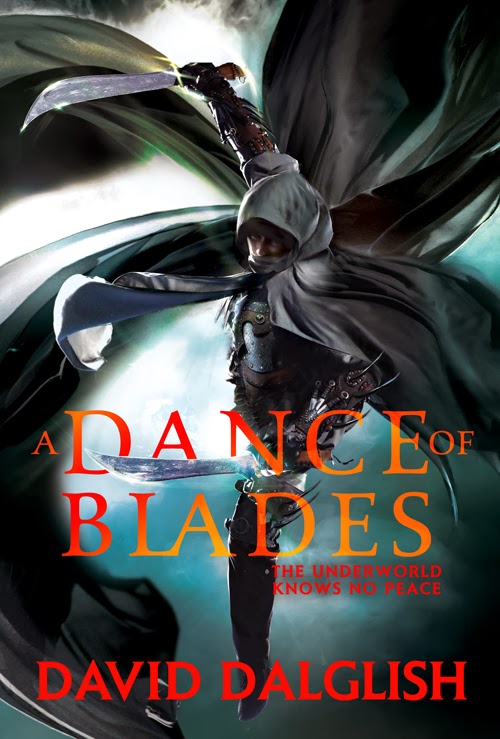
RE-REVIEW: A Dance Of Blades by David Dalglish (Reviewed by Mihir Wanchoo)
Official Author Website
Order the book HERE
Read Fantasy Book Critic's review of A Dance Of Cloaks
Read Fantasy Book Critic interview with David Dalglish
Read Fantasy Book Critic cover art interview with David Dalglish
AUTHOR INFORMATION: David Dalglish is the author of the popular Half Orc fantasy series and the Paladin series. He was born in Fort Lauderdale, Florida. He graduated from Missouri Southern State University in 2006 with a degree in Mathematics and used to work with Special Education students. He lives with his family in Missouri; A Dance Of Cloaks was his traditional publication debut.
OFFICIAL BLURB: It's been five long years since the city learned to fear...
The war between the thief guilds and the powerful allegiance known as the Trifect has slowly dwindled. Now only the mysterious Haern is left to wage his private battle against the guilds in the guise of the Watcher - a vicious killer who knows no limits. But when the son of Alyssa Gemcroft, one of the three leaders of the Trifect, is believed murdered, the slaughter begins anew. Mercenaries flood the streets with one goal in mind: find and kill the Watcher.
Peace or destruction; every war must have its end.
CLASSIFICATION: Featuring a world wherein there are multiple factions at work, this book is a dark, character-driven, gritty fantasy novel in the vein of Jon Sprunk, Brent Weeks and Peter V. Brett.
FORMAT/INFO: A Dance of Blades is 407 pages divided over thirty-two numbered chapters and an epilogue. Narration is in the third person via several different point-of-views, both major and supporting characters, including the main protagonist Haern the Watcher, Alyssa Gemcroft, Veliana, Deathmask, Nathaniel Gemcroft, Arthur Hadfield, Oric, Ghost, etc. A Dance of Blades is self-contained, but is the second volume in the Shadowdance series after A Dance of Cloaks.
November 5, 2013 marked the trade paperback and e-book publication of A Dance of Blades via Orbit Books. Cover illustration is provided by Michael Frost and Gene Mollica.
ANALYSIS: As with my re-review of A Dance Of Cloaks, I'm attempting to do a similar thing with this one as this book has changed the least with only some minor text changes. I read this book more than two years ago and since then have absolutely loved this series. The story begins nearly five years since the events shown in “A Dance of Cloaks”. The city of Veldaren is slowly recovering from the catastrophic night in which the Guilds decided to remove the Trifect from the political equation. Unfortunately, things did not go as planned for Thren Felhorn because of the valor and dedication of a select few. Since then, the Guilds have fractured even further and now fight amongst themselves in an attempt to regain their earlier powers. The Trifect also suffers, but fares slightly better than their rivals. Complicating matters is a new addition to the city: the Watcher.
The Watcher calls himself Haern, and is the son of the most famous and devious guildlord (a secret known to no one). Using his former training, Haern’s goal is to sow dissent among the Guilds. Meanwhile, Alyssa Gemcroft, one of the leaders of the Trifect, has successfully taken over the Gemcroft estate and now has a son, Nathaniel, from her dalliance in the previous book. Serving Alyssa as her protector is Zusa, the ex-forsaken of Karak and also a confidante to Veliana. Veliana’s mission to save the Ash guild was successful, but she is now subservient to the new Guild master. Readers are also introduced to Deathmask, a character from The Half Orcs series, while Lord Arthur Hadfield and Mark Tullen try to obtain Alyssa Gemcroft’s hand in marriage.
The heart of the story unfolds when Haern comes across a devious plot to kill the child Nathaniel. Haern intervenes, but with chaotic results. Word soon spreads that the child is missing, presumably dead, so Alyssa in her grief decides to finish off the Guilds and kill the Watcher, who she believes are the guilty parties behind her son’s death. From here, A Dance of Blades follows Haern as he battles the Guilds, the Trifect, and perhaps his greatest enemy, an odd giant of a man who goes by the title of Ghost...
Compared to A Dance of Cloaks, the prose in A Dance of Blades is remarkably more polished and a major highlight of the book. Pacing is similar to the first novel, meaning thrilling action sequences mingled with intriguing characters that reminded me of Paul S. Kemp and David Gemmell, but Dalglish has definitely turned up the excitement level. The story is more linear and streamlined than its predecessor, but there are still lots of machinations and subplots going on, while a deeper exploration of the world of Dezrel is provided. The grimness, which was so prevalent in the first book, has been toned down a bit, although plenty of killing can still be found in A Dance of Blades. Personally, I was glad for this as the author managed to surprise me a couple of times by killing off a certain character, while saving another. Thematically, salvation is a major theme, with many of the book’s characters seeking redemption, with both successful & unsuccessful results.
Characterization remains top-notch giving readers a wide variety of characters to follow, including Haern with his psychological scars, Veliana with her toughness and never-say-die attitude, and Alyssa who now understands her father better than ever. What I love most about the characters is how they are all so unique and interesting, which is important in a book that features so many different POVs. Meanwhile, quite a few characters from The Half-Orcs series make an appearance in A Dance of Blades. With this book, there's a slight increase in the magic or paranormal nature of the world, of course in the previous book there were events and things happening that clarified that magic was present but with this volume, the author starts building it up even more starkly with the presence of Deathmask and his antics.
Negatively, Haern’s abilities and vigilante actions reminded me of Batman, which made some things in the book easy to predict. Also, because the Shadowdance series is a prequel to The Half-Orcs series, and features many of the same characters, those who have already finished the Half Orc books know who will survive and who won’t. For me, this is the single biggest flaw in reading any prequel series, which is why I have purposefully held off from reading The Half-Orcs novels.
CONCLUSION: Overall, A Dance of Blades is an excellent sequel, further establishing Haern’s story, while showcasing David Dalglish’s impressive growth as a writer. So now, after having fully enjoyed the first two books in the Shadowdance series, I can’t wait to read what happens next in Haern’s saga in the third book, A Dance of mirrors...
Tuesday, November 26, 2013
"Ever After High: The Storybook of Legends (Ever After High #1)" by Shannon Hale (Reviewed by Cindy Hannikman)

Visit Shannon Hale's Official Site Here
OVERVIEW: At Ever After High, an enchanting boarding school,
the children of fairytale legends prepare themselves to fulfill their destinies
as the next generation of Snow Whites, Prince Charmings and Evil
Queens...whether they want to or not. Each year on Legacy Day, students sign
the Storybook of Legends to seal their scripted fates. For generations, the
Village of Book End has whispered that refusing to sign means The End-both for
a story and for a life.
As the daughter of the Evil Queen, Raven Queen's destiny is to follow in her mother's wicked footsteps, but evil is so not Raven's style. She's starting to wonder, what if she rewrote her own story? The royal Apple White, daughter of the Fairest of Them All, has a happy ever after planned for herself, but it depends upon Raven feeding her a poison apple in their future.
What if Raven doesn't sign the Storybook of Legends? It could mean a happily never after for them both.
FORMAT: Ever After High: Storybook of Legends is a middle
school fairy tell retelling. It stands at 320 pages and was published by
Little, Brown Books for Young Readers on October 8, 2013. This is the first
book of a series.
ANALYSIS: I am not a huge fan of books that are created with
the sole purpose of selling, promoting Internet websites/TV shows/app. I
understand that it is essentially a marketing tool that gets kids to read, but
I am just not a fan of it.
So, imagine my surprise when I picked up Ever After High
based off of the description only to discover it is a book designed to subtly
(or maybe not so subtly) promote a series of Mattel dolls. I wasn't thrilled
and almost put it back, but seeing as I love fairy tale retellings; I figured
I'd give it a go. And I am glad I did.
Ever After High: Storybook of Legends was a fast-paced,
light read that really gave fairy tales a new twist. The book is intended for
middle school readers and the writing style, conversations, and some of the
problems the characters faced reflect that, but I don't think there is anything
'older' readers can't relate to in this book.
The plot of Ever After High: Storybook of Legends revolves
around the idea that the sons/daughters of famous storybook/fairy tale
characters all attend a boarding school together. The first year, they are
given the freedom to choose classes that they like, but the second year they
are 'groomed' to be the characters/people their parents are in their stories.
Second year is when the characters must sign their name in
the Storybook of Legends and pledge to assume their role as the
hero/subcharacter/villain/etc. They have no choice in the matter, they must do
this or they will disappear and the other characters in their story will not be
able to get their 'happily ever after'.
Raven Queen, daughter of the Evil Queen, is having second
thoughts about this. The plot of the first book revolves around Raven Queen
trying to discover herself and see if there is a way that she can change her
destiny and not become the Evil Queen.
I believe this plot line allows 'older' readers to relate to
the story. Every adult knows what it is like to not fit in, feel as if their
life is in the hands of others, etc. In addition to relating to older readers,
this plot line sends a subtle, but important message to the younger readers –
that your destiny and life is your own.
Normally, I would say a novel that incorporates this idea is
doomed to fail, but Shannon Hale really pulls this off. Sure, there are quirky
things that drove me a little crazy, but it was a nice, fast, read that I
really enjoyed. I can only think of a handful of other authors that would be
able to pull this type of novel off without it being a total disaster.
One thing that drove me crazy for example was everything
(and I mean everything) has some sort of cutesy nickname. Hextbooks instead of
textbooks and things like that. I think it would be cute for younger readers,
but it just made my eye twitch sometimes.
Shannon Hale does an excellent job of taking familiar characters,
Snow White, Evil Queen, etc., and adding a unique twist to them. The characters
are still familiar, but Hale really does make them her own. I think this above
all is what makes this book stand out.
Just be warned, there are 2 more books planned for the
series. So, not all questions or problems are solved in this book, which is a
little disappointing.
Overall, if you are able to put aside the obvious marketing
ploy and love fairy tale retellings this may be the book for you. The writing
style is definitely middle school, but this novel is a page-turner and worth
the read.
Monday, November 25, 2013
GUEST POST: Omnipotence is Impotence: Or Why Control Freaks Make Poor Fantasy Writers by Robert V.S. Redick

I’ve just received three messages from readers. They’re utterly different in their concerns, and yet somehow they all bring me to the same place.
Reader One told me that he’d finally gotten his hands on The Night of the Swarm. He added, “Sandor Ott had better die horribly at the end.” [Something everyone can agree on, I thought]
Reader Two explained that she’d just reached that end, and loved it, BUT:
As I was reading it and seeing how Pazel ________________ I just wanted to cry. And then to end it with _______________ was so heartbreaking…[it] hits too close to home. Great job in rousing deep feelings in how this story ends. I will probably think about this for weeks to come and carry these feelings of sadness for days.
[It’s strange—about half the readers who contact me find the end of the series heartbreaking. I didn’t expect this. I mean, it’s no dancing-Ewoks conclusion, I realize. But…heartbreaking?]
Reader Three, finally, asked a great question about writing description. After we talked about that, he followed up with another:
How do you go about building your characters? I understand that cliché’s not a bad thing and I also know that using real people is good too, but can you give a more in-depth explanation?
What could I tell these readers? To the first, who hoped the venomous Sandor Ott would suffer and die, I confessed that I, too, kept waiting for some force to come along and chew him to pieces. I can easily imagine his response: Then why didn't you just make it happen?
To Reader Two, I wrote that I’d watched my beloved character Pazel walk through the story’s close with my mouth agape. “I thought he’d buy a house in Ballytween! I didn’t think he’d become a drinker and a wreck.” I can imagine her response as well: But wasn’t that… your choice?
To Reader Three--well, I hope this is the in-depth explanation you wanted.

1) Storytellers are explorers, not architects.
This is key. Great fantasy writers are often called “the architects” of their respective worlds, but the term is deceptive. Mountains don’t have architects. Enchanted mountains, where spirits drift and the shadow of a god troubles the heather, sure as hell don’t. Fantasy realms are, alas, partly constructed. But long before that they are found. The marrow (if not the bones) of these lands is our common inheritance. They are born of myth and folktale, ghost story and ancient yarn. Peter S. Beagle may go a bit too far when he says of Tolkien —
…the world he charts was there long before him…. He is a great enough magician to tap our most common nightmares, daydreams and twilight fancies, but he never invented them either: he found them a place to live, a green alternative to each day's madness here in a poisoned world.
— but only a bit. That notion of “tapping” is a good one. How do you tap a vein of nightmare, daydream, twilight fancy? Not with graph paper or genealogy charts. There are tools that just don’t exist in such realms. If you go there, you’ll find they’ve vanished from your hands. All this is to say that
2) Planning alone never brought a world to life.
It has even, when done obsessively, kept the spark of life from entering well-made worlds. You can do all the outlining, diagramming, plot-balancing, language-inventing, magic-system modeling, warhorse-feedbag nutritional analyses and ogre skeletal-structure weight-bearing trials you like [believe me, I have]. It’s honest work and may well pay dividends. But when you actually write the book the unexpected will happen. Indeed, must happen, if the story’s going to breathe.
Of course world-building is absolutely vital. It’s simply not the same thing as storytelling. The latter requires a different kind of effort. It requires dream.
3) To tell a story is to inhabit a waking dream.
It’s very easy to be woolly and mystical about this, especially if you’ve just finished a long and complex tale, and especially if you’re me. But the fact is that the act of writing shares many characteristics— singular focus, loss of present awareness, altered time sense, emotional conviction, personal vulnerability—with dreams. And that’s a problem, because
4) It is in the nature of dreams to elude control.
Nearly every writer who addresses this subject will tell you: the best stuff catches you by surprise. You think your heroine’s going to cross the Old City, climb the Long Stair to Raven’s Landing, sneak through the gardens of the Viceroys and knock on the door of the piano tuner. Because, see, the piano tuner’s shop is where the next plot element is going to snap into place. We know it is. We planned it that way.
But halfway up the Long Stair she smells smoke. She looks up from her reverie and sees her aunt—her once-beloved but long-since-vanished aunt, the one nobody speaks of anymore, the one who made her father sob like a child on the night she disappeared--gazing down at her with a look of horror. She doesn’t speak. In her hands smoldering book. She glances back over her shoulder, gasping a little, turns our heroine a final glance and dashes into a side-street.
HOLY TWO-HEADED ACID-SPITTING TOADS FROM HELL! Where did that woman come from? Where’s she been all these years? What’s frightened her? Why didn’t she speak? And what in God’s name is she doing with a half-burned book?

Now, it’s very possible that what’s waiting in the piano shop is of greater importance than the aunt and her burning book. If so, you must banish her to the Demented Visions folder (doesn’t everyone have a Demented Visions folder?). But what if this business with the aunt, this unplanned business, has you writing with more eagerness than you’ve found in weeks? What if it’s going somewhere that thrills you, and your paint-by-numbers plan is not? Remember the inscription that Digory Kirke finds in the dead world of The Magician’s Nephew:
Make your choice, adventurous stranger
Strike the bell and bide the danger
Or wonder, ‘till it drives you mad
What would have followed if you had.
Of course he gives in—every gun must go off—and hell, or hell’s queen anyway, immediately breaks lose and goes on a rampage. It’s a moment that captures the best of the Narnia books—economy of vision, a shockingly vivid scene, a reversal of the myth’s gender rolls (Eve resists, Adam succumbs). And then, pages later, the very worst. Lewis can’t help himself. He spells out not just the consequences, not just Digory’s mistake, but the absolute truth—that he knew better, that he betrayed his own soul, that the unchaining of evil is all his fault because he didn’t stick with The Plan.
Sorry, kid, you blew it. At least you’ll have a story to tell.
This is your choice as the writer of the scene on the staircase. Following your muse, following the voice of the weird in the waterfall, almost certainly will play havoc with your own version of The Plan. You don’t have to do it. You won’t actually go mad. But no story ever came from leaving the forbidden apple on the tree.
Two and a half centuries ago there was a spat between Voltaire and the latter-day champions of Shakespeare. The feud turned nasty and nationalist, but it brought to light a vital difference between the literary men. Voltaire is a thinker and a landscape gardener. Shakespeare is a bard. The former gives us systematic philosophy and logical argument. The latter gives us pain, love, rage, betrayal, hilarity, hope, catharsis. Voltaire offers shining ideals; Shakespeare, scalding experience. No one remembers Voltaire for his fiction per se: the wit, yes, the ideas, certainly. He's a genius with a reason for everything. A precise reason, one he can both articulate and defend. Before a judge if necessary.
I doubt very much that Shakespeare could defend Lady Macbeth, or Hamlet, or Lear. He didn’t plan them, contrive them as symbols, make them jerk and dance (like C.S. Lewis) to a moral-proving tune. They aren’t devices but forces of nature, famished bears at a picnic; they make a mess of things. Shakespeare’s genius is to achieve order anyway—to create world and music and meaning to encompass these monsters. Voltaire shows us what ought to be. Shakespeare conveys what terrifyingly is.
When you perceive that—when you sense what’s most true about your vision, rather than most cozy or entertaining or in vogue—your job, quite simply, is to capture it as best you can. Not to tame it, and never to squash it into the service of some lesser thing. Of course this makes your job much harder. And what's so bad about that? Yes, empty, featherpuff books sell more copies, as a rule. But no one reads an essay this long in pursuit of featherpuff.
Sooner or later, if we’re after something real, we step beyond the tidy garden of the book we’ve planned and light out for the territories. All hell breaks lose. The sword descends, Eden withers behind us; we sense a world ahead that is vast and frightening and raw. That is where discovery can happen. That is the step that must be dared.

Official Author Website
Read Fantasy Book Critic's review of The Red Wolf Conspiracy
Read Fantasy Book Critic's review of The Rats And The Ruling Sea
Read Fantasy Book Critic's review of The River of Shadows
Read Fantasy, History, Hannibal & Talking Rats: A Conversation between David Anthony Durham & Robert V.S. Redick
AUTHOR INFORMATION: Robert V.S. Redick is a writer of fantasy, mainstream fiction, creative nonfiction and criticism. He is the author of The Chathrand Voyage Quartet. The fourth novel in the series, The Night of the Swarm, was published earlier this year. He’s currently at work on a new epic fantasy series. Born and raised in Virginia, Mr. Redick currently lives Bogor, Indonesia. More information about him can be read at his website.
NOTE: This post was originally posted over at Robert's blog. The Longbridge art courtesy of Alexandra Semushina. Author picture courtesy of the author himself.
Saturday, November 23, 2013
Eragon (10th Anniversary edition) by Christopher Paolini (reviewed by Mihir Wanchoo)

Official Author Website
Order the book HERE
AUTHOR INFORMATION: Christopher Paolini was born in Southern California. and has lived most of his life in Paradise Valley, Montana with his parents and younger sister. Christopher was homeschooled by his parents and some of his favorite books were Bruce Coville's Jeremy Thatcher, Dragon Hatcher, Frank Herbert's Dune, and Raymond E. Feist's Magician, as well as books by Anne McCaffrey, Jane Yolen, Brian Jacques, E.R. Eddison, David Eddings, and Ursula K. Le Guin.
The idea of Eragon began as the daydreams of a teen. Christopher’s love for the magic of stories led him to craft a novel that he would enjoy reading. Christopher was fifteen when he wrote the first draft of Eragon and took a couple of years to self-publish it. In 2003 it was re-published by Knopf and has gone on to become an international bestseller. In 2007, it was also made into a film of the same name.
OFFICIAL BLURB: One boy . . . One dragon . . . A world of adventure.
When Eragon finds a polished blue stone in the forest, he thinks it is the lucky discovery of a poor farm boy; perhaps it will buy his family meat for the winter. But when the stone brings a dragon hatchling, Eragon soon realizes he has stumbled upon a legacy nearly as old as the Empire itself.
Overnight his simple life is shattered, and he is thrust into a perilous new world of destiny, magic, and power. With only an ancient sword and the advice of an old storyteller for guidance, Eragon and the fledgling dragon must navigate the dangerous terrain and dark enemies of an Empire ruled by a king whose evil knows no bounds.
Can Eragon take up the mantle of the legendary Dragon Riders? The fate of the Empire may rest in his hands
FORMAT/INFO: Eragon is 507 pages long divided over fifty-nine titled chapters with a prologue. Narration is in the third-person via Eragon solely. There is also a map, a glossary, a pronunciation guide, a note from the author explaining this edition & lastly the acknowledgments section. Eragon is the first volume of the Inheritance series.
October 22, 2013 marked the North American hardback publication of this edition and it was published by Knopf books for Young Readers.
ANALYSIS: When I got a chance to review Eragon’s 10th anniversary edition, I didn’t want to turn it down. Because
(a) I wanted to see how it would hold up when I read it nearly 10 years ago as a fantasy newbie
(b) This was a gorgeous special edition and being thebook-whore collector that I’m, there was no way I could pass up this chance.
What I’m going to do in this review is that I’m going to focus simply on the story of Eragon and not the entire series and also stress the coolness of this special edition. When I had first read the story back in late 2003 in India, I had just about started reading fantasy and had recently finished Lord Of The Rings. I hadn’t seen Star Wars (the old and the new trilogy) and yet when I read this story written by a teenager, I found it to be an interesting read if not simply a good one. Did I see some of the similarities between Tolkien’s magnum opus and Paolini’s debut; the answer would be yes, but I thought at that point that this was an interesting version told by a kid as was The Sword Of Shannara.
Fast forward to a decade later, when I’m re-reading this story after being massively disappointed by Eldest & giving up on the Inheritance series, still haven’t seen the Star Wars films and after reading quite a lot in fantasy. This time around my read wasn’t as smooth as my first one. Here’s what the gist of the plot is about. Eragon is an orphan living with his uncle and cousin Roran in a small village in the farther corners of an empire. His luck changes when he finds a smooth blue egg-shaped stone that hatches into a blue-scaled dragon.
He bonds with the dragon who calls her Saphira and then learns about what it might mean to be a dragon rider if he can survive long enough in his training. That’s how the story begins and soon Eragon and Saphira will become famous all across the lands of Alagaësia but not everyone who seeks them is a friend. The story then twists and turns as the reader is strung along and soon discovers that there’s more to this story than what was assumed. The story is told entirely through Eragon’s eyes and thus the reader slowly gets introduced to the intricacies of the world and the magic within. The author takes care never to overwhelm the readers at any time while doing out bits of history and world info that are interlaced through the dialogue.
The book has a reasonable pace that will keep the readers racing along and especially has a terrific, action-packed climax. This book also has six interior art pieces by these artists: John Jude Palancar, Michael Hague, Donato Giancola, Ciurelo, Raoule Vitale and one piece by the author himself. Another thing that works well within the story is the action sequences, the first half of the story is not quite action packed. But the second half more than makes up for it as the story races towards a terrific climax. The pace is also something that picks up as the story progresses and while it is a bit stagnant in the first few chapters, it does get better.
Now on to the things that make this book such a divisive one, the book’s plot seems very akin to Star Wars and also seems to have a strong inkling of Lord Of The Rings with its generous usage of terms and names that sound a lot similar to those found in the seminal fantasy epic. There’s also the “orphan/chosen one“ trope that the plot heartily plays out on, while this would be entertaining if you are reading it for the first time. But after reading a reasonable amount of fantasy books, this trope as well the story doesn’t quite generate the same amount of attention. But here’s why I still think that this book deserves some accolades, it was written by a teenager (15-17) and on that level, it’s quite a fun read.
Most writers don’t churn out original, path-breaking stuff during that age or much less get published with it. It’s to his and his parents’ perseverance that he got published and has gone on to such divisive fame (or infamy if you will, based on all the dislike as seen on Goodreads). So on that note, I must say that this book will continue to charm and inflame its readers but it can’t be completely discounted. This edition does spruce up that fact and so for readers who loved this story, this edition is a must have with its interior art.
CONCLUSION: The 10th anniversary edition of Eragon is a fine one; it’s a nice homage to a book that launched Christopher Paolini’s career. This book doesn’t have changes in the story but combined with the cool interior art, it does look quite regal. Which I believe is what the publishers and author was aiming for. So Eragon fans, if you don’t mind the price, then this book is a cool addition to your library.
The idea of Eragon began as the daydreams of a teen. Christopher’s love for the magic of stories led him to craft a novel that he would enjoy reading. Christopher was fifteen when he wrote the first draft of Eragon and took a couple of years to self-publish it. In 2003 it was re-published by Knopf and has gone on to become an international bestseller. In 2007, it was also made into a film of the same name.
OFFICIAL BLURB: One boy . . . One dragon . . . A world of adventure.
When Eragon finds a polished blue stone in the forest, he thinks it is the lucky discovery of a poor farm boy; perhaps it will buy his family meat for the winter. But when the stone brings a dragon hatchling, Eragon soon realizes he has stumbled upon a legacy nearly as old as the Empire itself.
Overnight his simple life is shattered, and he is thrust into a perilous new world of destiny, magic, and power. With only an ancient sword and the advice of an old storyteller for guidance, Eragon and the fledgling dragon must navigate the dangerous terrain and dark enemies of an Empire ruled by a king whose evil knows no bounds.
Can Eragon take up the mantle of the legendary Dragon Riders? The fate of the Empire may rest in his hands
FORMAT/INFO: Eragon is 507 pages long divided over fifty-nine titled chapters with a prologue. Narration is in the third-person via Eragon solely. There is also a map, a glossary, a pronunciation guide, a note from the author explaining this edition & lastly the acknowledgments section. Eragon is the first volume of the Inheritance series.
October 22, 2013 marked the North American hardback publication of this edition and it was published by Knopf books for Young Readers.
ANALYSIS: When I got a chance to review Eragon’s 10th anniversary edition, I didn’t want to turn it down. Because
(a) I wanted to see how it would hold up when I read it nearly 10 years ago as a fantasy newbie
(b) This was a gorgeous special edition and being the
What I’m going to do in this review is that I’m going to focus simply on the story of Eragon and not the entire series and also stress the coolness of this special edition. When I had first read the story back in late 2003 in India, I had just about started reading fantasy and had recently finished Lord Of The Rings. I hadn’t seen Star Wars (the old and the new trilogy) and yet when I read this story written by a teenager, I found it to be an interesting read if not simply a good one. Did I see some of the similarities between Tolkien’s magnum opus and Paolini’s debut; the answer would be yes, but I thought at that point that this was an interesting version told by a kid as was The Sword Of Shannara.
Fast forward to a decade later, when I’m re-reading this story after being massively disappointed by Eldest & giving up on the Inheritance series, still haven’t seen the Star Wars films and after reading quite a lot in fantasy. This time around my read wasn’t as smooth as my first one. Here’s what the gist of the plot is about. Eragon is an orphan living with his uncle and cousin Roran in a small village in the farther corners of an empire. His luck changes when he finds a smooth blue egg-shaped stone that hatches into a blue-scaled dragon.
He bonds with the dragon who calls her Saphira and then learns about what it might mean to be a dragon rider if he can survive long enough in his training. That’s how the story begins and soon Eragon and Saphira will become famous all across the lands of Alagaësia but not everyone who seeks them is a friend. The story then twists and turns as the reader is strung along and soon discovers that there’s more to this story than what was assumed. The story is told entirely through Eragon’s eyes and thus the reader slowly gets introduced to the intricacies of the world and the magic within. The author takes care never to overwhelm the readers at any time while doing out bits of history and world info that are interlaced through the dialogue.
The book has a reasonable pace that will keep the readers racing along and especially has a terrific, action-packed climax. This book also has six interior art pieces by these artists: John Jude Palancar, Michael Hague, Donato Giancola, Ciurelo, Raoule Vitale and one piece by the author himself. Another thing that works well within the story is the action sequences, the first half of the story is not quite action packed. But the second half more than makes up for it as the story races towards a terrific climax. The pace is also something that picks up as the story progresses and while it is a bit stagnant in the first few chapters, it does get better.
Now on to the things that make this book such a divisive one, the book’s plot seems very akin to Star Wars and also seems to have a strong inkling of Lord Of The Rings with its generous usage of terms and names that sound a lot similar to those found in the seminal fantasy epic. There’s also the “orphan/chosen one“ trope that the plot heartily plays out on, while this would be entertaining if you are reading it for the first time. But after reading a reasonable amount of fantasy books, this trope as well the story doesn’t quite generate the same amount of attention. But here’s why I still think that this book deserves some accolades, it was written by a teenager (15-17) and on that level, it’s quite a fun read.
Most writers don’t churn out original, path-breaking stuff during that age or much less get published with it. It’s to his and his parents’ perseverance that he got published and has gone on to such divisive fame (or infamy if you will, based on all the dislike as seen on Goodreads). So on that note, I must say that this book will continue to charm and inflame its readers but it can’t be completely discounted. This edition does spruce up that fact and so for readers who loved this story, this edition is a must have with its interior art.
CONCLUSION: The 10th anniversary edition of Eragon is a fine one; it’s a nice homage to a book that launched Christopher Paolini’s career. This book doesn’t have changes in the story but combined with the cool interior art, it does look quite regal. Which I believe is what the publishers and author was aiming for. So Eragon fans, if you don’t mind the price, then this book is a cool addition to your library.
Subscribe to:
Posts (Atom)


