
Order The Buried Giant HERE
AUTHOR INFORMATION: Kazuo Ishiguro is the author of six novels, including the international bestsellers The Remains of the Day (winner of the Booker Prize) and Never Let Me Go. He received an OBE for service to literature and the Chevalier de l'Ordre des Arts et des Lettres. He lives in London with his wife and daughter.
OVERVIEW: King Arthur has been dead some years, and a mysterious mist of forgetfulness covers Britain, shielding the Saxons and Britons who live together peacefully from their memories. Axl and Beatrice, two elderly Britons, realize the existence of this mist as their dear son whom they have not seen in years becomes more and more difficult for them to recall.
Determined to see him again, they decide to set out on the journey they’ve so often discussed taking and visit their son in his village a few days walk from their own. They know their trip to hold many dangers—some strange and otherworldly, others the result of their age and physical aptitude—but none of their planning has prepared them for the Saxon warrior, his orphan charge, and the mysterious knight who join their company, turning their path away from their son and toward restoring their memories and ridding Britain of the cursed mist that plagues it, a mist brought on by the terrible dragon Querig.
FORMAT INFO: The Buried Giant, a literary fantasy, is Kazuo Ishiguro’s first novel in a decade. Divided into four parts, the 317 page book is told in the voice of a first person omniscient narrator who remains outside of the story until the final chapter.
The Buried Giant was published on March 3, 2015 by Knopf, an imprint of Random House, and it is available as a hardcover, large print paperback, e-book, and audiobook.
ANALYSIS: Readers of fantasy tend to enjoy the genre because they value story and plot above other aspects of a book, while fans of literary fiction, I would imagine, are more concerned with the author’s actual ability to put words on paper, focusing instead on the themes they write about and the way they present them. So when I discovered The Buried Giant, a fantasy written by an author of literary fiction, I was more than intrigued. I thought, here is going to be a book with all of the magic and mystery of a good fantasy and all the craft of a master writer, which there is no doubt that Kazuo Ishiguro is. While I can’t speak for fans of literary fiction, as I am not one myself, I admit that I found the book disappointing.
That isn’t to say there aren’t parts of the story I found enjoyable. The use of an elderly couple as the main protagonists is something I have never seen before in fantasy, and it is a refreshing change. Additionally, the setting, an ancient, post-King Arthur Britain where trolls and dragons and magic are not just superstitions, is beautifully rendered and highly believable. And the theme of the story, the power and importance of memory, is beautifully fleshed out.
The mist of forgetfulness perfectly evokes the foggy feeling one feels in their own head when trying to remember something they cannot, and the ultimate question that plagues the characters throughout the story is one that is interesting to contemplate: is it better to retain all of your life’s memories or to forget some good ones in order to keep the bad ones at bay.
Unfortunately, there wasn’t much else I cared for. The story itself moves at a glacial pace that even the two elderly protagonists would find slow, and all the while nothing happens. The book is just one encounter after another with a handful of characters who are only mildly interesting. There is hardly any action at all, and in the few instances where there could be, it is brief. Even the final showdown with the dragon, which one would expect to be exciting, is uneventful and boring.
Another problem I had with the book was that it was extraordinarily predictable. Just by reading the synopsis of the book, which tells of a mist of forgetfulness and a couple who want to visit the son they are already starting to forget, one could successfully figure out the outcome of the couple’s journey. As the story continues and certain characters cross Axl and Beatrice’s path, more accurate predictions are easily made. The only twist at all is not so much the occurrence of something unexpected as the sudden realization that a well-liked character might not actually be deserving of such fond affection, while another who comes off as untrustworthy and slightly irritating might be. That change is probably the most enjoyable part of the entire story, as it’s the only time when it feels like something is actually happening.
Yet despite being slow, boring, and unsurprising, the most unbearable part of the book is the repetition. Every single character, though particularly the knight, repeats themselves constantly, to the point where two could be conversing and both are just repeating a single thought that doesn’t even relate to what the other is saying, as if they are just speaking to themselves. Unfortunately, conversations like these occur far too often.
CONCLUSION: Ultimately, I would not recommend The Buried Giant to readers of fantasy who seek suspense and plot development in the books they choose to read, and I caution readers of literary fantasy to approach at their own risk.
 12:01 AM |
 Posted by
The Reader |


Tuesday, July 21, 2015
"A Court of Thorns and Roses: A Court of Thorns and Roses 1" by Sarah J. Maas (Reviewed by Cindy Hannikman)

Visit Sarah J. Maas' Official Website Here
OVERVIEW: When nineteen-year-old huntress Feyre kills
a wolf in the woods, a beast-like creature arrives to demand retribution for
it. Dragged to a treacherous magical land she only knows about from legends,
Feyre discovers that her captor is not an animal, but Tamlin—one of the lethal,
immortal faeries who once ruled their world.
As she dwells on his estate, her feelings for Tamlin transform from icy hostility into a fiery passion that burns through every lie and warning she's been told about the beautiful, dangerous world of the Fae. But an ancient, wicked shadow grows over the faerie lands, and Feyre must find a way to stop it . . . or doom Tamlin—and his world—forever.
Perfect for fans of Kristin Cashore and George R. R. Martin, this first book in a sexy and action-packed new series is impossible to put down!
FORMAT: A Court of Thorns and Roses is the
first novel in a new young adult/new adult series. It is a slight retelling of
Beauty and the Beast mixed with Faerie lore. The novel is heavy on the romance
with fantasy and faerie lore slightly mixed in.
A Court of Thorns and Roses was published May 5, 2015 by
Bloomsbury Children's. It stands at 416 pages.
ANALYSIS: My love
for Beauty
and the Beast got the better of me again. When I saw that A
Court of Thorns and Roses was marketed as a retelling of Beauty and the
Beast but with a faerie lore twist, I knew I had to give it a try.
A Court of Thorns and Roses is very much a romance novel. Sure,
there is action and faerie court politics, but the main bulk of the novel
centers around the budding romance between Feyre and Tamlin. The heavy focus on
romance is enough to turn a lot of readers away, but if you are in the mood for
a well-written YA/NA novel, this is definitely for you.
Think of this more of a supernatural romance with slight
fantasy elements mixed in. Keeping this in mind, you won't be disappointed.
However, if you are looking for a fantasy novel with slight romance, this won't
be for you.
The comparison to Beauty and the Beast is a bit over
exaggerated. Tamlin (the beast) is anything but a beast. He's an eye-catching
pretty faerie. Sure, he kidnaps a young girl and keeps her prisoner, but he
spoils her till no end and they fall in love. The times when Tamlin was 'mean'
weren't overly beastly. His meanness was more because our main character, Feyre
felt he was doing her an injustice and not because he was truly mean. Take it
as a very loose retelling of the story and you'll be fine.
Sarah J. Maas has
crafted a faerie world that is dark, and interesting. While it is not super
original, she gives it enough of a twist that it will keep readers interested. Even
though I found some of the creatures and elements throughout the novel to be
familiar to me, I wasn't bored. Between the fast paced nature of the writing
(the beginning is a bit slow, but at about the 50% mark things pick up) and
Maas' ability to add a bit of flair to the story, I was drawn in.
Now, when it comes to the characters in the story, I had a
harder time with this aspect. I found that while I enjoyed the world building and
setting in A Court of Thorns and Roses, I struggled to really form a
connection with the characters. All of the characters seemed one-sided or just
dull.
There is one character who was interesting – Lucien – but he
is more of a background figure and side character. I found myself disappointed
when he wasn't involved with scenes in the book, but frustrated when Tamlin
would be the main focus. I just found Tamlin so plain and flat. Yes, he was
good looking, but he came across as very robotic and stiff.
While I enjoyed reading the novel, there is one aspect that
kept nagging me - the 'instalove' between Feyre and Tamlin.
I couldn't push away the feeling that Feyre felt that since Tamlin was a High
Lord, she had to love him and had to fall in love with him. There just seemed
to be no chemistry or real connection between them. This is just my opinion,
but it felt very forced.
There was a certain point in the book where Feyre starts
referring to Tamlin as 'my lord' and 'my High Lord'. When I read this, I was
curious as to when Feyre became so passionate about Tamlin because she could
have cared less just a few chapters before. I understand that romance can
subtly blossom, but this just seemed random and forced. In fact, there was more
chemistry and interaction between Feyre and Lucien than there was with the
romance we were given.
There is a teaser for a possible new romance, which seems
more interesting than what was going on with Tamlin. I am pretty excited to see
where this leads, as I wasn't really feeling the whole Feyre and Tamlin
romance.
Another aspect that was slightly annoying, and this was stylistic, was the way Maas wrote the narrative for the main character Feyre. The character would be narrating the story and there would be parts where the character would pause to think, but it was written into the writing. For example: "Does he want me...... me a lowly human" or "There is ..... a sickness in this land ". See the ..... represent pauses and thinking. This is usually found in Internet conversations, so seeing it in a novel was a bit unsettling. If it had been used once or twice, it would have been okay, but it was used frequently to the point it got a bit distracting.
Another aspect that was slightly annoying, and this was stylistic, was the way Maas wrote the narrative for the main character Feyre. The character would be narrating the story and there would be parts where the character would pause to think, but it was written into the writing. For example: "Does he want me...... me a lowly human" or "There is ..... a sickness in this land ". See the ..... represent pauses and thinking. This is usually found in Internet conversations, so seeing it in a novel was a bit unsettling. If it had been used once or twice, it would have been okay, but it was used frequently to the point it got a bit distracting.
Monday, July 20, 2015
Guest Post: So Grim It's Cute Again (or: the Fallacy of the Turtle) by Max Gladstone

Nihilism feels charmingly lighthearted to me these days.
Maybe that feeling springs from my memories of high school. Young Max never went full Goth, but he hung out with folks who did, or who went what passed for goth in rural Tennessee—the Marilyn Manson and Aleister Crowley contingent, dyed-black hair and spiked collars and long gloves, teenagers born with a gift of laughter and a feeling the world was mad. Artful sneers as far as the eye could see.
Kind of makes you want to build a time machine just to go back and ruffle folks’ hair, doesn’t it? “Of course! Life is meaningless! Morality is a lie! Joy a cruel joke we keep playing on ourselves! Staaaaare into the abyss where once there was your sooooooooul.” Aw, sweetie! It’s cute! And to this day it’s a fun sort of ideological vacation, you know, a retreat to a simpler time when we thought Quentin Tarantino movies should be read at face value, that Alex in A Clockwork Orange responds reasonably to a world of hypocrites, that everyone who doesn’t understand that love and hope are disgusting jokes, that human life is just vipers eating vipers all the way down, is fooling himself. Look at us, for we are the moral hard men-or-women!
I suspect that "cute-grim" feeling is part of the plan in some fantasy universes—especially dear Warhammer 40,000, land of Space Marines and Shoulder Pads and Everything Wot With Guns On, a setting so maximalist and self-consciously grim that it might as well be wearing a NIN t-shirt smoking clove cigarettes out back of the dining hall in 1995. And, like that kid in the NIN t-shirt, part of the fun comes from the fact that the arch-cynic's ideological position is absolutely safe.
You’ve been in a fight, probably, or failing that a sparring match of some kind. If not, here’s how it works, in my experience: someone’s trying to hit you. You want to hit them back. If you’re fighting with any kind of rules, though, it’s not that difficult to turtle: to put up your dukes, practice your guard, and lock yourself behind a defensive wall. The problem is, you never hit this way. You can dance around the ring, you can block every strike, but if you ever want to do more, you have to break your perfect defense. To win, you have to strike.
The trick, of course, is that striking opens you up. If your punch gets blocked, you're open for a knee to the ribs, an elbow to the face. There’s no sound in fencing quite so soul-crushing as the whisper of your blade across your opponent’s forte, because she caught your lunge in a parry and her riposte won’t miss. If you’re not in a striking contest, then each grab becomes an opportunity for a lock, a bar, a shoot.

(Oh, and before someone brings up Ali: Rope-a-Dope only works if you really are biding your time. If you never once hit back in all your thirteen rounds, St. Peter won’t pat you on the back and hand you the victory in a decision.)
A bit of turtling makes sense. Life’s hard for a kid, no matter how many advantages you’ve stumbled or been born into. You live in a world you didn’t make, and one you don’t have much power to change. Trying to use the little power you do have, opens you up to enormous reprisals from people with power, and when you look to your comrades for support you’re like as not to find a raised eyebrow and an aloof expression. Your mistake was caring, in the first place. It’s scary shit.
So people, especially dudes who get taught fear isn’t something they should feel, and as a result never learn how handle it—they turtle. Get those dukes up, but never, god, hit anything that might hit back. Dance around the outside. Scorn commitment and hope because they’re exposure. Don’t, god, make common cause with anyone who seems worse off than you—they can’t help. And when someone tells you the world’s shit and nothing changes and nothing makes the pain stop, you listen, because it means you’re right to keep those damn dukes up. Raise shields. Do not engage. If you must engage something because you’re drowning in isolation, then hit the easiest target you can find, in a moment of weakness if you can.
Life can seem pretty grim, for a kid. But there’s a kind of comfort to the grim. In that world, you’re right not to work, not to change, not to stretch out your hand. I was about to write here, “we all have to grow up sometime,” but we don’t, really. We can stay locked behind those walls. We can resign ourselves to a world we can’t change, and tell ourselves that’s what realism looks like—even though in fact we’ve never felt the real, we've never felt the pain of trying, because we’ve convinced ourselves it’s not worth the effort. Not caring is a pretty good defense strategy. But if we don’t take a chance, we waste our brief opportunity to build a better world. Better to try something scary, I think, than to live in fear.
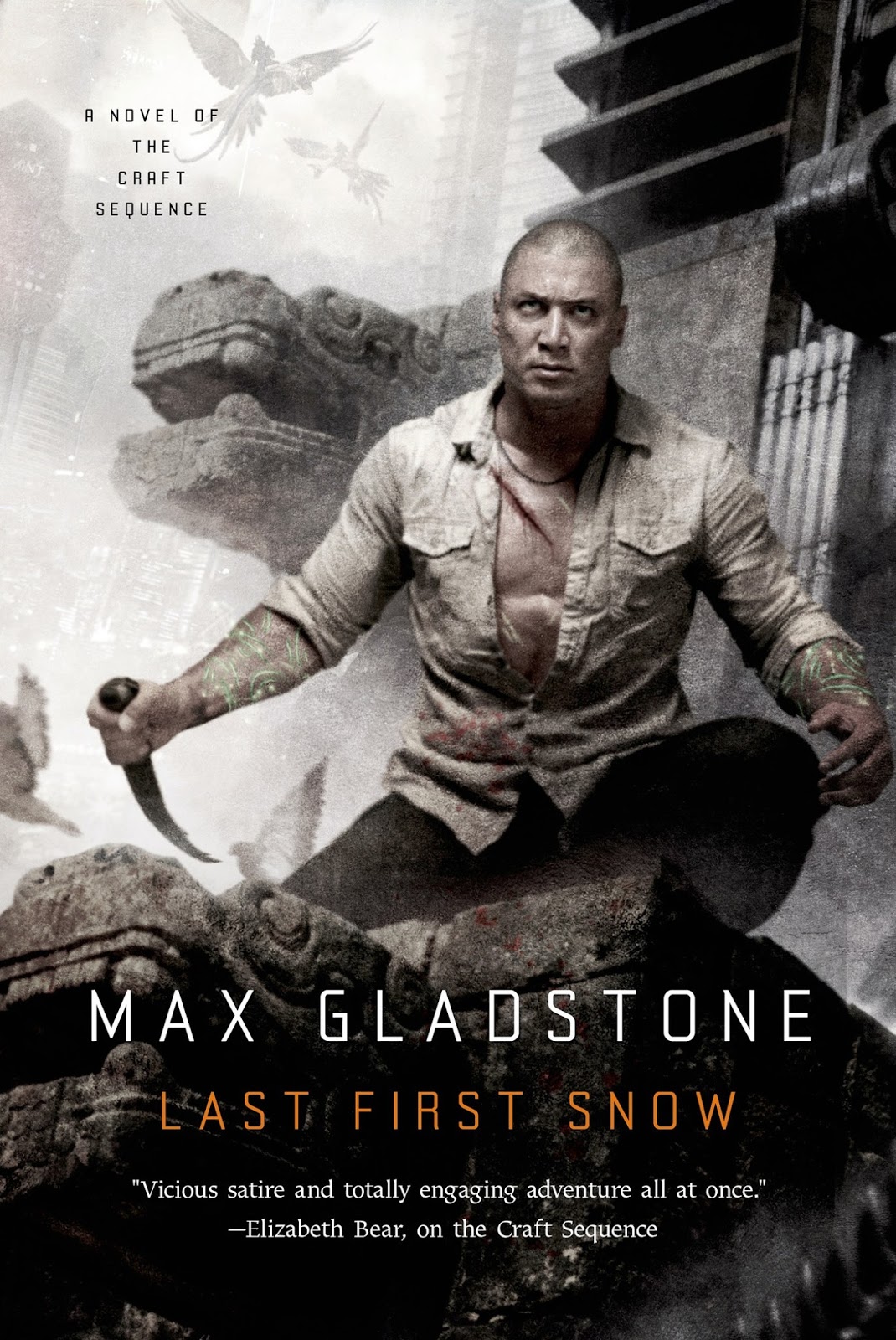
So when I sat down to write a story about a protest—a story about people rising up against a powerful, vicious system, ordinary men and women against god-shattering magic, I tried to start not from cynicism, but from hope. The central characters of my book Last First Snow stand against enormous odds—because they're fighting for something they believe in. They want to protect their homes against magical gentrification, against a system that's come to break them. In fact, both sides of the movement are full of people who care. Protesters care about their homes and families and livelihoods; Temoc, their leader (sort of) cares about his gods and his family; the King in Red, revolutionary lich-turned-utility magnate, cares about protecting his city, and keeping it free of the gods who almost destroyed him; Elayne Kevarian, tasked to negotiate a settlement, cares about peace and her friends and the future. They all strive. They all reach out. And because of that, they're all vulnerable.
That’s real danger, real darkness, I think: once you care, once you fight, you can lose. The odds are against you, the climb’s uphill, it’s dark, and you’re wearing sunglasses.
Sounds a bit like heroism, doesn't it?
That’s real danger, real darkness, I think: once you care, once you fight, you can lose. The odds are against you, the climb’s uphill, it’s dark, and you’re wearing sunglasses.
Sounds a bit like heroism, doesn't it?
*---------------*---------------*---------------*

Official Author Website
Order Last First Snow HERE
Read Fantasy Book Critic's review of Three Parts Dead
Read Fantasy Book Critic's review of Two Serpents Rise
Read Fantasy Book Critic's review of Full Fathom Five
Read The Mahabharata: A Recollection and Q&A with Max Gladstone
Read "Gods, Monsters, Magic & Metaphor" by Max Gladstone (guest post)
Read Max Gladstone's review of Adi Parva by Amruta Patil
AUTHOR INFORMATION: Max Gladstone has taught in southern Anhui, wrecked a bicycle in Angkor Wat, and been thrown from a horse in Mongolia. Max graduated from Yale University, where he studied Chinese and was nominated for the John W Campbell Best New Writer Award. He is the author of The Craft Sequence which consists of Three Parts Dead, Two Serpents Rise, Full Fathom Five, and Last First Snow.

Interior Illustration #: Parasaurolophus!
Parasaurolophus walkeri, having a bad day. Hadrosaurs – duckbill dinosaurs – such as this one and the round-crested Corythosaurus casuarius, are by far the most common war-mounts for the élite of Nuevaropa’s warrior-nobility, the Dinosaur Knights. At over thirty feet and almost three tons, they are themselves the riders’ most powerful weapons.
Their thick hides offer substantial protection. Judging from how deep some arrows are driven in this unfortunate specimen, they must have been shot at close enough range to do some real harm. Their common name is Sackbut, after the trombone-like instrument. Which the nasal passages running through its distinctive long crest cause it to sound like.
Raising war-hadrosaurs for Nuevaropa’s nobles is big business. Domestic ones are easily bred for hue, often in the purchaser’s family colors. But not all the blue-blooded buyers have good taste, so along with the fact that it’s gorgeous—like all artist Richard Anderson’s illustrations for THE DINOSAUR LORDS—we might have another reason to be grateful the image is in black and white.

*---------------*---------------*---------------*
GUEST AUTHOR INFORMATION: Victor Milán is best known for his award-winning novel Cybernetic Samurai. In previous worlds he’s been a cowboy and Albuquerque’s most popular all-night prog-rock DJ. He’s never outgrown his childhood love of dinosaurs…and hopes you didn’t either.The Dinosaur Lords is the start of a sprawling epic fantasy series. He can be found over at his website.

Pre-order The Dinosaur Lords HERE
ABOUT THE DINOSAUR LORDS: Intrigue, beauty, brutality, and dinosaurs – welcome to Paradise.
A world made by the Eight Creators on which to play out their games of passion and power, Paradise is a sprawling, diverse, often cruel place. Men and women live on Paradise but dinosaurs predominate: wildlife, monsters, beasts of burden – and of war. Colossal plant-eaters like Brachiosaurus; terrifying meat-eaters like Allosaurus and the most feared of all, Tyrannosaurus rex rule the land. Armored knights ride dinosaurs to battle legions of war-trained Triceratops and their upstart peasant crews. Seeking to centralize real power in his figurehead Fangèd Throne, Emperor Felipe of Nuevaropa sets off a chain of wars that may blaze up to consume the continent called the Tyrant’s Head. But is Imperial ambition the only spark, or are more sinister forces at work?
And so we have as our players in the tale: Fallen hero Karyl Bogomirsky, who wants to escape from constant headaches and nightmares and gets lured into the quixotic task of raising an army from a province of pacifists. Part-time Dinosaur Master and minstrel, and full-time rogue Rob Korrigan, who wants to get paid and laid—but he follows the man he’s written and sung about into what looks like certain disaster. Princess Melodia, who is eager to escape the shadow of her indulgent but neglectful father the Emperor but is faced by consequences she never anticipated. And Imperial Champion Jaume, Count of the Flowers, the Empire’s most celebrated swordsman and poet, who wants to serve Beauty and the right. But what can he do when faced with two equally wrong and ugly choices?
Lush, exotic and utterly chaotic, Victor Milan’s splendidly weird world of The Dinosaur Lords is a fantastical creation, a mirror image of 14th century Europe with its dynastic rivalries, religious wars, and byzantine politics…and the weapons of choice are dinosaurs.

Official Author Website
Order the book HERE
Read Fantasy Book Critic's review of The Intern's Handbook
Read Qwill’s interview with Shane Kuhn
AUTHOR INFORMATION: Shane Kuhn is a writer and filmmaker with twenty years of experience working in the entertainment business and the ad world. A shameless product pusher in the ad world, he has worked as a copywriter, creative director, and broadcast video director and producer for several notable brands and charitable organizations. As a college baseball player, he threw a fastball in the low 90s but his career was cut short by a Bull Durham strike zone. He currently lives with his wife and family in a bi-coastal/mountain migration pattern that includes Massachusetts, Colorado, Los Angeles, and San Francisco.
OFFICIAL BOOK BLURB: Professional assassin John Lago faces off against his deadliest adversary yet—his wife—in Hostile Takeover, the exciting sequel to Shane Kuhn’s bestselling debut The Intern’s Handbook, which the New York Post called “a sexy, darkly comic thriller.”
At the end of The Intern’s Handbook, John tracks down his nemesis Alice but instead of putting a bullet in her head, he puts a ring on her finger and marries her. Together, they execute a hostile takeover of Human Resources, Inc., the “placement agency” that trains young assassins to infiltrate corporations disguised as interns and knock off high profile targets. As HR’s former top operatives, they are successful until conflicting management styles cause an ugly breakup that locks John out of the bedroom and the boardroom.
But when Alice takes on a new HR target, John is forced to return to the office battlefield in a role he swore he would never play again: the intern. What starts out as a deadly showdown turns into the two of them fighting side by side to save HR, Inc.—and their marriage.
“Those who like Dexter will love John Lago” (Booklist), and in Shane Kuhn’s sequel to The Intern’s Handbook, readers will be rooting for this smart, witty antihero to come out on top
CLASSIFICATION: Lisa Lutz aptly described it as “The Intern's Handbook is Dexter meets Office Space—the blackest and goriest office comedy you could imagine, with an intern-slash-assassin in the starring role.”
FORMAT/INFO: Hostile Takeover is 256 pages long divided over fifty-five numbered chapters along with a prologue and epilogue. Narration is in the first person solely via John Lago. This is book two of the John Lago series.
July 14, 2015 marked the hardback and e-book publication of Hostile Takeover via Simon and Schuster. It was also published as Shoot The Messenger on July 14, 2015 in the UK by an imprint of Little Brown.

OVERVIEW/ANALYSIS: I was thoroughly enamored by The Intern’s Handbook as it combined action, intricate plot twists and showed a super slice of dark humor that befit a story of a hitman for hire. We got to learn about John Lago and his initiation into HR, Inc. The story involved one last job before John retires however the story with all its twists and action-packed climax wowed me completely. The story ended on a couple of massive twists and the ending basically begs the reader to grab the sequel.
Hostile Takeover begins with John Lago surprisingly in a holding cell in Quantico, Virginia in the present day. The story then goes back to three years to that night wherein The Intern’s Handbook ended so precariously. We get to see what happens next and going with the tone of the preceding novel, it seems completely appropriate. We find that Alice and John have decided to get hitched and take over HR, Inc. They do manage to take over after getting rid of the new “Bob” and find themselves with a gaggle of “Interns” who are awed by John.
They (the interns) having read John’s work, look up to him and soon John & Alice have things going top-notch. The only issue, there might be a mole and John still doesn’t know who truly controls HR. It will be up to both these psychopaths to add their mental muscle along with their killing finesse to figure out the answers. The only problem, can they survive each other’s love? I enjoyed this sequel as I was expecting more of the kickass humor along with dark, action-packed plot. The story does seem to build on the story that was introduced and this time around, the thrill is finding out what exactly happened for John to land up in the FBI’s clutches. The story from its start has a streamlined structure that makes the reader zip through the story. Plus the action and intrigue are present and doubled due to certain happenings in the story.
However this sequel certainly doesn’t quite hold up to the excellence that was The Intern’s Handbook. One thing that went against it is the dark humour and the snappy quotes that were such a core part of The Intern’s Handbook. This book while being a fun sequel plays a little differently and is more like a straight thriller. The plot twists in this one while being zany aren’t entirely unpredictable. The middle part of the story went through a predictable route with regards to Alice and John and again in the ending. The twist that the plot hinges upon isn’t entirely believable and hence that dulled the read for me.
CONCLUSION: Hostile Takeover is a fun sequel that tries to build up on the predecessor and while it had its good moments, for me it was a good book that didn’t quite match the high of The Intern’s Handbook. You’ll enjoy it if you go in with an open mind and don’t expect too much.

Official Author Website
Order Winter's Reach HERE
AUTHOR INFORMATION: Craig Schaefer was born in Chicago and wanted to be a writer since a very young age. His writing was inspired by Elmore Leonard, Richard Stark, Clive Barker & H. P. Lovecraft. After reaching his 40th birthday he decided to give in to his passion and since then has released six novels in about fourteen months. He currently lives in Joielt, Illinois and loves visiting museums and libraries for inspiration.
OFFICIAL BOOK BLURB: Pope Benignus is dying, and the man who takes his throne will hold the reins of an empire. Conspiracies swirl like shadows around Livia, the pope's daughter, who refuses to be anyone's pawn: chasing the whispers of a deadly coup, she vows to expose the truth and save her church from disaster. Livia has secrets of her own, though, and one wrong move could cost her life and her soul.
Felix is the scion of a dying merchant house, a man with just one chance to save his family and the woman he loves. His last hope lies in the snowbound hell of Winter's Reach, a former prison colony turned "free city" under a brutal tyrant's reign.
Livia and Felix have never crossed paths, but they've both been snared in a far greater web than they can imagine. They -- along with a pair of veteran bounty hunters, an exiled politician, and a sadistic coven of witches -- are cogs in one man's apocalyptic plan for revenge. A plan which, if it succeeds, will leave an entire nation in flames.
FORMAT/INFO: Winter’s Reach is 367 pages long divided over fifty-six chapters. Narration is in the third-person, via Felix Rossini, Werner Holst, Lodovico Marchetti, Amadeo Lagorio, Simon Koertig, Livia Benignus, Basilio Grimaldi, Mari Renault, Hedy, Renata, Bear, Dante Uccello and a couple of other minor characters. This is the first volume of The Revanche Cycle.
November 11, 2014 marked the North American paperback and e-book publication of Winter’s Reach and it was self-published by the author. Cover art and design is by James T. Egan of Bookfly Design.
CLASSIFICATION: Featuring a vast character cast, and focusing on political, religious and magical intrigue. The Revanche Cycle is very reminiscent of the works of Jennifer Fallon, Tad Williams and Daniel Abraham.
ANALYSIS: This is the first volume of the Revanche cycle and is set in a world that's very reminiscent of medieval Italy. The story features a multitude of POVs and is an epic fantasy that slowly introduces the world and magic system. One of the first POV characters we come across is Felix Rossini who is the second scion of a house in financial tatters. Felix has plans to rescue his house's worth and fortunes however he has to be taciturn as he has a secret worth protecting. The next POVs are Werner Holst and Mari Renault, a pair of mercenaries who are horrified by their last job, which resulted in the burning of an (alleged) teenage witch.
Lodovico Marchetti is a merchant lord who is planning quite a few things in the city of Mirenze and has things in motion that will unsettle things across the lands. Simon Koertig is his accountant who also doubles up as an assassin who likes to kill in numerous ways. Amadeo Lagorio is a priest who serves as confidant and confessor to the dying Pope Benignus. Lastly there's Livia who is the first born papal child who is forced to abandon her leadership credentials simply because of the patriarchal society.
These are the major POV characters and there are a few more introduced but basically the plot hinges around the actions of the afore-mentioned characters as well as the plot twists that have been set by the author. The primary draw of the story is the strong characterization, beginning with both male and female characters, as well as the antagonists and protagonists. The author absolutely nails down these characters and as each chapter focuses upon a new one we get a very multi-faceted view of the world within. This approach was very reminiscent of George R.R. Martin’s ASOIAF, while Craig Schaefer cannot claim the same high level prose, he does emulate GRRM’s ability to make the reader invested in the POV of the character they are currently reading.
My favorite characters were Mari, Livia, Felix and Simon. Mari is a person suffering from a severe form of PTSD due to her family dying in a horrible manner. Livia bristles against the patriarchal traps set by the society and is forced to watch her father's crown pass own to her drunken sot of a brother. Felix is an honest person forced to take gargantuan risks to save his family, marry the love of his life and possibly make the Rossinni clan a successful one again. Lastly there's also Simon who while being a murderer is very intriguing with his narrow-minded focus and multi-variate ways to kill people. These characters and others truly make the story that much more shining. I thoroughly enjoyed this aspect of the story wherein we truly get a 360-degree view into the happenings of the story.
The next positive factor is the top-notch plot pace as frequently we end a chapter and the next chapter easily shifts the focus on to a new person thereby amping up the tension as well as intrigue. The overall plot while seemingly predictable has plenty of plot twists to keep readers guessing and ultimately take quite an unorthodox route to the climax. I enjoyed how the author explored the various roles especially vis-a-vis the female characters stuck in a patriarchal society. Both Livia and Mari are quite fierce, capable characters who strive to make the best of their sordid situations. I believe the author has special plans for both of them and I'm very excited to see what arcs they end up taking.
While expecting a medieval epic fantasy, the author certainly undercuts expectations by providing a very fast-paced character driven story that while being fantasy has magic in very small amounts (This was very GRRM-esque). Of course there are hints provided about the true nature of the world, also there's a fantastic sequence over water that features a creature that is sure to provide terrify readers. Also there's a certain sound associated with the creature and I can't wait to read how the author imagines it to be.
The storyline is also not without its flaws, the background history of the world isn’t really explored and only hints are strewn through. The magic system also seems to be a tad confusing and I hope the author shines a light on it in the sequel volumes. Lastly as with any fantasy series, a map is always a plus. This series doesn't have one and as a cartophile, I was disappointed.
CONCLUSION: Overall this story ends on a strong note and leaves almost all characters in certain places because of which readers will be compelled to pick up the second volume The Instruments Of Control. I believe this is book one on a series of four books and I started reading the second book almost immediately after I finished this one. Winter' Reach is the start of a fascinating political fantasy that will be sure to find its fans. Make sure you graba copy and enjoy Craig Schaefer's magnificent skills.
Thursday, July 16, 2015
GUEST POST: Free to Choose: the Women of The Ascendant Kingdoms by Gail Z. Martin

Fantasy Book Critic welcomes Gail Z. Martin. Gail is here to
talk about her latest book in the Ascendant Kingdom Saga, War of Shadows. War
of Shadows was published April 21, 2015 and is the third book in the series.
In addition to this guest post, we are also hosting a giveaway of the Ascendant Kingdom. Giveaway details can be found here!
In addition to this guest post, we are also hosting a giveaway of the Ascendant Kingdom. Giveaway details can be found here!
*****************************************************************
Free to
Choose: the Women of The Ascendant Kingdoms
by Gail
Z. Martin
Nothing
like a cataclysm to strip away social constraints, loosen the bonds of custom
and habit, and strip away artificial restrictions of class and privilege. In my
Ascendant Kingdoms Saga, those who survive the Great Fire and the Cataclysm
that destroys the kingdom of Donderath face great hardship, but they also have
the ability to remake the world as they see fit. And for the women in my book,
that presents a lot of new possibilities.
In the
Velant prison and the colony of freed convicts on Edgeland, class, title,
privilege and wealth were stripped away long before the Great Fire by virtue of
exile. So while the prisoners and colonists are on equal footing now, in
reality the population cuts across social class. For those who survive the
harsh prison to become colonists, value is placed on how a person can
contribute to the survival of the group, and that survival is tenuous enough to
sweep aside gender and class distinctions that might have applied. If it needs
to be done in order for an individual or the colony to survive, someone has to
do it and it makes the most sense for the people best at the particular task to
undertake it. It's a harsh meritocracy, but there's thin margin for error and
no leeway for people to be less than fully productive, so no talent or ability
can be wasted.
At the
same time, prisoners and colonists do their best to retain the parts of their
culture and religious beliefs that help them survive tough times, give meaning
to life, and mark the passage of momentous life occasions like birth, death and
marriage. The Wise Women are the keepers of this cultural power. As the older
women of the colony, they have survived much, and it is their memories and knowledge
which transmit vital information. They are the midwives for birth and the ones
who prepare the dead for burial. They mediate and intercede in disputes, since
the small colony relies on the skills of all its members and cannot survive
factions and splinter groups. This gives the Wise Women important social power
even though before exile, they might have come from the lowest classes of
society and lacked formal education.
And
likewise, women whose upper class position or poverty might have kept them from
pursuing a craft or business are freed by necessity to contribute to the
colony's survival where their gifts best lie. They become shopkeepers,
craftspeople, madams, farmers and healers, raise livestock, go out on the
fishing boats and work alongside the men to do whatever needs to be done. Women
whose choices were severely constrained either by their past choices or social
class are free to do what they do best. Edgeland's harsh reality imposes its
own stark equality.
Back in
Donderath, the devastation of the Great Fire and the Cataclysm works a similar
leveling, sweeping away the social and cultural traditions that restricted what
women of a particular class were permitted to do, and valuing hard work and
competence. So many of the men died in the war or were conscripted by the
warlords' armies that women had no choice except to rally together to save
their families and villages. They, too, become farmers and fisherfolk, leaders
and brewers, soldiers, spies and fighters. We meet a lot of these women throughout
the series, and their quiet strength and capability is the force that helps to
knit the shattered kingdom back together, just as important to the recovery as
the battles and fortifications.
When
Blaine McFadden, my main character, is exiled to Velant for murder, his crime
affects the social standing of his family and his betrothed, Carensa. They are
shamed, no longer welcome at court, and for both Carensa and Blaine's younger
sister Mari, marriage prospects dim because of the scandal that has tainted
them. That all changes the night of the Great Fire, when the king and nobles
are killed in the Cataclysm that destroys not only the court, but much of the
kingdoms' infrastructure. Limiting social conventions have no place or meaning
in this harsh reality.
Carensa
marries and is widowed, then finds new purpose as a scholar and a magic-user.
Mari and Blaine's Aunt Judith are also freed from social stigma and step up to
leadership roles in order to save the people who rely on them. Kestel Falke,
sent to Velant as a spy and assassin is also free to leave her courtesan past
behind her and play a key role in bringing the kingdom out of ruin as a leader
and a warrior. Zaryae is a seer, an outlander, and a vagabond. Alsibeth is also
a gifted clairvoyant. Before the Great Fire, they told fortunes in taverns to
earn enough money to eat. After the Cataclysm, their abilities elevate them to
the forefront of the war effort, where they play key roles with strategy and
crucial decision-making. In addition to their increased status, all of these
women are now freed to make their own choices about love, choices that would
have been unacceptable before the Great Fire.
Even in
the ruined royal city of Castle Reach, the women who survived the Cataclysm
step into new positions of leadership by virtue of necessity. They become
street fighters, protecting their home territory against rival gangs and
raiders. Some of the women gather the orphans and care for the sick. They
augment scarce food supplies by turning unused land into gardens and put their
knowledge of folk remedies to use as healers. Others go to sea with the fishing
boats, help to rebuild the buildings damaged in the Great Fire, or scavenge the
ruins for objects that can be used or repurposed. Now, it is their ingenuity
that matters, not their former position or wealth. Dire circumstances require
that the best use is made of all resources, including individual skills and
knowledge.
Throughout
history, when times are rough people do what they need to do to get by, and
that often includes setting aside social constraints to make the most of
individual talent. This was true long before World War II-era housewives traded
aprons for coveralls to follow 'Rosie the Riveter' into factories. Only after
the frontier has been tamed, the war is over or the emergency is resolved do
people reclaim traditional roles, and even then they often find that those
roles are significantly and permanently altered.
The Hawthorn Moon Sneak
Peek Event includes book giveaways, free excerpts and readings, all-new guest blog posts and author Q&A on 28
awesome partner sites around the globe.
For a full list of where to go to get the goodies, visit www.AscendantKingdoms.com.
***********************************************************************

Gail Z. Martin writes epic fantasy, urban fantasy and steampunk for Solaris
Books and Orbit Books. In addition to Iron and Blood, she is the author of
Deadly Curiosities and the upcoming Vendetta in her urban fantasy series; The
Chronicles of The Necromancer series (The Summoner, The Blood King, Dark Haven,
Dark Lady’s Chosen) from Solaris Books and The Fallen Kings Cycle (The Sworn,
The Dread) as well as Ice Forged, Reign of Ash, and War of Shadows in The
Ascendant Kingdoms Saga from Orbit Books. Gail writes two series of ebook short
stories: The Jonmarc Vahanian Adventures and the Deadly Curiosities Adventures
and her work has appeared in over 20 US/UK anthologies.
Find her at
www.AscendantKingdoms.com, on Twitter @GailZMartin, on
Facebook.com/WinterKingdoms, at DisquietingVisions.com blog and
GhostInTheMachinePodcast.com, on Goodreads https://www.goodreads.com/GailZMartin
free excerpts, Wattpad http://wattpad.com/GailZMartin.
Subscribe to:
Posts (Atom)


