Showing posts with label science fantasy. Show all posts
Showing posts with label science fantasy. Show all posts

ABOUT THE AUTHOR: Samantha Mills is a Hugo, Locus, Sturgeon, and Nebula Award-winning author who has published a dozen short stories since 2018. Her fiction has appeared in Uncanny Magazine, Beneath Ceaseless Skies, Strange Horizons, Escape Pod, and others. Mills has been nominated for the Pushcart Prize, as well as the Hugo and Astounding Awards. She has a Master's Degree in Information and Library Science, and she is a trained archivist focusing on helping local historical societies and research libraries. Mills lives in Southern California. The Wings Upon Her Back is her debut novel.
Publisher: Tachyon (Apr 23) Length: 336 pages Formats: Genre: Science Fantasy, Alternate History
 3:00 AM |
  Posted by
Łukasz |
Posted by
Łukasz |

 Labels:

Book Review: Grievar's Blood by Alexander Darwin

Buy Grievar's Blood HERE
Read Shazzie's review of The Combat Codes HERE
Read Caitlin's review of The Combat Codes HERE
OFFICIAL AUTHOR BIO: Alexander Darwin is an author living near Boston with his wife and three daughters. Outside of writing, he teaches and trains martial arts (Brazilian Jiu Jitsu). He’s inspired by old-school Hong Kong action flicks, jRPGs, underdog stories and bibimbap bowls.
Outside of writing fiction, Alexander has written for publications such as Rolling Stone Magazine and SF Signal. His latest piece - "The Lost Diary of Anthony Bourdain" - was a featured piece in Rolling Stone’s January 2022 issue.
Interview with Kritika H. Rao, author of The Surviving Sky
Order The Surviving Sky HERE
Read Fantasy Book Critic's review of the book here
INTERVIEW
Welcome to Fantasy Book Critic! Thank you so much for taking the time to chat with us, could you please tell us a little bit about yourself?
Thank you so much for having me! I love FBC and it's great to be here. I am Kritika H. Rao, and I am a science-fiction and fantasy author, a mom of a beautiful, naughty toddler boy, an immigrant, and a general weirdo trying to make sense of life and adulting.
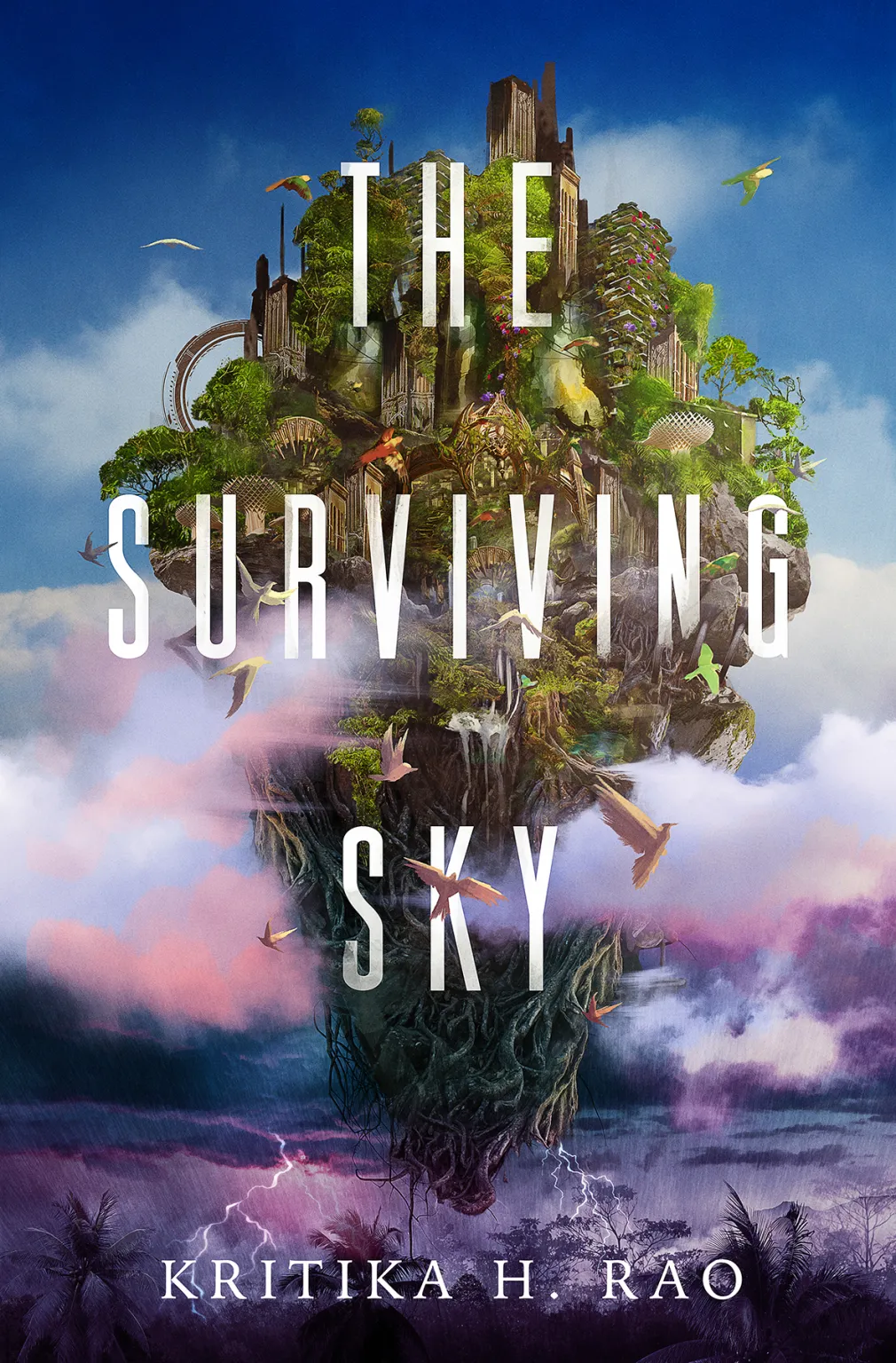
Could you describe your book, THE SURVIVING SKY, in three words, and then in three sentences?
Competent people chaos.
Survival of the human species depends on one unhinged married couple; There are large creatures and jungle storms; This is a genre-weird but logically sound world.
I find it every hard to explain how, as a desi (Indian subcontinental) reader, I feel quite seen in the characters in THE SURVIVING SKY. You've said this yourself, that representation matters. The desi readers have found lots to love, and the others have received the book very well too. How has it been, since the big release?
This might be the nicest compliment an author can get. Why else to we write if not to see pieces of ourselves and the world in stories, and to have a shared common experience with readers--even though each interpretation is uniquely its own! It's been frankly amazing since the release - a few months have gone by and readership is still going strong. I've heard from fans who have admitted the same thing you just have - that the book has helped them see themselves (even when the readers haven't been desi), and find their creativity, and helped them through their own questions about identity. That is incredibly rewarding as an author to hear. I'm overwhelmed and humbled by it.
You do not act as a tour guide for global readers. You unabashedly use concepts and terms from Hindu philosophy without feeling the need to write them in a Eurocentric manner, but at the same time, I think your book is extremely readable for everybody. How did you work towards this?
Mostly by writing the book for me and myself alone. I exist in this world as someone who has an understanding of Hindu philosophy, having studied it and lived within it. But any understanding is only one understanding, and that I think is the beauty of the philosophy - in its truest form, it is fluid and encompassing (no matter what fascists today are trying to reduce it to, which let's not get into that in this space). I also exist in this world as someone who has consumed and loved a lot of Eurocentric media, so there are certainly reflections of that in the book as well, whether they are genre conventions or tropes or whatever. I don't think I actively thought about how to blend the two. I told the story to myself for me, and I'm lucky enough that others liked it/ and that publishers picked it up for worldwide distribution. It's the dream.
The ashram setting in the book is everything. It is a civilisation with a collective mindset, and one that glorifies those with certain abilities, and has rigid social strata. Where did you draw the inspiration for these structures?
Ashrams historically, in Indian mythos, were places of knowledge and meditation, where sages would go to be removed from the world and meditate--but they functioned as mini societies too, with students and councils and (in myth) often a husband-wife couple who were at the head of the ashram, leading and guiding disciples. The aim of the ashram was singular - to work with a collective mindset, being a part of society and being removed from it too. I imagined that in a dystopian futuristic science-fiction world, and Nakshar was born of that-- a part of the planet and jungle, but removed from it by floating above it too. Architects became, in a sense, like the main students of an ashram -- powerful but also removed. The way I interpreted all of it really was very much from a space of "here's a good idea gone wrong" and a lot of complications of the world arose from that.
Your magic system is based on an organic ecosystem, and stresses on the importance of ecological balance. Was this an intentional choice, and how did you arrive at it?
I cannot overemphasize how the ecological themes within the story were completely organic to the storytelling. It's interesting to me how that happened, because I think in so many ways nature does that to us all the time. It creeps in on us in our lives, it is omnipresent, we think we are walking away from it--shutting the outdoors--when we close our windows and doors and go to sleep, or work in our little offices; but that's a ridiculous way of thinking, isn't it? We are embedded in nature, it surrounds us. Any separation from it is such an illusion. In so many ways, nature crept into the storytelling too, and it formed its own balance - violently - just as it is doing with us in real life now. Whether the characters will survive it is another question, but nature and ecology are doing what they always do... participating.
The end of the book teases us with a promise of a wide expansive world. I assume that a lot of attention will be paid to the natural world, but that the ashram setting will be important too. Could you tell us what we can expect?
I think there will be a lot of surprises, for the characters and by extension, for the readers. You're right - the ashram setting will be important, as will the natural world - but it won't be in the way you expect. One thing I've tried to do with the series is ensure there are so many layers to it, and new knowledge that comes to the surface with every changing notions of society, of the characters themselves, of the world and what they know of it. A lot of that will happen in Book 2.
As someone who grew up in India, the way family relationships and expectations are integral to the functioning of the ashram resonated with me. The protagonists have a rocky marriage with one partner being given all the privileges available to individuals in the society, and the other is quite solely defined by their connection to their spouse, and are expected to aid them contribute to society in a prescribed manner. Even the cultural pressure to have children is depicted at some point in the book. Would you like to tell our readers more about this?
Hmm, again, those are things that kind of crept in the storytelling. I knew that Ahilya and Iravan must personify very different states of being, and belief systems, while also being complementary to each other. Otherwise, how else would their marriage have worked at all? The exciting thing for me with A&I is the ability to look at one thing, and then see through their lens totally different interpretations to it---so much so that it seems you're looking at entirely different things. Marriage, their differing privilege, their roles in the ashram -- all of that really came from putting them on opposite ends of the spectrum and seeing how those ends really look more like a continuum of a circle, when you zoom out a bit. LOL I'm sorry if that doesn't make much sense.
Most desi storytellers derive inspiration from our biggest epic, the Mahabharatha. Your book does not reference it as much, but has strong undertones of our collective mythos. What are your favourite stories from the Indian storytelling culture, and which of those do you most often visit?
Honestly, anything to do with Shiva gives me comfort. If you look to see, his mythos along with that of Shakti is embedded all through The Rages Trilogy.
Along the same vein, what characters in Indian epics seem most underrated to you?
I'm going to answer this question slightly differently and say, that there are tons of women, trans, LGBTQ characters in Indian myths that don't get enough screentime. I'd be here all day trying to list them, because it's always the big gods and myths that get their share, when there is so much rich story out there. On that note, stay tuned for an announcement in the near future - I'm doing my small part to highlight more women stories myself in Indian mythology.
We are having a massive year with respect to desi inspired stories. What other books would you recommend to readers hungry for more?
I haven't read these yet myself, but Sons of Darkness by Gourav Mohanty, The Pheonix King by Aparna Verma, are both desi stories which I've heard great things about. I've read R. R. Virdi's The First Binding, which is gorgeous and lyrical and talks about the shape of stories itself. Then there is Tasha Suri too, whose Burning Thrones Trilogy series ender I am super excited about.
Before we wrap this up, let's talk about you as a reader. What books are you drawn to, and what genres do you read the most?
Mostly SFF, honestly, and lots of picture books, thanks to my son. The books that truly do it for me though are ones that delve deep into ideas - if there is an intriguing question at the heart of a book, about us as human beings or the nature of the world, or bigger things like consciousness and the universe - that's totally my kind of jam.
In closing, do you have any parting thoughts for our readers?
Yeah, this is going to sound controversial, but I've always wanted to kind of say it - no book will be the perfect book for you. I mean, I get it, the thought behind needing books to come to us exactly in the way we expect them to, but books change their shape in the act of reading, I think they change us as readers when we're reading too. I think sometimes we forget... that it's okay to be surprised, and intrigued, and yes, even be confused by a book. It's okay to not understand it fully - and personally, I don't know that it takes away my enjoyment of that thing. I don't need to look up at the night sky and understand every bit of it to delight in it. It serves me well as a reader to bring that attitude to books I'm reading too.

Monday, August 19, 2013
"Obsidian Mirror: Chronoptika #1" by Catherine Fisher (Reviewed by Cindy Hannikman)

Visit Catherine Fisher's Official Website Here
Read FBC's Review of Incarceron Here
Read FBC's Review of Sapphique Here
OVERVIEW: Jake's father disappears while working on
mysterious experiments with the obsessive, reclusive Oberon Venn. Jake is
convinced Venn has murdered him. But the truth he finds at the snow-bound
Wintercombe Abbey is far stranger ... The experiments concerned a black mirror,
which is a portal to both the past and the future. Venn is not alone in wanting
to use its powers. Strangers begin gathering in and around Venn's estate: Sarah
- a runaway, who appears out of nowhere and is clearly not what she says,
Maskelyne - who claims the mirror was stolen from him in some past century.
There are others, a product of the mirror's power to twist time. And a tribe of
elemental beings surround this isolated estate, fey, cold, untrustworthy, and
filled with hate for humans. But of them all, Jake is hell-bent on using the
mirror to get to the truth. Whatever the cost, he must learn what really
happened to his father.
FORMAT: Obsidian Mirror is the first novel in a proposed YA
trilogy. It does not really fit into any one category. It has a combination of
sci-fi, fey characters, mystery, adventure, and historical feel. There is also
reference to people traveling from the future and special magical powers. It
stands at 384 pages and was published in the US on April 23, 2013 by Dial.
ANALYSIS: Every so often a fantasy/sci-fi book comes along
that just sweeps you off your feet and you honestly don't know why. Obsidian
Mirror is one of those books, at least for me, for the year. And it should come
as no surprise considering who the author of this book is – Catherine Fisher.
Catherine Fisher has made a name for herself throughout the
fantasy/sci-fi community for creating detailed, highly original novels and
Obsidian Mirror is no exception.
Obsidian Mirror has a little bit of everything. There are
the fey creatures, wonderful historic London, time traveling, love, greed,
mystery, action, and adventure. Think of it almost as a combination of a time
traveling novel/sci-fi/fantasy novel, but its set in the modern world.
I was unsure how I liked this combination of genres and
elements. I was undecided at first, but by the end of the novel I was loving
it. It really just came together and worked. I think for some authors this
combination of elements and genres could have been disastrous and appeared
forced, but Fisher has made it work and turned out an amazing novel which will
hopefully be the start of a great YA series.
Readers just venturing into Obsidian Mirror might get
slightly confused at first. In classic Fisher style there is a lot going on,
but readers are not given any real backstory or explanation of what is going on.
Readers are forced to go with the flow and learn as they read. Everything is
nicely put together and explained eventually, but it can be a tiny bit
confusing at first.
Very similar to other novels that Fisher has penned, the
characters in Obsidian Mirror are a bit of a mystery to readers. They are
extremely detailed and react honestly to situations with intense emotions, but
they this mysterious vibe to them. Readers throughout the novel will slowly
start to get to know the characters, what makes them tick, what their motives
are, and what role they may or may not play in this entire novel.
The mysterious element, just like the slow unraveling of the
plot/back story, can be slightly frustrating, but Fisher works her magic and
really pulls it all together. The pacing of the novel, eloquent writing style,
and unique feel of the novel really makes this novel stand out from the rest.
This novel is a part of a trilogy and does end with a
cliffhanger. The main plot elements are temporarily resolved, but there are
dozens of unresolved plot elements that leaves readers wanting and craving
more. Unfortunately, they have to wait for the next installment.
Overall, Obsidian Mirror is another wonderful addition to
the YA sci-fi/fantasy world. It is definitely a top novel for 2013 and I have
high hopes for the series. I hope Fisher has learned from the Incarceron
series, where it started out with a bang and fizzled out to a disappointing
end.
If you are looking for something new, unique and fun, yet
not too overly complicated, a fan of Fisher's previous workers, or like
adventure, sci-fi, and time travel, this is definitely a novel for you to try.
The pacing is quick, the characters detailed, and the plot is one is not filled
with the same old, same old.

Order "The Sacrifice Game" HERE
Read FBC Review of “In the Courts of the Sun”
INTRODUCTION: In 2009, Brian D'Amato published the superb In the Courts of the Sun first in an announced trilogy called The Sacrifice Game. The novel was a combination of near-future extrapolations, time travel and a wonderful recreation of the Maya world of the 7th century, all narrated by unlikely hero Jed de Landa, or more precisely by Jed 1 and Jed 2 as the novel uses a form of time travel which leads to an instance of the consciousness of Jed to be time shifted to the brain of Chacal, a star Maya ball player of the Harpy clan of Ix.
Read FBC Review of “In the Courts of the Sun”
INTRODUCTION: In 2009, Brian D'Amato published the superb In the Courts of the Sun first in an announced trilogy called The Sacrifice Game. The novel was a combination of near-future extrapolations, time travel and a wonderful recreation of the Maya world of the 7th century, all narrated by unlikely hero Jed de Landa, or more precisely by Jed 1 and Jed 2 as the novel uses a form of time travel which leads to an instance of the consciousness of Jed to be time shifted to the brain of Chacal, a star Maya ball player of the Harpy clan of Ix.
Here is my description of Jed in the FBC review linked above:
"born in 1974 and displaced from his native Guatemalan village by military action, Jed is taken as a young age to the US and grows up in foster care in Utah, exhibiting physical frailty since he suffers from hemophilia so any wound or cut is potentially fatal, while showing great mental agility especially in fast numerical computations and ability to play games of skill and chance".
I was entranced by the novel and its fascinating narrator and I kept looking for the second book in 2010, 2011 and then sort of forgot about it. Imagine my surprise to recently discover that the 2nd Jed de Landa novel that bears the trilogy title, The Sacrifice Game will be published on July 5.
As the blurb of the novel includes a major spoiler for the ending of In the Courts of the Sun, I will not include it here just in case you have not read that but are intrigued by the above and want to pick it first, but I will note that The Sacrifice Game starts precisely where the earlier volume ends and the rest of the blurb is both true and misleading in the sense that there is no more "Jed", but Jed 1 and Jed 2 who diverged markedly - to say the least - in the first volume and some of the blurb refers to one, some to the other...
OVERVIEW/ANALYSIS: "Sometimes—at times like this, I’d say, especially—one might as well just go with the cliché: I was crushed. Yes, it’d be nice to come up with a more clever word than crushed, but really, why bother? Crushed pretty well does the job.
What surprised even me, though, was how much I wasn’t crushed just because I was a lazy slob and I’d thought I could relax. It was that I—even I—was rather annoyed, in fact more than annoyed, in fact, let’s say again, crushed—that the world was still doomed. And I even realized that I cared about it in the general sense, not just personally, that even if I died back here from my neuroblastomas or in a ball game or by the flint dagger or the wooden sword or whatever, even if I didn’t get back to the thirteenth b’aktun to see Marena and the gang and catch the next season of Game of Thrones, I still wanted the good old crazy ratty loathsome ridiculous old world to keep rolling on.
Okay. Look. We can do this, I thought...."
The Sacrifice Game is even badder, crazier and more explicit and brutal than In the Courts of the Sun - which was not tame by any stretch - as it is almost all narrated in the same unforgettable voice of Jed de Landa, though Jed 2, the 660's Maya one and to whom the stream of consciousness musings above belong, carries on for most of the book.
Structurally, The Sacrifice Game starts with Jed 1 in the modern world after his momentous decision at the end of the last book and deals with its implementation and a few consequences, but soon it moves to the Maya world where the book just explodes as it gets even better than In the Courts of the Sun with unbounded sense of wonder, meticulous research and all around inventiveness that matches anything I've read in sf set on an alien world; of course here we are still on Earth, but in a civilization where the author hits the sweet spot in the mixture of alien and familiar in describing it:
"A brace of bearers brought in the white-wrapped ball Hun Xoc had brought back from 31 Courts, holding the too-potent bundle with wooden hands, and tied it to the service cord. An umpire inspected the knot, signaled, and the ball was hoisted up, hanging above the central marker stone.
“Now, One, Two, Four, Five, Seven, Nine, Thirteen,” the Magister Ludi chanted, switching from the second-person plural imperative to the apostrophic tense you used only when speaking to gods,
“Now Twenty, Fifty-Two, Two Hundred Sixty,
O Night, O Wind, O Day, O Rain, O Zero,
Now, guests, inspect 2 Creeper’s blood-washed head.”
2 Creeper had been the greatest Ixian ballplayer in living memory, but he’d sacrificed himself thirty-nine solar years ago after an ankle injury. The Ball had been wound of white rubber around 2 Creeper’s skull as a hollow center—to increase the bounce—and then baked black and studded with painted thorns, like little nails. Finally the ball had been purified in two kinds of blood and then washed in original water boiled over the offering fires of both houses’ grandfathers-houses."
Lady Koh, ultimate Sacrifice Game player of the age and big time politician to boot, 2 Jeweled Skull, leader of the Harpy clan in Ix, second most powerful man there, adoptive father to Jed/Chacal, currently in the contest of his life with 9 Fanged Hummingbird, the Ocelot clan supremo of Ix, Hun Xoc, son of 2JS, lead ball player of the Harpies team and Jed's main adviser/friend, 1 Gila, right hand man of Lady Koh and war leader of her followers are back, while of course quite a few new Mayan characters appear. As excerpted above there
is one unforgettable game of hipball for the fate of Ix and by extension, our heroes and life as we know it, not to speak of many other
goodies which I do not want to spoil for you...
There are quite a few twists and turns and the author manages a rare feat as first person narration goes; while it would be a major spoiler to talk about it in detail, I am sure any attentive reader will observe it by the end of the novel.
The
last few chapters that take place back in the modern world have a thriller-ish feel to them - after all the book is set in 2012
close to 12-21-12 and the race to avoid the ultimate "doomster" is the
main storyline in the contemporary part of the novel.
The Sacrifice Game has another
surprising but fitting ending giving the book the feel of a complete experience which also leaves one quite in the dark about where the
series will go next as it's supposed to be a trilogy.
Subscribe to:
Posts (Atom)


