
Order “The Sharing Knife: Passage” HERE
Fantasy comes in all forms. Epic fantasy. Dark fantasy. Contemporary fantasy. Historical fantasy. Erotic fantasy. Then there’s The Sharing Knife series by award-winning author Lois McMaster Bujold (The Vorkosigan Saga, The Spirit Ring, the Chalion novels) which is an altogether different kind of fantasy…
In a familiar world that recalls The Last of the Mohicans, there are two peoples—Lakewalkers and farmers—who are ignorant of each others ways. Despite this centuries old prejudice, a young farmer girl and a Lakewalker patroller manage to fall in love and get married, which is basically Beguilement & Legacy in a nutshell. Obviously there’s much more to the story like the vast cultural barriers that the lovers have to face, the age difference—Dag is 55, Fawn 18—their families to contend with, and many other complications including Fawn’s unwanted pregnancy, Dag’s first wife, and his handicap. And what’s a fantasy novel without a little magic and adventure? That’s where groundsense abilities, sharing knives, mud-men, mind-slaves and malices come in. But overall, the premise in The Sharing Knife is really quite simple and because of this simplicity the author is able to really imbue her characters and the world they reside in with a depth and realism that is lacking in a lot of fantasy today.
The real beauty of what Lois McMaster Bujold is trying to accomplish though starts to take shape in Passage, the third Sharing Knife novel. Still recovering from the climactic events that took place in Legacy, Dag Redwing Hickory and Fawn Bluefield have decided to go on a belated wedding trip by boat down to the Southern Sea. On this journey, they are joined by new companions including Fawn’s brother Whit, the farmer boy Hod that Dag accidentally ‘beguiled’, a couple of in-training Lakewalker patrollers (Remo & Barr) who have gotten in trouble with their elders, and Captain Berry Clearcreek who is hunting for her missing father, brother and betrothed which eventually leads to an even greater mystery and a new threat…
What’s interesting about this book is that while Passage is a continuation of The Sharing Knife series and again revolves around Dag and Fawn—specifically alternating between their two point-of-views—the novel is a bit different from the original duology. For one, the romantic elements have been really toned down with Passage focusing more on what Dag is going to do with his life now that he’s ‘retired’ from patrolling and how he can bridge that cultural gap between Lakewalkers & farmers. As a result, Dag spends a lot of time explaining ‘secret’ Lakewalker customs to farmers and experimenting with groundsense which introduces some new abilities like ground-ripping as well as offering intriguing insights into medicine making, beguilement and knife making. At the same time though, these experiments and explanations bring up a bunch of new questions that will hopefully be addressed in the next Sharing Knife book, as well as explaining where the Lakewalkers got their abilities in the first place :) Secondly, supporting characters are figured more prominently in the new book. In other words, when I was reading Beguilement and Legacy the only characters I really cared about were Dag & Fawn which makes sense since they were the center of the story. In Passage however, the book is not just about Dag & Fawn, but also their companions, and by the end of the novel I came to think of everyone as this one big happy family :) Lastly, unlike the duology which was obviously one single story split into two volumes, Passage—for all that it is a sequel and possesses overriding themes & plotlines that will be concluded in Horizon—is essentially a self-contained novel…
Of course, for all its differences Passage remains a Sharing Knife novel. That means the prose remains accessible and colorful—particularly the Lakewalkers/farmers’ dialect—the pace is page-turning, and the story is character-driven. That also means there’s not very much action in the book, at least not the kind that is normally associated with fantasy novels. In fact, Passage may have less action in it than either of the previous Sharing Knife book since the mystery/threat that our heroes do face is resolved relatively quickly. Then again, Passage is not meant to be an action-thriller and instead, it’s the journey and how it changes the characters that is important and from that viewpoint, Lois succeeds wildly. And then there’s the good-natured humor that has been a staple of the series so far and continues in Passage including a sheep-rescuing operation, a giant catfish, and a joke involving pots, as well as various other humorous asides ;)
As a whole, Passage is another delightful and gripping entry in The Sharing Knife saga, a fantasy series that continues to offer readers a unique, but no less rewarding experience. So if you decide to give Lois McMaster Bujold’s The Sharing Knife a chance, expect characters you can’t help but fall in love with, a world that sometimes feels more alive than our own, and themes that we can all relate to including prejudice, sacrifice, family, and of course, love…
NOTE: For my thoughts on Beguilement & Legacy, please visit my review of the duology HERE and read on for a wonderful interview with Lois McMaster Bujold below…
BONUS FEATURE — Lois McMaster Bujold Author Q&A:
 Q: Your new book Passage is out April 22, 2008 and continues The Sharing Knife saga that began in Beguilement and Legacy, and as I understand it you've already completed book four which is titled Horizon (February 2009). Now are the new books like the first duology which was basically a single story split in half? Also, is it better for new readers if they start with Beguilement first or can they just pick up Passage; and what is it about Fawn Bluefield, Dag Redwing and their world that you find so enjoyable to write about?
Lois: Since the second pair of books in the Sharing Knife quartet were intended to be a duology from (nearly) the start (instead of being split apart after the fact), they individually are somewhat more rounded than the first pair. Each volume has plot elements that are set up and resolved within its covers, as well as each being unified by its setting (Passage is a river journey, Horizon is a road trip.) So they may be read as stand-alones, or at least, the mid-point between the two isn’t the sort of cliffhanger to give readers heart failure. But there are larger plot and thematic concerns that spread over both volumes – in fact, all four volumes – that will only be resolved at the end of Horizon, when the whole pattern can at last be seen.
If I could draw it here, the TSK series structure would look like a row of four little arcs (the volumes) surmounted by two arcs (the two duologies) surmounted by one over-arching arc (the series/tetralogy).
There is enough backstory round-up at the start of each volume that they could in a pinch be read as stand-alones (and undoubtedly will be, by some readers), but that’s not what the Chef Recommends; pieces of the thematic foundation would be missing from the structure growing in the reader’s head.
 For those who haven’t caught up with the beginning, a sample can still be found HERE.
First three chapters of Beguilement, free on-line. Why make the poor writer sit there and tell you about the book, when you can see it for yourself? Books are meant to be experienced, not described.
TSK began as a project to give myself pleasure in writing again, at a time when I felt very dry, and it held up well for that purpose pretty much from end to end. I was doing several literary experiments at once, including playing with landscapes and social-scapes that were distinctly New World, not recycled European medievaloid. Another quest was to see what would happen if I gave my characters a real grown-up problem to grapple with, one that defied easy, cathartic solutions like cutting off some bad guy’s head or toppling the Dark Tower du Jour. “Demographic” is a word that doesn’t even exist in Dag’s vocabulary, but he sees the shape of the tale’s central problem clearly enough. Seeing the solution is as hard for him as it is for us.
But foremost I wanted to see what would happen when I tried to make a romance the central plot of a fantasy novel – and wow was that ever a learning experience, not only about what makes a romance story work, but, more unexpectedly, uncovering many of the hidden springs and assumptions that make fantasy work. It turns out to be a much harder blending that I’d thought, going in – after all, I’d had romantic sub-plots in both my fantasy and my SF books before, and wasn’t it just a matter of shifting the proportions a bit?
Well, no, it turns out. The two forms have different focal planes. In a romance in the modern genre sense, which may be described as the story of a courtship from first meeting to final commitment, the focus is personal; nothing in the tale (such as the impending end of the world, ferex) can therefore be presented as more important. On a secret level, it’s also true; romances are in effect tales about the promulgation of human evolution through sexual selection, a far more fundamental and important long-term activity than any year’s, or millenia’s, passing politics. (For one thing, it is now theorized by evolutionary biologists that human intelligence is a result of sexual selection.) So romances are at once more personal and more universal than most F&SF plots.
Viewing the reader response to the first two volumes of TSK, it has been borne in upon me how intensely political most F&SF plots in fact are. Political and only political activity (of which war/military is a huge sub-set) is regarded as “important” enough to make the protagonists interesting to the readers in these genres. The lyrical plot is rare, and attempts to make the tale about something, anything else – artistic endeavor, for instance – are regularly tried by writers, and as regularly die the grim death in the marketplace. (Granted The Wind in the Willows or The Last Unicorn will live forever, but marginalized as children’s fiction.)
I have come to believe that if romances are fantasies of love, and mysteries are fantasies of justice, F&SF are fantasies of political agency. (Of which the stereotypical “male teen power fantasy” is again merely an especially gaudy and visible subset.)
 At any rate, the second pair of TSK books grapple more directly with the political issues that have been inherent all along in the persons of Dag and Fawn, each representing their own culture in this tale of culture clash. It will be interesting to see if the fantasy readers therefore find their plots more apprehendable. The books as a group are very much about the tensions between the personal and the political, and how the latter depends, so thoroughly that it dares not acknowledge the debt lest it face bankruptcy, upon the former.
Anyway, the courtship tale being a done deal by the end of the second volume, the second duology shifts more to the political plane; I loved the worldbuilding and the characters, and even when I was forced to plunge again into a political plot for the continuation, they carried me along. I look forward with fascination to the reader response from both sides of the genre fence to this second duology, and wonder if it will be as revealing as what I’ve seen so far.
Q: Currently you're working on a new Vorkosigan novel for Baen Books which I'm sure many readers are excited about. Is there anything you can tell us about this book or any other writing projects that you might be working on?
Lois: The new Miles book is, as they say, Under Development at present, happily a lot more so today than, say, a month ago, when I was getting very unhelpfully frantic and cranky about it. Pre-writing is starting to happen, scribbling notes to myself and what-not. There isn’t a lot more I can say about it at this time, except that as it is getting started about four months later than I’d hoped, with about two months worth of unplanned interruptions still to come, it will also be finished later than originally projected. It will be a book; it will have Miles in it.
The Vorkosigan Companion, a compendium of interviews, articles, and a concordance on the Vorkosiverse (as the readers have dubbed it, since I declined to name it myself) will be upcoming from Baen. I haven’t been told the schedule yet, though Locus lists it as Dec. 2008. My oldest friend Lillian Stewart Carl is one of the editors, along with the crew at Marty Greenberg’s Teknobooks.
WorldCon wants something from me for their program book, preferably a story, which I should have expected but somehow didn’t. (They also want a speech.) I haven’t written a short story for two decades, so that may be a problem; unless some neurons fire big-time between now and May 1st (which is a problem since I really want all my remaining brain for the Miles book) they’re probably going to get an excerpt from the upcoming The Vorkosigan Companion. I have at least two more promised e-interviews circling in the queue this month (blog posts for Eos, an interview from my Chinese publisher). I’ve done what feels like about three hundred but is probably half a dozen e-interviews this year, and even with cut ‘n pasting I’m not keeping up. More to come, I’m sure.
Q: In speculative fiction there seems to be this great divide between science fiction & fantasy, including the way publishers market books, fan support and so on. Since you've had the pleasure of writing both science fiction and fantasy, what are your thoughts on this divide and what do you feel are the differences between science fiction and fantasy literature?
Lois: I know some people feel fantasy and science fiction are two different genres, but I think they are more a continuum. A long, branching, and complicated continuum, true. I would say, “If the supernatural is presented as real, it’s fantasy”, but where does that leave alternate history? SF aims at inducing a sense of wonder in the reader, fantasy at inducing a sense of the numinous; are these really two different things, or only two names for something that’s the same at heart? And so on.
For me, the technical aspects of writing – setting up scenes and viewpoints, worldbuilding, characterization, pacing and plotting – are the same for both genres. And, as discussed above, both genres share a peculiar focus on the political as subject matter, although I’ve tried to wrest my work away from that, in different ways, in both the Chalion and The Sharing Knife books. So while books out on the extreme ends of the F&SF continuum are readily distinguishable, not much in the middle is.
Classification is a problem for theorists. I’m data. My job is not to explain, but simply to be, to the best of my abilities.
Q: Staying on this topic, what is your opinion on the evolution of fantasy and science fiction since you were first published in the mid-80s, and where do you see speculative fiction going in the future especially concerning technological advancements?
Lois: Certainly there is hotter competition for audience time and attention, on which there is a hard limit of 24/7. There comes a point – for me, rather quickly – where a person simply can’t take in any more information, any faster, without a pause to digest it all. I sometimes feel, in this world of information-glut, like a person who has been led into a giant supermarket and told she must eat all the food on the shelves. It’s just not going to happen.
If SF as a literary genre is to be saved (does it need to be?) it will need to be done by the younger writers, I suspect. I do run into odd pockets of anti-genre bias here and there – Britain, I am told, is hostile to the genres. (No, I don’t know how this jibes with Harry Potter, Tolkien, etc; this assertion doesn’t add up for me, either.) But if there is a falling-off of interest, I haven’t seen signs of it yet; what I do see is a loss of market share to individual writers simply because there are so many more of us producing so much more stuff – and the stuff from the past is not only not going away, but being actively recovered and made simultaneously available. The e-book purveyor Fictionwise.com is adding 125 new titles a week. So we’re hitting that 24/7 limit. In other words, a town that can support two grocery stores can’t support three, or five, or five hundred.
But actually, this is a boom time for readers.
I can say, I watch almost no broadcast/cable TV these days; I watch more DVDs, however, mostly anime, science and nature, and travel. This is a result of TV filling up with trash and DVDs becoming more available (through such services as Netflix, which is now shifting to direct downloads, by the way.) It’s been pointed out that while movies make their living selling stories to the viewers, TV makes its living selling viewers to advertisers. If the market structure shifts so that we’re buying TV-length stories directly again, instead of having our attention being sold to sponsors who have no direct interest in the art, it might help divert, at least in part, that race-to-the-bottom effect that made TV so repulsive. Or not...
Something I hadn’t expected was what the development of iPods and MP3 downloads is doing to the audiobooks market, which is, by its modest standards, exploding. Instead of having to wrestle with bulky and expensive physical media, people can just load up whole books, or libraries, into audio format and go. Because access is made easy and choices are so hugely expanded (as Netflix did for me with DVDs), more people are trying more books, and getting into the habit of listening.
I do think all the new media creation tools distributed to mass hands is going to make new art forms possible, plus art coming up through non-traditional channels. On-line comics, self-made videos (no, not that kind, though even that kind may find itself having to improve quality in order to attract and hold viewers), pixel-based imaging – the top few percent of works from any huge enough base of creative people is bound to be pretty impressive.
Q: Considering how long you've been writing, all the awards (Hugos, Nebulas) that you've accumulated and being a New York Times bestselling author, what still challenges you and what do you still want to accomplish?
Lois: Well, for one thing, I’m only a NYTimes bestseller by the broad definition – I’ve been in the top 35 several times, which qualifies one to emblazon it on one’s books, but I’ve not yet hit the Big List, the top 16, the list that gets placed in every bookstore and newspaper in the country. This wouldn’t have occurred to me as an ambition except that I’ve come so close inadvertently – why not those last few steps? It’s an award that’s given out 64 times a month, how can it be so much harder to gain than an award that’s given out once a year? Or so I muse. So that remains an unclimbed mountain for me.
But I think what I want most these days is to gain control of my own time. I’ve puzzled over what “retirement” means to me when what I’d want to do, if I retired, is stay home and write books, which is pretty much what I do now. I would very much like to retire from having deadlines, however, and from doing excessive PR, although it seems that’s incompatible with that NYT hankering. I sometimes wonder about the utility of the effort, though. I mean, J.R.R. Tolkien doesn’t go on book tours, or maintain a blog, or blare his opinions all over the Internet, and his books sell just fine. If I hid out and pretended I was dead, would they let me just write? I picture a steady stream of newly-discovered posthumous Bujold manuscripts emanating from a Minnesota attic, or in my case, basement...
Without actually faking a funeral, I think I would like to circle back to my beginnings and write all my books on spec, at my own pace, selling nothing till it’s finished. (Except without getting my utilities cut off, or having my checks bounce, or having no health insurance, or all the other un-charms of that long-ago era.) I would be there right now this year, but I made a special exception for publisher Toni Weisskopf at Baen, in light of the two decades we’ve been working together.
Q: Recently on SF Signal's Mind Meld the following question was asked: "Two of the most highly regarded fantasy authors - Tolkien and Lewis - were also Christians, whereas the fathers of science fiction were atheists, and SF itself, it could be argued, grew out of Darwinism and other notions of deep time. Is science fiction antithetical to religion?" The answers to this question can be found HERE, but how would you respond?
Lois: Given the number of F&SF writers I know who are variously devout, including Quakers, Roman Catholics, Mormons, Jews, assorted Protestants, as well as agnostics and atheists (and the same goes for scientists), I’d say no; religion or its absence is a matter of the writer’s world view, and will vary with the writer, not with the genre.
Darwinism isn’t necessarily incompatible with religion, either, but it requires a non-childish and perhaps less comfortable form of religion.
Everything is incompatible with the goofier sort of fundamentalism that isn’t itself, by self-definition; there’s no way any art can respond to that, since such beliefs basically stick their fingers in their ears and cry La-La-La to the world. Self-defending with a vengeance.
Q: In closing, last year was tough for writers of speculative fiction. Several authors passed away including Robert Jordan, Madeline L'Engle, Lloyd Alexander, Leigh Eddings, Fred Saberhagen, Jack Williamson, Alice Borchardt, and Kurt Vonnegut Jr. while Terry Pratchett was diagnosed with Alzheimer's. And just recently SF legend Arthur C. Clarke passed away. Were you affected by any of this and is there anything you would like to say?
Lois: It has certainly renewed my consciousness of the value of my own time, and the people in it, and put all careers, including my own, into perspective. Leaves in the wind. All voices fall silent. I suppose it isn’t rational to say “But it’s too soon!” about writers passing in their 90’s, though we do, but finding the increasing number of folks my age or younger in the Locus obituary column naturally gives me more pause. (Don’t forget John M. Ford in that list.)
It also reminds me that this genre I work in is still new, only one long generation old. I do quite hope I live long enough to see it hijacked by a younger generation and carried off to new life and uses, preferably to a chorus of “But that’s so wrong!” from the superannuated, of which, if I’m lucky and careful, I hope to be one. And if not, well, I’ve had one heckuva turn already.
In a familiar world that recalls The Last of the Mohicans, there are two peoples—Lakewalkers and farmers—who are ignorant of each others ways. Despite this centuries old prejudice, a young farmer girl and a Lakewalker patroller manage to fall in love and get married, which is basically Beguilement & Legacy in a nutshell. Obviously there’s much more to the story like the vast cultural barriers that the lovers have to face, the age difference—Dag is 55, Fawn 18—their families to contend with, and many other complications including Fawn’s unwanted pregnancy, Dag’s first wife, and his handicap. And what’s a fantasy novel without a little magic and adventure? That’s where groundsense abilities, sharing knives, mud-men, mind-slaves and malices come in. But overall, the premise in The Sharing Knife is really quite simple and because of this simplicity the author is able to really imbue her characters and the world they reside in with a depth and realism that is lacking in a lot of fantasy today.
The real beauty of what Lois McMaster Bujold is trying to accomplish though starts to take shape in Passage, the third Sharing Knife novel. Still recovering from the climactic events that took place in Legacy, Dag Redwing Hickory and Fawn Bluefield have decided to go on a belated wedding trip by boat down to the Southern Sea. On this journey, they are joined by new companions including Fawn’s brother Whit, the farmer boy Hod that Dag accidentally ‘beguiled’, a couple of in-training Lakewalker patrollers (Remo & Barr) who have gotten in trouble with their elders, and Captain Berry Clearcreek who is hunting for her missing father, brother and betrothed which eventually leads to an even greater mystery and a new threat…
What’s interesting about this book is that while Passage is a continuation of The Sharing Knife series and again revolves around Dag and Fawn—specifically alternating between their two point-of-views—the novel is a bit different from the original duology. For one, the romantic elements have been really toned down with Passage focusing more on what Dag is going to do with his life now that he’s ‘retired’ from patrolling and how he can bridge that cultural gap between Lakewalkers & farmers. As a result, Dag spends a lot of time explaining ‘secret’ Lakewalker customs to farmers and experimenting with groundsense which introduces some new abilities like ground-ripping as well as offering intriguing insights into medicine making, beguilement and knife making. At the same time though, these experiments and explanations bring up a bunch of new questions that will hopefully be addressed in the next Sharing Knife book, as well as explaining where the Lakewalkers got their abilities in the first place :) Secondly, supporting characters are figured more prominently in the new book. In other words, when I was reading Beguilement and Legacy the only characters I really cared about were Dag & Fawn which makes sense since they were the center of the story. In Passage however, the book is not just about Dag & Fawn, but also their companions, and by the end of the novel I came to think of everyone as this one big happy family :) Lastly, unlike the duology which was obviously one single story split into two volumes, Passage—for all that it is a sequel and possesses overriding themes & plotlines that will be concluded in Horizon—is essentially a self-contained novel…
Of course, for all its differences Passage remains a Sharing Knife novel. That means the prose remains accessible and colorful—particularly the Lakewalkers/farmers’ dialect—the pace is page-turning, and the story is character-driven. That also means there’s not very much action in the book, at least not the kind that is normally associated with fantasy novels. In fact, Passage may have less action in it than either of the previous Sharing Knife book since the mystery/threat that our heroes do face is resolved relatively quickly. Then again, Passage is not meant to be an action-thriller and instead, it’s the journey and how it changes the characters that is important and from that viewpoint, Lois succeeds wildly. And then there’s the good-natured humor that has been a staple of the series so far and continues in Passage including a sheep-rescuing operation, a giant catfish, and a joke involving pots, as well as various other humorous asides ;)
As a whole, Passage is another delightful and gripping entry in The Sharing Knife saga, a fantasy series that continues to offer readers a unique, but no less rewarding experience. So if you decide to give Lois McMaster Bujold’s The Sharing Knife a chance, expect characters you can’t help but fall in love with, a world that sometimes feels more alive than our own, and themes that we can all relate to including prejudice, sacrifice, family, and of course, love…
NOTE: For my thoughts on Beguilement & Legacy, please visit my review of the duology HERE and read on for a wonderful interview with Lois McMaster Bujold below…
BONUS FEATURE — Lois McMaster Bujold Author Q&A:
 Q: Your new book Passage is out April 22, 2008 and continues The Sharing Knife saga that began in Beguilement and Legacy, and as I understand it you've already completed book four which is titled Horizon (February 2009). Now are the new books like the first duology which was basically a single story split in half? Also, is it better for new readers if they start with Beguilement first or can they just pick up Passage; and what is it about Fawn Bluefield, Dag Redwing and their world that you find so enjoyable to write about?
Lois: Since the second pair of books in the Sharing Knife quartet were intended to be a duology from (nearly) the start (instead of being split apart after the fact), they individually are somewhat more rounded than the first pair. Each volume has plot elements that are set up and resolved within its covers, as well as each being unified by its setting (Passage is a river journey, Horizon is a road trip.) So they may be read as stand-alones, or at least, the mid-point between the two isn’t the sort of cliffhanger to give readers heart failure. But there are larger plot and thematic concerns that spread over both volumes – in fact, all four volumes – that will only be resolved at the end of Horizon, when the whole pattern can at last be seen.
If I could draw it here, the TSK series structure would look like a row of four little arcs (the volumes) surmounted by two arcs (the two duologies) surmounted by one over-arching arc (the series/tetralogy).
There is enough backstory round-up at the start of each volume that they could in a pinch be read as stand-alones (and undoubtedly will be, by some readers), but that’s not what the Chef Recommends; pieces of the thematic foundation would be missing from the structure growing in the reader’s head.
 For those who haven’t caught up with the beginning, a sample can still be found HERE.
First three chapters of Beguilement, free on-line. Why make the poor writer sit there and tell you about the book, when you can see it for yourself? Books are meant to be experienced, not described.
TSK began as a project to give myself pleasure in writing again, at a time when I felt very dry, and it held up well for that purpose pretty much from end to end. I was doing several literary experiments at once, including playing with landscapes and social-scapes that were distinctly New World, not recycled European medievaloid. Another quest was to see what would happen if I gave my characters a real grown-up problem to grapple with, one that defied easy, cathartic solutions like cutting off some bad guy’s head or toppling the Dark Tower du Jour. “Demographic” is a word that doesn’t even exist in Dag’s vocabulary, but he sees the shape of the tale’s central problem clearly enough. Seeing the solution is as hard for him as it is for us.
But foremost I wanted to see what would happen when I tried to make a romance the central plot of a fantasy novel – and wow was that ever a learning experience, not only about what makes a romance story work, but, more unexpectedly, uncovering many of the hidden springs and assumptions that make fantasy work. It turns out to be a much harder blending that I’d thought, going in – after all, I’d had romantic sub-plots in both my fantasy and my SF books before, and wasn’t it just a matter of shifting the proportions a bit?
Well, no, it turns out. The two forms have different focal planes. In a romance in the modern genre sense, which may be described as the story of a courtship from first meeting to final commitment, the focus is personal; nothing in the tale (such as the impending end of the world, ferex) can therefore be presented as more important. On a secret level, it’s also true; romances are in effect tales about the promulgation of human evolution through sexual selection, a far more fundamental and important long-term activity than any year’s, or millenia’s, passing politics. (For one thing, it is now theorized by evolutionary biologists that human intelligence is a result of sexual selection.) So romances are at once more personal and more universal than most F&SF plots.
Viewing the reader response to the first two volumes of TSK, it has been borne in upon me how intensely political most F&SF plots in fact are. Political and only political activity (of which war/military is a huge sub-set) is regarded as “important” enough to make the protagonists interesting to the readers in these genres. The lyrical plot is rare, and attempts to make the tale about something, anything else – artistic endeavor, for instance – are regularly tried by writers, and as regularly die the grim death in the marketplace. (Granted The Wind in the Willows or The Last Unicorn will live forever, but marginalized as children’s fiction.)
I have come to believe that if romances are fantasies of love, and mysteries are fantasies of justice, F&SF are fantasies of political agency. (Of which the stereotypical “male teen power fantasy” is again merely an especially gaudy and visible subset.)
 At any rate, the second pair of TSK books grapple more directly with the political issues that have been inherent all along in the persons of Dag and Fawn, each representing their own culture in this tale of culture clash. It will be interesting to see if the fantasy readers therefore find their plots more apprehendable. The books as a group are very much about the tensions between the personal and the political, and how the latter depends, so thoroughly that it dares not acknowledge the debt lest it face bankruptcy, upon the former.
Anyway, the courtship tale being a done deal by the end of the second volume, the second duology shifts more to the political plane; I loved the worldbuilding and the characters, and even when I was forced to plunge again into a political plot for the continuation, they carried me along. I look forward with fascination to the reader response from both sides of the genre fence to this second duology, and wonder if it will be as revealing as what I’ve seen so far.
Q: Currently you're working on a new Vorkosigan novel for Baen Books which I'm sure many readers are excited about. Is there anything you can tell us about this book or any other writing projects that you might be working on?
Lois: The new Miles book is, as they say, Under Development at present, happily a lot more so today than, say, a month ago, when I was getting very unhelpfully frantic and cranky about it. Pre-writing is starting to happen, scribbling notes to myself and what-not. There isn’t a lot more I can say about it at this time, except that as it is getting started about four months later than I’d hoped, with about two months worth of unplanned interruptions still to come, it will also be finished later than originally projected. It will be a book; it will have Miles in it.
The Vorkosigan Companion, a compendium of interviews, articles, and a concordance on the Vorkosiverse (as the readers have dubbed it, since I declined to name it myself) will be upcoming from Baen. I haven’t been told the schedule yet, though Locus lists it as Dec. 2008. My oldest friend Lillian Stewart Carl is one of the editors, along with the crew at Marty Greenberg’s Teknobooks.
WorldCon wants something from me for their program book, preferably a story, which I should have expected but somehow didn’t. (They also want a speech.) I haven’t written a short story for two decades, so that may be a problem; unless some neurons fire big-time between now and May 1st (which is a problem since I really want all my remaining brain for the Miles book) they’re probably going to get an excerpt from the upcoming The Vorkosigan Companion. I have at least two more promised e-interviews circling in the queue this month (blog posts for Eos, an interview from my Chinese publisher). I’ve done what feels like about three hundred but is probably half a dozen e-interviews this year, and even with cut ‘n pasting I’m not keeping up. More to come, I’m sure.
Q: In speculative fiction there seems to be this great divide between science fiction & fantasy, including the way publishers market books, fan support and so on. Since you've had the pleasure of writing both science fiction and fantasy, what are your thoughts on this divide and what do you feel are the differences between science fiction and fantasy literature?
Lois: I know some people feel fantasy and science fiction are two different genres, but I think they are more a continuum. A long, branching, and complicated continuum, true. I would say, “If the supernatural is presented as real, it’s fantasy”, but where does that leave alternate history? SF aims at inducing a sense of wonder in the reader, fantasy at inducing a sense of the numinous; are these really two different things, or only two names for something that’s the same at heart? And so on.
For me, the technical aspects of writing – setting up scenes and viewpoints, worldbuilding, characterization, pacing and plotting – are the same for both genres. And, as discussed above, both genres share a peculiar focus on the political as subject matter, although I’ve tried to wrest my work away from that, in different ways, in both the Chalion and The Sharing Knife books. So while books out on the extreme ends of the F&SF continuum are readily distinguishable, not much in the middle is.
Classification is a problem for theorists. I’m data. My job is not to explain, but simply to be, to the best of my abilities.
Q: Staying on this topic, what is your opinion on the evolution of fantasy and science fiction since you were first published in the mid-80s, and where do you see speculative fiction going in the future especially concerning technological advancements?
Lois: Certainly there is hotter competition for audience time and attention, on which there is a hard limit of 24/7. There comes a point – for me, rather quickly – where a person simply can’t take in any more information, any faster, without a pause to digest it all. I sometimes feel, in this world of information-glut, like a person who has been led into a giant supermarket and told she must eat all the food on the shelves. It’s just not going to happen.
If SF as a literary genre is to be saved (does it need to be?) it will need to be done by the younger writers, I suspect. I do run into odd pockets of anti-genre bias here and there – Britain, I am told, is hostile to the genres. (No, I don’t know how this jibes with Harry Potter, Tolkien, etc; this assertion doesn’t add up for me, either.) But if there is a falling-off of interest, I haven’t seen signs of it yet; what I do see is a loss of market share to individual writers simply because there are so many more of us producing so much more stuff – and the stuff from the past is not only not going away, but being actively recovered and made simultaneously available. The e-book purveyor Fictionwise.com is adding 125 new titles a week. So we’re hitting that 24/7 limit. In other words, a town that can support two grocery stores can’t support three, or five, or five hundred.
But actually, this is a boom time for readers.
I can say, I watch almost no broadcast/cable TV these days; I watch more DVDs, however, mostly anime, science and nature, and travel. This is a result of TV filling up with trash and DVDs becoming more available (through such services as Netflix, which is now shifting to direct downloads, by the way.) It’s been pointed out that while movies make their living selling stories to the viewers, TV makes its living selling viewers to advertisers. If the market structure shifts so that we’re buying TV-length stories directly again, instead of having our attention being sold to sponsors who have no direct interest in the art, it might help divert, at least in part, that race-to-the-bottom effect that made TV so repulsive. Or not...
Something I hadn’t expected was what the development of iPods and MP3 downloads is doing to the audiobooks market, which is, by its modest standards, exploding. Instead of having to wrestle with bulky and expensive physical media, people can just load up whole books, or libraries, into audio format and go. Because access is made easy and choices are so hugely expanded (as Netflix did for me with DVDs), more people are trying more books, and getting into the habit of listening.
I do think all the new media creation tools distributed to mass hands is going to make new art forms possible, plus art coming up through non-traditional channels. On-line comics, self-made videos (no, not that kind, though even that kind may find itself having to improve quality in order to attract and hold viewers), pixel-based imaging – the top few percent of works from any huge enough base of creative people is bound to be pretty impressive.
Q: Considering how long you've been writing, all the awards (Hugos, Nebulas) that you've accumulated and being a New York Times bestselling author, what still challenges you and what do you still want to accomplish?
Lois: Well, for one thing, I’m only a NYTimes bestseller by the broad definition – I’ve been in the top 35 several times, which qualifies one to emblazon it on one’s books, but I’ve not yet hit the Big List, the top 16, the list that gets placed in every bookstore and newspaper in the country. This wouldn’t have occurred to me as an ambition except that I’ve come so close inadvertently – why not those last few steps? It’s an award that’s given out 64 times a month, how can it be so much harder to gain than an award that’s given out once a year? Or so I muse. So that remains an unclimbed mountain for me.
But I think what I want most these days is to gain control of my own time. I’ve puzzled over what “retirement” means to me when what I’d want to do, if I retired, is stay home and write books, which is pretty much what I do now. I would very much like to retire from having deadlines, however, and from doing excessive PR, although it seems that’s incompatible with that NYT hankering. I sometimes wonder about the utility of the effort, though. I mean, J.R.R. Tolkien doesn’t go on book tours, or maintain a blog, or blare his opinions all over the Internet, and his books sell just fine. If I hid out and pretended I was dead, would they let me just write? I picture a steady stream of newly-discovered posthumous Bujold manuscripts emanating from a Minnesota attic, or in my case, basement...
Without actually faking a funeral, I think I would like to circle back to my beginnings and write all my books on spec, at my own pace, selling nothing till it’s finished. (Except without getting my utilities cut off, or having my checks bounce, or having no health insurance, or all the other un-charms of that long-ago era.) I would be there right now this year, but I made a special exception for publisher Toni Weisskopf at Baen, in light of the two decades we’ve been working together.
Q: Recently on SF Signal's Mind Meld the following question was asked: "Two of the most highly regarded fantasy authors - Tolkien and Lewis - were also Christians, whereas the fathers of science fiction were atheists, and SF itself, it could be argued, grew out of Darwinism and other notions of deep time. Is science fiction antithetical to religion?" The answers to this question can be found HERE, but how would you respond?
Lois: Given the number of F&SF writers I know who are variously devout, including Quakers, Roman Catholics, Mormons, Jews, assorted Protestants, as well as agnostics and atheists (and the same goes for scientists), I’d say no; religion or its absence is a matter of the writer’s world view, and will vary with the writer, not with the genre.
Darwinism isn’t necessarily incompatible with religion, either, but it requires a non-childish and perhaps less comfortable form of religion.
Everything is incompatible with the goofier sort of fundamentalism that isn’t itself, by self-definition; there’s no way any art can respond to that, since such beliefs basically stick their fingers in their ears and cry La-La-La to the world. Self-defending with a vengeance.
Q: In closing, last year was tough for writers of speculative fiction. Several authors passed away including Robert Jordan, Madeline L'Engle, Lloyd Alexander, Leigh Eddings, Fred Saberhagen, Jack Williamson, Alice Borchardt, and Kurt Vonnegut Jr. while Terry Pratchett was diagnosed with Alzheimer's. And just recently SF legend Arthur C. Clarke passed away. Were you affected by any of this and is there anything you would like to say?
Lois: It has certainly renewed my consciousness of the value of my own time, and the people in it, and put all careers, including my own, into perspective. Leaves in the wind. All voices fall silent. I suppose it isn’t rational to say “But it’s too soon!” about writers passing in their 90’s, though we do, but finding the increasing number of folks my age or younger in the Locus obituary column naturally gives me more pause. (Don’t forget John M. Ford in that list.)
It also reminds me that this genre I work in is still new, only one long generation old. I do quite hope I live long enough to see it hijacked by a younger generation and carried off to new life and uses, preferably to a chorus of “But that’s so wrong!” from the superannuated, of which, if I’m lucky and careful, I hope to be one. And if not, well, I’ve had one heckuva turn already.
 8:01 AM |
  Posted by
Robert |
Posted by
Robert |


Congratulations to Jennifer Javarone (New York) and Katherine Gaines (Arkansas) who were both randomly selected to win a SET of Kate Elliott’s Crossroads books including copies of “Spirit Gate” and “Shadow Gate” courtesy of Tor Books!!! And just in case you missed it, I recently posted an interview with the author HERE and my review of “Shadow Gate” HERE, which is officially released today :D
 In book news, Stephen Baxter’s short story “Last Contact” has been shortlisted for the 2008 Hugo Award. In celebration of this achievement, Solaris Books—who originally printed the short story in The Solaris Book of New Science Fiction anthology edited by George Mann—have decided to make “Last Contact” available online for FREE. So be sure to take this opportunity and read “Last Contact” HERE.
 In other news, “Street: Empathy”, the debut novel by UK-based cyberpunk novelist Ryan A. Span, has been released by Gryphonwood Press. Span is the author of the popular online serial Street of Eyes. “Street: Empathy” comprises the first year of the online serial, and includes a preview of year two. Span says of his debut novel, “If you like dark science-fiction, you'll like it. If you like cyberpunk in particular, you've hit gold.” Street: Empathy is Gryphonwood's sixth release. Other titles include “The Silver Serpent” (Reviewed HERE) by David Debord, “Seabird” by Sherry Thompson, “Dourado” by David Wood, “An Old-Fashioned Christmas” by James Weidman, and the anthology “Stories From the Inkslingers”.
 Moving on, Bragelonne, the leading French fantasy publishing house, and Gollancz, an imprint of the Orion Publishing Group, are delighted to announce that Pierre Pevel’s dragon fantasy sequence, beginning with “Les Lames du Cardinal”, will be translated and published in English in 2009.
The first adult French fantasy novel to be translated into English, “Les Lames du Cardinal/The Cardinal’s Blades” is a superb swashbuckling novel set in a vividly realized seventeenth century Paris where intrigue, duels, spies and adventure are rife and Cardinal Richelieu’s men may be prevailed upon to risk life and limb in the name of France at a moments notice. And the defense of France has never been more pressing. A threat is growing in the south – a threat which would see a huge dragon-shaped shadow cast over France, quite unlike the little pet dragonets which roam the cities like stray cats, or the tame wyverns men can ride like horses high above the Parisian rooftops. These dragons and their descendents are ancient, powerful, terrible . . . and their influence is spreading. It’s up to Captain La Fargue and his elite group of men, the Cardinal’s Blades, to stop them – or to die in the attempt.
 Gillian Redfearn, editor at Gollancz, says: ‘I’m delighted to welcome Pierre Pevel to the Gollancz list, and am looking forward enormously to working with him on The Cardinal’s Blades. It’s a great concept, and a gripping, superbly executed story – you can feel the menace, taste the Parisian mud and feel the breeze stirred up by dragon’s wings.’
Stéphane Marsan, Editorial Director of Bragelonne, adds: ‘This is a great day for the genre, and a fabulous personal reward after the thirteen years I’ve devoted to publishing French Fantasy writers, to see a French fantasy be translated for the English speaking market. For such a prestigious UK imprint to choose to publish Pierre Pevel’s work is cause for immense joy and great pride. It’s also a fantastic, and deserved, achievement for Pierre Pevel and a testament to the skill and broad appeal of his work. This deal shows Gollancz’s open mind, curiosity and taste and I hope it’ll pave the way for more English translations of foreign Fantasy novels in the future.’
Pierre Pevel, born in 1968, is one of the foremost writers of French fantasy today. The author of seven novels, he was awarded the Grand Prix de l’Imaginaire in 2002 and the Prix Imaginales in 2005, both for Best Novel. He's also Ian Fleming's James Bond series French translator and an expert on TV series scriptwriting. “Les Lames du Cardinal” is also sold in Germany, the Netherlands, Spain, the Czech Republic and Russia. Sounds a little bit like Naomi Novik’s Temeraire novels and I’m definitely intrigued. I wonder if it will get published in North America?
 Lastly, if you’re a fan of the author James Rollins—also writes fantasy under the pen name James Clemens—like I am, then be sure to stop by The Signed Page who is offering preorders for signed copies of both James’ novelization of the upcoming movie Indiana Jones and the Kingdom of the Crystal Skull and his new Sigma Force adventure “The Last Oracle” (Release Date: June 24, 2008)!!!
 Oh, one last thing :) I just happened across this little blog called Cover Out Loud that features books covers and thought some readers might be interested in it, particularly the various artwork on display for Neil Gaiman’s forthcoming release “The Graveyard Book” (Fall 2008). Like the image above for instance ;) So definitely check it out!
 In book news, Stephen Baxter’s short story “Last Contact” has been shortlisted for the 2008 Hugo Award. In celebration of this achievement, Solaris Books—who originally printed the short story in The Solaris Book of New Science Fiction anthology edited by George Mann—have decided to make “Last Contact” available online for FREE. So be sure to take this opportunity and read “Last Contact” HERE.
 In other news, “Street: Empathy”, the debut novel by UK-based cyberpunk novelist Ryan A. Span, has been released by Gryphonwood Press. Span is the author of the popular online serial Street of Eyes. “Street: Empathy” comprises the first year of the online serial, and includes a preview of year two. Span says of his debut novel, “If you like dark science-fiction, you'll like it. If you like cyberpunk in particular, you've hit gold.” Street: Empathy is Gryphonwood's sixth release. Other titles include “The Silver Serpent” (Reviewed HERE) by David Debord, “Seabird” by Sherry Thompson, “Dourado” by David Wood, “An Old-Fashioned Christmas” by James Weidman, and the anthology “Stories From the Inkslingers”.
 Moving on, Bragelonne, the leading French fantasy publishing house, and Gollancz, an imprint of the Orion Publishing Group, are delighted to announce that Pierre Pevel’s dragon fantasy sequence, beginning with “Les Lames du Cardinal”, will be translated and published in English in 2009.
The first adult French fantasy novel to be translated into English, “Les Lames du Cardinal/The Cardinal’s Blades” is a superb swashbuckling novel set in a vividly realized seventeenth century Paris where intrigue, duels, spies and adventure are rife and Cardinal Richelieu’s men may be prevailed upon to risk life and limb in the name of France at a moments notice. And the defense of France has never been more pressing. A threat is growing in the south – a threat which would see a huge dragon-shaped shadow cast over France, quite unlike the little pet dragonets which roam the cities like stray cats, or the tame wyverns men can ride like horses high above the Parisian rooftops. These dragons and their descendents are ancient, powerful, terrible . . . and their influence is spreading. It’s up to Captain La Fargue and his elite group of men, the Cardinal’s Blades, to stop them – or to die in the attempt.
 Gillian Redfearn, editor at Gollancz, says: ‘I’m delighted to welcome Pierre Pevel to the Gollancz list, and am looking forward enormously to working with him on The Cardinal’s Blades. It’s a great concept, and a gripping, superbly executed story – you can feel the menace, taste the Parisian mud and feel the breeze stirred up by dragon’s wings.’
Stéphane Marsan, Editorial Director of Bragelonne, adds: ‘This is a great day for the genre, and a fabulous personal reward after the thirteen years I’ve devoted to publishing French Fantasy writers, to see a French fantasy be translated for the English speaking market. For such a prestigious UK imprint to choose to publish Pierre Pevel’s work is cause for immense joy and great pride. It’s also a fantastic, and deserved, achievement for Pierre Pevel and a testament to the skill and broad appeal of his work. This deal shows Gollancz’s open mind, curiosity and taste and I hope it’ll pave the way for more English translations of foreign Fantasy novels in the future.’
Pierre Pevel, born in 1968, is one of the foremost writers of French fantasy today. The author of seven novels, he was awarded the Grand Prix de l’Imaginaire in 2002 and the Prix Imaginales in 2005, both for Best Novel. He's also Ian Fleming's James Bond series French translator and an expert on TV series scriptwriting. “Les Lames du Cardinal” is also sold in Germany, the Netherlands, Spain, the Czech Republic and Russia. Sounds a little bit like Naomi Novik’s Temeraire novels and I’m definitely intrigued. I wonder if it will get published in North America?
 Lastly, if you’re a fan of the author James Rollins—also writes fantasy under the pen name James Clemens—like I am, then be sure to stop by The Signed Page who is offering preorders for signed copies of both James’ novelization of the upcoming movie Indiana Jones and the Kingdom of the Crystal Skull and his new Sigma Force adventure “The Last Oracle” (Release Date: June 24, 2008)!!!
 Oh, one last thing :) I just happened across this little blog called Cover Out Loud that features books covers and thought some readers might be interested in it, particularly the various artwork on display for Neil Gaiman’s forthcoming release “The Graveyard Book” (Fall 2008). Like the image above for instance ;) So definitely check it out!
Read Fantasy Book Critic’s REVIEW of “Shadow Gate”
One of my favorite fantasy series of all time is the Crown of Stars saga by Kate Elliott—pen name for Alis A. Rasmussen—so when she agreed to participate in an interview supporting the release of her new book “Shadow Gate”, I couldn’t have been happier :) And whether you’re familiar with the author or not, I think you’re in for a real treat because Kate goes over and beyond in answering the following questions which offers incredible insight into the kind of writer she is, her goals & inspirations behind the new Crossroads series, her thoughts on the Crown of Stars saga, and future projects including four more books set in the Crown of Stars milieu:
Q: You’ve been a published writer since the late 80s, first under your own name Alis A. Rasmussen (The Labyrinth Gate, The Highroad Trilogy), and then as Kate Elliott including the Jaran books, the Crown of Stars series, the Golden Key collaboration (w/Melanie Rawn & Jennifer Roberson), several short stories, and your current series Crossroads. For someone who hasn’t read any of your titles, how would you describe your writing style and where would you recommend they start?
Kate: I write lurid adventure fiction.
I write historical novels set in imaginary worlds.
I write HBO-style fantasy and SF, heavy on the characterization and detail with a big canvas and complex narrative.
Take your pick, or ask me to come up with a different description.
While there are many “traditional” elements to the novels I write, I also work to bring stories and characters into the epic fantasy (and epic space opera, when I’ve written it) that are normally not considered to be part of “the tradition”. Whose lives are “worth” examining? Whose stories get neglected or overlooked because they aren’t deemed “important enough”? Who decides what matters? As a writer, I get to decide for my own books, and I always try to challenge my own expectations and assumptions about who needs, and gets, a voice.
As for where to start, I think it depends on what any given person likes to read.
 “Jaran” (1992) can be read as a standalone adventure novel with a love story, steppe nomads, alien overlords, light cavalry inspired battle scenes, and a young woman trying to figure out her place in the world. The subsequent Novels of the Jaran (1993-94) follow up by expanding the field of play from a single region on a single planet to the larger conflict among humankind and their alien masters, but there are still lots of horse-riding nomads, big battle set-pieces contrasted with more intimate scenes, actors, colonialism, and more characters trying to figure out who they are and where they fit into the cosmos. I might call it anthropological SF, with sabers.
“The Labyrinth Gate” was published (1988) before I had heard the term steampunk. It’s set in the early Industrial Revolution in a world in which factories are powered by magic and ancient powers still work in the land. Also, there is a magical tarot-like deck (of my own devising) as well as a sub-plot about universal suffrage and the early development of unions. It’s a “through-the-looking-glass” novel in which two people from our world accidentally cross into another world.
The Highroad Trilogy (1990) is space opera, set in an isolated region of space colonized by cryo-ships that has long been cut off from the main inhabited systems of the galaxy. I borrowed elements of the plot from the story of the Russian Revolution because I was interested in the mechanisms of revolution and also because any Stalin analogue makes a great villain. The heroine’s sidekick is a little robot called Bach, who communicates in—as you might expect—music. Looking back, I realize that the majority of the characters in this trilogy are PoC for reasons embedded in the way I set up the colonization of Reft Space. By the way, this trilogy and “The Labyrinth Gate” were written under my real name, Alis A Rasmussen, and are currently out of print. Everything else is under Kate Elliott—and if it isn’t in print, it should be!
 “The Golden Key” (1996): magic and art set in an Italo-Spanish-Mediterranean alternate world setting, with a villain so fabulous (if I must say so myself) that the amazing cover artist Michael Whelan used himself as the model for the cover art, which portrays the antagonist. Working with Melanie Rawn and Jennifer Roberson was an exceptional experience; we clicked on this thing and wrote something no one of us could have managed alone.
Crown of Stars (1997-2006): if you like long convoluted fantasy narratives set in an alternate medieval world with lots of dirt and plenty of battles and magic and drama, this is the series for you.
At the heart of everything I write lies character and landscape. Having studied martial arts and fought in the SCA back in my youth, I enjoy writing a good fight scene. I’m particularly interested in the historical process and in examining the ways cultures change over time and how they meet—with resistance, with conflict, with cooperation and curiosity—and interact with other cultures.
Q: “Shadow Gate”, the follow-up to last year’s “Spirit Gate” and second volume in your new Crossroads series, is set to drop in the UK on April 3, 2008 (Orbit) and April 15, 2008 in the US (Tor). What can you tell us about the new book?
 Kate: First of all, I want to say that I write multi-volume novels not because publishers tell me to do so but because my mind works that way: that is, all my books to a greater or lesser degree explore the nature of unfolding, and often unexpected, consequences.
As a digression on this subject, with each book I identify an aspect of craft I want to specifically work on for that book. With “Shadow Gate” I chose two things: 1) use of detail and 2) trimming words. I made a couple of passes through the manuscript purely for cutting words, phrases, sentences, and sometimes entire paragraphs. Once or twice I was able to cut whole pages of text. On those days I was scarcely able to contain my excitement.
Additionally, I worked hard to make every detail in the book (and it’s a long book) work not just as a narrative detail for “local color” but to perform at least one other duty, whether as characterization (it’s the kind of detail this character would notice that another character would not), foreshadowing (that’ll be important later), backshadowing (recalling an earlier incident), targeted world-building, cultural contrast, and so on.
Oh—the plot? As befits the title, I think this is a darker book than “Spirit Gate” because I highlight consequences of social breakdown, war, and systemic slavery, although it’s also very much a book about how people find the strength to adapt, survive, and fight back.
Q: As with your previous series, Crossroads looks to feature excellent worldbuilding. What is it about worldbuilding that you love, and what are the keys to successfully crafting such a believable, yet fantastical world like that of the Hundred?
Kate: I don’t believe in keys or secret handshakes—different approaches will work for different people or for the same people but at different times—but two things I use for world-building are:
ordinary life + immersion.
I try to conceptualize, comprehend, and construct the ordinary lives of ordinary people.
 Ordinary life goes like this: Where do we (in this world) get our food? How often are we likely to be hungry? What songs do we sing? What festivals do we observe? What clothes do we wear and why? What technology do we take for granted? How do we relate to our family groupings and to larger social groupings? How do they relate to us? And so on. That gives me some insight into the kind of attitudes and expectations the characters will have.
I then work to write from inside their perspective, not outside it from my perspective, so the characters’ views of the world are embedded within the culture they are “living” in rather than being viewed as by an outsider. For instance, obviously we are embedded in our own cultural views of the world. We often don’t really think much about it, but if I am writing in a secondary world that is not this world I am always thinking about how my view of their world is not meant to be their view of their world. This is the part I call immersion. (As a footnote I would reference Farah Mendlesohn’s argument for “four categories within the fantastic: the intrusive, the estranged, the portal, and the immersive fantasy,” [from her article “Toward a Taxonomy of Fantasy”] but if I understand her argument correctly—see her forthcoming book Rhetorics of Fantasy—my secondary world fantasies use elements of both portal and immersive fantasy as she defines them; that discussion is beyond the purview of my comments here.)
In order to write this way, I have to craft both the world and the characters, and that takes more text time than, say, urban fantasy set in a modern—usually familiar suburban-urban USA lifestyle—setting in which the writer can take for granted that a lot of the setting and expectations are understood by the reader. I also try to avoid writing second world fantasy in which some bad exists which is not seen as bad in the context of the society being portrayed (let’s use slavery as an example) but in which one “enlightened” character—who stands in for our own modern attitudes—parades around self-righteously for us to identify with. Note my use of the word “try” since, as with pretty much every other trick known to writers, I have employed this my own self although I’ll leave you to judge whether I did it on purpose or accidentally.
But in general, and preferably, if I write about a society in which, say, slavery is part and parcel of the cultural and economic landscape, I may well write characters who either approve of it or who never question it, not because I approve of slavery but because they function within the context of their society. I may also write characters who disapprove of slavery within the context of their own situation, where appropriate. In Crossroads I do in fact deal with the some of the ramifications of slavery, and if you read closely I hope you will see my critique of that institution through the cruelties it imposes on people who are enslaved, even if certain of my most sympathetic characters never question slavery’s existence or immorality.
 Having said that, do I think every writer of secondary world fantasy or SF ought to write as I do, with intensive world-building? Not at all. This isn’t a manifesto, just an exploration of how I work. I have enjoyed novels with modern characters in fancy dress; I have enjoyed stories that employed modern settings where I don’t have to work to figure out the landscape. I’ve enjoyed sff that skimmed over the landscape to focus on character interaction or prose style.
I think the strength of our field is that we have so many disparate voices writing so many different kinds of narrative. Why on earth would I want everyone else to write like me? I can write like me. I need writers to write like them, so I can read something I couldn’t or wouldn’t write. Indeed, we could use more inclusion, not less. Celebrate diversity. If you can’t be with the one you love, love the one you’re with. Sorry. I’m dating myself.
Q: Speaking of the diverse cultures and mythologies explored in Crossroads, what were some of your influences?
Kate: The instigation for Crossroads was an online comment made years ago by a person who stated that no polytheistic religion could be moral. Of course then I had to write one. I ended up getting interested in how justice is conceptualized, which inevitably meant that the story-line was destined to spend most of its time dealing with injustice.
Add the eagle reeves, courtesy of my spouse, a former police officer.
 Toss in the nine cloaked guardians who are out-takes from my first completed (never published) novel, written when I was 19; all that is really left from the original conception is the different colored cloaks. I have no idea why I then found or still find this bit of business (cloaks of many colors) appealing.
Stir with the law code of medieval Danish king Vladimir II, in whose reign was promulgated the Jyske Lov (Jutland Code), whose first statement can be translated as “with law shall the land be built.” (Yes, reader, I stole the phrase. And I was proud to do it, being of Danish-American heritage.)
Construct an Asia-Pacific inspired setting courtesy of my exposure to the Asia-Pacific culture of Hawaii, where I now live.
Place in a sub-tropical physical landscape because I didn’t want to have to write about snow.
That’s the short version. I’m not sure you really want the long one.
Q: Crossroads was originally conceived as three trilogies with “each trilogy telling a complete story but with one larger narrative strand that will link all three together (over three generations)”. While the first and third trilogies would each have three volumes, I believe your plan was to tell the middle trilogy in a single volume. So, with “Shadow Gate” on the way, is your overall concept still progressing the way you wanted it to, and how far along are you with the other books in the series?
Kate: Crossroads is not a seven volume novel.
If all goes well, the book I am writing now will close off several major plot lines and thematic explorations so that the first three books will function as a trilogy. If I can pull it off, the middle story would not even be a trilogy, it would just be a standalone novel. What a challenge!
 The “second trilogy” is actually the original story I wanted to tell, but as I was writing the prologue for that story, the prologue got longer and longer and longer and finally my husband suggested I separate it off and turn it into a (single) book. Next time he suggests that I might just, um, shoot him. Or me. Or something.
Maybe I should also state that (at this point in time) I do not want to ever again write a seven volume novel as long and complex as Crown of Stars. It was exhausting, for one thing, and honestly—in purely economic terms it does not benefit a writer to write 300,000 words over two and a half years and have a single volume appear on the shelves almost three years after their last book while another writer has written 300,000 words and had three volumes appear in the same period of time. Not that I would ever reduce things to purely economic terms, mind you, but I do have to eat.
I have no quarrel with myself for what I did in the sense that I wrote what I had to (and was able to and wanted to) write at the time. I hope I am a better writer for what I did well, that I learned from my mistakes, and that over the long haul I can build on my strengths and mitigate my weaknesses in order to write stronger, leaner, but equally powerful and in-depth books in the future.
Q: You’ve always maintained a close relationship with your readers which I think is fantastic. Why is this important to you?
Kate: If a tree falls in a forest and there is no one around to hear it, does it make a sound? As a writer, my career doesn’t exist without readers (I note parenthetically that I don’t think writers need an audience to be writers; people who write are writers). Therefore, I have a profound appreciation for my readership. I mean, they read my books! How amazing is that!
Q: This leads me to another question: how much do you let readers’ feedback inform your writing? For instance, one major complaint against the Crown of Stars was that the series ‘rambled’ too much and could have been condensed into fewer volumes. Is this something you’re addressing with Crossroads?
Kate: That’s a tricky question, to which the answer is yes and no. I do keep an eye on reader reaction, partly out of vanity but mostly because it helps to know what readers are responding to and how. That helps me figure out what is working, and what isn’t.
For example, from reader reaction I could tell that the character of Hugh in Crown of Stars was evoking exactly the emotional response I had written for.
If some element was clearly not getting across, I might then try to adapt how I was approaching it. For instance, in “Shadow Gate” I worked very hard to make every detail count and to make the pacing run quickly and smoothly because I recognize that for some readers the later Crown of Stars books bogged down a bit.
On the other hand, I have to write the books and characters as I conceive them. As a writer, I can’t substitute another person’s wishes or wants or ways of seeing for my own; otherwise—to make the obvious point—they wouldn’t be my books.
I do bring a particular and specific point of view to everything I write. Sure, there are universally only three stories, or seven stories, or whatever ancient and modern writing pundits like to say, but any storyteller can put their unique spin on the tale s/he is telling, so that it isn’t a story anyone else could have told. In fact, as a reader that’s what I look for. I’m happy to read nifty clever new concepts but I don’t privilege them; I’m more interested as a reader in feeling that the approach, the angle, the way detail is used, the insight into character, and/or the development of cultures and landscapes—whatever—is something this particular author is bringing to me regardless of how “novel” the main plot line is.
There is a thing I want to clarify: I often read the complaint that publishers force writers to pad their books in order to give them “epic length” (or some such variation on this complaint). Let me state for the record that I have never been asked to make my books longer in order to give them the magical “heft” to be marketed as a certain kind of fat fantasy novel. So if you need to blame someone for, say, Crown of Stars being too long and convoluted, blame me.
No, never mind, don’t even blame me. Blame John Hamby, who came to one of my signings years ago and assured me that it was FINE that I write as many volumes as it took because he would happily read them all. So it’s all his fault, and I’m sure he’s man enough to accept responsibility.
Q: On the topic of the Crown of Stars, what are your thoughts on the series as a whole and will there be any further stories set in that world or are you done with it?
Kate: Can I write a seven volume trilogy as an answer? Wow, big question.
Here’s the short answer: I am satisfied that I wrote the ending as I had envisioned it all along. Getting to that end took me the long way round.
The long answer follows:
 First of all, the basic stories—Alain, Liath, and Sanglant—fell out as I had planned, although there were numerous detours along the way as is obvious to anyone who read the series.
Detours can be both good and bad.
They are problematic if, as happened to me at times, they end up going off on a tangent and diffusing the story to the point where it gets too complex, too tangled, too spread out in too many directions. Did I do that with Crown of Stars? Well. Probably. It’s very tempting when a new path opens up to go charging down it. Sometimes the well worn paths get boring because you know them, and the unknown track has a sense of mystery that makes you want to explore that way: should I write another scene with a well known character in a well known setting working through an issue I’ve already dealt with even if it’s not quite yet resolved? Or launch someone into a new culture or up against a new obstacle? I did not always say ‘no, not that way’ when maybe I should have.
 On the other hand, the question of what I could have done differently with the complexity and letting some of the sub plots get away from me is a tricky one. Looking back on it from this side, I’m not sure which plot lines I would cut (as opposed to trim); I’m not sure I would cut any of the plot lines because they do all actually contain plot elements that feed into the larger narrative as I specifically conceived it, which may not be exactly the narrative some readers thought they were getting. Anyway, I’m continually learning as I go, so there remains a question of how much I learned from writing Crown of Stars that allows me to look back on it with hindsight, as opposed to how much I could really have changed what I did knowing what I did at the time.
 The one thing I definitely had trouble doing and which needed to be done was cutting excess verbiage, extraneous description, and in general just trimming back the undergrowth to make the whole thing leaner. So while I don’t think there could or should have been fewer volumes (with the exception of volumes six and seven which were originally written as a single novel but split in half because of length), the individual volumes could, with better cutting, have been shorter. Was I capable of doing that cutting at that time? I don’t know. I did my best. I labored mightily over those books. I’m still learning.
To go back to main narrative: when would detours be good, you may ask?
 As a writer I have learned to trust that oftentimes my subconscious works better than my conscious. Through the process of writing first draft and revising later drafts, I stumble across scenes, places, interactions, details, characters and etc. that work far better than anything I could have plotted out in advance. There is for me something in the movement and development of a first draft in its forward motion that triggers a kind of subconscious hyperlinking.
For instance, in “King’s Dragon”, in the chapter in which I introduce Liath and her situation, I quote from a rather dumb little poem I made up which seemed like a good idea at the time but which I later was kind of embarrassed by. Until I hit the end of “The Burning Stone”. Then, while shaping the basic plots of volume four, “Child of Flame”, I realized that my dumb little poem was the architecture on which the entirety of Liath’s plot in “Child of Flame” would be built. It was as if I had planted it without knowing what I was planting.
 Likewise, in my current work in progress (Traitors’ Gate, the third Crossroads novel), I was slowly working my way through a section with character M which I had outlined to cover all the things I knew needed to happen, an open and shut case. As part of this section, I had to write a paragraph travel sequence in which M travels over many many days into isolated country, and at one point she halts for a night, a break from traveling on a beach where, I thought, no human lived. Only one did. In fact, many more than one. Several isolated villages caught, in a way, in the past because the big events of recent decades had passed them by. And suddenly an entire scene flowered into being that illuminates aspects of what society used to look like in, I think, a way that really matters both for the character’s journey and for the reader to understand what has been lost. I could not have planned out that scene in advance; it came alive, as it were, out of the act of writing.
 Looking back over the seven volumes of Crown of Stars, there are parts I can still read back through and really enjoy – scenes, interactions, or descriptions that caught as well as I am capable of the emotion or color or movement I wanted to get across. I could do a tour of “my favorite scenes and lines” in the books. Also, I really like the chapter titles. I’m pretty much entirely satisfied with all the Alain chapters, although I admit I became too emotionally attached to the Bronze Age segments in “Child of Flame” and did not trim them down as I should have. And in the larger narrative sense, with the big questions I attempted to tackle and the big canvas on which it was all painted, I feel I achieved epic scope.
 Finally (I told you it would be a seven part answer), in terms of my original vision of creating a world of a certain technological level and a certain set of cultures in conflict, I think overall that I accomplished what I set out to do. I feel the world comes across as having a sense of grittiness and mud and physical hardship, unfairness due to the social system, distances made difficult by lack of good transportation and roads, and diversity of cultures explored. I also worked hard to evoke a kind of depth of field so that the reader gets the sense that if s/he were to “read off the page” into something going on at the same time elsewhere, there would be such a place; that characters walk off the scene and keep going rather than folding up until they’re deployed later; that there is another village over the hill. But this is an important part of why I write: I do like to world build.
As for reader and critical reaction, naturally I am chuffed when people like the books, and crushed when they don’t like them. However, I recognize that once I have released the finished manuscript into the world, it’s out of my hands and people will (and should) respond to it according to their own tastes. I do get annoyed by people who insist on judging my work by what they think must be in it rather than what is in it (I’ve had people tell me to my face what kind of fantasy I write—they’re usually wrong—and then in the next breath as good as admit they haven’t read it yet), but beyond that, part of being a writer is giving up control over reader reactions.
Q: What about Jaran and “The Golden Key”? Can you update readers with any news pertaining to possible sequels to these books? How about other writing projects that you might be involved in?
Kate: At this point in time I think it unlikely I will write another novel in “The Golden Key” universe.
I do have more to say about the Jaran universe, but I don’t currently have a timetable for completion of additional novels.
I have a plot set in the Crown of Stars world about five hundred years after the events in “Crown of Stars” (characters from the first series will be long dead). It will most likely be a Young Adult-style quartet of shorter books in which each novel functions with its own complete plot but the larger quartet follows a longer narrative arc as well. It will, among other things, answer the question of what exactly happened to Count Lavastine.
Related to the YA-style fantasy series mentioned above, I am writing a short story for Subterranean Press. Look again at those words—short story—and wish me luck.
As always, I have other things stewing but nothing I can discuss at the moment.
Q: One of the things that most impresses me about you as a writer, is your ability to produce novels at a regular, almost yearly rate. What’s your secret?
Kate: Desperation.
On a material level, in terms of earning a living, a person might write and produce because s/he needs the money. I am currently able to write full-time, but I also have a spouse whose work provides lower-cost health insurance for our family. Obviously if I had to work another job and write, I would not be able to write as much.
On a career level, perhaps one is driven to produce regularly in order to maintain the momentum of a building career, or at least not to lose too much momentum. Big gaps between books can hurt shelf life, can cause an author to fall out of the public eye, can hurt sales. In some cases, a big gap between books might throw the much awaited novel of a writer into high relief (e.g. George R. R. Martin’s forthcoming fantasy), but it’s just as likely to set back a writer’s career.
When my children were little—and given that I was home all the time with them—I often wrote in order to get mental space for myself, in my own world where others did not, for five minutes or an hour or two, intrude. Writing at that time was a form of sanity.
In the larger sense, I have difficulty conceiving of existing without writing, so in that sense I write and continue to write because it’s like breathing. It’s not that I’m desperate to breathe; it’s that I have to in order to be alive.
Also, I am aware that we cannot predict what will happen tomorrow: my career or my life could be over next week (although obviously I hope not!), or I could (as I devoutly hope) be churning along still writing and publishing in my 90s like the late Jack Williamson. I have a lot of stories I want to tell, and boy will they be pissed if they don’t get their chance to be told. That’s desperation.
Q: Are there any preconceived notions that you’d like to dispel about being a female speculative fiction author?
Kate: I don’t own or lease any cats. Nor am I owned by any cats. Other than that I’d be interested to hear what your readers think are the preconceived notions relating to female spec fic authors.
Q: After everything you’ve accomplished so far as a writer, what still challenges you?
Kate: Writing short.
Q: LOL :) Lastly, is there anything else you’d like to say to your fans?
Kate: I’d like to say: Thank you. I am continually amazed (but in a good way!) by what smart and interesting people you lot turn out to be. You all are the best.
Q: You’ve been a published writer since the late 80s, first under your own name Alis A. Rasmussen (The Labyrinth Gate, The Highroad Trilogy), and then as Kate Elliott including the Jaran books, the Crown of Stars series, the Golden Key collaboration (w/Melanie Rawn & Jennifer Roberson), several short stories, and your current series Crossroads. For someone who hasn’t read any of your titles, how would you describe your writing style and where would you recommend they start?
Kate: I write lurid adventure fiction.
I write historical novels set in imaginary worlds.
I write HBO-style fantasy and SF, heavy on the characterization and detail with a big canvas and complex narrative.
Take your pick, or ask me to come up with a different description.
While there are many “traditional” elements to the novels I write, I also work to bring stories and characters into the epic fantasy (and epic space opera, when I’ve written it) that are normally not considered to be part of “the tradition”. Whose lives are “worth” examining? Whose stories get neglected or overlooked because they aren’t deemed “important enough”? Who decides what matters? As a writer, I get to decide for my own books, and I always try to challenge my own expectations and assumptions about who needs, and gets, a voice.
As for where to start, I think it depends on what any given person likes to read.
 “Jaran” (1992) can be read as a standalone adventure novel with a love story, steppe nomads, alien overlords, light cavalry inspired battle scenes, and a young woman trying to figure out her place in the world. The subsequent Novels of the Jaran (1993-94) follow up by expanding the field of play from a single region on a single planet to the larger conflict among humankind and their alien masters, but there are still lots of horse-riding nomads, big battle set-pieces contrasted with more intimate scenes, actors, colonialism, and more characters trying to figure out who they are and where they fit into the cosmos. I might call it anthropological SF, with sabers.
“The Labyrinth Gate” was published (1988) before I had heard the term steampunk. It’s set in the early Industrial Revolution in a world in which factories are powered by magic and ancient powers still work in the land. Also, there is a magical tarot-like deck (of my own devising) as well as a sub-plot about universal suffrage and the early development of unions. It’s a “through-the-looking-glass” novel in which two people from our world accidentally cross into another world.
The Highroad Trilogy (1990) is space opera, set in an isolated region of space colonized by cryo-ships that has long been cut off from the main inhabited systems of the galaxy. I borrowed elements of the plot from the story of the Russian Revolution because I was interested in the mechanisms of revolution and also because any Stalin analogue makes a great villain. The heroine’s sidekick is a little robot called Bach, who communicates in—as you might expect—music. Looking back, I realize that the majority of the characters in this trilogy are PoC for reasons embedded in the way I set up the colonization of Reft Space. By the way, this trilogy and “The Labyrinth Gate” were written under my real name, Alis A Rasmussen, and are currently out of print. Everything else is under Kate Elliott—and if it isn’t in print, it should be!
 “The Golden Key” (1996): magic and art set in an Italo-Spanish-Mediterranean alternate world setting, with a villain so fabulous (if I must say so myself) that the amazing cover artist Michael Whelan used himself as the model for the cover art, which portrays the antagonist. Working with Melanie Rawn and Jennifer Roberson was an exceptional experience; we clicked on this thing and wrote something no one of us could have managed alone.
Crown of Stars (1997-2006): if you like long convoluted fantasy narratives set in an alternate medieval world with lots of dirt and plenty of battles and magic and drama, this is the series for you.
At the heart of everything I write lies character and landscape. Having studied martial arts and fought in the SCA back in my youth, I enjoy writing a good fight scene. I’m particularly interested in the historical process and in examining the ways cultures change over time and how they meet—with resistance, with conflict, with cooperation and curiosity—and interact with other cultures.
Q: “Shadow Gate”, the follow-up to last year’s “Spirit Gate” and second volume in your new Crossroads series, is set to drop in the UK on April 3, 2008 (Orbit) and April 15, 2008 in the US (Tor). What can you tell us about the new book?
 Kate: First of all, I want to say that I write multi-volume novels not because publishers tell me to do so but because my mind works that way: that is, all my books to a greater or lesser degree explore the nature of unfolding, and often unexpected, consequences.
As a digression on this subject, with each book I identify an aspect of craft I want to specifically work on for that book. With “Shadow Gate” I chose two things: 1) use of detail and 2) trimming words. I made a couple of passes through the manuscript purely for cutting words, phrases, sentences, and sometimes entire paragraphs. Once or twice I was able to cut whole pages of text. On those days I was scarcely able to contain my excitement.
Additionally, I worked hard to make every detail in the book (and it’s a long book) work not just as a narrative detail for “local color” but to perform at least one other duty, whether as characterization (it’s the kind of detail this character would notice that another character would not), foreshadowing (that’ll be important later), backshadowing (recalling an earlier incident), targeted world-building, cultural contrast, and so on.
Oh—the plot? As befits the title, I think this is a darker book than “Spirit Gate” because I highlight consequences of social breakdown, war, and systemic slavery, although it’s also very much a book about how people find the strength to adapt, survive, and fight back.
Q: As with your previous series, Crossroads looks to feature excellent worldbuilding. What is it about worldbuilding that you love, and what are the keys to successfully crafting such a believable, yet fantastical world like that of the Hundred?
Kate: I don’t believe in keys or secret handshakes—different approaches will work for different people or for the same people but at different times—but two things I use for world-building are:
ordinary life + immersion.
I try to conceptualize, comprehend, and construct the ordinary lives of ordinary people.
 Ordinary life goes like this: Where do we (in this world) get our food? How often are we likely to be hungry? What songs do we sing? What festivals do we observe? What clothes do we wear and why? What technology do we take for granted? How do we relate to our family groupings and to larger social groupings? How do they relate to us? And so on. That gives me some insight into the kind of attitudes and expectations the characters will have.
I then work to write from inside their perspective, not outside it from my perspective, so the characters’ views of the world are embedded within the culture they are “living” in rather than being viewed as by an outsider. For instance, obviously we are embedded in our own cultural views of the world. We often don’t really think much about it, but if I am writing in a secondary world that is not this world I am always thinking about how my view of their world is not meant to be their view of their world. This is the part I call immersion. (As a footnote I would reference Farah Mendlesohn’s argument for “four categories within the fantastic: the intrusive, the estranged, the portal, and the immersive fantasy,” [from her article “Toward a Taxonomy of Fantasy”] but if I understand her argument correctly—see her forthcoming book Rhetorics of Fantasy—my secondary world fantasies use elements of both portal and immersive fantasy as she defines them; that discussion is beyond the purview of my comments here.)
In order to write this way, I have to craft both the world and the characters, and that takes more text time than, say, urban fantasy set in a modern—usually familiar suburban-urban USA lifestyle—setting in which the writer can take for granted that a lot of the setting and expectations are understood by the reader. I also try to avoid writing second world fantasy in which some bad exists which is not seen as bad in the context of the society being portrayed (let’s use slavery as an example) but in which one “enlightened” character—who stands in for our own modern attitudes—parades around self-righteously for us to identify with. Note my use of the word “try” since, as with pretty much every other trick known to writers, I have employed this my own self although I’ll leave you to judge whether I did it on purpose or accidentally.
But in general, and preferably, if I write about a society in which, say, slavery is part and parcel of the cultural and economic landscape, I may well write characters who either approve of it or who never question it, not because I approve of slavery but because they function within the context of their society. I may also write characters who disapprove of slavery within the context of their own situation, where appropriate. In Crossroads I do in fact deal with the some of the ramifications of slavery, and if you read closely I hope you will see my critique of that institution through the cruelties it imposes on people who are enslaved, even if certain of my most sympathetic characters never question slavery’s existence or immorality.
 Having said that, do I think every writer of secondary world fantasy or SF ought to write as I do, with intensive world-building? Not at all. This isn’t a manifesto, just an exploration of how I work. I have enjoyed novels with modern characters in fancy dress; I have enjoyed stories that employed modern settings where I don’t have to work to figure out the landscape. I’ve enjoyed sff that skimmed over the landscape to focus on character interaction or prose style.
I think the strength of our field is that we have so many disparate voices writing so many different kinds of narrative. Why on earth would I want everyone else to write like me? I can write like me. I need writers to write like them, so I can read something I couldn’t or wouldn’t write. Indeed, we could use more inclusion, not less. Celebrate diversity. If you can’t be with the one you love, love the one you’re with. Sorry. I’m dating myself.
Q: Speaking of the diverse cultures and mythologies explored in Crossroads, what were some of your influences?
Kate: The instigation for Crossroads was an online comment made years ago by a person who stated that no polytheistic religion could be moral. Of course then I had to write one. I ended up getting interested in how justice is conceptualized, which inevitably meant that the story-line was destined to spend most of its time dealing with injustice.
Add the eagle reeves, courtesy of my spouse, a former police officer.
 Toss in the nine cloaked guardians who are out-takes from my first completed (never published) novel, written when I was 19; all that is really left from the original conception is the different colored cloaks. I have no idea why I then found or still find this bit of business (cloaks of many colors) appealing.
Stir with the law code of medieval Danish king Vladimir II, in whose reign was promulgated the Jyske Lov (Jutland Code), whose first statement can be translated as “with law shall the land be built.” (Yes, reader, I stole the phrase. And I was proud to do it, being of Danish-American heritage.)
Construct an Asia-Pacific inspired setting courtesy of my exposure to the Asia-Pacific culture of Hawaii, where I now live.
Place in a sub-tropical physical landscape because I didn’t want to have to write about snow.
That’s the short version. I’m not sure you really want the long one.
Q: Crossroads was originally conceived as three trilogies with “each trilogy telling a complete story but with one larger narrative strand that will link all three together (over three generations)”. While the first and third trilogies would each have three volumes, I believe your plan was to tell the middle trilogy in a single volume. So, with “Shadow Gate” on the way, is your overall concept still progressing the way you wanted it to, and how far along are you with the other books in the series?
Kate: Crossroads is not a seven volume novel.
If all goes well, the book I am writing now will close off several major plot lines and thematic explorations so that the first three books will function as a trilogy. If I can pull it off, the middle story would not even be a trilogy, it would just be a standalone novel. What a challenge!
 The “second trilogy” is actually the original story I wanted to tell, but as I was writing the prologue for that story, the prologue got longer and longer and longer and finally my husband suggested I separate it off and turn it into a (single) book. Next time he suggests that I might just, um, shoot him. Or me. Or something.
Maybe I should also state that (at this point in time) I do not want to ever again write a seven volume novel as long and complex as Crown of Stars. It was exhausting, for one thing, and honestly—in purely economic terms it does not benefit a writer to write 300,000 words over two and a half years and have a single volume appear on the shelves almost three years after their last book while another writer has written 300,000 words and had three volumes appear in the same period of time. Not that I would ever reduce things to purely economic terms, mind you, but I do have to eat.
I have no quarrel with myself for what I did in the sense that I wrote what I had to (and was able to and wanted to) write at the time. I hope I am a better writer for what I did well, that I learned from my mistakes, and that over the long haul I can build on my strengths and mitigate my weaknesses in order to write stronger, leaner, but equally powerful and in-depth books in the future.
Q: You’ve always maintained a close relationship with your readers which I think is fantastic. Why is this important to you?
Kate: If a tree falls in a forest and there is no one around to hear it, does it make a sound? As a writer, my career doesn’t exist without readers (I note parenthetically that I don’t think writers need an audience to be writers; people who write are writers). Therefore, I have a profound appreciation for my readership. I mean, they read my books! How amazing is that!
Q: This leads me to another question: how much do you let readers’ feedback inform your writing? For instance, one major complaint against the Crown of Stars was that the series ‘rambled’ too much and could have been condensed into fewer volumes. Is this something you’re addressing with Crossroads?
Kate: That’s a tricky question, to which the answer is yes and no. I do keep an eye on reader reaction, partly out of vanity but mostly because it helps to know what readers are responding to and how. That helps me figure out what is working, and what isn’t.
For example, from reader reaction I could tell that the character of Hugh in Crown of Stars was evoking exactly the emotional response I had written for.
If some element was clearly not getting across, I might then try to adapt how I was approaching it. For instance, in “Shadow Gate” I worked very hard to make every detail count and to make the pacing run quickly and smoothly because I recognize that for some readers the later Crown of Stars books bogged down a bit.
On the other hand, I have to write the books and characters as I conceive them. As a writer, I can’t substitute another person’s wishes or wants or ways of seeing for my own; otherwise—to make the obvious point—they wouldn’t be my books.
I do bring a particular and specific point of view to everything I write. Sure, there are universally only three stories, or seven stories, or whatever ancient and modern writing pundits like to say, but any storyteller can put their unique spin on the tale s/he is telling, so that it isn’t a story anyone else could have told. In fact, as a reader that’s what I look for. I’m happy to read nifty clever new concepts but I don’t privilege them; I’m more interested as a reader in feeling that the approach, the angle, the way detail is used, the insight into character, and/or the development of cultures and landscapes—whatever—is something this particular author is bringing to me regardless of how “novel” the main plot line is.
There is a thing I want to clarify: I often read the complaint that publishers force writers to pad their books in order to give them “epic length” (or some such variation on this complaint). Let me state for the record that I have never been asked to make my books longer in order to give them the magical “heft” to be marketed as a certain kind of fat fantasy novel. So if you need to blame someone for, say, Crown of Stars being too long and convoluted, blame me.
No, never mind, don’t even blame me. Blame John Hamby, who came to one of my signings years ago and assured me that it was FINE that I write as many volumes as it took because he would happily read them all. So it’s all his fault, and I’m sure he’s man enough to accept responsibility.
Q: On the topic of the Crown of Stars, what are your thoughts on the series as a whole and will there be any further stories set in that world or are you done with it?
Kate: Can I write a seven volume trilogy as an answer? Wow, big question.
Here’s the short answer: I am satisfied that I wrote the ending as I had envisioned it all along. Getting to that end took me the long way round.
The long answer follows:
 First of all, the basic stories—Alain, Liath, and Sanglant—fell out as I had planned, although there were numerous detours along the way as is obvious to anyone who read the series.
Detours can be both good and bad.
They are problematic if, as happened to me at times, they end up going off on a tangent and diffusing the story to the point where it gets too complex, too tangled, too spread out in too many directions. Did I do that with Crown of Stars? Well. Probably. It’s very tempting when a new path opens up to go charging down it. Sometimes the well worn paths get boring because you know them, and the unknown track has a sense of mystery that makes you want to explore that way: should I write another scene with a well known character in a well known setting working through an issue I’ve already dealt with even if it’s not quite yet resolved? Or launch someone into a new culture or up against a new obstacle? I did not always say ‘no, not that way’ when maybe I should have.
 On the other hand, the question of what I could have done differently with the complexity and letting some of the sub plots get away from me is a tricky one. Looking back on it from this side, I’m not sure which plot lines I would cut (as opposed to trim); I’m not sure I would cut any of the plot lines because they do all actually contain plot elements that feed into the larger narrative as I specifically conceived it, which may not be exactly the narrative some readers thought they were getting. Anyway, I’m continually learning as I go, so there remains a question of how much I learned from writing Crown of Stars that allows me to look back on it with hindsight, as opposed to how much I could really have changed what I did knowing what I did at the time.
 The one thing I definitely had trouble doing and which needed to be done was cutting excess verbiage, extraneous description, and in general just trimming back the undergrowth to make the whole thing leaner. So while I don’t think there could or should have been fewer volumes (with the exception of volumes six and seven which were originally written as a single novel but split in half because of length), the individual volumes could, with better cutting, have been shorter. Was I capable of doing that cutting at that time? I don’t know. I did my best. I labored mightily over those books. I’m still learning.
To go back to main narrative: when would detours be good, you may ask?
 As a writer I have learned to trust that oftentimes my subconscious works better than my conscious. Through the process of writing first draft and revising later drafts, I stumble across scenes, places, interactions, details, characters and etc. that work far better than anything I could have plotted out in advance. There is for me something in the movement and development of a first draft in its forward motion that triggers a kind of subconscious hyperlinking.
For instance, in “King’s Dragon”, in the chapter in which I introduce Liath and her situation, I quote from a rather dumb little poem I made up which seemed like a good idea at the time but which I later was kind of embarrassed by. Until I hit the end of “The Burning Stone”. Then, while shaping the basic plots of volume four, “Child of Flame”, I realized that my dumb little poem was the architecture on which the entirety of Liath’s plot in “Child of Flame” would be built. It was as if I had planted it without knowing what I was planting.
 Likewise, in my current work in progress (Traitors’ Gate, the third Crossroads novel), I was slowly working my way through a section with character M which I had outlined to cover all the things I knew needed to happen, an open and shut case. As part of this section, I had to write a paragraph travel sequence in which M travels over many many days into isolated country, and at one point she halts for a night, a break from traveling on a beach where, I thought, no human lived. Only one did. In fact, many more than one. Several isolated villages caught, in a way, in the past because the big events of recent decades had passed them by. And suddenly an entire scene flowered into being that illuminates aspects of what society used to look like in, I think, a way that really matters both for the character’s journey and for the reader to understand what has been lost. I could not have planned out that scene in advance; it came alive, as it were, out of the act of writing.
 Looking back over the seven volumes of Crown of Stars, there are parts I can still read back through and really enjoy – scenes, interactions, or descriptions that caught as well as I am capable of the emotion or color or movement I wanted to get across. I could do a tour of “my favorite scenes and lines” in the books. Also, I really like the chapter titles. I’m pretty much entirely satisfied with all the Alain chapters, although I admit I became too emotionally attached to the Bronze Age segments in “Child of Flame” and did not trim them down as I should have. And in the larger narrative sense, with the big questions I attempted to tackle and the big canvas on which it was all painted, I feel I achieved epic scope.
 Finally (I told you it would be a seven part answer), in terms of my original vision of creating a world of a certain technological level and a certain set of cultures in conflict, I think overall that I accomplished what I set out to do. I feel the world comes across as having a sense of grittiness and mud and physical hardship, unfairness due to the social system, distances made difficult by lack of good transportation and roads, and diversity of cultures explored. I also worked hard to evoke a kind of depth of field so that the reader gets the sense that if s/he were to “read off the page” into something going on at the same time elsewhere, there would be such a place; that characters walk off the scene and keep going rather than folding up until they’re deployed later; that there is another village over the hill. But this is an important part of why I write: I do like to world build.
As for reader and critical reaction, naturally I am chuffed when people like the books, and crushed when they don’t like them. However, I recognize that once I have released the finished manuscript into the world, it’s out of my hands and people will (and should) respond to it according to their own tastes. I do get annoyed by people who insist on judging my work by what they think must be in it rather than what is in it (I’ve had people tell me to my face what kind of fantasy I write—they’re usually wrong—and then in the next breath as good as admit they haven’t read it yet), but beyond that, part of being a writer is giving up control over reader reactions.
Q: What about Jaran and “The Golden Key”? Can you update readers with any news pertaining to possible sequels to these books? How about other writing projects that you might be involved in?
Kate: At this point in time I think it unlikely I will write another novel in “The Golden Key” universe.
I do have more to say about the Jaran universe, but I don’t currently have a timetable for completion of additional novels.
I have a plot set in the Crown of Stars world about five hundred years after the events in “Crown of Stars” (characters from the first series will be long dead). It will most likely be a Young Adult-style quartet of shorter books in which each novel functions with its own complete plot but the larger quartet follows a longer narrative arc as well. It will, among other things, answer the question of what exactly happened to Count Lavastine.
Related to the YA-style fantasy series mentioned above, I am writing a short story for Subterranean Press. Look again at those words—short story—and wish me luck.
As always, I have other things stewing but nothing I can discuss at the moment.
Q: One of the things that most impresses me about you as a writer, is your ability to produce novels at a regular, almost yearly rate. What’s your secret?
Kate: Desperation.
On a material level, in terms of earning a living, a person might write and produce because s/he needs the money. I am currently able to write full-time, but I also have a spouse whose work provides lower-cost health insurance for our family. Obviously if I had to work another job and write, I would not be able to write as much.
On a career level, perhaps one is driven to produce regularly in order to maintain the momentum of a building career, or at least not to lose too much momentum. Big gaps between books can hurt shelf life, can cause an author to fall out of the public eye, can hurt sales. In some cases, a big gap between books might throw the much awaited novel of a writer into high relief (e.g. George R. R. Martin’s forthcoming fantasy), but it’s just as likely to set back a writer’s career.
When my children were little—and given that I was home all the time with them—I often wrote in order to get mental space for myself, in my own world where others did not, for five minutes or an hour or two, intrude. Writing at that time was a form of sanity.
In the larger sense, I have difficulty conceiving of existing without writing, so in that sense I write and continue to write because it’s like breathing. It’s not that I’m desperate to breathe; it’s that I have to in order to be alive.
Also, I am aware that we cannot predict what will happen tomorrow: my career or my life could be over next week (although obviously I hope not!), or I could (as I devoutly hope) be churning along still writing and publishing in my 90s like the late Jack Williamson. I have a lot of stories I want to tell, and boy will they be pissed if they don’t get their chance to be told. That’s desperation.
Q: Are there any preconceived notions that you’d like to dispel about being a female speculative fiction author?
Kate: I don’t own or lease any cats. Nor am I owned by any cats. Other than that I’d be interested to hear what your readers think are the preconceived notions relating to female spec fic authors.
Q: After everything you’ve accomplished so far as a writer, what still challenges you?
Kate: Writing short.
Q: LOL :) Lastly, is there anything else you’d like to say to your fans?
Kate: I’d like to say: Thank you. I am continually amazed (but in a good way!) by what smart and interesting people you lot turn out to be. You all are the best.

Read An Excerpt HERE
Giant eagles and their reeves who patrol the skies as peacekeepers. Nine Guardians blessed by the Seven Gods to bring justice to the land of the Hundred who have mysteriously vanished. A Qin captain, his young bride and a company of soldiers forced into exile. A slave of twelve years who schemes to buy out his debt as well as his sister’s. An outlander—the youngest and least-favored of seven sons—who can see and hear ghosts goes on a quest in search of his uncle’s bones. A handsome reeve haunted by his lover’s death. And an army of thieves, murderers and other malcontents who threaten the Hundred from the north. These are just a few of the concepts, characters and storylines introduced in “Spirit Gate”, the opening chapter in a new epic fantasy series by Kate Elliott who previously brought readers the Jaran science fiction novels, “The Golden Key” collaboration w/Melanie Rawn & Jennifer Roberson, and the excellent Crown of Stars saga…
As confirmed by the author, Crossroads is a seven-volume series that will be divided into three parts—two trilogies and an interlocking standalone novel—so the new book “Shadow Gate” is essentially the middle volume in the first trilogy. As a result, readers can expect a few middle volume tendencies such as many events either being set up for or left unresolved until the next chapter “Traitor’s Gate”. At the same time however, the book also works as a standalone novel—as long as you’ve read the first one—and a companion piece to “Spirit Gate”, particularly because of the way the book is set up. You see, like its predecessor, the narrative in “Shadow Gate” is not followed chronologically and often jumps around. In fact, out of the novel’s seven ‘Parts’, two are actually flashbacks that answers many questions from “Spirit Gate” like where did Cornflower come from, who she is, how she became a slave and so on, and which act as a bridge between the two books. Readers will also discover more about the Guardians, including their abilities—riding winged horses, immortality, walking the 101 altars, possessing a third eye and a second heart to know a man’s darkest secrets, a staff of judgment, et cetera—learning who eight of the Nine are, and which Guardians have been corrupted.
Of the other storylines we have the pregnant Mai, her husband Captain Anji, and his fellow Qin who are trying to adjust to the strange customs of the Hundredfolk while settling down, which means finding themselves wives. Joss meanwhile, has become the Marshal of Argent Hall and is trying to strengthen the reeve halls and reestablish assizes courts following the events of the last book. Finally, two scouting parties have been sent off, one to the north to discover what kind of enemy the Hundred is facing, and another to the south where Emperor Farazadihosh of the Sirniakan Empire remains a threat to Captain Anji and his people. In short, there are several events happening at once in “Shadow Gate”—not to mention the number of additional subplots—so the story can get complicated real fast if you’re not paying attention, especially with the time shifts, but for those readers who are able to follow along and piece together how everything is connected, the book can be incredibly rewarding.
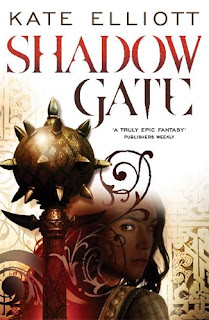 Now if you’re not familiar with the author’s work, it’s important to note that Kate places great emphasis on worldbuilding and characterization, both of which are featured prominently in the Crossroads series and thus, “Shadow Gate”. Of the former, the Hundred is an interesting place where slavery is not just accepted, but a large part of their society. The Hundredfolk also worship seven different gods, are policed by reeves—and Guardians at one point—and measure time by a complex system that seems influenced by the Chinese calendar since people are born in the year of some animal like Snake, Wolf or Ox. Where things really start to get interesting though is when different cultures clash like the Asian-influenced Qin who are distrusted because of their ‘slanted eyes’ or the blue-eyed, white-haired tribespeople who are viewed by the Hundred as demons and vice versa. Obviously there’s much more to the world than what I’ve already mentioned, and much more yet to come, but basically if you’re a fan of detailed worldbuilding and crave something a little different from traditional fantasy settings, then the Crossroads series is highly recommended.
Of the latter, “Shadow Gate”, like the first book in the series, features a huge cast of characters with the novel narrated by several different third-person POVs including returnees Joss, the former debt slave Keshad, Captain Anji’s wife Mai, and her older brother Shai while new perspectives consist of an envoy of Ilu, the pretty young woman Avisha, and Nallo, an ill-tempered widow chosen to become a reeve. Also, there are several supporting roles that are important to the story like Keshad’s sister Zubaidit, Captain Anji of course, Cornflower, the reeve Volias and a few surprises, namely characters from the first book who seemed insignificant then, but become essential components in “Shadow Gate”. And that’s really the beauty of Kate’s characters, not just their diversity—personalities range from drunken womanizers to noble outlanders and strong females—or how they evolve in unexpected ways, but how every single individual in the book, no matter how irrelevant they may seem, are integral to the novel. Of course, with such a large cast there are a few problems that arise like how unbalanced the narratives are—sometimes a character will disappear for a couple of hundred pages—or the occasional lapses where it’s difficult to tell who is actually speaking or thinking, but compared to Kate’s overall performance, these are minor complaints.
Theme-wise, “Shadow Gate” explores a number of provocative issues such as racism; how power doesn’t make an individual into a certain kind of person, but what they actually do with that power; and slavery which is depicted in several different forms including those who are forced to sell their labor, Reeves who are chosen by their eagles without any say in the matter, Guardians who are similarly chosen, and strict women’s roles like having to obey a marriage contract or certain codes of conduct like the Ri Amarah. Then there’s the book’s darker subject matter, specifically all of the rape, murder and abuse of women and children which can be shocking & disturbing, but necessary to the story. Because where there is darkness, light shines all the brighter and “Shadow Gate” is not without light for people find love, hope and new beginnings…
Admittedly when I first read “Spirit Gate” it took me a while to really get into the book, mainly because it was so different from the author’s Crown of Stars series which I had enjoyed so much. Eventually I came to accept the novel’s differences, and once I did I found myself totally immersed in the world of the Hundred and the vast story that Kate was weaving. “Shadow Gate” builds on that first book and doesn’t just continue the series, but takes us deeper into the world of the Hundred, its surrounding lands, and the lives of its characters through rich worldbuilding and intimate characterization. Factor in the answers that are revealed, the thought-provoking themes that the author examines, and a compellingly human story and the end result is a book that is much more powerful and satisfying than its predecessor. In the end, I know it’s early yet, but as of now Crossroads is shaping up to be Kate Elliott’s best work and is highly recommended to both fans of the author and any readers who appreciate fantasy in the vein of Robin Hobb, Jacqueline Carey, and J.V. Jones…
As confirmed by the author, Crossroads is a seven-volume series that will be divided into three parts—two trilogies and an interlocking standalone novel—so the new book “Shadow Gate” is essentially the middle volume in the first trilogy. As a result, readers can expect a few middle volume tendencies such as many events either being set up for or left unresolved until the next chapter “Traitor’s Gate”. At the same time however, the book also works as a standalone novel—as long as you’ve read the first one—and a companion piece to “Spirit Gate”, particularly because of the way the book is set up. You see, like its predecessor, the narrative in “Shadow Gate” is not followed chronologically and often jumps around. In fact, out of the novel’s seven ‘Parts’, two are actually flashbacks that answers many questions from “Spirit Gate” like where did Cornflower come from, who she is, how she became a slave and so on, and which act as a bridge between the two books. Readers will also discover more about the Guardians, including their abilities—riding winged horses, immortality, walking the 101 altars, possessing a third eye and a second heart to know a man’s darkest secrets, a staff of judgment, et cetera—learning who eight of the Nine are, and which Guardians have been corrupted.
Of the other storylines we have the pregnant Mai, her husband Captain Anji, and his fellow Qin who are trying to adjust to the strange customs of the Hundredfolk while settling down, which means finding themselves wives. Joss meanwhile, has become the Marshal of Argent Hall and is trying to strengthen the reeve halls and reestablish assizes courts following the events of the last book. Finally, two scouting parties have been sent off, one to the north to discover what kind of enemy the Hundred is facing, and another to the south where Emperor Farazadihosh of the Sirniakan Empire remains a threat to Captain Anji and his people. In short, there are several events happening at once in “Shadow Gate”—not to mention the number of additional subplots—so the story can get complicated real fast if you’re not paying attention, especially with the time shifts, but for those readers who are able to follow along and piece together how everything is connected, the book can be incredibly rewarding.
 Now if you’re not familiar with the author’s work, it’s important to note that Kate places great emphasis on worldbuilding and characterization, both of which are featured prominently in the Crossroads series and thus, “Shadow Gate”. Of the former, the Hundred is an interesting place where slavery is not just accepted, but a large part of their society. The Hundredfolk also worship seven different gods, are policed by reeves—and Guardians at one point—and measure time by a complex system that seems influenced by the Chinese calendar since people are born in the year of some animal like Snake, Wolf or Ox. Where things really start to get interesting though is when different cultures clash like the Asian-influenced Qin who are distrusted because of their ‘slanted eyes’ or the blue-eyed, white-haired tribespeople who are viewed by the Hundred as demons and vice versa. Obviously there’s much more to the world than what I’ve already mentioned, and much more yet to come, but basically if you’re a fan of detailed worldbuilding and crave something a little different from traditional fantasy settings, then the Crossroads series is highly recommended.
Of the latter, “Shadow Gate”, like the first book in the series, features a huge cast of characters with the novel narrated by several different third-person POVs including returnees Joss, the former debt slave Keshad, Captain Anji’s wife Mai, and her older brother Shai while new perspectives consist of an envoy of Ilu, the pretty young woman Avisha, and Nallo, an ill-tempered widow chosen to become a reeve. Also, there are several supporting roles that are important to the story like Keshad’s sister Zubaidit, Captain Anji of course, Cornflower, the reeve Volias and a few surprises, namely characters from the first book who seemed insignificant then, but become essential components in “Shadow Gate”. And that’s really the beauty of Kate’s characters, not just their diversity—personalities range from drunken womanizers to noble outlanders and strong females—or how they evolve in unexpected ways, but how every single individual in the book, no matter how irrelevant they may seem, are integral to the novel. Of course, with such a large cast there are a few problems that arise like how unbalanced the narratives are—sometimes a character will disappear for a couple of hundred pages—or the occasional lapses where it’s difficult to tell who is actually speaking or thinking, but compared to Kate’s overall performance, these are minor complaints.
Theme-wise, “Shadow Gate” explores a number of provocative issues such as racism; how power doesn’t make an individual into a certain kind of person, but what they actually do with that power; and slavery which is depicted in several different forms including those who are forced to sell their labor, Reeves who are chosen by their eagles without any say in the matter, Guardians who are similarly chosen, and strict women’s roles like having to obey a marriage contract or certain codes of conduct like the Ri Amarah. Then there’s the book’s darker subject matter, specifically all of the rape, murder and abuse of women and children which can be shocking & disturbing, but necessary to the story. Because where there is darkness, light shines all the brighter and “Shadow Gate” is not without light for people find love, hope and new beginnings…
Admittedly when I first read “Spirit Gate” it took me a while to really get into the book, mainly because it was so different from the author’s Crown of Stars series which I had enjoyed so much. Eventually I came to accept the novel’s differences, and once I did I found myself totally immersed in the world of the Hundred and the vast story that Kate was weaving. “Shadow Gate” builds on that first book and doesn’t just continue the series, but takes us deeper into the world of the Hundred, its surrounding lands, and the lives of its characters through rich worldbuilding and intimate characterization. Factor in the answers that are revealed, the thought-provoking themes that the author examines, and a compellingly human story and the end result is a book that is much more powerful and satisfying than its predecessor. In the end, I know it’s early yet, but as of now Crossroads is shaping up to be Kate Elliott’s best work and is highly recommended to both fans of the author and any readers who appreciate fantasy in the vein of Robin Hobb, Jacqueline Carey, and J.V. Jones…

Order “Iron Man: Beneath the Armor” HERE
On May 2, 2008 Paramount Pictures and Marvel Entertainment will be releasing the big-screen adaptation of the Marvel comic book character Iron Man which is directed by Jon Favreau (Elf, Zathura) and starring Robert Downey Jr. (Kiss Kiss Bang Bang, A Scanner Darkly) as Tony Stark, Terrence Howard (Crash, Hustle & Flow) as James ‘Rhodey’ Rhodes, Gwyneth Paltrow (Se7en, Shakespeare In Love) as Pepper Potts, and Jeff Bridges (Starman) as Obadiah Stane, not to mention appearances by Samuel L. Jackson, Hilary Swank, Ghostface Killah, and Stan Lee. Not surprisingly, in support of the movie’s upcoming release, a ton of cross-promotion is going on including mobile phones, Reebok, Burger King, Audi, 7-Eleven, a videogame based on the film, and an Iron Man novelization, among others. Then there’s “Iron Man: Beneath the Armor”, an original trade paperback published by Del Rey and put together by USA Today bestselling writer Andy Mangels (Star Wars, Star Trek, Roswell).
 As a comic book fan, I’m pretty familiar with all of Marvel’s signature books like Spider-Man, Captain America, the X-Men, Fantastic Four, and the Incredible Hulk, but there are certain titles that I never followed very closely including Thor, Daredevil and Iron Man. Now don’t get me wrong, I have read Iron Man comic books before, it’s just that the issues I’ve picked up were contemporary releases like Ultimates I + II, Ultimate Iron Man by novelist Orson Scott Card, the relaunch that was done by Warren Ellis and Adi Granov, or Civil War, so as far as Iron Man’s history and what really makes the character tick, I’m clueless. Which is why I enjoyed reading “Iron Man: Beneath the Armor” so much :)
 You see, “Iron Man: Beneath the Armor” is much more than a simple movie tie-in product. In fact, the film is only discussed on two of the book’s 215 pages. Instead, “Iron Man: Beneath the Armor” is an incredibly detailed examination about the history of Iron Man, going all the way back to the character’s inception in the early 1960s and his first appearance in Tales of Suspense #39. From there, Andy Mangels wonderfully catalogs the comic book’s ongoing evolution through 2008—its high points and low—and how it was influenced by many different writers & artists—some of which included Stan Lee, Jack Kirby, Larry Lieber, Don Heck, John Byrne, Jim Lee, Jeph Loeb (Smallville, Lost, Heroes), Kurt Busiek (Astro City), Adi Granov (See Insets) Joe Quesada (Marvel’s Editor-In-Chief), Warren Ellis (Transmetropolitan, The Authority), Orson Scott Card, Andy Kubert, and Daniel Knauf (Carnivale)—changes within the comic industry, and world events including Vietnam, the Cold War, corporate espionage, 9/11, terrorism, and the Iraq War. Along the way, the book also looks at merchandising (animation, videogames, action figures, trading cards, novels, and recent direct-to-DVD animated movies like The Invincible Iron Man), crossovers (Armor Wars, Avengers Disassembled, House of M, Civil War) and spinoffs/miniseries such as Ultimate Iron Man, War Machine, Marvel Adventures: Iron Man, et cetera.
 My favorite part of “Iron Man: Beneath the Armor” though has to be the interviews with the comic’s various creators, editors, writers and artists which gives readers an illuminating glimpse into the kind of book they were trying to make, how the character differs from other superheroes, and why the series has been able to remain popular & relevant all of these years. The interviews also reveal some pretty interesting tidbits like how Tony Stark is modeled after Howard Hughes and how Stan Lee began the first & last names of his characters with the same letter so he could better remember them, hence the names Peter Parker, Bruce Banner and Reed Richards ;) In addition to all of the interviews, historical information and a ton of artwork—including covers, panels, splash pages and photos—that are incorporated throughout the book, “Iron Man: Beneath the Armor” also features a comprehensive ‘Character Bios’ section that includes everyone from allies and rogues to alternate Iron Men, and a cool ‘Armor Gallery’ that breaks down different designs and their specs.
In the end, even though I’m not a very big Iron Man fan, I have to admit that I was thoroughly fascinated by this guidebook. Not only does it do an incredible job of celebrating Iron Man’s history, but I also thought it portrays the comic book medium in a positive light as an intelligent, diversifying and richly creative mode of storytelling. Plus, “Iron Man: Beneath the Armor” is the kind of book that can be appreciated by both hardcore fans and readers new to the character. In short, I applaud Del Rey and Andy Mangels for producing a title of such quality and just hope that “Iron Man: Beneath the Armor” won’t get lost somewhere among all of the other products that are being produced because of the movie’s marketing madness…
 As a comic book fan, I’m pretty familiar with all of Marvel’s signature books like Spider-Man, Captain America, the X-Men, Fantastic Four, and the Incredible Hulk, but there are certain titles that I never followed very closely including Thor, Daredevil and Iron Man. Now don’t get me wrong, I have read Iron Man comic books before, it’s just that the issues I’ve picked up were contemporary releases like Ultimates I + II, Ultimate Iron Man by novelist Orson Scott Card, the relaunch that was done by Warren Ellis and Adi Granov, or Civil War, so as far as Iron Man’s history and what really makes the character tick, I’m clueless. Which is why I enjoyed reading “Iron Man: Beneath the Armor” so much :)
 You see, “Iron Man: Beneath the Armor” is much more than a simple movie tie-in product. In fact, the film is only discussed on two of the book’s 215 pages. Instead, “Iron Man: Beneath the Armor” is an incredibly detailed examination about the history of Iron Man, going all the way back to the character’s inception in the early 1960s and his first appearance in Tales of Suspense #39. From there, Andy Mangels wonderfully catalogs the comic book’s ongoing evolution through 2008—its high points and low—and how it was influenced by many different writers & artists—some of which included Stan Lee, Jack Kirby, Larry Lieber, Don Heck, John Byrne, Jim Lee, Jeph Loeb (Smallville, Lost, Heroes), Kurt Busiek (Astro City), Adi Granov (See Insets) Joe Quesada (Marvel’s Editor-In-Chief), Warren Ellis (Transmetropolitan, The Authority), Orson Scott Card, Andy Kubert, and Daniel Knauf (Carnivale)—changes within the comic industry, and world events including Vietnam, the Cold War, corporate espionage, 9/11, terrorism, and the Iraq War. Along the way, the book also looks at merchandising (animation, videogames, action figures, trading cards, novels, and recent direct-to-DVD animated movies like The Invincible Iron Man), crossovers (Armor Wars, Avengers Disassembled, House of M, Civil War) and spinoffs/miniseries such as Ultimate Iron Man, War Machine, Marvel Adventures: Iron Man, et cetera.
 My favorite part of “Iron Man: Beneath the Armor” though has to be the interviews with the comic’s various creators, editors, writers and artists which gives readers an illuminating glimpse into the kind of book they were trying to make, how the character differs from other superheroes, and why the series has been able to remain popular & relevant all of these years. The interviews also reveal some pretty interesting tidbits like how Tony Stark is modeled after Howard Hughes and how Stan Lee began the first & last names of his characters with the same letter so he could better remember them, hence the names Peter Parker, Bruce Banner and Reed Richards ;) In addition to all of the interviews, historical information and a ton of artwork—including covers, panels, splash pages and photos—that are incorporated throughout the book, “Iron Man: Beneath the Armor” also features a comprehensive ‘Character Bios’ section that includes everyone from allies and rogues to alternate Iron Men, and a cool ‘Armor Gallery’ that breaks down different designs and their specs.
In the end, even though I’m not a very big Iron Man fan, I have to admit that I was thoroughly fascinated by this guidebook. Not only does it do an incredible job of celebrating Iron Man’s history, but I also thought it portrays the comic book medium in a positive light as an intelligent, diversifying and richly creative mode of storytelling. Plus, “Iron Man: Beneath the Armor” is the kind of book that can be appreciated by both hardcore fans and readers new to the character. In short, I applaud Del Rey and Andy Mangels for producing a title of such quality and just hope that “Iron Man: Beneath the Armor” won’t get lost somewhere among all of the other products that are being produced because of the movie’s marketing madness…
Subscribe to:
Posts (Atom)


