Wednesday, October 24, 2012
Two Mini-Reviews: Crimes Against Magic by Steve McHugh and The Daemon Whisperer by Candice Bundy (Reviewed by Mihir Wanchoo)

Order the book HERE
Read prequel short story "Small Time Vengeance"
OVERVIEW/ANALYSIS: Crimes Against Magic is Steve McHugh’s debut novel and is a dual story feature. I was very much interested in this story because of its Jason Bourne-like origin. I approached the author and he graciously agreed. I wanted to see how the book would hold up since it promised lots of action, magic & intrigue.
Nathan Garrett is a sorcerer who is living currently as a thief in London, he however remembers his life only ten years past as he was born again on the floor of a warehouse not remembering a whit about his past life. His journey since then has been a quiet one, fitting in with the world and not alerting people to him. His world however is soon to change when he discovers that there are people that know about his lost identity and who are wanting to kill him for hitherto unknown reasons. He also is embroiled with his neighbors’ lives as the same people target their young daughter. In another plot thread we meet Nathan in the past roughly in the 15th century wherein he is on a mission to recover a young girl and a few English soldiers from a group of supernatural folk who kill without remorse and simply refuse to die easy. Both plot threads showcase a man fighting against forces much more powerful than him and trying to discover the truth.
This book for me a whole lot of fun for various ones, firstly the book has a very fast paced plot, beginning with the current timeline, things start unraveling very promptly and similarly in the second plotline things are already hellish to begin with but soon take an even deadlier turn. The storyline has huge dollops of action and intrigue in both timelines thereby making the readers interested in both and constantly turning pages to find out what happens next in both. I very much enjoyed this action-packed story as it does not waste any pages on unnecessary side-plots. The author manages to keep his story streamlined and make the readers hooked on to the happenings of the Hellequin chronicles. Another plus point is the mythology utilized in the story, not that it is an original take however it does twist certain known perceptions and presents a different take on a well-known mythos and wizard.
The story deals with a primary first-person narrative and the author does a decent characterization effort with the narrator. The main character is presented as a cipher however in the second timeline we get a clear cut idea about who he is & what's his goal. This dual view into the character was a fun strategy on the author's part and with the way the story ends I'm very curious in regards to the plot direction of the future books. The story however lacks in certain areas namely on the world-building front. The story is presented in two different timelines however the world presented in both is a bit sketchy on the details and that might keep a few readers unhappy. Again it’s a tough line to balance the world-building needs against the story’s pace as too much description is often labelled as info-dumping and can be quite a turn-off for some. The author chose to go with the latter direction and so I’ll be looking forward to the second book to see whether he expands the world’s history as well as the character backstories.
This world can be easily described as UF-lite in regards to the world presented however the story has a lot of positive factors such as a fast-paced, action-filled story line with a plethora of twists. Steve McHugh is an author who shows a lot of flair and his book promises to give readers an exciting read a la Jim Butcher and Tim Marquitz. Crimes Against Magic is definitely a debut that should not be missed for all readers who want a great urban fantasy read.
Official Author Website
Order the book HERE
Read chapter one HERE
OVERVIEW/ANALYSIS: In regards to Candice Bundy’s The Daemon Whisperer, I was alerted to its existence by Steven Montano’s blog. I am a fan of his dark fantasy-thrillers and also his picks in regards to books have been along the same lines as my interests. Plus the book blurb promised a post-apocalyptic world wherein daemons are now present and can be summoned to our plane of existence. This book seemed to be a urban fantasy version of The Warded Man/The Painted Man. Therefore I was excited to see where the author would take the story and how she would develop the world. The author provided me with a reviewer's copy based on my inquiry.
Meriwether Storm is a daemon summoner who has become one due to the death/murder of her parents at the hands of one such daemon. She however doesn’t know which daemon caused this tragedy but she will do everything she can to find out its name. Every daemon summoner gets tattooed with the daemon’s sign/sigil and there haven’t been many with the amount of script that Meri has acquired. She however is still nowhere near to finding the name of her parent’s killer. Things soon take a weird turn as a daemon cabal approaches her with a potential job offer in turn for giving her the name she so fervently desires. What happens next is what readers will have to find out by reading the book.
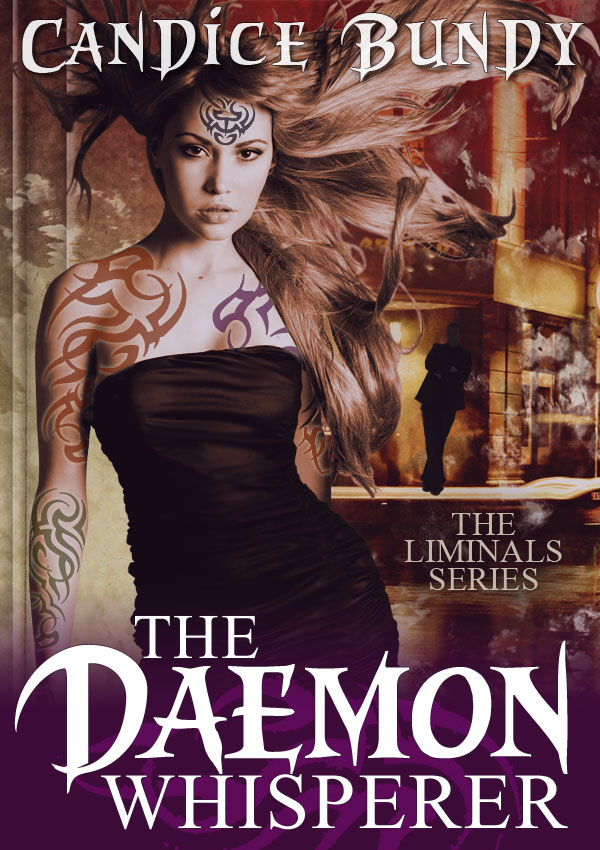
The best part of the story is its fast pace and slightly twisted storyline; the author does her best to write a story that manages to bridge the storyline from its post-apocalyptic roots into the thriller components of the story. However the biggest surprise for me was the higher content of paranormal romance in this storyline than I expected. The story I felt had a great chance to showcase a gritty world, which has been changed irrevocably after the apocalypse and the presence of the Daemons on our plane of existence. However the author manages to sidestep this world-building front and focuses only on the story and the interaction between the main POV characters and reveals the truth about the Liminals. The book also has a great cover done by Amber Shah.
The author does write competently and also includes a touch of wryness to the proceedings and makes this tale much lighter than I would have expected. The story however doesn’t shy away from action and in the latter half of the book we do get some terrific action-oriented proceedings that help in setting up a terrific climax. Also I’m not a fan of PNR-heavy storylines and so this turn of events was one, which I didn’t particularly enjoy. Readers who enjoy PNR stories will find this turn to be a good one and one that is handled as classily as possible. I’m not an expert on sex scenes and so take my opinion on this detail of the story with a huge grain of salt. Lastly I would have loved to see more about the post-apocalyptic world and so I will be reading the next book to see whether the author expands the world on this front.
Candice Bundy has written the story, which she had planned to write. I perhaps had different expectations based on the blurb and that curtailed my enjoyment of this book. I think this is a good urban fantasy book but that which focuses on some things that I derive very little enjoyment from. This book is more leaning towards the paranormal romance subgenre than towards the urban fantasy subgenre. So be warned before you jump in to this book. This is however a good start to an interesting series and should be a book that should be enjoyable for readers of Nalini Singh and Jeanine Frost.
Order the book HERE
Read chapter one HERE
OVERVIEW/ANALYSIS: In regards to Candice Bundy’s The Daemon Whisperer, I was alerted to its existence by Steven Montano’s blog. I am a fan of his dark fantasy-thrillers and also his picks in regards to books have been along the same lines as my interests. Plus the book blurb promised a post-apocalyptic world wherein daemons are now present and can be summoned to our plane of existence. This book seemed to be a urban fantasy version of The Warded Man/The Painted Man. Therefore I was excited to see where the author would take the story and how she would develop the world. The author provided me with a reviewer's copy based on my inquiry.
Meriwether Storm is a daemon summoner who has become one due to the death/murder of her parents at the hands of one such daemon. She however doesn’t know which daemon caused this tragedy but she will do everything she can to find out its name. Every daemon summoner gets tattooed with the daemon’s sign/sigil and there haven’t been many with the amount of script that Meri has acquired. She however is still nowhere near to finding the name of her parent’s killer. Things soon take a weird turn as a daemon cabal approaches her with a potential job offer in turn for giving her the name she so fervently desires. What happens next is what readers will have to find out by reading the book.
The best part of the story is its fast pace and slightly twisted storyline; the author does her best to write a story that manages to bridge the storyline from its post-apocalyptic roots into the thriller components of the story. However the biggest surprise for me was the higher content of paranormal romance in this storyline than I expected. The story I felt had a great chance to showcase a gritty world, which has been changed irrevocably after the apocalypse and the presence of the Daemons on our plane of existence. However the author manages to sidestep this world-building front and focuses only on the story and the interaction between the main POV characters and reveals the truth about the Liminals. The book also has a great cover done by Amber Shah.
The author does write competently and also includes a touch of wryness to the proceedings and makes this tale much lighter than I would have expected. The story however doesn’t shy away from action and in the latter half of the book we do get some terrific action-oriented proceedings that help in setting up a terrific climax. Also I’m not a fan of PNR-heavy storylines and so this turn of events was one, which I didn’t particularly enjoy. Readers who enjoy PNR stories will find this turn to be a good one and one that is handled as classily as possible. I’m not an expert on sex scenes and so take my opinion on this detail of the story with a huge grain of salt. Lastly I would have loved to see more about the post-apocalyptic world and so I will be reading the next book to see whether the author expands the world on this front.
Candice Bundy has written the story, which she had planned to write. I perhaps had different expectations based on the blurb and that curtailed my enjoyment of this book. I think this is a good urban fantasy book but that which focuses on some things that I derive very little enjoyment from. This book is more leaning towards the paranormal romance subgenre than towards the urban fantasy subgenre. So be warned before you jump in to this book. This is however a good start to an interesting series and should be a book that should be enjoyable for readers of Nalini Singh and Jeanine Frost.
 12:01 AM |
  Posted by
The Reader |
Posted by
The Reader |


Tuesday, October 23, 2012
"Red Country" by Joe Abercrombie (Reviewed by Liviu Suciu and Mihir Wanchoo)

INTRODUCTION: "They burned her home. They stole her brother and sister. But vengeance is following.
Shy
South hoped to bury her bloody past and ride away smiling, but she'll
have to sharpen up some bad old ways to get her family back, and she's
not a woman to flinch from what needs doing. She sets off in pursuit
with only a pair of oxen and her cowardly old step father Lamb for
company. But it turns out Lamb's buried a bloody past of his own. And
out in the lawless Far Country the past never stays buried.
Their journey will take them across the barren plains to a frontier town gripped by gold fever, through feud, duel and massacre, high into the unmapped mountains to a reckoning with the Ghosts. Even worse, it will force them into alliance with Nicomo Cosca, infamous soldier of fortune, and his feckless lawyer Temple, two men no one should ever have to trust . . ."
Their journey will take them across the barren plains to a frontier town gripped by gold fever, through feud, duel and massacre, high into the unmapped mountains to a reckoning with the Ghosts. Even worse, it will force them into alliance with Nicomo Cosca, infamous soldier of fortune, and his feckless lawyer Temple, two men no one should ever have to trust . . ."
Bursting upon the epic fantasy scene with his superb First Law trilogy, Joe Abercrombie became the "perfect" representative of the "new gritty" epic fantasy for me and his books have not disappointed so far. Best Served Cold was a top 5 sff of mine in 2009 while Before They Are Hanged was my top fantasy in 2007.
So of course Red Country was a huge asap, especially when early comments leaked that Logen Ninefingers will make his return here after more than a decade since we have last seen him in the last paragraph of the First Law trilogy:
The water came up to meet him. It hit him in the side like a charging bull, punched the air out of his lungs, knocked the sense out of his head, sucked him in and down into the cold darkness…"
OVERVIEW/ANALYSIS (Mihir): I was lucky to get a copy of Red Country from
Gollancz and my thanks to Jon Weir for sending it all the way across the pond. To
say this book was highly anticipated would be an understatement, once it was
announced that this book would be featuring the return of Logen Ninefingers. A
character that has been synonymous with the term “bad-ass” along with other
famous ones such as Druss, Anomander Rake, Waylander, Oberyn Martell etc.
After
reading the ending to the First Law trilogy, many readers were left stymied a
bit with it. Most characters had an ending that belied their start however for
one particular character the journey was a full circle. People were left
wondering what exactly happened to Ninefingers and this book answers the
pivotal question of his survival without divulging any particular details as to
how. The following review will have some minor spoilers for the previous five
books and for this one so be warned for those who haven’t read all the previous
titles.
The story begins in a bloody fashion of sorts
wherein we are introduced to the main protagonists Shy South and Temple. Shy is
a person who has had a rough adolescence and is now learning to live straight.
She has her stepfather Lamb to help her out however with his timid behavior it
often turns out that she has to step in to take care of situations as they
arise. Temple is a jack-of-many-trades, who considers himself a coward of the
highest order and is currently working as the legal counsel to Nicomo Cosca and
his band of mercenaries.
Both characters have a journey
ahead of them thanks to the actions of others and this is where this fantasy
western story really explores the arc of each and every character. The story is focused on Shy & Lamb's search for Ro & Pit, the two missing children
who have been abducted along with a host of others by an outlaw called Grega
Cantliss. Their search however will cross roads with Nicomo Cosca and his band
of mercenaries that include Temple and sergeant Friendly (seen previously in Best Served Cold). Cosca is going along with the inquisition to root out the
rebels and is actively searching for a specific rebel leader.
For me this book was the best of Joe's standalone
books and possibly one, that is great for all those wanting to see and read more
about Ninefingers as he returns in a bloody manner as befitting his nature. The
story follows a couple of plot threads that start divergently but soon merge in
a surprising way that makes the book slightly more streamlined. Shy South and Temple can be said to be the
main POV characters among the various ones featured in the book; however the
sad part is that we don't get a POV from the character that we want to know
about the most.
This part seriously was the biggest downer of the story for me as with everyone else I wanted to know about Logen and what he had been doing after his betrayal by Black Dow. We never get a clear cut idea about whether his so-called berserker state is super-natural or just a part of his mental persona. The author certainly loses points for this move as to not feature Ninefingers as a POV robs the story mightily of its sheen.
This part seriously was the biggest downer of the story for me as with everyone else I wanted to know about Logen and what he had been doing after his betrayal by Black Dow. We never get a clear cut idea about whether his so-called berserker state is super-natural or just a part of his mental persona. The author certainly loses points for this move as to not feature Ninefingers as a POV robs the story mightily of its sheen.
The pacing of the story however is spot on and we get a story that is a western as well as a redemption tale. The character arcs explored are very similar to a Stephen King story wherein flawed characters either make it or they don’t but their journey will be one that enthralls the readers and powers the story completely. Plus Logen Ninefingers finally transcends his journey into an iconic one by accepting who he is and what he is not, hopefully the author might provide further illumination by featuring him in more stories.
I was waiting to know all and be enchanted by Logen’s presence in the book but to paraphrase Logen himself “you have to be realistic about these things.” The ending of Red Country is perhaps much more optimistic than of the First Law trilogy and for that I’m glad however it is still as open ended as its predecessor and that might be a sticky point for some. I loved this book and the way the story ends readers will be hoping that we get to know more about what happens next for several characters.
Joe Abercrombie definitely knows how to write a
story, he also knows to create memorable characters but his strongest suit is
his dialogue and writing copious amounts of black humor. This book is no
stranger to these facts and it manages to be the most uplifting of all his
standalone books by virtue of twists and turns of this story.
The book is a complete winner for all fans waiting for the return of one of the most iconic barbarians ever, however for fans wanting to know Logen’s inner thoughts they might just have to wait a little longer. Dive in to read another fantastic effort by a veritable fantasy writer who is the first law when it comes to writing dark, bloody, action packed stories.

ANALYSIS (Liviu): "Severed heads,’ Cosca was explaining, ‘never go out of fashion. Used sparingly and with artistic sensibility, they can make a point a great deal more eloquently than those still attached. Make a note of that. Why aren’t you writing?"
The quote above shows Joe Abercrombie at his best and encapsulates why the first half of Red Country was awesome. After that, the insistence of the author to limit himself at least temporarily to the convention of the western leads to a considerable slowing down of the action, as we are treated with cliche after cliche in the frontier town of Crease.
Luckily, either that was a feint to prepare for what comes next, or the author realized that mimicking the "new western" is maybe not such a great idea and the book comes back to roaring life with a great last third of all out action, twists, turns, comedy and tragedy.
Shy and Temple as main leads and with a great role change from the usual stereotype, so she is the "tough guy" and he is the one to be protected, work very well in a book that is the most "personal" of the author, as the stakes are not the world as in the First Law, or various countries as in the two previous standalones, but the fates of the characters introduced here.
However, from the smallest touches - oxen called Scale and Calder (!) - Lamb, the current incarnation of Logen Ninefingers, is the true star of the novel and ultimately the main driver of action too. Yes, we do not get a POV from him and we see his actions at a distance or through the eyes of Shy and the others, but I think the decision was the correct one as it preserved the essential "mystery" at the core of Ninefingers.
On the other hand, I was disappointed in Cosca; excellent in the first half but for what it seemed mostly like authorial intent than something deriving from the story, a cartoon villain with no subtlety in the second half.
The rest of the large cast worked well overall, both known characters like Pike or Friendly and new like Dab Sweet for example - the whole ensemble mixed well and I thought the author did a very good job in balancing the over-the-top and cynical with the ironic and even the earnest on occasion...
I also loved the ending which I found somewhat predictable from a point on, but still very good nonetheless. Overall, Red Country is not quite at the level of the author's signature works to date, Before They Are Hanged and Best Served Cold, but by escaping from the self-imposed shackles of its western sub-genre, it is better than the limited The Heroes and consequently a top 25 of mine for 2012, with its scope almost matching the superb writing and characters that Joe Abercrombie never failed so far to produce.
The book is a complete winner for all fans waiting for the return of one of the most iconic barbarians ever, however for fans wanting to know Logen’s inner thoughts they might just have to wait a little longer. Dive in to read another fantastic effort by a veritable fantasy writer who is the first law when it comes to writing dark, bloody, action packed stories.

ANALYSIS (Liviu): "Severed heads,’ Cosca was explaining, ‘never go out of fashion. Used sparingly and with artistic sensibility, they can make a point a great deal more eloquently than those still attached. Make a note of that. Why aren’t you writing?"
The quote above shows Joe Abercrombie at his best and encapsulates why the first half of Red Country was awesome. After that, the insistence of the author to limit himself at least temporarily to the convention of the western leads to a considerable slowing down of the action, as we are treated with cliche after cliche in the frontier town of Crease.
Luckily, either that was a feint to prepare for what comes next, or the author realized that mimicking the "new western" is maybe not such a great idea and the book comes back to roaring life with a great last third of all out action, twists, turns, comedy and tragedy.
Shy and Temple as main leads and with a great role change from the usual stereotype, so she is the "tough guy" and he is the one to be protected, work very well in a book that is the most "personal" of the author, as the stakes are not the world as in the First Law, or various countries as in the two previous standalones, but the fates of the characters introduced here.
However, from the smallest touches - oxen called Scale and Calder (!) - Lamb, the current incarnation of Logen Ninefingers, is the true star of the novel and ultimately the main driver of action too. Yes, we do not get a POV from him and we see his actions at a distance or through the eyes of Shy and the others, but I think the decision was the correct one as it preserved the essential "mystery" at the core of Ninefingers.
On the other hand, I was disappointed in Cosca; excellent in the first half but for what it seemed mostly like authorial intent than something deriving from the story, a cartoon villain with no subtlety in the second half.
The rest of the large cast worked well overall, both known characters like Pike or Friendly and new like Dab Sweet for example - the whole ensemble mixed well and I thought the author did a very good job in balancing the over-the-top and cynical with the ironic and even the earnest on occasion...
I also loved the ending which I found somewhat predictable from a point on, but still very good nonetheless. Overall, Red Country is not quite at the level of the author's signature works to date, Before They Are Hanged and Best Served Cold, but by escaping from the self-imposed shackles of its western sub-genre, it is better than the limited The Heroes and consequently a top 25 of mine for 2012, with its scope almost matching the superb writing and characters that Joe Abercrombie never failed so far to produce.

Official Author Website
Read FBC's Review of Govinda
Order Govinda HERE
Govinda by Krishna Udayasankar was a debut that I absolutely loved. Not only was it based on the Indian epic Mahabharata (which I believe to be the greatest Mytho-historical epic ever) but the author had rewritten it to be a socio-political story thereby making the story unpredictable to a viable degree. I was very much impressed by the author's efforts in writing this book and so I was interested in knowing more about her efforts & her thoughts specifically about her debut series. So read ahead to know more about Krishna, her previous accomplishments and the effect of Star Wars on the Aryavarta Chronicles...
Q] Welcome to Fantasy Book Critic. For starters, please introduce yourself, tell us what inspired you to write and describe your journey to becoming a published author.
KU: Hello! Thanks for having me on the site, and it really is humbling to be here. I shall gush unabashedly and tell you how excited I am about this – You see, I’ve been creating imaginary worlds in my head for as long as I can remember, and fantasy has been a genre that I have read in a bid to house and nurture these alternate universes for just as long.
I guess then, that writing – an activity I love in itself – was the next step. I used to write as a kid, but as life caught up with me, I tried to put my passion into my work, combining my interest in wordplay with ideas that I found fascinating, such as the philosophy of the complex socio-economic world around us. This probably also explains my education and career choices: I graduated from the National Law School, Bangalore, spent some time working for an NGO, then went on to study International Business at Sydney before ending up with a PhD in Strategic Management from the Nanyang Business School, Singapore.
But at some point, it just wasn’t enough. When I look back now, I wonder how I went all these years being anything but a writer – though I also know that my work today is very much the product of life’s experiences.
Q] My next question is about the genesis of the Aryavarta Chronicles and how it occurred? How long have you been working on it?
KU: OK, here’s a confession: When I began work on this story, almost four years ago, I intended for it to be a satirical poem. I was not looking at alternative history or even an epic novel, just a funny socio-political commentary that stuck largely to the popular version of events. And I’d even gotten into the story to a good extent when two things happened: First, I ran into characters – particularly the protagonists of the novel – who weren’t easily dealt with or dismissed. Second, I started reading up on the Epic, basically to get my facts right. And then it was like an explosion and a whirlpool at the same time. Suffice it to say that a couple of months later, I started writing The Aryavarta Chronicles.
It took me about two and half years, including research, to send out a completed manuscript, and then, once Hachette India came onboard we’ve spent about another year or so in editing and production.
Q] Tell us more about the world that Govinda is set in and some of the series’ major characters.
KU: The Aryavarta Chronicles is a series set in the Epic Ages of Indian History – roughly circa 2000 BC. While stories of these times are often clouded in mystery and myth, in fact, this was a period of great political, social and technological change. In terms of the universe of the Chronicles, the land – Aryavarta - has been ravaged by a long and bloody conflict between two orders: the Firstborn under their generations of leaders known as the Vyasas and the Firewrights, who are master inventors and weapon-makers. In the socio-political aftermath of their conflict, one man is rises to do what he must to keep his people safe. That man is the protagonist, Govinda.
I personally prefer to describe this story, neither as a retelling of mythology, nor as a reinterpretation of an epic. Rather, The Aryavarta Chronicles is an attempt to capture what could well have been history, based on systematic research into the stories that lie behind symbol and metaphors. Fundamentally, it is a story of hope, of ordinary men and women, who grow to be something more in extraordinary times.
The characters, unlike typical Indian mythology, tend to be brave but completely human, rather than gods or super-beings. In fact, I kind of like the fact that all characters in the book tend to have nuances and shades of grey, instead of being totally good or bad. Of course, you’ll also find some sexy, snide men and women, who enjoy pithy banter and a battle of wits as much as one of swords. What can I say, there’s more than one person in the book that I wouldn’t mind sitting down for a drink and some conversation!
Q] Your debut novel is the first volume in a series. How is the next book coming along? I’m sure the readers would appreciate any details about the sequel “Firewright”, and the outline of your plans for the series as a whole?
KU: ‘Firewright’ – that is, Book 2 of The Aryavarta Chronicles - takes off from where ‘Govinda’ ends. Though it is a sequel, it has its own distinct storyline and plot and there are shades to the characters that one cannot anticipate from the first book. As for the third book - it is going to be a prequel. I also have in mind the plotlines for two more books in the series, but it is too soon to talk about them. My editor and I are working on Firewright right now, and we hope to have it out in the second quarter of 2013.
Q] Your series is based on the world’s longest epic The Mahabharata however the magic & divinity is retracted from the story and presented as a socio-political saga. Could you expound on this literary decision?
KU: Understanding the history behind what has subsequently been aggrandized into mythology and used to legitimize or justify today’s social structures and norms was, to me, an essential way of understanding the world we live in. Consequently, I wanted to explore the scriptures as the epics as tales of humanity, not divinity; as something that could have been history, even an alternate reality, but not some improbable, sacrosanct tale that defied all logic and science. Don’t get me wrong, I don’t mean to take all fantasy or epic elements out of it – my focus was with relevance, with believable chains of events and fallible, yet likeable, characters. Removing divinity seemed essential to reveal the real heroism and sacrifice of these characters.
But one can’t just remove the magic and not replace it with something else – there still needs to be an explanation for why things happens the way they do. The more I tried to find these explanations, the more I caught on to the idea of the epic ages as a time of socio-political revolution, and my story as one of change in the status quo.

Q] In regards to your series, you chose to alter the names of most characters from what has been the case classically. (Syyodhan/Suryodhan, Partha, etc). Of course the names you use were alternate names but we are a little less used to hearing them. How and why did you pick these names?
KU: The most obvious name changes, such as they seem, are actually uses of the original or birth names given to these characters – for example: Syoddhan for Duryodhan and Vasusena for Karna.
I also went went for less common names in some instances because I hoped to make readers who might be familiar with the story pause and process these characters a little differently, instead of relying on familiar assumptions. The names used, in this case, often convey or highlight another facet of the person in question – for example, of the three natural born to Pritha (Kunti’s birth name, Kunti being a patronym and not her original name) why was Arjun more commonly known by the matronym Partha?
Researchers find that names have been used to great effect in the epic, both in poetic and symbolic terms. Indeed, the Mahabharat has been referred to as the story of four ‘Krishnas’ – Dwaipayana Vyasa, Govinda, Panchali and Partha – all of whom share the common moniker of Krishna!
Q] A curious thing I noticed on your website is that the third book of your series seems to be a prequel. It’s a very different pattern to write a series wouldn’t you say?
KU: I guess that’s the Star Wars influence you see there… Just kidding!
When I started writing this story, all I had in mind was one book – which subsequently became two. By the time I had finished with that part of events, I was way too intrigued by the central characters and by the events that had shaped these characters into who they were. A prequel was but natural, especially since a lot of the themes in Books 1 and 2 – like revenge and succession - have to do with events that happen before.
When I started writing this story, all I had in mind was one book – which subsequently became two. By the time I had finished with that part of events, I was way too intrigued by the central characters and by the events that had shaped these characters into who they were. A prequel was but natural, especially since a lot of the themes in Books 1 and 2 – like revenge and succession - have to do with events that happen before.
Surprisingly, and this I found out much later, as I was doing research for the prequel, the original author of the Mahabharata and its associated text, the Harivamsa, also followed the same order of setting things down: The tale goes that he was so disappointed by the end of an era that he had to go back in time and narrate a more cheerful story.
Q] What did you think was the most challenging part about writing your debut novel? What about the easiest or most rewarding parts?
KU: The toughest part was believing that I could, and to go on, and on and on… till one day its was almost done. I don’t know how true this is, but I hear that of the many who dream of writing a book, few attempt to do so, and fewer still will end up completing a manuscript. The fear of not being able to finish what I had begun, well, simply because I didn't have it in me or was not good enough, was always there. But here’s the funny part – the fear hasn't quite gone away since the book hit the stores, but has in a weird Newtonian way, changed form. I now worry if I can do again what I've somehow managed to do once. It never ends!
The most rewarding part was the act of writing itself. I’ve enjoyed every moment of the process – be it imagining scenes, tracing story arcs or sometimes watching characters exchanging pithy dialogues. The story has a life of its own, and writing is being a witness to that life. It’s an incredible feeling!
Q] In a note about research methodology in the book, it’s mentioned in your research you came across the presence of alternate versions of the Mahabharata such as the Bhil and Indonesian versions. Could you mention a few things that differ drastically from the classical version conventionally known to us?
KU: OK, let me see if I can knock your socks off with some really surprising stuff: According to the Indonesia Baratayudha, Draupadi is won in marriage not by Arjuna, but Bhima – the latter competes on behalf of his brother Yudhishtra because he is already married. In this version, Shikandi is a woman, and married to Arjuna! Another interesting love angle is that between Amba and Bhisma. Indeed, quite recently I heard a Indian Sanskrit scholar speak about how Bhisma may well have been married before he took his famous vow – a conclusion based on the very telling use of the word “Henceforth, I shall remain celibate…”
Q] Another Project you mentioned on your blog is Immortal, it seems to be a contemporary fantasy tied to India’s mythological roots. What can you tell us about this book and any other works that you are currently writing?
KU: Immortal is a project that was inspired by Glen Duncan’s The Last Werewolf. I loved how Duncan’s book was fantasy and literature at the same time, and such a far cry from the typical werewolf-vampire sagas. It set me thinking about Indian mythology, and the absence of similarly sexy creatures immortals – or so I thought!
Before I knew it, I had begun writing a new story, about this warrior who is supposedly cursed to eternal life at the end of the Epic Mahabharata war, and so is alive today. What I've particularly enjoyed about this book is that I've changed my style a bit to write in first person. Also, for all the demystification and rationalization that has gone into The Aryavarta Chronicles, this book admits the possibility of the super-scientific, even fantastical, in terms of this character’s immortality. Being in his head sure changes one’s world view!


Q] You have also written other books besides the Aryavarta chronicles. Please tell us about those as well.
KU: You don’t mean my International Business textbook, do you? :) Yes, believe it or not, I’ve co-authored a textbook! Other than that, I finished work a couple of months ago on a volume of prose-poetry titled ‘Objects of Affection.’ This is a set of pieces that describe human relationships from the point of view of inanimate objects – a watch, or a key, or a book. We tend to reveal things about ourselves when we think we are truly alone, like straighten our clothes in a lift or scratch an itch in an empty corridor. Objects of Affection is an attempt to capture some of those private thoughts and moments from the point of view of the inanimate witnesses to our emotions that are around when no one else is.
Q] Another thing I noticed was that your book eschews the familiar pattern of relationships between characters as known to all MBH fans, thereby making your story different as well as interesting (For eg Draupadi/Panchali has a very different persona than that presented in the MBH text). What made you write the relationships in such an askew/offbeat manner?
KU: Like with the names, I think the various personalities presented in the book are closer to the critical edition of the text though perhaps they seem different from popular versions. In fact, Panchali is shown as a very bold and vocal person in the Mahabharata – though unfortunately, popular lore remembers her for saying many things that probably were interpolations – like swearing vengeance and slighting Karna. As a lawyer, I was particularly blown away by the sequential and logical pattern of questioning she follows in a sticky situation – I’d love to say more, but we are now getting into Book 2 material, so shall stop right there :)
But I will add this much – I tend to be reluctant to introduce something that has no basis at all. I’m not saying that I’ve presented a categorical replication of the original text of the Mahabharata, but most of the story, including the relationships you see in the book, do have their basis in the nuances of the original text – so not a complete flight of fancy, but a more constrained scope of construction.
Q] Your book has small nuggets of information in regards to prehistoric sub-continental culture, clothing patterns & other minutiae, which are authentic and make for a fascinating read. How do you go about your research & what makes you decide what stays and what doesn't?
KU: Being a trained social sciences researcher sure comes in handy, because it helps me go about finding and collating information systematically (though at times you’ll find me sitting on the floor, surrounded by printouts and scrawled-on post-its). My sources tend to be popular as well as academic. I begin by reading widely, letting the ideas and propositions about what may have been take form. I then start focused research, which drills down. With mytho-historical or even historical research, it’s tough to conclude what is ‘fact’. One can just try and present an explanation with as high likelihood as possible, that’s all.
What stays, what goes: The story decides what info-bits are needed. I learnt, by my second draft, that there is a huge difference between what I need to know to write a story and what a reader needs to know. Typical examples that I think most fantasy writers deal with at some point of time or the other are things like the speed and stamina of horses, or how long it takes for an army of a given size to march from A to B. I probably need to know exactly how long a horse can run, how often it needs to rest, drink, eat… But sometimes all the reader needs to know is that it took the hero three days to reach his destination.
Q] What do you do when you aren't writing, what hobbies and proclivities engage you?
KU: I enjoy working out and am pretty regular at the gym. I’m a die-hard fan of power yoga too. Beyond that, I’m a pretty laid back person, who doesn’t do much but write (usually with music on), read and spend time with family – which includes two Siberian Huskies. My idea of a great Friday night is beer, pizza and watching a movie with my feet up on the coffee table.
Q] In closing, do you have any last thoughts or comments you’d like to share with our readers?
KU: First of all, I’d like to thank you, Mihir, and Fantasy Book Critic for this opportunity. It’s an amazing feeling to think of being ‘up there’ on a blog with so many greats that I’ve admired!
KU: First of all, I’d like to thank you, Mihir, and Fantasy Book Critic for this opportunity. It’s an amazing feeling to think of being ‘up there’ on a blog with so many greats that I’ve admired!
To the readers: I’d like to thank them for their patience in reading this interview – I know I kind of tend to go on and on when I start talking about the books, and yeah…
I’d also like to thank all those out there who’ve bought ‘Govinda’ and read it - for their willingness to try something new. I firmly believe that a story writes itself, and that it comes to life in the mind of the reader… I’m kind of just an instrument or medium in between! So here’s hoping the world of Aryavarta comes alive and that all the readers out there have as much in Aryavarta as I have.
Sunday, October 21, 2012
"Tom Swan and the Head of St. George - Serial Installments I,II and III" by Christian Cameron (Reviewed by Liviu Suciu)

INTRODUCTION: Starting with Tyrant, Christian
Cameron has become the preeminent writer of our time for historical
fiction set in Classical Greece and he has been getting only better in
both style and structure. While I have been waiting for his recent novel Poseidon's Spear, I found out to my surprise that Mr. Cameron had embarked on a serial that takes place in the 1450's with plans to go for quite a while, if readers take to it and make it possible by supporting it.
"1450s France. A young
Englishman, Tom Swan, is kneeling in the dirt, waiting to be killed by
the French who've taken him captive.
He's not a professional soldier. He's really a merchant and a scholar looking for remnants of Ancient Greece and Rome - temples, graves, pottery, fabulous animals, unicorn horns. But he also has a real talent for ending up in the midst of violence when he didn't mean to. Having used his wits to escape execution, he begins a series of adventures that take him to street duels in Italy, meetings with remarkable men - from Leonardo Da Vinci to Vlad Dracula - and from the intrigues of the War of the Roses to the fall of Constantinople
He's not a professional soldier. He's really a merchant and a scholar looking for remnants of Ancient Greece and Rome - temples, graves, pottery, fabulous animals, unicorn horns. But he also has a real talent for ending up in the midst of violence when he didn't mean to. Having used his wits to escape execution, he begins a series of adventures that take him to street duels in Italy, meetings with remarkable men - from Leonardo Da Vinci to Vlad Dracula - and from the intrigues of the War of the Roses to the fall of Constantinople
Now with three installments out, first bought by me the moment I found out about it and read in the first free hour I had after that, second and third bought and read on their publication days, I decided to present short reviews of each to be followed in a few months by reviews of the next three installments which the author is now writing and should continue appearing roughly at monthly intervals starting in late November - early December. Try the first as it is an engaging short read of about 50 odd pages at a very reasonable price and if you get hooked on our hero's (mis) adventures, get the following two and support this wonderful series!
OVERVIEW/ANALYSIS: Tom Swan and the Head of St. George 1: Chatillon
The blurb gives a good idea of what the story is about, and I would add that the detail, accuracy and the no sentimentalism expected from the Greek World books from the author are present here. Our hero, Tom Swan, illegitimate son of an English Cardinal and prince and a tavern keeper, educated both in the ways of tavern by his mother and later at court by his father and finding himself at loose ends after the death of the Cardinal, decides to follow a patron from the nobility on the field of glory in France at the tail end of the 100 Years War.
Of course the field of glory turns into the mire of defeat, his patron dies in the final battle at Chatillon which shattered the English claims in France and the brutal character of this last campaign - brutal even for the times - means that prisoners are given no quarter and the book starts with their methodical execution, Tom being there in line and awaiting the inevitable...
"For good or ill, Thomas Swan had been one of the first men into the French gun positions and one of the last to be taken. So he was on the right of the line of captives as the blood-maddened crowd of peasants and foot soldiers killed Englishmen.
Swan was too tired to struggle. He thought about it. By the time he’d watched them kill a couple of men-at-arms worth far more than he was worth, he realised that they were all going to die."
However, by luck, Greek Cardinal Bessarion - a refugee from Constantinople and one of the main promoters of the union of the Greek and Catholic Churches as a last ditch effort to save the city from Islamic occupation, union that ultimately would be rejected by the Greeks who in quite famous words, would prefer the Prophet to the Pope - passes by and Tom tries a desperate gamble, begging for mercy in Greek...
"Swan pushed through his despair. It couldn’t hurt. It might even help.
‘Kyrie eleison, Pater! Kyrie, Agie Pater!’ he shouted in Greek.
All that learning ought to be good for something"
‘Kyrie eleison, Pater! Kyrie, Agie Pater!’ he shouted in Greek.
All that learning ought to be good for something"
The gambit works and later Tom lies his way into being taken as a rich prisoner from a noble family who would pay a lot to ransom him, while the "money challenged" Cardinal bites the hook and takes Tom with him toward Paris where the ransoms are arranged. Of course things happen and Tom attaches himself to the Cardinal's party for good.
An excellent first part of what I hope to be a long series...

Tom Swan and the Head of St. George 2: Venice
The land of France becoming somewhat inhospitable after the first volume and anyway with business beckoning in Italy, there we go with the Cardinal and his party, now including our hero as newest member.
"Italy was a different world. The air was different. Farms were different. Food was delicious, women were beautiful, they flirted harder and they hit harder when offended. Men were quick to make friends and quick to draw knives.
Swan liked it.
They paused for a week in Florence, where Bessarion had relatives. Swan was enough part of the cardinal’s household that he had come to understand that the cardinal had an extensive network of informants and special friends who provided him with the essential information that allowed him to remain important and powerful – while impoverished."
The book is slightly longer then the
first installment at close to 80 pages, but with less set-up it is almost all action so it is even a faster
read. We see Rome, Venice, the sea and Constantinople 6 months after the fall,
nasty noblemen, Jewish teachers, daring (or foolish) acts, pirates,
Turkish warlords and of course the inaccessible and highly inadvisable
to fall for girl...
With a cliffhanger ending, this installment is the best of the three - maybe the length, maybe the varied locations, maybe the new characters introduced - and it established the series as a top class one.
With a cliffhanger ending, this installment is the best of the three - maybe the length, maybe the varied locations, maybe the new characters introduced - and it established the series as a top class one.

Tom Swan and the Head of St. George 3: Constantinople
Slightly
shorter then the second installment, but with pretty much no setup, so again all action and a very fast read. It obviously starts from the cliffhanger ending and Tom waking up in a let's
say interesting position with most of his body still not under his
control, though one part conspicuously so...
"Swan tried to prop himself on his elbow, but he didn’t seem to be in full control of his body. One part of him was working very well – rather embarrassingly well. The rest – refused their duty."
And so it goes with fights, romance and the famous subterranean canals of Constantinople. More expansion of the series universe, more new characters, while Tom has to loot - ok, "repossess the contents" for the lawful master exiled forever by the Turkish occupation - the Cardinal's mansion, romance and more the beautiful inaccessible girl while fending off her very accessible but devious and nasty aunt and her angry father, a powerful Bey and Ottoman Sealord, save some Christian slaves and not least get away with it all...
If there is one niggle, another cliffhanger ending so volume 4 is another asap. All in all, Tom Swan and the Head of St. George is a superb adventure series from which I would read an installment a month for a long time and not get tired of.
As a bonus, I include the author's note at the end of this book, so you can see what new goodies are in store for us; though again, the author needs our support to be able to put these out!
"The tales of Tom Swan will be continued – if enough readers want them – Tom Swan and the Conqueror’s Ring – in which Tom, against his better judgement, will return to Constantinople to find the lost ring of Alexander – and to buy a whole city for the Pope. And perhaps end a war. Or maybe just start one."
Subscribe to:
Posts (Atom)


