
Order Cold Spectrum HERE
Read Fantasy Book Critic's review of The Long Way Down
Read Fantasy Book Critic's review of The White Gold Score
Read Fantasy Book Critic's review of Redemption Song
Read Fantasy Book Critic's review of The Living End
Read Fantasy Book Critic's review of A Plain-Dealing Villain
Read Fantasy Book Critic's review of The Killing Floor Blues
Read Fantasy Book Critic's review of The Castle Doctrine
Read Fantasy Book Critic's review of The Castle Doctrine
Read Fantasy Book Critic's review of Winter's Reach
Read Fantasy Book Critic's review of The Instruments Of Control
Read Fantasy Book Critic's review of Harmony Black
Read Fantasy Book Critic's review of Red Knight Falling
Read Fantasy Book Critic's review of Glass Predator
Read Fantasy Book Critic's review of Double Or Nothing
Read Fantasy Book Critic's review of Double Or Nothing
Read Fantasy Book Critic's Harmony Black Series Interview with Craig Schaefer
AUTHOR INFORMATION: Craig Schaefer was born in Chicago and wanted to be a writer since a very young age. His writing was inspired by Elmore Leonard, Richard Stark, Clive Barker & H. P. Lovecraft. After reaching his 40th birthday he decided to give in to his passion and since then has released twelve novels in the last three years. He currently lives in Joliet, Illinois and loves visiting museums and libraries for inspiration.
OFFICIAL BOOK BLURB: Criminologist Harmony Black is a witch with a loaded Glock. Her partner, Jessie Temple, is packing fierce lupine heat. Together, they’re part of Vigilant Lock, an elite FBI black ops group dedicated to defeating criminals with supernatural connections. But when they uncover a demonic conspiracy in the highest ranks of the government, it appears that everything Harmony and her friends have worked for, fought for, and risked their lives for might be a lie.
Framed for a casino massacre, Harmony and Jessie are on the run—in the real world and in their own. From the seedy casinos of Atlantic City to the steamy bayous of Louisiana and the imposing facades of Washington, DC, there’s not a soul on earth they can trust.
The only way they can clear their names is to take down the conspiracy from within and uncover the truth behind a secret that both the government and the powers of hell want to keep buried. .
FORMAT/INFO: Cold Spectrum is 333 pages long divided over forty-six chapters with a prologue, an epilogue and an afterword. Narration is in the first-person, via Harmony Black solely for the chapters and via third person for the prologue and epilogue via Nadine, Linder, & Bobby Diehl. This is the fourth volume of the Harmony Black series which is a spin-off to the Daniel Faust series.
October 31, 2017 marks the North American paperback and e-book publication of Cold Spectrum and it was published by 47 North (Amazon Publishing). Cover design is by David Drummond.
OVERVIEW/ANALYSIS: Cold Spectrum is the hotly awaited fourth volume of the Harmony Black series. This volume follow right on the heels of Glass Predator literally and figuratively as the main plot is set in under two days of the events of Glass Predator.
As the story opens, we see our Circus team huddling together and trying to figure out how to best survive and how to expose Linder. Things however are not going their way as someone higher up in their shadowy department is orchestrating events and forcing them on the run. Soon they realize their only way out is to connect with the sole remnants of Douglas Bradford’s team who have been hidden from Glass Predator’s virtual eye. This search will take them to Atlantic City via a detour to Portland (on the west coast) and finally a trip to the Louisiana bayous. Harmony, Jessie & team really are on tenterhooks as their own agency is now hunting them and the one of their own squads (Panic cell) is on to them as well.
This book is potentially dealing with the fallout from Glass Predator in more ways than one. Beginning with Harmony, after facing down Nadine and her vile powers, Harmony is facing a personal blowback to her powers. In the last outing she was barely able to control her inner self and find the requisite strength to do the needful. She however finds out that dealing with a succubus and the after-effects are a whole different ballgame. Unlike Harmony, Jessie is exuberant at her recent fortune of finding out more about her inner wolf and is ready to do what’s necessary to survive. April Cassidy and Kevin bring up the rest of the team and they bring their own skills as all of it will be needed for them to survive the nationwide manhunt.
This story is a crackerjack one and Craig had mentioned many times over that this book is a game changer and it is in more ways than one. Primarily the whole reveal about what Cold Spectrum is and what Douglas Bradford unearthed is fully laid bare in this story. Its mind boggling to say the very least and deftly showcases how much of a master planner Craig Schaefer is. There have been clues spread throughout the series so far and in this volume. Plus there’s the big reveal about everything so far and the answers we get are beguiling to say the least. I loved how the reveal ties into the grand mythology of the this series and it even clarifies a few things from the Daniel Faust series since both of them are so heavily entwined together. Lastly I believe this mythology will further enriched by further volumes in both series. I can’t wait to read the next volumes in both series however both of them are at least a year out.
The action sequences following on from Glass Predator are amped up as well, in this regard Cold Spectrum has more to share with Red Knight Falling. The atmosphere and locales change frequently and the action never seems to let up. In the last book there was a fascinating sub-plot introduced which dealt with the Hounds from two infernal courts. In this volume, we get a full resolution to that sub-plot with a wonderful cameo from one of the main characters from the Daniel Faust series. Plus Cold Spectrum also features a surprise appearance from a Hound of an infernal court who has never been featured before. So far each of the hounds we have met in this world have been very different from each other and this new hound is perhaps the most vicious of them all.
Another positive of the book is its pace which never lets up and we constantly are taken from location to location with wonderful action sequences in between. This book while seemingly darker than its predecessors (possibly scoring a tie with the first book for being the grimmest of the series) has a lot more comedy to it as well. Particularly with the scenes focusing on Jessie & Harmony, and I believe this (Jessie’s & Harmony’s relationship) has been one of the series cornerstones. Focusing on the chronological front, I believe this book is set just a couple of days after the events of Glass Predator and potentially runs parallel to some of the earlier events in Double Or Nothing.
This volume being the fourth of the series, we also get a look into Dr. April Cassidy’s life and this I believe is the weakest portion of the book. April Cassidy has been built up as this enigma and a brilliant strategist but we never quite get a focused look into her past. There are comments and insinuations but no dice with the actual history. I was thoroughly disappointed with this aspect. I get why the author might have done so for sake of brevity and keeping the plot on point but I felt that being the last Circus team member and having such a crucial hand in the formation of the Circus team and Jessie’s rehabilitation. It would have been glorious if we had gotten a deeper look into her history and backstory.
This was the biggest drawback of this book in my opinion as otherwise this book is pretty much a runaway thriller. It also sets up things nicely with Harmony and this is where my inclinations about her role in the cosmic story are becoming stronger and stronger. I believe we might get more insight about this in the Wisdom’s Grave trilogy and I for one can’t wait to get my hands on it.
CONCLUSION: Cold Spectrum is a spectacular conclusion to the first arc of the Harmony Black series and I for one am absolutely gung-ho about where this series is headed. Cold Spectrum is an absolute cracker of a story and I can’t recommend it enough. This series is a must read for those who love X-Files, Hellraiser, & a solid dose of dark humor to even out the grim edge of urban fantasy presented within.
OFFICIAL BOOK BLURB: Criminologist Harmony Black is a witch with a loaded Glock. Her partner, Jessie Temple, is packing fierce lupine heat. Together, they’re part of Vigilant Lock, an elite FBI black ops group dedicated to defeating criminals with supernatural connections. But when they uncover a demonic conspiracy in the highest ranks of the government, it appears that everything Harmony and her friends have worked for, fought for, and risked their lives for might be a lie.
Framed for a casino massacre, Harmony and Jessie are on the run—in the real world and in their own. From the seedy casinos of Atlantic City to the steamy bayous of Louisiana and the imposing facades of Washington, DC, there’s not a soul on earth they can trust.
The only way they can clear their names is to take down the conspiracy from within and uncover the truth behind a secret that both the government and the powers of hell want to keep buried. .
FORMAT/INFO: Cold Spectrum is 333 pages long divided over forty-six chapters with a prologue, an epilogue and an afterword. Narration is in the first-person, via Harmony Black solely for the chapters and via third person for the prologue and epilogue via Nadine, Linder, & Bobby Diehl. This is the fourth volume of the Harmony Black series which is a spin-off to the Daniel Faust series.
October 31, 2017 marks the North American paperback and e-book publication of Cold Spectrum and it was published by 47 North (Amazon Publishing). Cover design is by David Drummond.
OVERVIEW/ANALYSIS: Cold Spectrum is the hotly awaited fourth volume of the Harmony Black series. This volume follow right on the heels of Glass Predator literally and figuratively as the main plot is set in under two days of the events of Glass Predator.
As the story opens, we see our Circus team huddling together and trying to figure out how to best survive and how to expose Linder. Things however are not going their way as someone higher up in their shadowy department is orchestrating events and forcing them on the run. Soon they realize their only way out is to connect with the sole remnants of Douglas Bradford’s team who have been hidden from Glass Predator’s virtual eye. This search will take them to Atlantic City via a detour to Portland (on the west coast) and finally a trip to the Louisiana bayous. Harmony, Jessie & team really are on tenterhooks as their own agency is now hunting them and the one of their own squads (Panic cell) is on to them as well.
This book is potentially dealing with the fallout from Glass Predator in more ways than one. Beginning with Harmony, after facing down Nadine and her vile powers, Harmony is facing a personal blowback to her powers. In the last outing she was barely able to control her inner self and find the requisite strength to do the needful. She however finds out that dealing with a succubus and the after-effects are a whole different ballgame. Unlike Harmony, Jessie is exuberant at her recent fortune of finding out more about her inner wolf and is ready to do what’s necessary to survive. April Cassidy and Kevin bring up the rest of the team and they bring their own skills as all of it will be needed for them to survive the nationwide manhunt.
This story is a crackerjack one and Craig had mentioned many times over that this book is a game changer and it is in more ways than one. Primarily the whole reveal about what Cold Spectrum is and what Douglas Bradford unearthed is fully laid bare in this story. Its mind boggling to say the very least and deftly showcases how much of a master planner Craig Schaefer is. There have been clues spread throughout the series so far and in this volume. Plus there’s the big reveal about everything so far and the answers we get are beguiling to say the least. I loved how the reveal ties into the grand mythology of the this series and it even clarifies a few things from the Daniel Faust series since both of them are so heavily entwined together. Lastly I believe this mythology will further enriched by further volumes in both series. I can’t wait to read the next volumes in both series however both of them are at least a year out.
The action sequences following on from Glass Predator are amped up as well, in this regard Cold Spectrum has more to share with Red Knight Falling. The atmosphere and locales change frequently and the action never seems to let up. In the last book there was a fascinating sub-plot introduced which dealt with the Hounds from two infernal courts. In this volume, we get a full resolution to that sub-plot with a wonderful cameo from one of the main characters from the Daniel Faust series. Plus Cold Spectrum also features a surprise appearance from a Hound of an infernal court who has never been featured before. So far each of the hounds we have met in this world have been very different from each other and this new hound is perhaps the most vicious of them all.
Another positive of the book is its pace which never lets up and we constantly are taken from location to location with wonderful action sequences in between. This book while seemingly darker than its predecessors (possibly scoring a tie with the first book for being the grimmest of the series) has a lot more comedy to it as well. Particularly with the scenes focusing on Jessie & Harmony, and I believe this (Jessie’s & Harmony’s relationship) has been one of the series cornerstones. Focusing on the chronological front, I believe this book is set just a couple of days after the events of Glass Predator and potentially runs parallel to some of the earlier events in Double Or Nothing.
This volume being the fourth of the series, we also get a look into Dr. April Cassidy’s life and this I believe is the weakest portion of the book. April Cassidy has been built up as this enigma and a brilliant strategist but we never quite get a focused look into her past. There are comments and insinuations but no dice with the actual history. I was thoroughly disappointed with this aspect. I get why the author might have done so for sake of brevity and keeping the plot on point but I felt that being the last Circus team member and having such a crucial hand in the formation of the Circus team and Jessie’s rehabilitation. It would have been glorious if we had gotten a deeper look into her history and backstory.
This was the biggest drawback of this book in my opinion as otherwise this book is pretty much a runaway thriller. It also sets up things nicely with Harmony and this is where my inclinations about her role in the cosmic story are becoming stronger and stronger. I believe we might get more insight about this in the Wisdom’s Grave trilogy and I for one can’t wait to get my hands on it.
CONCLUSION: Cold Spectrum is a spectacular conclusion to the first arc of the Harmony Black series and I for one am absolutely gung-ho about where this series is headed. Cold Spectrum is an absolute cracker of a story and I can’t recommend it enough. This series is a must read for those who love X-Files, Hellraiser, & a solid dose of dark humor to even out the grim edge of urban fantasy presented within.
 12:01 AM |
  Posted by
The Reader |
Posted by
The Reader |


Saturday, October 28, 2017
SPFBO Semifinalist: The Songweaver's Vow by Laura VanArendonk Baugh (Reviewed by Mihir Wanchoo)

Official Author Website
Order The Songweaver’s Vow HERE
AUTHOR INFORMATION: Laura was born at a very early age and never looked back. She overcame her childhood deficiencies of having been born without teeth and unable to walk, and by the time she matured into a recognizable adult she had become a behavior analyst, an internationally-recognized and award-winning animal trainer, a costumer/cosplayer, a chocolate addict, and of course a writer.
Laura writes historical and fantasy works as well as non-fiction in the art and science of behavior and training. She live in the state of Indiana and is often traipsing in the Midwest as an active cosplayer.
OFFICIAL BOOK BLURB: She tells Greek legends to entertain Norse gods -- until one of her stories leads to murder.
When Euthalia’s father trades her to Viking raiders, her best hope is to be made a wife instead of a slave. She gets her wish – sort of – when she is sacrificed as a bride to a god.
Her inhuman husband seems kind, but he visits only in the dark of night and will not allow her to look upon him. By day Euthalia becomes known as a storyteller, spinning ancient Greek tales to entertain Asgard’s gods and monsters.
When one of her stories precipitates a god’s murder and horrific retribution, Euthalia discovers there is a monster in her bed as well. Alone in a hostile Asgard, Euthalia must ally with a spiteful goddess to sway Odin himself before bloody tragedy opens Ragnarok, the prophesied end of the world.
FORMAT/INFO: The Songweaver’s Vow is 304 pages long divided over thirty-nine chapters and an author’s notes section. Narration is in the third person via Euthalia solely. This is a standalone story.
February 21, 2017 marked the e-book & paperback publication of The Songweaver’s Vow and it was self-published by the author. Cover design is provided by Damonza.
OVERVIEW/ANALYSIS: The Songweaver’s Vow was a book whose blurb details were a hook that I simply couldn’t resist. The story had an intriguing mix of historical fiction (to a minor degree) and Norse mythology (majorly) and also one of the most original SPFBO entries (in terms of plot) that I’ve read so far in the past three years.
The plot begins with Euthalia who’s travelling along with her Greek father and whose ship gets accosted by men whom we later find to be Vikings. She’s been selected as a slave or a dragon bride who is to be given to the dragon. Not knowing what that means, Euthalia is terrified and faces an uncertain future. Things however take a turn for the strange when she faces a kind persona who doesn’t reveal himself but tells her that she is his bride. Soon she’s transported to a different land wherein she finds one of the villager woman named Birna waiting to meet her. Soon she finds that she is in Asgard of yore and that she’s wedded to one of the sons of Odin but she never sees him (as he only comes in the pitch black of night & forbids her from visiting in the daylight).
Thereafter she meets the various personae of the Asgardian court such as Thor, Odin, Loki, Freya, and more. But she still doesn’t know who her husband is and soon her curiosity leads her down a path wherein all the horrible Norse legends come in to play. Soon Euthalia realizes how twisted the fates can be and how capricious the gods truly can be.
What I loved and enjoyed about this book was the way the author had presented this story. To the average reader (due to the advent of the Thor Marvel movies) there’s some background knowledge of the whole Asgardian entities. For readers with a definitive knowledge of Norse mythology, they will certainly enjoy how the author portrays Asgard and all of its inhabitants. From Euthalia’s point of view, it’s an interesting thing to see as she’s a person from an age wherein knowledge wasn’t easily available and we the readers having knowledge of the events & personae will certainly enjoy the thrill that the story offers.
The biggest plus points of the story are the story settings and characterization. Beginning with the story settings, the way the author frames the story, we get a very “Alice In Wonderland” feel however the author quickly shows the reader and Euthalia how dangerous these new lands and people are. I loved how the author intermingled the various Norse myths about people and events and streamlined the story to reach an effective climax. Personally I’m a big fan of mythology and when used effectively it can be a huge plus. This story does that in spades and I’ve to hand it to the author for her superb use of Norse myths and quirky facts.
Going on to the characters, this is where it gets tricky as we have Euthalia a human and almost everyone else is a Norse persona (gods, demons, etc.) The author wonderfully keeps the story grounded from Euthalia’s human perspective as she undergoes, awe, shock, wonderment, jealousy & a bunch of other feelings. The author wonderfully keeps the story focused within Euthalia and her husband’s love and manages to make it epic but focused tightly. I enjoyed this narrative aspect of the story which made it personal but not claustrophonic.
At the same time, the author also provides a startling look in to the Asgardian persona and this is where she excels. As while we get to see all the gods from Euthalia’s perspective only, she does wonderfully well to differentiate all the gods. We get to see them with all their grandeur, cruelty, capriciousness & otherworldliness to say the least. I loved reading about them and their encounters with Euthalia. It was fun trying to decipher who Euthalia’s husband was from the legends that I knew. The author’s reveal was certainly a big surprise to me and to Euthalia as well.
It’s for these two solid reasons that I couldn’t stop reading this story and I finished it within two-three days of reading at night. The story builds up slowly but surely and then the plot pace picks up nicely and then races along to a Ragnarok of a finale. The finale is definitely a stunner and ties into perfectly with Norse mythos. I enjoyed how neatly the author ties up the story in the end. There’s also a love story which is nicely tied into the main plot, in fact I would say it’s what powers the whole story. The love story is kind of subdued and for those who look for more sparks and intimacy, might be disappointed. Lastly for those looking for a lot of action and adventure might not find it to their heart’s content.
What I mean is that while there’s are a few specific action sequences (particularly highlighted by Norse legends), there’s no overt action sequences like in the Marvel movies. There’s some interesting aspects of Greek mythology and story which Euthalia introduces to the Asgardians and it was interesting to note the parallels between both these mythos and how the Asgardians reacted to the various Greek tragedies and the characters within. This was an interesting contrast provided by the author and I would loved to see more of this explored within.
I enjoyed how the story played out but there were certain portions in the book when the pace slackened and it made the read a bit uneven. The love story like I mentioned previously is what fuels this plot but it didn't quite have that touch of otherworldliness which I thought was otherwise wonderfully shown with the other Asgardian characters. These were the only drawbacks which I experienced within this book. I’m sure others might find other things to nitpick about it but honestly it would be very subjective.
CONCLUSION: The Songweaver’s Vow is an interesting story and kudos to the author for exploring this unique angle. The Songweaver’s Vow is an imaginative cross between “Alice In Wonderland” and Norse mythology and I can’t recommend it enough. Laura Vanarendock Baugh showcases her imagination & writing skills deftly with it and I for one will be on the lookout for her next book intently.
Order The Songweaver’s Vow HERE
AUTHOR INFORMATION: Laura was born at a very early age and never looked back. She overcame her childhood deficiencies of having been born without teeth and unable to walk, and by the time she matured into a recognizable adult she had become a behavior analyst, an internationally-recognized and award-winning animal trainer, a costumer/cosplayer, a chocolate addict, and of course a writer.
Laura writes historical and fantasy works as well as non-fiction in the art and science of behavior and training. She live in the state of Indiana and is often traipsing in the Midwest as an active cosplayer.
OFFICIAL BOOK BLURB: She tells Greek legends to entertain Norse gods -- until one of her stories leads to murder.
When Euthalia’s father trades her to Viking raiders, her best hope is to be made a wife instead of a slave. She gets her wish – sort of – when she is sacrificed as a bride to a god.
Her inhuman husband seems kind, but he visits only in the dark of night and will not allow her to look upon him. By day Euthalia becomes known as a storyteller, spinning ancient Greek tales to entertain Asgard’s gods and monsters.
When one of her stories precipitates a god’s murder and horrific retribution, Euthalia discovers there is a monster in her bed as well. Alone in a hostile Asgard, Euthalia must ally with a spiteful goddess to sway Odin himself before bloody tragedy opens Ragnarok, the prophesied end of the world.
FORMAT/INFO: The Songweaver’s Vow is 304 pages long divided over thirty-nine chapters and an author’s notes section. Narration is in the third person via Euthalia solely. This is a standalone story.
February 21, 2017 marked the e-book & paperback publication of The Songweaver’s Vow and it was self-published by the author. Cover design is provided by Damonza.
OVERVIEW/ANALYSIS: The Songweaver’s Vow was a book whose blurb details were a hook that I simply couldn’t resist. The story had an intriguing mix of historical fiction (to a minor degree) and Norse mythology (majorly) and also one of the most original SPFBO entries (in terms of plot) that I’ve read so far in the past three years.
The plot begins with Euthalia who’s travelling along with her Greek father and whose ship gets accosted by men whom we later find to be Vikings. She’s been selected as a slave or a dragon bride who is to be given to the dragon. Not knowing what that means, Euthalia is terrified and faces an uncertain future. Things however take a turn for the strange when she faces a kind persona who doesn’t reveal himself but tells her that she is his bride. Soon she’s transported to a different land wherein she finds one of the villager woman named Birna waiting to meet her. Soon she finds that she is in Asgard of yore and that she’s wedded to one of the sons of Odin but she never sees him (as he only comes in the pitch black of night & forbids her from visiting in the daylight).
Thereafter she meets the various personae of the Asgardian court such as Thor, Odin, Loki, Freya, and more. But she still doesn’t know who her husband is and soon her curiosity leads her down a path wherein all the horrible Norse legends come in to play. Soon Euthalia realizes how twisted the fates can be and how capricious the gods truly can be.
What I loved and enjoyed about this book was the way the author had presented this story. To the average reader (due to the advent of the Thor Marvel movies) there’s some background knowledge of the whole Asgardian entities. For readers with a definitive knowledge of Norse mythology, they will certainly enjoy how the author portrays Asgard and all of its inhabitants. From Euthalia’s point of view, it’s an interesting thing to see as she’s a person from an age wherein knowledge wasn’t easily available and we the readers having knowledge of the events & personae will certainly enjoy the thrill that the story offers.
The biggest plus points of the story are the story settings and characterization. Beginning with the story settings, the way the author frames the story, we get a very “Alice In Wonderland” feel however the author quickly shows the reader and Euthalia how dangerous these new lands and people are. I loved how the author intermingled the various Norse myths about people and events and streamlined the story to reach an effective climax. Personally I’m a big fan of mythology and when used effectively it can be a huge plus. This story does that in spades and I’ve to hand it to the author for her superb use of Norse myths and quirky facts.
Going on to the characters, this is where it gets tricky as we have Euthalia a human and almost everyone else is a Norse persona (gods, demons, etc.) The author wonderfully keeps the story grounded from Euthalia’s human perspective as she undergoes, awe, shock, wonderment, jealousy & a bunch of other feelings. The author wonderfully keeps the story focused within Euthalia and her husband’s love and manages to make it epic but focused tightly. I enjoyed this narrative aspect of the story which made it personal but not claustrophonic.
At the same time, the author also provides a startling look in to the Asgardian persona and this is where she excels. As while we get to see all the gods from Euthalia’s perspective only, she does wonderfully well to differentiate all the gods. We get to see them with all their grandeur, cruelty, capriciousness & otherworldliness to say the least. I loved reading about them and their encounters with Euthalia. It was fun trying to decipher who Euthalia’s husband was from the legends that I knew. The author’s reveal was certainly a big surprise to me and to Euthalia as well.
It’s for these two solid reasons that I couldn’t stop reading this story and I finished it within two-three days of reading at night. The story builds up slowly but surely and then the plot pace picks up nicely and then races along to a Ragnarok of a finale. The finale is definitely a stunner and ties into perfectly with Norse mythos. I enjoyed how neatly the author ties up the story in the end. There’s also a love story which is nicely tied into the main plot, in fact I would say it’s what powers the whole story. The love story is kind of subdued and for those who look for more sparks and intimacy, might be disappointed. Lastly for those looking for a lot of action and adventure might not find it to their heart’s content.
What I mean is that while there’s are a few specific action sequences (particularly highlighted by Norse legends), there’s no overt action sequences like in the Marvel movies. There’s some interesting aspects of Greek mythology and story which Euthalia introduces to the Asgardians and it was interesting to note the parallels between both these mythos and how the Asgardians reacted to the various Greek tragedies and the characters within. This was an interesting contrast provided by the author and I would loved to see more of this explored within.
I enjoyed how the story played out but there were certain portions in the book when the pace slackened and it made the read a bit uneven. The love story like I mentioned previously is what fuels this plot but it didn't quite have that touch of otherworldliness which I thought was otherwise wonderfully shown with the other Asgardian characters. These were the only drawbacks which I experienced within this book. I’m sure others might find other things to nitpick about it but honestly it would be very subjective.
CONCLUSION: The Songweaver’s Vow is an interesting story and kudos to the author for exploring this unique angle. The Songweaver’s Vow is an imaginative cross between “Alice In Wonderland” and Norse mythology and I can’t recommend it enough. Laura Vanarendock Baugh showcases her imagination & writing skills deftly with it and I for one will be on the lookout for her next book intently.

Official Author Website
Order Faithless HERE
OFFICIAL AUTHOR INFORMATION: Graham Austin-King was born in England. From a young age, his interests ran from fantasy novels to computers and tabletop gaming. Having previously worked in the fields of journalism, international relations, and law, he found himself returning to his love of fantasy and creating rich worlds. He has finished his debut fantasy trilogy focusing on the Fae and decided to do something different with his next work. He currently lives in the south of England with his family after living in the northern part of the country and Canada.
OFFICIAL BOOK BLURB: The temples of the Forgefather have fallen. The clerics and defenders that could once be found across the nine lands are no more. Priests huddle in the great temple, clinging to the echoes of their lost religion. But the Father has fallen silent. There are none who still hear his voice.
The mines of Aspiration lie far below the temple's marble halls. Slaves toil in the blackness, striving to earn their way into the church and the light. Wynn has been sold into this fate, traded for a handful of silver. In the depths of the mines, where none dare carry flame, he must meet his tally or die. But there are things that lurk in that darkness, and still darker things within the hearts of men.
When the souls bound to the great forge are released in a failed ritual, one novice flees down into the darkness of the mines. The soulwraiths know only hunger, the risen know only hate. In the blackest depths Kharios must seek a light to combat the darkness which descends
OVERVIEW/ANALYSIS: Faithless is Graham Austin King’s second major outing, following on from his debut trilogy Fae: The Riven Wyrd Saga. Faithless, a standalone self-published novel, is a grimdark low-fantasy for fans of Mark Lawrence, Anna Stephens and Peter V Brett.
Told through two point of view characters, Wynn a newcomer-come-newbie-miner to the subterranean realm of Aspiration, and Khareos a priest of the Forgefather, Faithless embodies the suffocating atmosphere of the mines its (mostly) set in, whilst somehow retaining a ‘breath of fresh air’ quality for readers looking for something a little different than the usual grimdark fair.
The Good: Next-level’ world building, second-to-none level to detail and attention, sympathetic and believable characters, a claustrophobic atmosphere throughout, and a kicker of a twist.
The Bad: There’s a balance to be struck with world-building, exposition, detail and descriptions, and at times this weighed too far to the heavy side for me, which in turn made the pace of the story suffer for it.
The Ugly Truth: Faithless is one of those rare books where it achieved exactly what it set out to do. It’s an uncomfortable read – but that’s a good thing. A sense of claustrophobia that pervades throughout, corrupt priests, a faith seemingly built on falsities, lies and hard labour, slavery, punishment, perversion and purity for the sake of progress. As I eluded to above, the story does suffer from some pacing issues, but it’s well worth persevering for the reward at the end. As the saying goes, ‘a diamond in the rough’, well this is a ‘diamond in the deepest and darkest of roughs’ there is – human nature.
Full Review: People often ask ‘what is grimdark?’, and I feel that I could hand them ‘Faithless’ as an answer. It’s grim (an exploration of intimacy vs invasiveness, hope vs hardship, faith vs – well, it’s in the title, – faithlessness) and it’s dark (the exploration does lead down some pretty dark paths, oh, and it’s set in a mine…a mine!).
Faithless is told through the experience of Wynn, who is sold into slavery, and Khareos, a priest who arguably seeks to buy freedom through faith. Wynn is the author’s tool, in this case a miner’s pick, used to chip away at the world and explain its surface to the reader. Khareos is the hammer, And in this analogy, Khareos would be a hammer, a blunt edge swung with all his faith at the world, only to realize just how cracked it is. As with the two point of view characters, we also have two major settings: the mines and the temple. The plot is character driven, there’s no world-spanning adventure or big bad dark lord to defeat here, but the path it does tread is all the more intimate and invasive than an ‘action epic’.
Faithless takes the ‘quest-journey’ plotline found in most fantasy and inverts it. As the reader, this means that the book takes you on an inward journey, rather than out into the unknown. But sometimes, in the case of the unknown, knowing is worse than not knowing. The story dares to go deeper than the pits of the mines that it is set in, to the darkest parts of human nature. And in the darkest of places, where the light doesn’t shine, we do know what humanity is capable of...
On that note, and I think the ‘cool kids’ use the term ‘trigger’ for something like this, but if sexual abuse is a no-go for you, then consider yourself warned. Whilst it’s not graphic, it is present, but for a purpose, and not just ‘because of’. Considering these themes, and the setting, Faithless is not a comfortable read, but it is a good one!
Because of the level of attention and detail put into the worldbuilding, and maybe partly because the story is more personal than it is ‘big picture plot’, ‘Faithless’ does have some pacing issues, and I can empathise with other reviewers who ‘did not finish’ this book. However, that being said, the reward is well worth the reading.
CONCLUSION: Faithless is something a little different, a little darker, and a whole lot deeper than you’d expect. It’s not ‘just another grimdark’ novel, as it’s something a whole lot more than that. I enjoyed reading it, and whilst it’s not one of my personal favourites, I really do recommend that fans of grimdark and fantasy alike pick this up and try it.
Dare to be different.
Dare to have faith. Or in this case…
Dare to be Faithless.
Order Faithless HERE
OFFICIAL AUTHOR INFORMATION: Graham Austin-King was born in England. From a young age, his interests ran from fantasy novels to computers and tabletop gaming. Having previously worked in the fields of journalism, international relations, and law, he found himself returning to his love of fantasy and creating rich worlds. He has finished his debut fantasy trilogy focusing on the Fae and decided to do something different with his next work. He currently lives in the south of England with his family after living in the northern part of the country and Canada.
OFFICIAL BOOK BLURB: The temples of the Forgefather have fallen. The clerics and defenders that could once be found across the nine lands are no more. Priests huddle in the great temple, clinging to the echoes of their lost religion. But the Father has fallen silent. There are none who still hear his voice.
The mines of Aspiration lie far below the temple's marble halls. Slaves toil in the blackness, striving to earn their way into the church and the light. Wynn has been sold into this fate, traded for a handful of silver. In the depths of the mines, where none dare carry flame, he must meet his tally or die. But there are things that lurk in that darkness, and still darker things within the hearts of men.
When the souls bound to the great forge are released in a failed ritual, one novice flees down into the darkness of the mines. The soulwraiths know only hunger, the risen know only hate. In the blackest depths Kharios must seek a light to combat the darkness which descends
OVERVIEW/ANALYSIS: Faithless is Graham Austin King’s second major outing, following on from his debut trilogy Fae: The Riven Wyrd Saga. Faithless, a standalone self-published novel, is a grimdark low-fantasy for fans of Mark Lawrence, Anna Stephens and Peter V Brett.
Told through two point of view characters, Wynn a newcomer-come-newbie-miner to the subterranean realm of Aspiration, and Khareos a priest of the Forgefather, Faithless embodies the suffocating atmosphere of the mines its (mostly) set in, whilst somehow retaining a ‘breath of fresh air’ quality for readers looking for something a little different than the usual grimdark fair.
The Good: Next-level’ world building, second-to-none level to detail and attention, sympathetic and believable characters, a claustrophobic atmosphere throughout, and a kicker of a twist.
The Bad: There’s a balance to be struck with world-building, exposition, detail and descriptions, and at times this weighed too far to the heavy side for me, which in turn made the pace of the story suffer for it.
The Ugly Truth: Faithless is one of those rare books where it achieved exactly what it set out to do. It’s an uncomfortable read – but that’s a good thing. A sense of claustrophobia that pervades throughout, corrupt priests, a faith seemingly built on falsities, lies and hard labour, slavery, punishment, perversion and purity for the sake of progress. As I eluded to above, the story does suffer from some pacing issues, but it’s well worth persevering for the reward at the end. As the saying goes, ‘a diamond in the rough’, well this is a ‘diamond in the deepest and darkest of roughs’ there is – human nature.
Full Review: People often ask ‘what is grimdark?’, and I feel that I could hand them ‘Faithless’ as an answer. It’s grim (an exploration of intimacy vs invasiveness, hope vs hardship, faith vs – well, it’s in the title, – faithlessness) and it’s dark (the exploration does lead down some pretty dark paths, oh, and it’s set in a mine…a mine!).
Faithless is told through the experience of Wynn, who is sold into slavery, and Khareos, a priest who arguably seeks to buy freedom through faith. Wynn is the author’s tool, in this case a miner’s pick, used to chip away at the world and explain its surface to the reader. Khareos is the hammer, And in this analogy, Khareos would be a hammer, a blunt edge swung with all his faith at the world, only to realize just how cracked it is. As with the two point of view characters, we also have two major settings: the mines and the temple. The plot is character driven, there’s no world-spanning adventure or big bad dark lord to defeat here, but the path it does tread is all the more intimate and invasive than an ‘action epic’.
Faithless takes the ‘quest-journey’ plotline found in most fantasy and inverts it. As the reader, this means that the book takes you on an inward journey, rather than out into the unknown. But sometimes, in the case of the unknown, knowing is worse than not knowing. The story dares to go deeper than the pits of the mines that it is set in, to the darkest parts of human nature. And in the darkest of places, where the light doesn’t shine, we do know what humanity is capable of...
On that note, and I think the ‘cool kids’ use the term ‘trigger’ for something like this, but if sexual abuse is a no-go for you, then consider yourself warned. Whilst it’s not graphic, it is present, but for a purpose, and not just ‘because of’. Considering these themes, and the setting, Faithless is not a comfortable read, but it is a good one!
Because of the level of attention and detail put into the worldbuilding, and maybe partly because the story is more personal than it is ‘big picture plot’, ‘Faithless’ does have some pacing issues, and I can empathise with other reviewers who ‘did not finish’ this book. However, that being said, the reward is well worth the reading.
CONCLUSION: Faithless is something a little different, a little darker, and a whole lot deeper than you’d expect. It’s not ‘just another grimdark’ novel, as it’s something a whole lot more than that. I enjoyed reading it, and whilst it’s not one of my personal favourites, I really do recommend that fans of grimdark and fantasy alike pick this up and try it.
Dare to be different.
Dare to have faith. Or in this case…
Dare to be Faithless.

The second Booknest awards shortlist was posted this previous Saturday (14th October) and I had the privilege to be one of the six bloggers who helped in creation of the long list. A huge thank you to Petros T. for enabling me to be a part of these awards.
The awards for each of these three categories are beyond eye-catching to say the least and here are the nominees in each category:
Best Traditionally Published Novel
- A Plague of Swords by Miles Cameron
- Age of Swords by Michael J. Sullivan
- Assassin's Fate by Robin Hobb
- Breath of Fire by Amanda Bouchet
- Down Among the Sticks and Bones by Seanan McGuire
- Red Sister by Mark Lawrence
- Sins of Empire by Brian McClellan
- Skullsworn by Brian Staveley
- The Stone Sky by N.K. Jemisin
- Wrath by John Gwynne
There’s some great books in the traditionally published category and I believe it will a tough fight between Mark Lawrence, John Gwynne, Robin Hobb, Michael Sullivan & Brian Stavely as all of them have written amazing books and have a very passionate fan base. Among all the titles in this category, in my mind, the two strongest titles are Red Sister & Skullsworn and I’m having the hardest time in deciding who to vote for.
Best Self Published Novel
- A Keeper's Tale by J.A. Andrews
- Darklands by M.L. Spencer
- Faithless by Graham Austin King
- On the Wheel by Timandra Whitecastle
- Revenant Winds by Mitchell Hogan
- Sufficiently Advanced Magic by Andrew Rowe
- The Fifth Empire of Man by Rob J. Hayes
- The Heart of Stone by Ben Galley
- The Mirror's Truth by Michael R. Fletcher
- A Dragon of A Different Color by Rachel Aaron
This is another tough category as there are so many amazing titles and quite a few are in the running for the SPFBO title this year. I have read quire a few of them such as ADOADC (Rachel Aaron), SAM (Andrew Rowe), TFEOM (Rob J. Hayes), Darklands (M. L. Spencer), THOS (Ben Galley), TMT (Michael R. Fletcher). I’ve read all of these aforementioned titles and can vouch for their amazing nature. In this category my vote was divided between TFEOM and ADOADC and right now I’m leaning a tad towards TFEOM for its insane finale, mind-blowing characters and an ending twist that would have made GRRM proud.
Best Debut Novel
- Blackwing by Ed McDonald
- Gilded Cage by Vic James
- Godblind by Anna Stephens
- Kings of the Wyld by Nicholas Eames
- River of Teeth by Sarah Gailey
- The Bear And The Nightingale by Katherine Arden
- The Court of Broken Knives by Anna Smith Spark
- The Dragon's Legacy by Deborah A. Wolf
- The Guns Above by Robyn Bennis
- Age of Assassins by RJ Barker
The best debut category, I believe is the true group of death. This year has been a phenomenal year for debuts and it shows with Ed McDonald, RJ Barker, Nicholas Eames, Katherine Arden, Anna Stephens, etc. This category is anybody’s guess and honestly I’m sad that Alec Hutson didn’t make the cut. He would be another contender for sure. In this category, I’m having the hardest time selecting my choice as it changes with every hour. I’ll be waiting to see who wins eventually.
So dear readers please go ahead and vote for your choices in the aforementioned categories. The voting ends on 31st October so make your votes count
The awards for each of these three categories are beyond eye-catching to say the least and here are the nominees in each category:
Best Traditionally Published Novel
- A Plague of Swords by Miles Cameron
- Age of Swords by Michael J. Sullivan
- Assassin's Fate by Robin Hobb
- Breath of Fire by Amanda Bouchet
- Down Among the Sticks and Bones by Seanan McGuire
- Red Sister by Mark Lawrence
- Sins of Empire by Brian McClellan
- Skullsworn by Brian Staveley
- The Stone Sky by N.K. Jemisin
- Wrath by John Gwynne
There’s some great books in the traditionally published category and I believe it will a tough fight between Mark Lawrence, John Gwynne, Robin Hobb, Michael Sullivan & Brian Stavely as all of them have written amazing books and have a very passionate fan base. Among all the titles in this category, in my mind, the two strongest titles are Red Sister & Skullsworn and I’m having the hardest time in deciding who to vote for.
Best Self Published Novel
- A Keeper's Tale by J.A. Andrews
- Darklands by M.L. Spencer
- Faithless by Graham Austin King
- On the Wheel by Timandra Whitecastle
- Revenant Winds by Mitchell Hogan
- Sufficiently Advanced Magic by Andrew Rowe
- The Fifth Empire of Man by Rob J. Hayes
- The Heart of Stone by Ben Galley
- The Mirror's Truth by Michael R. Fletcher
- A Dragon of A Different Color by Rachel Aaron
This is another tough category as there are so many amazing titles and quite a few are in the running for the SPFBO title this year. I have read quire a few of them such as ADOADC (Rachel Aaron), SAM (Andrew Rowe), TFEOM (Rob J. Hayes), Darklands (M. L. Spencer), THOS (Ben Galley), TMT (Michael R. Fletcher). I’ve read all of these aforementioned titles and can vouch for their amazing nature. In this category my vote was divided between TFEOM and ADOADC and right now I’m leaning a tad towards TFEOM for its insane finale, mind-blowing characters and an ending twist that would have made GRRM proud.
Best Debut Novel
- Blackwing by Ed McDonald
- Gilded Cage by Vic James
- Godblind by Anna Stephens
- Kings of the Wyld by Nicholas Eames
- River of Teeth by Sarah Gailey
- The Bear And The Nightingale by Katherine Arden
- The Court of Broken Knives by Anna Smith Spark
- The Dragon's Legacy by Deborah A. Wolf
- The Guns Above by Robyn Bennis
- Age of Assassins by RJ Barker
The best debut category, I believe is the true group of death. This year has been a phenomenal year for debuts and it shows with Ed McDonald, RJ Barker, Nicholas Eames, Katherine Arden, Anna Stephens, etc. This category is anybody’s guess and honestly I’m sad that Alec Hutson didn’t make the cut. He would be another contender for sure. In this category, I’m having the hardest time selecting my choice as it changes with every hour. I’ll be waiting to see who wins eventually.
So dear readers please go ahead and vote for your choices in the aforementioned categories. The voting ends on 31st October so make your votes count

In my American Craftsmen trilogy, psychic spies (farseers) can view intel across the distances of time and space (farsight). Their visions guide the missions of magical and mundane soldiers, and they play against the farseers of hostile powers.
I want to look briefly at some of the popular stories of magical surveillance. The use of magical or psychic means to view across space and time is an old idea. Yet few of the stories that come immediately to mind view such power as an unambiguous good for the wielder. In the story of Snow White, the evil queen uses a magic mirror for scrying. Like many such devices, the mirror is a two-edged weapon. On the one hand, the mirror demonstrates what powerful surveillance can accomplish; for example, the attempt of Snow White and the huntsman to fake her death fails because of it. On the other hand, the mirror seems to be driving the queen to her eventual destruction by doling out only as much information as she requests and no more.
In The Lord of the Rings, we have the Mirror of Galadriel, the palantíri, and the Ring itself. All of these are in their own way unreliable. The Mirror of Galadriel shows Sam a vision of an industrializing Shire that momentarily discourages him from his mission, when his mission is the one hope of Middle Earth. Denethor’s palantir gives him true intel, but only what Sauron wants him to see, and so he goes mad with despair. In turn, Aragorn is able to use Saruman’s palantir to nudge Sauron into rushing his attack. The Ring seems to serve as a sort of tracking device, but only when Frodo puts it on does it work well enough to zero in on him.
(By the way, Palantir Technologies is the name of a big data analysis, counterterrorism company, as anyone who’s taken the DC metro over the last few years knows from its ads.)
In the original Oz book, the Wicked Witch of the West only had one eye, “yet this eye was as strong and powerful as a telescope, and could see everywhere in the Winkie Country.” (In the film, this was changed to a crystal ball.) Yet this eye, which clearly helped her enslave the Winkies, also led to her doom, because it’s explicitly stated that Dorothy would not have been able to find the Witch, but the Witch was able to find Dorothy.
I want to look briefly at some of the popular stories of magical surveillance. The use of magical or psychic means to view across space and time is an old idea. Yet few of the stories that come immediately to mind view such power as an unambiguous good for the wielder. In the story of Snow White, the evil queen uses a magic mirror for scrying. Like many such devices, the mirror is a two-edged weapon. On the one hand, the mirror demonstrates what powerful surveillance can accomplish; for example, the attempt of Snow White and the huntsman to fake her death fails because of it. On the other hand, the mirror seems to be driving the queen to her eventual destruction by doling out only as much information as she requests and no more.
In The Lord of the Rings, we have the Mirror of Galadriel, the palantíri, and the Ring itself. All of these are in their own way unreliable. The Mirror of Galadriel shows Sam a vision of an industrializing Shire that momentarily discourages him from his mission, when his mission is the one hope of Middle Earth. Denethor’s palantir gives him true intel, but only what Sauron wants him to see, and so he goes mad with despair. In turn, Aragorn is able to use Saruman’s palantir to nudge Sauron into rushing his attack. The Ring seems to serve as a sort of tracking device, but only when Frodo puts it on does it work well enough to zero in on him.
(By the way, Palantir Technologies is the name of a big data analysis, counterterrorism company, as anyone who’s taken the DC metro over the last few years knows from its ads.)
In the original Oz book, the Wicked Witch of the West only had one eye, “yet this eye was as strong and powerful as a telescope, and could see everywhere in the Winkie Country.” (In the film, this was changed to a crystal ball.) Yet this eye, which clearly helped her enslave the Winkies, also led to her doom, because it’s explicitly stated that Dorothy would not have been able to find the Witch, but the Witch was able to find Dorothy.

In the Dune books, Paul Atreides has an incredible power of precognition, but he has difficulty seeing the actions of opponents scheming under the protective umbrella of a Spacing Guild Navigator because the Navigator is also a precog. In the end, Paul’s foresight only leaves him with one tragic choice.
The most famous oracle of Classical Greece was at Delphi. Scholars think that it may have in part functioned as an intelligence gathering and exchange point, and it was particularly effective for guiding the Greeks in their founding of colonies. But the oracle could also be notoriously ambiguous and potentially disastrous to the unwary and hubristic. According to Herodotus, one such oracular prediction was that if Croesus made war on the Persians, he would destroy a mighty empire. That empire turned out to be Croesus’s own.
Finally, related to the ambiguous oracle is the unheeded prophecy. Cassandra is the archetypical example; her ability is precise and accurate, but no one believes her anyway. Many stories of biblical prophecies are similar--the prophet clearly warns that if bad behavior continues, disaster will surely follow, yet we have fewer stories of the prophecy being avoided than fulfilled.
I’m uncertain as to why the limitations of farsight are such a consistent theme in our stories about it. However, the Dune series points out a particular problem of perfect prescience--under the God Emperor of Dune, history as we understand it comes to a halt. Perfect prescience may not eliminate free will, but it may negate its force in the universe.
Or perhaps any power without a limit or flaw just makes for bad storytelling.
So, what are the limits of farsight in my secret history of our world?
1. Farsight is probabilistic. In the fashion of scientists, my psychic spies report their predictions in the form of probabilities, with absolute certainty never fully achieved, only very closely approached.
The most famous oracle of Classical Greece was at Delphi. Scholars think that it may have in part functioned as an intelligence gathering and exchange point, and it was particularly effective for guiding the Greeks in their founding of colonies. But the oracle could also be notoriously ambiguous and potentially disastrous to the unwary and hubristic. According to Herodotus, one such oracular prediction was that if Croesus made war on the Persians, he would destroy a mighty empire. That empire turned out to be Croesus’s own.
Finally, related to the ambiguous oracle is the unheeded prophecy. Cassandra is the archetypical example; her ability is precise and accurate, but no one believes her anyway. Many stories of biblical prophecies are similar--the prophet clearly warns that if bad behavior continues, disaster will surely follow, yet we have fewer stories of the prophecy being avoided than fulfilled.
I’m uncertain as to why the limitations of farsight are such a consistent theme in our stories about it. However, the Dune series points out a particular problem of perfect prescience--under the God Emperor of Dune, history as we understand it comes to a halt. Perfect prescience may not eliminate free will, but it may negate its force in the universe.
Or perhaps any power without a limit or flaw just makes for bad storytelling.
So, what are the limits of farsight in my secret history of our world?
1. Farsight is probabilistic. In the fashion of scientists, my psychic spies report their predictions in the form of probabilities, with absolute certainty never fully achieved, only very closely approached.

So, my first book, American Craftsmen, has passages like “High probability of end of American democracy,” and another where one spy counts down the seconds and another gives the survival odds. The third book, War and Craft, mentions a probability of greater than five sigma of a certain character’s destruction. War and Craft also introduces the insane, drug-addled precogs of the Left Hand, who under apocalyptic stresses made such absurd predictions as “probability the sun turns into a giant clown-faced wolf at ten to the minus tenth percent.”
In its more sober form, this use of probabilities allows those who use the psychic intel to weigh it, but it also underlines the limitations of such intel perhaps more honestly and directly than other more mundane reports and considerations.
2. My farseers are limited by other precogs and the Dune rule. No one nation, ideology, or moral stance has a monopoly on precog, and sufficiently skilled psychic competitors of all stripes can see the oncoming probabilities of certain events. Beyonds a ubiquitous passive observer effect, this means that rivals can attempt to take action to avoid certain outcomes. Also, associates of a farseer (or in one case, friends of the child of a very powerful precog) are largely screened from such predictions.
3. Farseers have a variety of skill levels and trustworthiness. It’s proverbial that military intelligence is only as good as the people delivering it and using it. Some of the best farseers have become unstable because of the tragic choices they are forced to repeatedly make. Sometimes those responsible for giving the orders based on the intel fail to do so because they don’t trust the particular farseer or prediction. In my books, the unbalanced yet powerful oracle codenamed Sphinx issued predictions that were so distant in time and extreme in counteraction that the tragedies occurred anyway: “Evacuate the embassy in Tehran. Close all the airports in September.”
4. From their experience, my characters (particularly morally dubious ones) know that if they lean on precog intel too much, the prediction may spring some karmic trap upon them. As one evil character reflects, “responding too directly to oracles was a quick trip to poetic justice,” especially when the ambiguities are almost screaming in the choice of words.
However, even my characters who aren’t precog specialists pick up bits of oracular statements everywhere. Combat heightens the sense of irony and of the perversity of fate. Anything that sounds like “famous last words” triggers their psychic warning bells, and certain characters are gifted or cursed with strong forebodings of their own deaths.
Thank you to Fantasy Book Critic for hosting this post. I hope you’ll check out my psychic spies for yourselves.
2. My farseers are limited by other precogs and the Dune rule. No one nation, ideology, or moral stance has a monopoly on precog, and sufficiently skilled psychic competitors of all stripes can see the oncoming probabilities of certain events. Beyonds a ubiquitous passive observer effect, this means that rivals can attempt to take action to avoid certain outcomes. Also, associates of a farseer (or in one case, friends of the child of a very powerful precog) are largely screened from such predictions.
3. Farseers have a variety of skill levels and trustworthiness. It’s proverbial that military intelligence is only as good as the people delivering it and using it. Some of the best farseers have become unstable because of the tragic choices they are forced to repeatedly make. Sometimes those responsible for giving the orders based on the intel fail to do so because they don’t trust the particular farseer or prediction. In my books, the unbalanced yet powerful oracle codenamed Sphinx issued predictions that were so distant in time and extreme in counteraction that the tragedies occurred anyway: “Evacuate the embassy in Tehran. Close all the airports in September.”
4. From their experience, my characters (particularly morally dubious ones) know that if they lean on precog intel too much, the prediction may spring some karmic trap upon them. As one evil character reflects, “responding too directly to oracles was a quick trip to poetic justice,” especially when the ambiguities are almost screaming in the choice of words.
However, even my characters who aren’t precog specialists pick up bits of oracular statements everywhere. Combat heightens the sense of irony and of the perversity of fate. Anything that sounds like “famous last words” triggers their psychic warning bells, and certain characters are gifted or cursed with strong forebodings of their own deaths.
Thank you to Fantasy Book Critic for hosting this post. I hope you’ll check out my psychic spies for yourselves.

Official Author Website
Order War And Craft HERE
Read Fantasy Book Critic's review of American Craftsmen
Read "Mixing Magic With The Mundane World" by Tom Doyle (guest post)
OFFICIAL AUTHOR INFORMATION: Tom Doyle is the author of a contemporary fantasy trilogy from Tor Books. In the first book, American Craftsmen, two modern magician-soldiers fight their way through the legacies of Poe and Hawthorne as they attempt to destroy an undying evil--and not kill each other first. In the sequel, The Left-Hand Way, the craftsmen are hunters and hunted in a global race to save humanity from a new occult threat out of America's past. In the third book, War and Craft (Sept. 2017), it's Armageddon in Shangri-La, and the end of the world as we know it.
Some of Tom’s award-winning short fiction is collected in The Wizard of Macatawa and Other Stories. He writes in a spooky turret in Washington, DC. You can find the text and audio of many of his stories on his website.
Order War And Craft HERE
Read Fantasy Book Critic's review of American Craftsmen
Read "Mixing Magic With The Mundane World" by Tom Doyle (guest post)
OFFICIAL AUTHOR INFORMATION: Tom Doyle is the author of a contemporary fantasy trilogy from Tor Books. In the first book, American Craftsmen, two modern magician-soldiers fight their way through the legacies of Poe and Hawthorne as they attempt to destroy an undying evil--and not kill each other first. In the sequel, The Left-Hand Way, the craftsmen are hunters and hunted in a global race to save humanity from a new occult threat out of America's past. In the third book, War and Craft (Sept. 2017), it's Armageddon in Shangri-La, and the end of the world as we know it.
Some of Tom’s award-winning short fiction is collected in The Wizard of Macatawa and Other Stories. He writes in a spooky turret in Washington, DC. You can find the text and audio of many of his stories on his website.
Tuesday, October 10, 2017
SPFBO Semifinalist: The Woven Ring by M.D. Presley (Reviewed by Mihir Wanchoo)
Official Author Website
Order The Woven Ring HERE
OFFICIAL AUTHOR INFORMATION: Born and raised in Texas, Matthew D. Presley spent several years on the East Coast and now lives in California with his wife. His favorite words include defenestrate, callipygian, and Algonquin. The fact that monosyllabic is such a long word keeps him up at night. He’s also worked as a professional Hollywood screenwriter who has written for Chinese TV serials as well. When not writing, he also makes jewelry for fun. This is his debut book.
OFFICIAL BOOK BLURB: A fantasy re-imagining of the American Civil War, The Woven Ring pits muskets against magic, massive war machines against mind readers, and glass sabers against soldiers in psychic exoskeletons.
In exile since the civil war that tore the nation of Newfield apart, former spy and turncoat Marta Childress wants nothing more than to quietly live out her remaining days in the West. But then her manipulative brother arrives with one final mission: Transport the daughter of a hated inventor deep into the East. Forced to decide between safely delivering the girl and assassinating the inventor, Marta is torn between ensuring the fragile peace and sparking a second civil war.
Aided by an untrustworthy Dobra and his mysterious mute companion, Marta soon discovers that dark forces, human and perhaps the devil herself, seek to end her quest into the East.
CLASSIFICATION: Think Mark Lawrence's edgy characters mixed in with Brandon Sanderson's excellent world-building skills and you will have an exact answer to what awaits within this amazing debut.
FORMAT/INFO: The Woven Ring is 292 pages long divided over thirty-four chapters and a prologue. Narration is in the third person via Marta Childress mostly and a few others. This is the first volume of the Sol’s Harvest series.
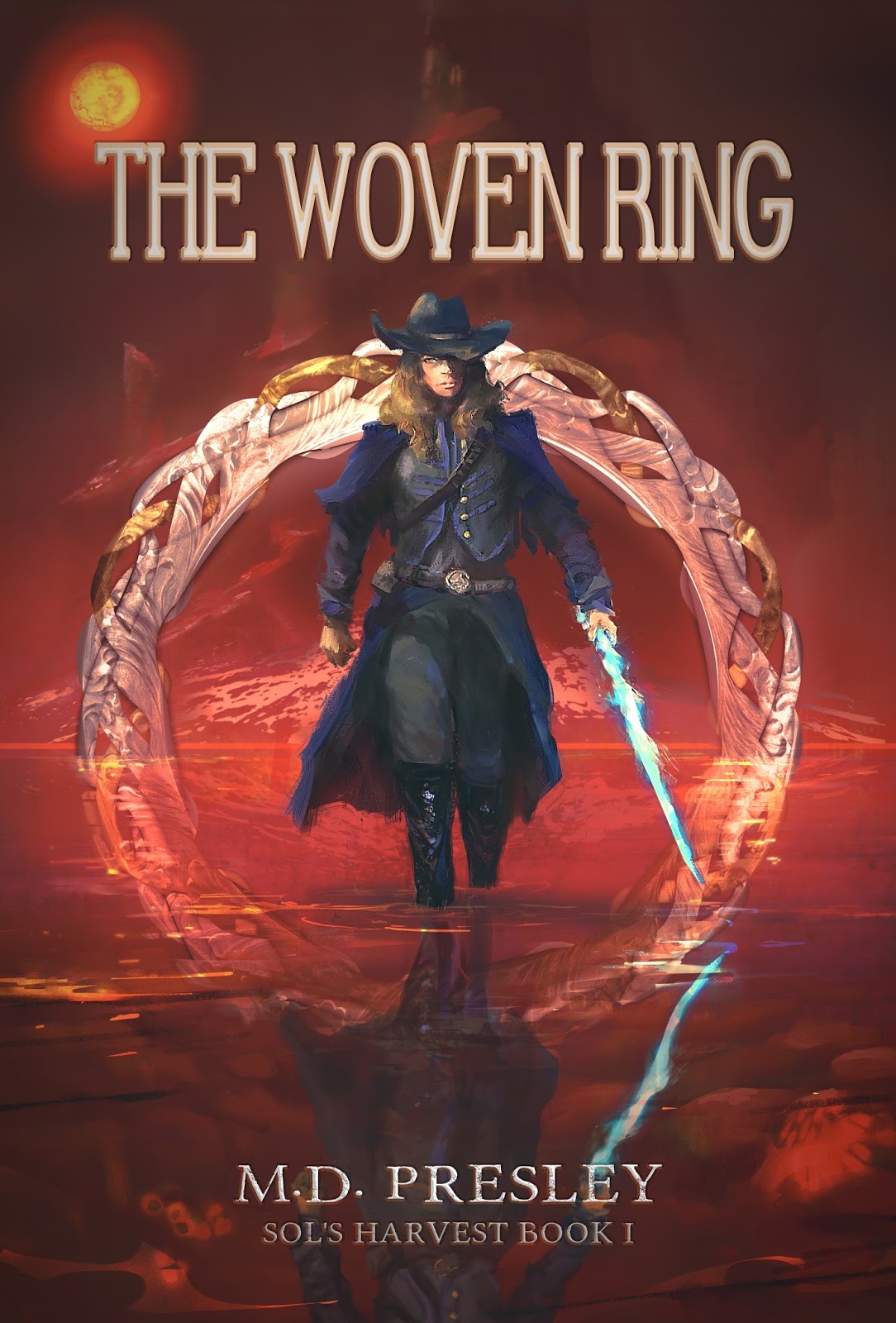
July 10, 2016 marked the e-book & paperback publication of The Woven Ring and it was self-published by the author. Cover art and design is provided by Amit Dutta.
OVERVIEW/ANALYSIS: The Woven Ring is M. D. Presley's debut book and a glorious introduction to the world of Soltera. This title is another one that I was lucky enough to be graced with in this year’s SPFBO. This book was one that stood out to my mind based on its blurb and the fact that it was a fantasy reimagining of the American civil war in a secondary fantasy world. I dove in with a lot of expectations and was rewarded immensely. It was an easy semifinalist pick along with The Songweaver's Vow.
The story begins in two timelines in the world of Soltera. The first track starts nineteen years ago as we meet Marta our protagonist a six year old girl who faces a terrible situation. The first line of the book sets up the scene wonderfully “Marta was mad. Carmichael had lied to her. Again!” While this line & scene might not seem particularly vicious, we soon learn what truly has happened and how much of a twat Carmichael is. The second timeline opens up nearly nineteen years later, Marta is no longer a fresh-eyed girl. She’s a veteran of the civil war that has shaken their nation and left her scarred emotionally & physically. She however is tasked by her elder sibling Carmichael to hunt down a person whom she hates more than her brother. Thus begin the two timelines as we see Marta’s painful evolution into the person that we meet in the second timeline.
Very few titles capture the reader’s interest by offering more than one surprise. This debut book not only has spectacular world building but it also manages dual storylines very coherently. Let’s talk about what captivated me so strongly about this book. Talking about the world & magic system mentioned within. I have to note when it comes to books that have spectacular world-building, often times the book’s plot and characters aren’t quite that up to the mark. On the flip side, often when characters/plot are focused upon then the world-building might conversely suffer. It’s rare for a book to ace both factors, fewer books especially debuts do these things so smoothly. A few examples who fall into this unique category are:
- Scott Lynch’s The Lies Of Locke Lamora,
- Mark Lawrence’s Prince Of Thorns,
- Anthony Ryan's Blood Song
All of these debuts won readers over and have created legacies that most debut authors would love to emulate. With this title by MD Presley, I believe we have another debut which while different from the aforementioned titles, will set its own path. The author has to be lauded for creating a world that while mirroring the American civil war but creates its own legacy. Let’s talk about the world, what the author has so wonderfully done is that while he doesn’t focus on the slavery angle, he builds up a religious conflict which is centered on a magic system. The magic system while being simplistic is quite fascinating. The author builds upon the concept of breath which plants have one (body), animals have two (body, mind) & humans have three (body, mind, soul). With some human beings have four and depending on the location of the fourth breath. The magic users could be classified as a:
- Shaper (body)
- Listener (mind)
- Whisperer (mind)
- Render (soul)
- Weaver (soul)
Order The Woven Ring HERE
OFFICIAL AUTHOR INFORMATION: Born and raised in Texas, Matthew D. Presley spent several years on the East Coast and now lives in California with his wife. His favorite words include defenestrate, callipygian, and Algonquin. The fact that monosyllabic is such a long word keeps him up at night. He’s also worked as a professional Hollywood screenwriter who has written for Chinese TV serials as well. When not writing, he also makes jewelry for fun. This is his debut book.
OFFICIAL BOOK BLURB: A fantasy re-imagining of the American Civil War, The Woven Ring pits muskets against magic, massive war machines against mind readers, and glass sabers against soldiers in psychic exoskeletons.
In exile since the civil war that tore the nation of Newfield apart, former spy and turncoat Marta Childress wants nothing more than to quietly live out her remaining days in the West. But then her manipulative brother arrives with one final mission: Transport the daughter of a hated inventor deep into the East. Forced to decide between safely delivering the girl and assassinating the inventor, Marta is torn between ensuring the fragile peace and sparking a second civil war.
Aided by an untrustworthy Dobra and his mysterious mute companion, Marta soon discovers that dark forces, human and perhaps the devil herself, seek to end her quest into the East.
CLASSIFICATION: Think Mark Lawrence's edgy characters mixed in with Brandon Sanderson's excellent world-building skills and you will have an exact answer to what awaits within this amazing debut.
FORMAT/INFO: The Woven Ring is 292 pages long divided over thirty-four chapters and a prologue. Narration is in the third person via Marta Childress mostly and a few others. This is the first volume of the Sol’s Harvest series.
July 10, 2016 marked the e-book & paperback publication of The Woven Ring and it was self-published by the author. Cover art and design is provided by Amit Dutta.
OVERVIEW/ANALYSIS: The Woven Ring is M. D. Presley's debut book and a glorious introduction to the world of Soltera. This title is another one that I was lucky enough to be graced with in this year’s SPFBO. This book was one that stood out to my mind based on its blurb and the fact that it was a fantasy reimagining of the American civil war in a secondary fantasy world. I dove in with a lot of expectations and was rewarded immensely. It was an easy semifinalist pick along with The Songweaver's Vow.
The story begins in two timelines in the world of Soltera. The first track starts nineteen years ago as we meet Marta our protagonist a six year old girl who faces a terrible situation. The first line of the book sets up the scene wonderfully “Marta was mad. Carmichael had lied to her. Again!” While this line & scene might not seem particularly vicious, we soon learn what truly has happened and how much of a twat Carmichael is. The second timeline opens up nearly nineteen years later, Marta is no longer a fresh-eyed girl. She’s a veteran of the civil war that has shaken their nation and left her scarred emotionally & physically. She however is tasked by her elder sibling Carmichael to hunt down a person whom she hates more than her brother. Thus begin the two timelines as we see Marta’s painful evolution into the person that we meet in the second timeline.
Very few titles capture the reader’s interest by offering more than one surprise. This debut book not only has spectacular world building but it also manages dual storylines very coherently. Let’s talk about what captivated me so strongly about this book. Talking about the world & magic system mentioned within. I have to note when it comes to books that have spectacular world-building, often times the book’s plot and characters aren’t quite that up to the mark. On the flip side, often when characters/plot are focused upon then the world-building might conversely suffer. It’s rare for a book to ace both factors, fewer books especially debuts do these things so smoothly. A few examples who fall into this unique category are:
- Scott Lynch’s The Lies Of Locke Lamora,
- Mark Lawrence’s Prince Of Thorns,
- Anthony Ryan's Blood Song
All of these debuts won readers over and have created legacies that most debut authors would love to emulate. With this title by MD Presley, I believe we have another debut which while different from the aforementioned titles, will set its own path. The author has to be lauded for creating a world that while mirroring the American civil war but creates its own legacy. Let’s talk about the world, what the author has so wonderfully done is that while he doesn’t focus on the slavery angle, he builds up a religious conflict which is centered on a magic system. The magic system while being simplistic is quite fascinating. The author builds upon the concept of breath which plants have one (body), animals have two (body, mind) & humans have three (body, mind, soul). With some human beings have four and depending on the location of the fourth breath. The magic users could be classified as a:
- Shaper (body)
- Listener (mind)
- Whisperer (mind)
- Render (soul)
- Weaver (soul)

The conflict that builds up in the nation of Newfield is due to the theological & philosophical clash that occurs between Renders & Weavers and the eastern and western halves of the nation of Newfield. I loved how the author made this an eastern vs western one (holding a mirror but yet changing events a bit). There’s also the Pseudo-European lands called the Auld lands from whose descendants the nation of Newfield is founded by. There’s also the Myna nations and Ingios territories who are similes’ foe the Native American tribes. I loved how the author managed to weave the travails of the land with the religio-political squabbles that cause all the tension within the story. The author also manages to showcase the science within the story by making the magic system logical and making it a tad boring. What I mean by this is that the magic in this story isn’t the unknown arcane power. It is studied, and harnessed. There are vehicles which are utilized by tapping into the Ley lines of the land. There are ways of communication invented. All of this following the magic system and the powers that can be. All of this is very logically presented & from a world-building perspective is just so damned fine to read.
There’s also characters and this is where I want to talk about Marta. The Marta we meet in the past and the Marta we see in the present timeline are two completely different people. The beauty of the story and the author’s writing is we get to see her first see as a bright & energetic six year old but who then slowly transforms into the twenty five year old, scarred veteran that we meet immediately in the start of the story. While much of the plot is narrated from Marta’s POV, we do get a few POVs from other characters but majorly it’s Marta who shows us the world. I also want to highlight the fact that she’s clearly an anti-hero but perhaps by showing how she became that way, the readers will be able to sympathize with her actions and understand her way of thinking. Like I mentioned previously Marta was a character whom I both admired & disliked. I look forward to what reactions she creates among other readers. There’s also the other characters we meet via Marta, and like Anthony Ryan’s Blood Song, we seem them as flesh & blood ones with dreams, plans & aspirations of their own. I very much enjoyed the greyness of most characters as they are caught in this conflict which makes everyone a puppet of other folks. Not to say that there aren’t villainous characters, there are but the true fun is reading morally ambiguous folks who are defined by their circumstances rather than personal choices.
The mythology of the land, plus the presence of certain magical creatures is very well ensconced within the story and doesn’t feel like an infodump and this was truly an outstanding feature. Because in a world this rich, it might be all too easy to have characters go on soliloquys explaining different facets of the world, religion, etc. Credit to the author he explains a lot without making it all too complex or boring. For a cartophile like me, there’s also three maps provided which further enriched my read.
Lastly I can think of only two drawback in this story, firstly we truly never get a viewpoint into Carmichael Childress and this was disappointing. One of the major conflicts of the story is this sibling rivalry between Marta & Carmichael and to never get a different side to it was slightly off putting. But since this only volume one of the entire story I’m willing to wait and see how the story unfolds. There’s also the plot pace which is a bit slow in the start of both story lines however within the first two-three chapters of each timepoint it picks up rapidly and from that point onwards, it just surges forward slowly and surely building up to a dual climax in the past and present. For some readers though this might not be the pace they are used to expect.
CONCLUSION: The Woven Ring is an understated effort however it’s not an underwhelming one. M. D. Presley has given the readers a story that touches the elegant writings of Mark Lawrence in creating wholly realized, unlikeable anti-heroes whom you cannot ignore. Plus the scale & depth of world-building is definitely on par with some of Brandon Sanderson’s finest efforts. All of this is a debut which heralds a rich future for Matt D. Presley and I for one will have a very, very hard time in deciding who will be our ultimate finalist based on all the four semifinalist selected so far.
There’s also characters and this is where I want to talk about Marta. The Marta we meet in the past and the Marta we see in the present timeline are two completely different people. The beauty of the story and the author’s writing is we get to see her first see as a bright & energetic six year old but who then slowly transforms into the twenty five year old, scarred veteran that we meet immediately in the start of the story. While much of the plot is narrated from Marta’s POV, we do get a few POVs from other characters but majorly it’s Marta who shows us the world. I also want to highlight the fact that she’s clearly an anti-hero but perhaps by showing how she became that way, the readers will be able to sympathize with her actions and understand her way of thinking. Like I mentioned previously Marta was a character whom I both admired & disliked. I look forward to what reactions she creates among other readers. There’s also the other characters we meet via Marta, and like Anthony Ryan’s Blood Song, we seem them as flesh & blood ones with dreams, plans & aspirations of their own. I very much enjoyed the greyness of most characters as they are caught in this conflict which makes everyone a puppet of other folks. Not to say that there aren’t villainous characters, there are but the true fun is reading morally ambiguous folks who are defined by their circumstances rather than personal choices.
The mythology of the land, plus the presence of certain magical creatures is very well ensconced within the story and doesn’t feel like an infodump and this was truly an outstanding feature. Because in a world this rich, it might be all too easy to have characters go on soliloquys explaining different facets of the world, religion, etc. Credit to the author he explains a lot without making it all too complex or boring. For a cartophile like me, there’s also three maps provided which further enriched my read.
Lastly I can think of only two drawback in this story, firstly we truly never get a viewpoint into Carmichael Childress and this was disappointing. One of the major conflicts of the story is this sibling rivalry between Marta & Carmichael and to never get a different side to it was slightly off putting. But since this only volume one of the entire story I’m willing to wait and see how the story unfolds. There’s also the plot pace which is a bit slow in the start of both story lines however within the first two-three chapters of each timepoint it picks up rapidly and from that point onwards, it just surges forward slowly and surely building up to a dual climax in the past and present. For some readers though this might not be the pace they are used to expect.
CONCLUSION: The Woven Ring is an understated effort however it’s not an underwhelming one. M. D. Presley has given the readers a story that touches the elegant writings of Mark Lawrence in creating wholly realized, unlikeable anti-heroes whom you cannot ignore. Plus the scale & depth of world-building is definitely on par with some of Brandon Sanderson’s finest efforts. All of this is a debut which heralds a rich future for Matt D. Presley and I for one will have a very, very hard time in deciding who will be our ultimate finalist based on all the four semifinalist selected so far.

With the first & second semi-finalists already chosen, it was high time that we went through the other titles. I have to apologize in this regard as work had caused my reviewing to take a backseat. Cindy had a family emergency which also took most of her time. As I had explained in my 2017 SPFBO introduction post. We’ll be ideally selecting one book semifinalist from every five books. These book groupings are random and sometimes we might have no semi-finalists or we might have more than one in one group.
As with our previous two lots I’ve tried to read at least five chapters or 20% of the book (whichever was longer). So here are my concise thoughts on each of them:
The Songweaver’s Vow by Laura VanArendonk Baugh – This book was the third book based on the blurb and the excerpt and this book completely blew me away. The story is set in pre-historic times and features a Greek girl among Vikings, and Norse gods of yore. Plus she has to navigate her survival there with just her wits and her stories. The author’s characterization and lovely prose made me a fan and once I finished it. This book was a straightforward semifinalist for me. More to come in review next week…
Dybsy by A.M. Macdonald – Dybsy is an interesting fantasy-SF hybrid story that I enjoyed reading but ultimately I couldn’t select to go forward. Let me be clear, the author has made it a very simple story to follow and the pace is terrific as well. The one thing that’s mars the read to a certain degree is the simplistic characterization. This book would be better enjoyed by 14-year old me but 34 year old me didn’t quite enjoy it to the same degree. A valiant effort and the author has to be lauded for this imaginative hybrid story with shades of Ender’s Game & Ready Player One (though with a lot less pop culture references).
The Defenders' Apprentice by Amelia Smith – The Defender’s Apprentice is a classic fantasy story that will certainly have its fans. Amelia Smith does a good job of introducing her world and the relatable POV characters however its scope is limited because of the very predictable storyline. This is not a dig against the book and it certainly is for younger readers of fantasy. However for most genre readers (like myself) it doesn’t offer anything startling or original to mark itself out. A decent story that I liked but couldn’t really say that it would make me pick up the next book.
The Hiss of the Blade by Richard Writhen – The Hiss Of The Blade was a book that I had high hopes for as I often enjoy darker turns of fantasy. This book was a bit on the shorter side and while it offered some dark thrills. It didn’t quite seem that cohesive plot wise. I liked how the author set up the story with a gruesome murder and the noir shades to the story were very interesting however the characterization was a bit flat. Overall this is a story with some terrific scary bits to it but the execution wasn’t all that good which is why the story seemed more than a bit dry and I couldn’t care much for it.
The Woven Ring by M. D. Presley – This was another surprise for me as while the blurb seemed intriguing, this book blew me away completely. Let me be clear, this book has its odd bits to it but so far in the three years of SPFBO and among all the titles which I’ve read. This book has the best world-building showcased that I’ve ever come across. Not to say that’s the only plus point but featuring a dual storyline akin to Mark Lawrence’s Thorn trilogy. The author gives us a superb female anti-hero who will make readers admire & dislike her in equal parts. This book for me is the biggest surprise in SPFBO and I’ll be talking more about it in the proper review next week. Think Mark Lawrence's edgy characters meets Brandon Sanderson's worldbuiding skills and you will have an exact answer to what awaits within...
As with our previous two lots I’ve tried to read at least five chapters or 20% of the book (whichever was longer). So here are my concise thoughts on each of them:
The Songweaver’s Vow by Laura VanArendonk Baugh – This book was the third book based on the blurb and the excerpt and this book completely blew me away. The story is set in pre-historic times and features a Greek girl among Vikings, and Norse gods of yore. Plus she has to navigate her survival there with just her wits and her stories. The author’s characterization and lovely prose made me a fan and once I finished it. This book was a straightforward semifinalist for me. More to come in review next week…
Dybsy by A.M. Macdonald – Dybsy is an interesting fantasy-SF hybrid story that I enjoyed reading but ultimately I couldn’t select to go forward. Let me be clear, the author has made it a very simple story to follow and the pace is terrific as well. The one thing that’s mars the read to a certain degree is the simplistic characterization. This book would be better enjoyed by 14-year old me but 34 year old me didn’t quite enjoy it to the same degree. A valiant effort and the author has to be lauded for this imaginative hybrid story with shades of Ender’s Game & Ready Player One (though with a lot less pop culture references).
The Defenders' Apprentice by Amelia Smith – The Defender’s Apprentice is a classic fantasy story that will certainly have its fans. Amelia Smith does a good job of introducing her world and the relatable POV characters however its scope is limited because of the very predictable storyline. This is not a dig against the book and it certainly is for younger readers of fantasy. However for most genre readers (like myself) it doesn’t offer anything startling or original to mark itself out. A decent story that I liked but couldn’t really say that it would make me pick up the next book.
The Hiss of the Blade by Richard Writhen – The Hiss Of The Blade was a book that I had high hopes for as I often enjoy darker turns of fantasy. This book was a bit on the shorter side and while it offered some dark thrills. It didn’t quite seem that cohesive plot wise. I liked how the author set up the story with a gruesome murder and the noir shades to the story were very interesting however the characterization was a bit flat. Overall this is a story with some terrific scary bits to it but the execution wasn’t all that good which is why the story seemed more than a bit dry and I couldn’t care much for it.
The Woven Ring by M. D. Presley – This was another surprise for me as while the blurb seemed intriguing, this book blew me away completely. Let me be clear, this book has its odd bits to it but so far in the three years of SPFBO and among all the titles which I’ve read. This book has the best world-building showcased that I’ve ever come across. Not to say that’s the only plus point but featuring a dual storyline akin to Mark Lawrence’s Thorn trilogy. The author gives us a superb female anti-hero who will make readers admire & dislike her in equal parts. This book for me is the biggest surprise in SPFBO and I’ll be talking more about it in the proper review next week. Think Mark Lawrence's edgy characters meets Brandon Sanderson's worldbuiding skills and you will have an exact answer to what awaits within...

So there we have it, for the first time ever, we have two semifinalists chosen. The Songweaver’s Vow & The Woven Ring are two fantastic titles that SPFBO has unearthed and you all should be reading them pronto to see why they are so special IMHO.
Also I’ll be interviewing both the authors as well so look forward to their thoughts on a variety of topics…
Also I’ll be interviewing both the authors as well so look forward to their thoughts on a variety of topics…
Friday, September 22, 2017
SPFBO: Interview With A. W. Exley (Interviewed by Cindy Hannikman & Mihir Wanchoo)

Official Author Website
Order Nefertiti's Heart HERE
Read Fantasy Book Critic's review of Nefertiti's Heart
Anita W. Exley's Nefertiti's Heart really captivated both Cindy & me as evidenced in our review. It had the perfect mix of characterization, plot pace & Victorian settings that made the story so compelling. We were more than thrilled when Anita agreed to answer a few questions about her writing, the Artifact Hunter series & herself. So read ahead to get to know her better, checkout the gorgeous covers of her books and lose yourself in a captivating world.
Q] Welcome to Fantasy Book Critic. To begin with, could you tell us a little about yourself, your background & your interests?
AWE: I'm Anita and I live in rural New Zealand where I have horses. I used to be a forensic accountant, until I realized it was more fun to sit at home and kill people ;) I'm one of those people born in the wrong era - I ride sidesaddle, adore hats, wear a corset, and was steampunk long before I ever heard the word.
Q] Can you tell us what inspired you to be a writer in the first place, what experience you went through in finishing your book, & why you chose to go the self-publishing route?
AWE: As cliché as it sounds, I'm one of those people who has always written. Books were my escape as a child and creating my own worlds was a natural extension of that, I just never finished anything! lol When I took a parenting break from my accounting job, I was looking for something to keep my mind engaged and decided to take the plunge and finish writing a book. From there it grew as I became more focused and I hit the query trenches trying to land an agent (hint: I failed). I had a friend who gave up on querying despite agent offers, and she headed off into indie waters and encouraged me to follow.
Q] Please elaborate how the genesis of Nefertiti’s Heart occurred. How long have you been working on it? Has it evolved from its original idea (if any)?
AWE: I had written a young adult steampunk novel that failed to interest agents, so decided to try my hand at an older novel with different characters. I have always loved Egypt and wanted to finally use my Egyptology studies! I was staring at my text books, trying to figure out a way to bring ancient Egypt into a steampunk England when I decided to do it via an ancient artifact. I was fascinated by the story of Nefertiti and Akhenaton and once the idea of the mechanical heart popped into my mind, the story grew from there. I think it took me about a year to write the book after that.
Q] Many writers have a muse, who directs their writing, and others do not seem to be affected the same way. Which group do you fall into? What is your main motivation and source of inspiration?
AWE: I listen with envy to other authors who say how their muse pours forth words onto a page. I have to hunt my muse with a sack and a tranq gun. I'm a very slow writer and spend a lot of time turning a scene over in my head before I write it down. I tend to start with the seed of an idea (like a mechanical heart and a killer intent on finding it) and often the ending, then I have to work backwards and figure out how it all unfolded.
Order Nefertiti's Heart HERE
Read Fantasy Book Critic's review of Nefertiti's Heart
Anita W. Exley's Nefertiti's Heart really captivated both Cindy & me as evidenced in our review. It had the perfect mix of characterization, plot pace & Victorian settings that made the story so compelling. We were more than thrilled when Anita agreed to answer a few questions about her writing, the Artifact Hunter series & herself. So read ahead to get to know her better, checkout the gorgeous covers of her books and lose yourself in a captivating world.
Q] Welcome to Fantasy Book Critic. To begin with, could you tell us a little about yourself, your background & your interests?
AWE: I'm Anita and I live in rural New Zealand where I have horses. I used to be a forensic accountant, until I realized it was more fun to sit at home and kill people ;) I'm one of those people born in the wrong era - I ride sidesaddle, adore hats, wear a corset, and was steampunk long before I ever heard the word.
Q] Can you tell us what inspired you to be a writer in the first place, what experience you went through in finishing your book, & why you chose to go the self-publishing route?
AWE: As cliché as it sounds, I'm one of those people who has always written. Books were my escape as a child and creating my own worlds was a natural extension of that, I just never finished anything! lol When I took a parenting break from my accounting job, I was looking for something to keep my mind engaged and decided to take the plunge and finish writing a book. From there it grew as I became more focused and I hit the query trenches trying to land an agent (hint: I failed). I had a friend who gave up on querying despite agent offers, and she headed off into indie waters and encouraged me to follow.
Q] Please elaborate how the genesis of Nefertiti’s Heart occurred. How long have you been working on it? Has it evolved from its original idea (if any)?
AWE: I had written a young adult steampunk novel that failed to interest agents, so decided to try my hand at an older novel with different characters. I have always loved Egypt and wanted to finally use my Egyptology studies! I was staring at my text books, trying to figure out a way to bring ancient Egypt into a steampunk England when I decided to do it via an ancient artifact. I was fascinated by the story of Nefertiti and Akhenaton and once the idea of the mechanical heart popped into my mind, the story grew from there. I think it took me about a year to write the book after that.
Q] Many writers have a muse, who directs their writing, and others do not seem to be affected the same way. Which group do you fall into? What is your main motivation and source of inspiration?
AWE: I listen with envy to other authors who say how their muse pours forth words onto a page. I have to hunt my muse with a sack and a tranq gun. I'm a very slow writer and spend a lot of time turning a scene over in my head before I write it down. I tend to start with the seed of an idea (like a mechanical heart and a killer intent on finding it) and often the ending, then I have to work backwards and figure out how it all unfolded.

Q] Nefertiti’s Heart is the first volume in the Artifact Hunter series. The series is completed so could you talk about what the readers can expect next in the series?
AWE: Life becomes more complicated for my heroine as she adapts to life with the villainous viscount and the secrets he is keeping. Queen Victoria succumbs to megalomania brought on by an artifact from Hatshepsut, a powerful woman who became a pharaoh. Cara needs to figure out how to get the necklace off the queen before she takes over the world. Then someone intent on keeping a decades old secret uses a fiddle that once belonged to Nero to tidy up loose ends by inducing spontaneous human combustion …
Q] One of the things I noticed in your debut was a good mix of steampunk mixed in with a solid mystery. Could you tell us about the research which you undertook before attempting to write the Victorian era as described within it? What were the things which you focused upon and any fascinating things that you found amidst your research?
AWE: I read a lot of non fiction about British history, plus grew up on a steady diet of BBC programmes. I've spent some time walking the streets of London and love the sense of history that soaks up from the cobbles and it was natural to take Victorian London as a starting point. From there I determined how my world differed and how I would utilize steam/mechanical technology.
It's the tiny details about every day life that I find the most amazing. Like learning that an electric light was first demonstrated in 1835 and in the 1840s a French nobleman lit up his estate with electric lights, long before Edison even thought about the light bulb. I also discovered that condoms were made by the Goodyear tyre company in the 1860s and bore a lot in common with inner tubes…! lol
Q] Cover art is always an important factor in book sales (whether we like it or not). This factor becomes even more crucial with self-publishing wherein reader prejudice can be higher. Your Artifact Hunters has some gorgeous cover art, I would love to hear how these covers came to be?
AWE: The covers started with a very simplistic idea of hand + artifact. However by the time I got to book 4, a staff just didn't seem that interesting as a cover symbol. I had a look around at a number of other steampunk books that feature women in corsets. However I'm a corset snob and no cheap plastic boned monstrosity was going on my books! I have a friend who is a very talented photographer and fellow corset wearer and she offered to do a custom photo shoot for me. The mechanical heart that Ricky Gunawan designed is such a powerful image (and central to my author branding) so I kept that for book 1, but used custom photographs as the basis for books 2, 2.5, 3 and 4. Regina from Mae I Design then took the photos and gave each a different treatment that reflects the tone of the book, like the fire for Nero's Fiddle and the frozen London of Moseh's Staff.
Q] Talking about characters, even though your book focusses on Cara & Nathaniel primarily. The character cast however is no less intriguing with folks such as Jackson and the Scotland Yard detectives. In this regard I found your book to be very exciting. Could you talk about how you develop your characters and how do their personas come forth?
AWE: I think secondary characters are often more interesting and believe they should each have their own backstory and motivations, they are after all the stars of their own stories, just not the current focus. When I create a secondary character I spend a bit of time thinking about who they are, where they came from and what pivotal moments impacted their personality/flaws. Two of mine (former pugilist Jackson and airship captain Loki) spawned their own books and I have always wanted to go back and write my detective's story and his investigation into the serial killer known as The Grinder.
AWE: Life becomes more complicated for my heroine as she adapts to life with the villainous viscount and the secrets he is keeping. Queen Victoria succumbs to megalomania brought on by an artifact from Hatshepsut, a powerful woman who became a pharaoh. Cara needs to figure out how to get the necklace off the queen before she takes over the world. Then someone intent on keeping a decades old secret uses a fiddle that once belonged to Nero to tidy up loose ends by inducing spontaneous human combustion …
Q] One of the things I noticed in your debut was a good mix of steampunk mixed in with a solid mystery. Could you tell us about the research which you undertook before attempting to write the Victorian era as described within it? What were the things which you focused upon and any fascinating things that you found amidst your research?
AWE: I read a lot of non fiction about British history, plus grew up on a steady diet of BBC programmes. I've spent some time walking the streets of London and love the sense of history that soaks up from the cobbles and it was natural to take Victorian London as a starting point. From there I determined how my world differed and how I would utilize steam/mechanical technology.
It's the tiny details about every day life that I find the most amazing. Like learning that an electric light was first demonstrated in 1835 and in the 1840s a French nobleman lit up his estate with electric lights, long before Edison even thought about the light bulb. I also discovered that condoms were made by the Goodyear tyre company in the 1860s and bore a lot in common with inner tubes…! lol
Q] Cover art is always an important factor in book sales (whether we like it or not). This factor becomes even more crucial with self-publishing wherein reader prejudice can be higher. Your Artifact Hunters has some gorgeous cover art, I would love to hear how these covers came to be?
AWE: The covers started with a very simplistic idea of hand + artifact. However by the time I got to book 4, a staff just didn't seem that interesting as a cover symbol. I had a look around at a number of other steampunk books that feature women in corsets. However I'm a corset snob and no cheap plastic boned monstrosity was going on my books! I have a friend who is a very talented photographer and fellow corset wearer and she offered to do a custom photo shoot for me. The mechanical heart that Ricky Gunawan designed is such a powerful image (and central to my author branding) so I kept that for book 1, but used custom photographs as the basis for books 2, 2.5, 3 and 4. Regina from Mae I Design then took the photos and gave each a different treatment that reflects the tone of the book, like the fire for Nero's Fiddle and the frozen London of Moseh's Staff.
Q] Talking about characters, even though your book focusses on Cara & Nathaniel primarily. The character cast however is no less intriguing with folks such as Jackson and the Scotland Yard detectives. In this regard I found your book to be very exciting. Could you talk about how you develop your characters and how do their personas come forth?
AWE: I think secondary characters are often more interesting and believe they should each have their own backstory and motivations, they are after all the stars of their own stories, just not the current focus. When I create a secondary character I spend a bit of time thinking about who they are, where they came from and what pivotal moments impacted their personality/flaws. Two of mine (former pugilist Jackson and airship captain Loki) spawned their own books and I have always wanted to go back and write my detective's story and his investigation into the serial killer known as The Grinder.

Q] The world described in your book is Victorian but with steampunk technology added to it. One of things that I would have better enjoyed in this book if more of the world-building were revealed. What was your inspiration for the setting and what are your thoughts on world-building in general?
AWE: Nefertiti's Heart definitely suffers from first book syndrome and by that I mean things that in retrospect, I wish I had done better or differently. In hindsight I completely agree with you and wish I had spent longer thinking about the world, how its technology differed and what impact that had on society. In many ways I winged it and dealt with issues as they arose, but if I had fleshed the world out before I started writing, I think it would have delivered a deeper and more satisfying experience. By the time book 2 was written and the series was gathering momentum I was stuck with the boundaries I had created and had to make the best of it.
It's been a learning experience for me, and with other series I am tackling I am sorting out the world building beforehand and trying to have certain cornerstones in place before I start writing.
Q] Please tell us about the books and authors who have captured your imagination and inspired you to become a wordsmith in your own right. Similarly, are there any current authors you would like to give a shout out to?
AWE: My introduction to fantasy came as a child when I discovered Anne McCaffrey. Pern captured my imagination and never let go, and who doesn't want to Impress a dragon? Even today I still enjoy her continuing legacy and the novels written by her son, Todd. I also chewed through the Dragonlance chronicles and discovered Raymond E Feist. Fantasy is my first and enduring love but my catnip these days is when fantasy is twisted up with a historical time period like Gail Carriger's Parasol Protectorate series or Bec McMaster's London Steampunk.
I'd like to give a shout out to the Historical Fantasy Bookclub. We have a monthly book that we read (and twice a year we watch a historical fantasy movie) and I've been reading far wider and outside my usual go-to authors. I've found many new authors to follow and lost myself in books and worlds I wouldn't normally pick up
Q] Thank you for taking the time to answer all the questions. In closing, do you have any parting thoughts or comments you would like to share with our readers?
AWE: A huge thank you to Mark Lawrence for the work he does in organizing and running the SPFBO and I want to take a moment to thank Cindy & Mihir, the Fantasy Book Critic crew, for the time and effort you put into reading and reviewing for participating authors. I've been visiting the blogs and adding to my growing TBR pile but there's no way I'd want to try and pick just one book to put forward!
AWE: Nefertiti's Heart definitely suffers from first book syndrome and by that I mean things that in retrospect, I wish I had done better or differently. In hindsight I completely agree with you and wish I had spent longer thinking about the world, how its technology differed and what impact that had on society. In many ways I winged it and dealt with issues as they arose, but if I had fleshed the world out before I started writing, I think it would have delivered a deeper and more satisfying experience. By the time book 2 was written and the series was gathering momentum I was stuck with the boundaries I had created and had to make the best of it.
It's been a learning experience for me, and with other series I am tackling I am sorting out the world building beforehand and trying to have certain cornerstones in place before I start writing.
Q] Please tell us about the books and authors who have captured your imagination and inspired you to become a wordsmith in your own right. Similarly, are there any current authors you would like to give a shout out to?
AWE: My introduction to fantasy came as a child when I discovered Anne McCaffrey. Pern captured my imagination and never let go, and who doesn't want to Impress a dragon? Even today I still enjoy her continuing legacy and the novels written by her son, Todd. I also chewed through the Dragonlance chronicles and discovered Raymond E Feist. Fantasy is my first and enduring love but my catnip these days is when fantasy is twisted up with a historical time period like Gail Carriger's Parasol Protectorate series or Bec McMaster's London Steampunk.
I'd like to give a shout out to the Historical Fantasy Bookclub. We have a monthly book that we read (and twice a year we watch a historical fantasy movie) and I've been reading far wider and outside my usual go-to authors. I've found many new authors to follow and lost myself in books and worlds I wouldn't normally pick up
Q] Thank you for taking the time to answer all the questions. In closing, do you have any parting thoughts or comments you would like to share with our readers?
AWE: A huge thank you to Mark Lawrence for the work he does in organizing and running the SPFBO and I want to take a moment to thank Cindy & Mihir, the Fantasy Book Critic crew, for the time and effort you put into reading and reviewing for participating authors. I've been visiting the blogs and adding to my growing TBR pile but there's no way I'd want to try and pick just one book to put forward!
*---------------*---------------*---------------*
Thursday, September 21, 2017
SPFBO Review "Neferiti's Heart: The Artifact Hunters Book 1" by A.W. Exley (Reviewed by Mihir Wanchoo and Cindy Hannikman)

OVERVIEW:
1861. Cara has a simple mission in London – finalise her father’s estate and sell off his damned collection of priceless artifacts. Her plan goes awry when a killer stalks the nobility, searching for an ancient Egyptian relic rumoured to hold the key to immortality.
Nathaniel Trent, known as the villainous viscount, is relentless in his desire to lay his hands on both Cara and the priceless artifacts. His icy exterior and fiery touch stirs Cara’s demons, or could he lay them to rest?
Self-preservation fuels Cara’s search for the gem known as Nefertiti’s Heart. In a society where everyone wears a mask to hide their true intent, she needs to figure out who to trust, before she sacrifices her own heart and life
1861. Cara has a simple mission in London – finalise her father’s estate and sell off his damned collection of priceless artifacts. Her plan goes awry when a killer stalks the nobility, searching for an ancient Egyptian relic rumoured to hold the key to immortality.
Nathaniel Trent, known as the villainous viscount, is relentless in his desire to lay his hands on both Cara and the priceless artifacts. His icy exterior and fiery touch stirs Cara’s demons, or could he lay them to rest?
Self-preservation fuels Cara’s search for the gem known as Nefertiti’s Heart. In a society where everyone wears a mask to hide their true intent, she needs to figure out who to trust, before she sacrifices her own heart and life
ANALYSIS: (Mihir) Nefertiti’s Heart is an intriguing book that
popped up in Fantasy Book Critic’s lot. Firstly it was a top 3 contender with its
gorgeous cover art and the blurb was exciting enough for me to get started on
it early on. The book’s blurb details our protagonist’s hurry to sell off her
father’s estate for reasons that become crystal clear in the first few chapters
itself. Cara Devon is a person who’s been shaped by her teenage/adolescent
years and those hardships have left mental, physical & psychological scars
on her. These scars inform her current behavior and outlook in life wherein she
has decided she wants nothing to do with her dad and his precious collection.
Cara’s struggles are further compounded
when she learns that some of the items in her father’s collections are prized
by similarly focused individuals who share even less morality than her recently
departed father. There’s also the concern that her father’s death wasn’t a
natural one and due to which Scotland Yard detectives are very much intrigued
by her and her whereabouts. There’s also the Viscount who’s interested in her
legacy and a Scotland Yard officer who wants the truth to be uncovered. These
are the main characters in play and there’s a serial killer at work too. These
are the tangled threads that author A. W. Exley puts into play in the first
volume of The Artifact Hunters series. The book ends on a strong climax which
solve the mystery presented in this first volume but sets up a romantic plot
thread that will resolve over the series as well gives us a colorful cast of
characters to follow.
What I loved immediately about this
book upon starting it was the characterization beginning with Cara. She’s a
formidable character who will intrigue the reader with the hints about her past
and her resoluteness in her wish to be rid of her father’s legacy. I was
immediately drawn to her and as the story progresses we find that there’s more
to her grit. The story is almost a thriller with some solid romantic overtones
to it and I felt that as a thriller lover, I was able to enjoy the story and
even the romance. I can’t speak to how well the romance is crafted since I’m
not that big a romance reader but the story held up for me. A word of caution
though there’s some dark stuff within with regards to Cara’s backstory and it
might not be palatable to everyone. Any plus point about the book was its
streamlined pace and the mystery at its core. In this regard this book was a
definite surprise as it managed to successfully mold aspects of the thriller,
romance & steampunk genres in its fold confidently. Lastly the book cover
is an eye-catching one and was in the top 3 from our lot.
The not so fun parts to this story,
well there’s the whole romance buildup which takes place between our
protagonist and the Viscount which doesn’t quite add up. For example our
heroine doesn’t like been touched but is strangely drawn to the count’s dark
brooding ways. The author explains some of this attraction later on in the plot
but it didn’t quite ring much for me. Maybe for romance readers this might be a
genre trope and that would explain it. For me, that was a bit of a glitch in
the story. There’s also the steampunk aspect of the story which seems a tad
window dressing like. Sure there’s mention of airships and other things from
time to time but not much explanation is provided of how things came to be as
they are.
Overall these are minor complaints from
me as I still was able to enjoy the story because of the main mystery, the
engaging characters (main and side cast) as well as the plot pace which makes
it quite easy to want to keep on reading. I think this book definitely deserves
a semifinal slot and I would be interested to see how the author develops the
world and characters in the sequels. Nefertiti’s Heart is a fun but dark
romantic mystery story that offers a bit of many genres and marks itself as a
good read nonetheless.
(Cindy) I think I have mentioned a time or two or even more
that I love reading books that take place in London. When I saw that
Nefertiti's Heart took place in a Victorian-era London, I instantly had to give
it a shot.
Nefertiti's Heart is a mixed bag of genres all combined into
one book. There is a little bit of sci-fi/steampunk, adventure, mystery,
gothic, and romance. Normally this wouldn't work out as it would seem that mixing
so many different genres would cause the plot/characters/flow of the book to
suffer, but it didn't.
I will admit that there is a heavier emphasis on the romance
element than I am used to or really would care to read, but – for me – the
mystery and steampunk elements were strong enough that I could easily look over
the romance-heavy sections.
There were a lot of things that I really enjoyed about
Nefertiti's Heart. It had a very fast-paced feel to it, the mystery was
captivating, and I really "clicked" with the characters. Add in the
fact that much of the mythology referenced and time period was very well
researched and you have a solid novel that is extremely enjoyable.
While I really enjoyed Nefertiti's Heart, I will admit that
it isn't going to be everyone's cup of tea. The romance-heavy sections are
really heavy on the romance. Not every reader is going to be able to overlook
it and some may even feel it draws from the plot.
There is also another issue that really needs to be
mentioned. It isn't so much an issue, but it does – I feel – need to be noted
so readers can make an informed decision. Nefertiti's Heart brings up some
pretty grim and heavy topics. If you are squeamish regarding abuse, especially
the physical and sexual abuse of a child/teen, the entire novel isn't going to
fit for you. While these topics are heavy, I felt they were handled in an
appropriate manner.
Overall, I feel Nefertiti's Heart is a strong novel. It
certainly isn't going to be everyone's favorite book and there are going to be
a lot of things some readers don't like, but for me, personally, it worked.
Give it a shot, you might be impressed.
Subscribe to:
Posts (Atom)


