
To celebrate the October 2011 publication of Manhattan In Reverse, Peter F. Hamilton’s first short story collection in thirteen years, SFX and Pan Macmillan are delighted to announce a very special and unique artwork competition. Two lucky winners will see their jacket designs adorn special eBook editions of two stories from the collection!
Manhattan In Reverse takes readers on a journey from a murder mystery in an alternative Oxford in the 1800s to a brand new story featuring Paula Myo, Deputy Director of the Intersolar Commonwealth’s Serious Crimes Directorate. Dealing with intricate themes and topical subject matter, this top ten bestselling author is at the top of his game.
Pan Macmillan will be releasing two short stories from the collection in eBook format a month early. These will be available to buy through Apple’s iBookstore, Amazon and Waterstone and WHSmith online. SFX and Pan Macmillan are looking for jacket designs for both stories.
The two winning designs will be selected by a judging panel that includes Peter, his publishing team at Pan Macmillan and SFX staff.
Peter F Hamilton says: “There’s so much promising design talent out there and I’m excited to see how my stories are interpreted.”
SFX will be posting entries online as they come in and Peter will be dropping in to talk about his favourites and his writing more generally between now and the winning announcement in August.
The two winning designs will be selected by a judging panel that includes Peter, his publishing team at Pan Macmillan and SFX staff.
Peter F Hamilton says: “There’s so much promising design talent out there and I’m excited to see how my stories are interpreted.”
SFX will be posting entries online as they come in and Peter will be dropping in to talk about his favourites and his writing more generally between now and the winning announcement in August.
HOW TO ENTER:
• Pan Macmillan has provided cover briefs for the short stories The Demon Trap and Footvote—click on the links to view the briefs. These are exactly the type of briefs that professional artists will receive when they are commissioned to create cover artwork. Read them carefully because they are essential in helping you make your creative choices.
• You can provide entries for either or both stories.
• Your entry must be supplied in its complete form as a 300 dpi high resolution Jpeg or PDF under 2MB.
• Your entry must be 240mmx156mm.
• Your entry should be submitted to artwork@macmillan.co.uk
• Only original artwork or digital artwork will be considered and all artwork must be sent with your Name, Contact Telephone Number and Email Address in the body of the email and clearly marked in the subject header “Short Story Artwork Competition”. Incomplete entries will be disqualified.
• Entries must be received by Pan Macmillan on or before the closing date of August 1, 2011 before 5.30pm GMT. Pan Macmillan may require a higher res version of the file at a later date
• Please read the Official Terms and Conditions for more details.
 3:00 PM |
  Posted by
Robert |
Posted by
Robert |


Order “The Goblin Corps” HERE
Read FBC’s Review of “The Conqueror’s Shadow”
Read FBC’s Review of “The Warlord’s Legacy”
AUTHOR INFORMATION: Ari Marmell has a BA in Creative Writing at the University of Houston. He has worked for such role-playing games as Dungeons & Dragons and the World of Darkness, while written tie-in fiction for Vampire: the Masquerade and Magic: the Gathering. His first wholly original novel was The Conqueror’s Shadow, followed by the sequel, The Warlord’s Legacy. Forthcoming releases from Pyr include the YA novels, Thief’s Covenant and Witch Hunt.
PLOT SYNOPSIS: Morthûl, the dreaded Charnel King, has failed.
Centuries of plotting from the heart of the Iron Keep, deep within the dark lands of Kirol Syrreth—all for naught. Foiled at the last by the bumbling efforts of a laughable band of so-called heroes, brainless and over-muscled cretins without sense enough to recognize a hopeless cause when they take it on. Machinations developed over generations, schemes intended to deliver the world into the Dark Lord’s hands, now devastated beyond salvation. But the so-called forces of Light have paid for their meddling with the life of Princess Amalia, only child of the royal family of Shauntille.
Now, as winter solidifies its icy grip on the passes of the Brimstone Mountains, disturbing news has reached the court of Morthûl. King Dororam, enraged by the murder of his only child—and accompanied by that same group of delusional upstart “heroes”—is assembling all the Allied Kingdoms, fielding an army unlike any seen before. The armies of Kirol Syrreth muster to meet the attack that is sure to come as soon as the snows have melted from the mountain paths, but their numbers are sorely depleted. Still, after uncounted centuries of survival, the Dark Lord isn’t about to go down without a fight, particularly in battle against a mortal! No, the Charnel King still has a few tricks up his putrid and tattered sleeves, and the only thing that can defeat him now may just be the inhuman soldiers on whom he’s pinned his last hopes.
Welcome to the Goblin Corps. May the best man lose...
FORMAT/INFO: The Goblin Corps is 552 pages long divided over a Prologue, eleven numbered/titled chapters, and an Epilogue. Narration is in the third-person omniscient via numerous characters including the seven members of the Demon Squad, the Charnel King Morthûl, his lieutenant Vigo Havarren, Ananias DuMark, King Dororam, etc. The Goblin Corps works well as a standalone novel, coming to a satisfying stopping point, but there is room for a sequel. July 2011 marks the North American Trade Paperback publication of The Goblin Corps via Pyr. Cover art is provided by Lucas Graciano.
ANALYSIS: Ari Marmell’s The Conqueror’s Shadow really took me by surprise when it came out in 2010, establishing itself as one of the year’s most entertaining fantasy novels. Unfortunately, the sequel—The Warlord’s Legacy—was a major disappointment. As a result, I was on the fence regarding the author’s new novel, The Goblin Corps, before I eventually decided to give the book a chance.
To my relief, The Goblin Corps possesses the same elements that made The Conqueror’s Shadow so much fun to read. This includes cleverly subverted fantasy tropes—villains who are more likeable than the heroes, a wolf-like troll, a war against the Dark Lord that doesn’t go quite as planned, etc.—comical David Eddings-like humor, and Joe Abercrombie’s kick-ass grittiness.
At the same time, The Goblin Corps offers a couple of improvements that makes the book even more rewarding and fun to read than The Conqueror’s Shadow. The first is Ari Marmell’s writing, which continues to show improvement, particularly the author’s prose:
“The threadbare layer of carpeting over the floor was worn as full of holes as an old sock, and whatever color it might once have boasted had long been trampled into an unassuming, colorless gray. A single chair, its cushion torn and hemorrhaging stuffing, its wooden frame bending beneath the years, sulked in the corner. The bed frame, in equal disrepair and clearly not on speaking terms with the chair, would have long since collapsed if it hadn’t been propped against the wall.”
Secondly, the author doesn’t pull any punches in The Goblin Corps. One complaint I had about The Conqueror’s Shadow was the odd clash of PG-13 sensibilities and R-rated violence. In The Goblin Corps, the Demon Squad freely curse—they are villains after all; violence is unrestrained and gruesomely explicit, venturing at times into disturbing and horrific territory; and the body count is deliciously high, even including some of the main characters. In short, apart from the novel’s PG-13 humor, The Goblin Corps embraces its dark side—and thrives because of it.
Plot-wise, The Goblin Corps revolves around a new Demon Squad assembled to serve King Morthûl in preparation for the upcoming war against the Allied Kingdoms. This new Demon Squad includes Cræosh, an orc warrior; the bugbear Jhurpess; Gork, a kobold who specializes in pickpocketing; T’chakatimlamitilnog—“Katim” for short—a troll from the House of Ru; a gremlin named Gimmol Phicereune; the doppleganger Omb Fezeill; Belrotha, an ogre and governess of Itho; and Shreckt, a 20-inch tall gargoyle who acts as the squad’s drill sergeant.
Experiencing the Squad’s interactions with one another based on their physical/racial differences and contrasting personalities—Cræosh’s belligerence and vulgarity, Gork’s short stature, Belrotha’s dimwittedness, Jhurpess speaking in the third person (“Jhurpess hungry!”), etc.—is easily a highlight of the novel. That and the incessant banter; seeing how certain relationships play out (Gork’s animosity for Fezeill, the friendship that develops between Gimmol & Belrotha, the tension between Cræosh & Katim because Katim wants to kill the orc to serve her in the afterlife), interesting subplots (Gimmol’s hidden talent, Vigo Havarren’s relationship to Morthûl, Morthûl’s secret plan) and the Demon Squad’s numerous (mis)adventures—training in the frozen Steppes, running errands for Queen Anne, uncovering a spy, fulfilling Morthûl’s mission—which forces them to face a wide variety of dangerous enemies including yetis, worm-creatures, troglodytes, nagas, undead/ghosts, murderous ambulatory trees, “a huge fu**ing hard-shelled swamptopus”, and much more.
From a negative standpoint, The Goblin Corps suffers from many of the same issues found in The Conqueror’s Shadow and The Warlord’s Legacy including shallow characterization, unexplored themes, and straightforward plotting. However, since it is the novel’s intent to entertain, not challenge intellectually, these drawbacks are hardly noticeable. Especially since the book never takes itself seriously. Regarding The Goblin Corps specifically, some of the jokes and humor starts to become tiresome in the second half of the novel, while it seemed odd that the book was called “The Goblin Corps”, even though the Demon Squad is never referred to by that title.
CONCLUSION: As much as I enjoyed reading The Conqueror’s Shadow by Ari Marmell, The Warlord’s Legacy left a bad taste in my mouth, and because of that, I almost passed on The Goblin Corps. That would have been a huge mistake. As good as The Conqueror’s Shadow was, The Goblin Corps is better. Better written, funnier, more fulfilling, and twice as entertaining. Basically, The Goblin Corps is must-read material for anyone who is a fan of Joe Abercrombie and likes seeing fantasy tropes viciously subverted. Don’t let the Abercrombie comparisons fool you either. Ari has his own style which he is perfecting, and if he can continue writing books like The Conqueror’s Shadow and The Goblin Corps, then I wouldn’t be surprised if exciting new fantasy authors were one day compared to Ari Marmell...

Official Greg Egan Website
Order "The Clockwork Rocket" HERE or HERE (drm free multiformat ebook)
Read the First Seven Chapters HERE
INTRODUCTION: While contemporary sf is very diverse, encompassing everything from space opera to near-future to alt-history and steampunk, when I think of "pure sf" as the genre has originally evolved to intermix scientific speculation with literature, there are only two authors of today that stand at the top and one of them is Greg Egan whose superb far-future novels like Incandescence, Schild's Ladder or Diaspora combine the cutting edge of today's science with entertaining story-lines. Also Mr. Egan's short stories which are combined in several collections, most notably Luminous, Oceanic, Dark Integers and Crystal Nights and contain some of the most mind-blowing sf at short length that I've ever read, are mileposts of today's genre.
I have read almost all of Mr. Egan's work from the first novels like Permutation City and Quarantine to his prodigious short fiction output with only the two notable exceptions of his near future novels (Teranesia and Zendegi) which are of less interest for me and I never failed to be blown away by his ability to put the most abstract and farthest reaching concepts of modern science in a story that entertains and moves.
So when I read about his planned new series that takes place in a "Riemannian universe", one where the metric - the math concept that encodes the basic physics of the universe - is positive definite and symmetric in space and time as opposed to the indefinite antisymmetric metric in the Einsteinian universe we seemingly inhabit, I was truly intrigued and indeed The Clockwork Rocket was what I expected and more and so far it is my all around top novel of the year for the combination of sense of wonder, great world building, characters and general "human interest" - the shape-shifting, weird biology aliens of The Clockwork Rocket are both strange and familiar and the story of the main character Yalda is as emotional as any I've read this year...
OVERVIEW/ANALYSIS: "The Clockwork Rocket" is the perfect sf novel and a clear example why sf is still my favorite genre; on the one hand there is sense of wonder given by the speculative but informed exploration of an universe with definite though different laws of physics than ours, on the other hand the book flows on the page and it has in Yalda one of the best main characters in recent memories, while the supporting cast is well drawn and distinctive.
The protagonists of the story are strange: the metric of the universe requires complex molecules to be really complex so to speak, so all life is shapeshifting; our heroes are six limbed shapeshifters, symmetric in 3D in their "normal" form - so they have eyes both back and front for example - that emit light, sleep in beds dug in the ground to cool down - though of course the well off in cities have special cooled beds.
They reproduce by the mother being divided into four - two twin pairs, each usually forming a new reproducing couple, though there are the occasional solos like Yalda and the social misfits mostly female, that run away from their twin, not to speak of the usual hardships of life that prevent exponential overpopulation from the generational doubling above, while the longer lived men are conditioned to take care of the children...
A harsh universe with unstable matter, but also a culture of cities, science, technology, society, books, philosophers, scientists... The people in this universe are "not us" and in some ways are very strange due to their biology - "being able to fly is like being able to know your mother" is one of the simple proverbs that appear in the book - but they are also "us" in the ways that matter. So The Clockwork Rocket is a pitch perfect example of how to imagine aliens that are not "costume aliens" ie pseudo-humans with one human characteristic expanded to usually grotesque proportions a la Star Trek species, but that are similar enough that we understand and care about them...
The book follows the "solo" Yalda - ie she "ate" her twin in the womb as the other "normal" children tease her - from a farmer family but who is lucky enough to have a father who appreciates learning and who has promised Yalda's mother to school any of the offspring that shows inclination. So despite being almost twice as big as the normal female - and females are considerably bigger than males here for obvious biological reasons - and not expected to reproduce - ie be quartered in four - in the usual age range due to the lack of a twin mate, so being potentially of huge help on the family farm, Yalda gets to go to school and later is admitted to the university in one of the cities that form the civilization of the planet.
Soon she starts rewriting the physics books by some ingenious experiments, while becoming involved with a group of "liberated" professional females who had learned how to extend their lives and avoid the harsh fate nature destined for them, since even if they do not mate, there is "spontaneous" reproduction and the chances of such increase drastically with age, while the special drug that prevents it, needs to be taken in larger and larger doses...
And then of course comes the main story we read about in the blurb with the orthogonal stars, the threat to Yalda's civilization and the crazy solution she and some of her friends come up with...
So there is discovery, drama, even the stirrings of social change, while in the second part of the book the pace accelerates and the book becomes a true sf classic of people learning to cope with new, challenging and unforeseen circumstances, while Yalda's saga continues towards its clear conclusion. The novel moved me deeply too and I *really* want the second installment to see where the story goes next since there is ample scope for surprises and the author surely did not show his full hand about his exploration of this wonderfully imagined universe.
Overall, The Clockwork Rocket (A++) is the one sf novel I strongly recommend to read if you want to understand why the genre has fascinated so many people for so long. Even if you are confused at the beginning by the seemingly familiar but actually strange people of the book, keep reading since things will start making sense soon and the story is captivating from the first page till the superb but emotional last paragraph...
"When Yalda was almost three years old, she was entrusted with the task of bearing her grandfather into the forest to convalesce.
**************
After squeezing and prodding the old man all over with more hands than most people used in a day, Doctor Livia announced her diagnosis. “You’re suffering from a serious light deficiency. The crops here are virtually monochromatic; your body needs a broader spectrum of illumination.”
Order "The Clockwork Rocket" HERE or HERE (drm free multiformat ebook)
Read the First Seven Chapters HERE
INTRODUCTION: While contemporary sf is very diverse, encompassing everything from space opera to near-future to alt-history and steampunk, when I think of "pure sf" as the genre has originally evolved to intermix scientific speculation with literature, there are only two authors of today that stand at the top and one of them is Greg Egan whose superb far-future novels like Incandescence, Schild's Ladder or Diaspora combine the cutting edge of today's science with entertaining story-lines. Also Mr. Egan's short stories which are combined in several collections, most notably Luminous, Oceanic, Dark Integers and Crystal Nights and contain some of the most mind-blowing sf at short length that I've ever read, are mileposts of today's genre.
I have read almost all of Mr. Egan's work from the first novels like Permutation City and Quarantine to his prodigious short fiction output with only the two notable exceptions of his near future novels (Teranesia and Zendegi) which are of less interest for me and I never failed to be blown away by his ability to put the most abstract and farthest reaching concepts of modern science in a story that entertains and moves.
So when I read about his planned new series that takes place in a "Riemannian universe", one where the metric - the math concept that encodes the basic physics of the universe - is positive definite and symmetric in space and time as opposed to the indefinite antisymmetric metric in the Einsteinian universe we seemingly inhabit, I was truly intrigued and indeed The Clockwork Rocket was what I expected and more and so far it is my all around top novel of the year for the combination of sense of wonder, great world building, characters and general "human interest" - the shape-shifting, weird biology aliens of The Clockwork Rocket are both strange and familiar and the story of the main character Yalda is as emotional as any I've read this year...
OVERVIEW/ANALYSIS: "The Clockwork Rocket" is the perfect sf novel and a clear example why sf is still my favorite genre; on the one hand there is sense of wonder given by the speculative but informed exploration of an universe with definite though different laws of physics than ours, on the other hand the book flows on the page and it has in Yalda one of the best main characters in recent memories, while the supporting cast is well drawn and distinctive.
The protagonists of the story are strange: the metric of the universe requires complex molecules to be really complex so to speak, so all life is shapeshifting; our heroes are six limbed shapeshifters, symmetric in 3D in their "normal" form - so they have eyes both back and front for example - that emit light, sleep in beds dug in the ground to cool down - though of course the well off in cities have special cooled beds.
They reproduce by the mother being divided into four - two twin pairs, each usually forming a new reproducing couple, though there are the occasional solos like Yalda and the social misfits mostly female, that run away from their twin, not to speak of the usual hardships of life that prevent exponential overpopulation from the generational doubling above, while the longer lived men are conditioned to take care of the children...
A harsh universe with unstable matter, but also a culture of cities, science, technology, society, books, philosophers, scientists... The people in this universe are "not us" and in some ways are very strange due to their biology - "being able to fly is like being able to know your mother" is one of the simple proverbs that appear in the book - but they are also "us" in the ways that matter. So The Clockwork Rocket is a pitch perfect example of how to imagine aliens that are not "costume aliens" ie pseudo-humans with one human characteristic expanded to usually grotesque proportions a la Star Trek species, but that are similar enough that we understand and care about them...
The book follows the "solo" Yalda - ie she "ate" her twin in the womb as the other "normal" children tease her - from a farmer family but who is lucky enough to have a father who appreciates learning and who has promised Yalda's mother to school any of the offspring that shows inclination. So despite being almost twice as big as the normal female - and females are considerably bigger than males here for obvious biological reasons - and not expected to reproduce - ie be quartered in four - in the usual age range due to the lack of a twin mate, so being potentially of huge help on the family farm, Yalda gets to go to school and later is admitted to the university in one of the cities that form the civilization of the planet.
Soon she starts rewriting the physics books by some ingenious experiments, while becoming involved with a group of "liberated" professional females who had learned how to extend their lives and avoid the harsh fate nature destined for them, since even if they do not mate, there is "spontaneous" reproduction and the chances of such increase drastically with age, while the special drug that prevents it, needs to be taken in larger and larger doses...
And then of course comes the main story we read about in the blurb with the orthogonal stars, the threat to Yalda's civilization and the crazy solution she and some of her friends come up with...
So there is discovery, drama, even the stirrings of social change, while in the second part of the book the pace accelerates and the book becomes a true sf classic of people learning to cope with new, challenging and unforeseen circumstances, while Yalda's saga continues towards its clear conclusion. The novel moved me deeply too and I *really* want the second installment to see where the story goes next since there is ample scope for surprises and the author surely did not show his full hand about his exploration of this wonderfully imagined universe.
Overall, The Clockwork Rocket (A++) is the one sf novel I strongly recommend to read if you want to understand why the genre has fascinated so many people for so long. Even if you are confused at the beginning by the seemingly familiar but actually strange people of the book, keep reading since things will start making sense soon and the story is captivating from the first page till the superb but emotional last paragraph...
"When Yalda was almost three years old, she was entrusted with the task of bearing her grandfather into the forest to convalesce.
**************
After squeezing and prodding the old man all over with more hands than most people used in a day, Doctor Livia announced her diagnosis. “You’re suffering from a serious light deficiency. The crops here are virtually monochromatic; your body needs a broader spectrum of illumination.”
Monday, July 11, 2011
“Skeleton Crew” by Cameron Haley w/Bonus Review of “Retribution” (Reviewed by Mihir Wanchoo)

Order “Skeleton Crew” HERE
Read FBC’s Review of “Mob Rules”
Read FBC’s Interview with Cameron Haley
AUTHOR INFORMATION: Cameron Haley is a pseudonym for Greg Benage. Greg is a Magna Cum Laude graduate of Tulane University with a degree in Political Economy. He currently works as a Senior Product Manager in US Bank. He also worked as a managing editor and product development executive in the publishing industry for more than six years and has more than 14 years of experience in commercial writing and business communications. His bibliography includes Mob Rules and Skeleton Crew.
PLOT SUMMARY: Some people fear snakes. Me? Let it be known that Domino Riley hates zombies. Bodies are hitting the pavement in L.A. like they always do, but this time they’re getting right back up, death be damned. My mobbed-up outfit of magicians may be the strongest in the city, but even they aren’t immune to the living dead.
And I’ve yet to develop a resistance to Adan Rashan. If I don’t team up with the boss’s son, we won’t just be at each other’s throats over control of the outfit. We’ll be craving hearts and brains, as well.
Because as long as this nasty spirit from the Between is stopping souls from finding peace, I’m facing the biggest supernatural crisis to ever hit the City of Angels.
Zombies, it’s time you feared me..
CLASSIFICATION: Like its predecessor Mob Rules, Skeleton Crew is a dark Urban Fantasy novel set in a contemporary Los Angeles.
FORMAT/INFO: Skeleton Crew is 311 pages long divided over fifteen numbered chapters. Narration is in the first-person, exclusively via Domino Riley. Skeleton Crew is the second volume of The Underworld Cycle after Mob Rules. While Skeleton Crew can be read as a standalone novel, it would be advisable to read Mob Rules first for the best experience. April 19, 2011 marked the North American Trade Paperback publication of Skeleton Crew via Luna Books. Cover illustration is provided by Timothy Bradstreet.
ANALYSIS: After last year’s surprising debut by Cameron Haley, I was very interested to see how the author would further develop the story and setting in Skeleton Crew, the second volume of The Underworld Cycle. With the blurb promising zombies, I grew even more excited, wondering what surprises the author had in store for readers. A warning though before I continue. If you have not read Mob Rules, the first book of The Underworld Cycle, then please be aware that there are spoilers ahead...
Like most urban fantasy novels, The Underworld Cycle takes place in a contemporary setting where magic exists in the normal world. In this case, the residents of L.A. call magic “juice”. Domino Riley is one such practitioner and lately she’s had her hands full due to the events of the previous book, Mob Rules. This includes dealing with a new gang, Domino appointed the war general of her gang, and working alongside Adan Rashan—the son of Shanar Rashan, a Sumerian wizard ganglord.
Skeleton Crew meanwhile, opens with a funeral that quickly turns bizarre when the bodies of those getting buried climb out of their coffins craving human flesh. From here, Domino, Adan, Honey and her new pixie boyfriend must figure out why the spirits of the recently deceased are refusing to leave their mortal remains, and stop the zombie infestation before the US government decides to nuke L.A. At the same time, Domino must also deal with her complicated feelings for Adan and their power struggles.
Compared to Mob Rules, Skeleton Crew is definitely better. The pacing is excellent with events escalating to an exciting conclusion where Domino and company must face very difficult choices; Domino herself is very fun to read, reminding me of the criminal Parker by Richard Stark; and the tone of the book continues to venture into darker territory. Plus, the author utilizes a real-life controversial topic in the plot that was a good move, even if it is not developed very far.
Drawbacks are few, but include a protagonist who is portrayed more as a hero than the criminal she’s supposed to be—probably because Domino’s life as a gangster is told rather than shown—and an interesting setting that is restricted only to Los Angeles.
CONCLUSION: While Mob Rules showed some promise, it faltered during the middle and third parts of the novel. Skeleton Crew on the other hand, has very few dull moments as it races towards a macabre, but exciting conclusion, while giving readers larger doses of action, not to mention a kick-ass heroine and a worthwile incentive to come back for the third volume of The Underworld Cycle, which is being paved towards an explosive finale...
BONUS REVIEW — “Retribution”:

Retribution is a novella featured in the Harvest Moon anthology, which also includes novellas by Mercedes Lackey and Michelle Sagara. Retribution is 93 pages long, features Domino Riley as the first-person narrator, and is set before the events of Mob Rules, the first book in The Underworld Cycle.
The novella opens with Domino executing a would-be usurper out in the desert. Before he dies though, the gangster inflicts a terrible curse upon Domino involving Samael, the angel of death. From here, Retribution follows Domino as she trys to break the curse before it’s too late. What I liked best about this story was how it shows Domino for who she truly is: a ruthless gangster willing to do whatever it takes to get things done. The novella also reveals some of Domino’s background, which helps explain the hardened person she has become.
As a whole, Retribution is perhaps the best thing Cameron Haley has written so far. Not only is it the best interpretation of the character Domino, but the novella also evocatively captures the author’s writing style, while providing a fast-paced, entertaining story. In short, I would recommend Retribution to anyone interested in sampling Cameron Haley’s work...
After a month and a half of upheaval - moving a pretty big household 650 miles from the NYC suburbs to an university town in the Midwest - I am resuming regular posting and reviews, so to start with I will present my two lists of the best 2011 novels I have read so far.
I keep the updated 2011 English language novels reading log with links, ratings, etc on FBC HERE and the general mostly-complete 2011 reading log with all years, all languages and all kinds of books on Goodreads HERE. I do not include most rereads, in non-fiction I include only the "popular" books but not the professional ones, while a bunch of books especially in the Romanian language I have recently read or reread do not have Goodreads entries, so that reading log is only partial.
To my surprise I have not yet read one non-sff 2011 novel that blew me away and made my Top 25 list, while in the next tier of excellent, highly recommended books there are only 4 non-sff out of 21 so far. Since some of the books in the Top 25 list have been published in this hiatus period (Egan, Carey, Newton), I will start by reviewing them and then I will alternate new releases with other 2011 books from the second list that have appeared in the meantime.
************************************************************
Here is the cover collage for my Top 25 list so far with 12 books ranked in order as of now. The title list is available HERE and as usual the available reviews are in our continually updated Review Index page.
 Ordered Title List
************************************************************
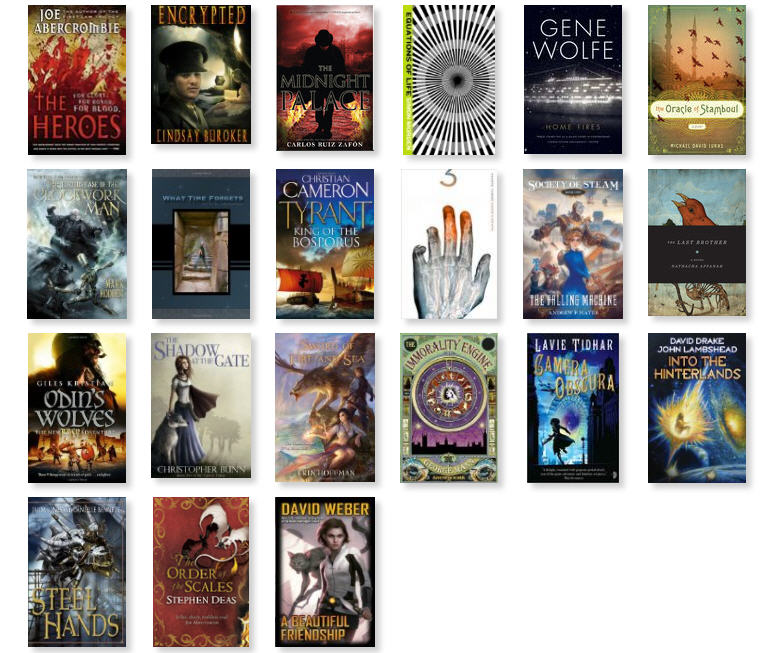
Here is the cover collage for the other 21 highly recommended books of 2011 with the title list HERE.

Unordered Title List
I keep the updated 2011 English language novels reading log with links, ratings, etc on FBC HERE and the general mostly-complete 2011 reading log with all years, all languages and all kinds of books on Goodreads HERE. I do not include most rereads, in non-fiction I include only the "popular" books but not the professional ones, while a bunch of books especially in the Romanian language I have recently read or reread do not have Goodreads entries, so that reading log is only partial.
To my surprise I have not yet read one non-sff 2011 novel that blew me away and made my Top 25 list, while in the next tier of excellent, highly recommended books there are only 4 non-sff out of 21 so far. Since some of the books in the Top 25 list have been published in this hiatus period (Egan, Carey, Newton), I will start by reviewing them and then I will alternate new releases with other 2011 books from the second list that have appeared in the meantime.
************************************************************
Here is the cover collage for my Top 25 list so far with 12 books ranked in order as of now. The title list is available HERE and as usual the available reviews are in our continually updated Review Index page.
 Ordered Title List
 ************************************************************
Here is the cover collage for the other 21 highly recommended books of 2011 with the title list HERE.
Unordered Title List
Subscribe to:
Posts (Atom)


