
ABOUT THE AUTHOR: Jim Butcher is the author of the Dresden Files, the Codex Alera, and a new steampunk series, the Cinder Spires. His resume includes a laundry list of skills which were useful a couple of centuries ago, and he plays guitar quite badly. An avid gamer, he plays tabletop games in varying systems, a variety of video games on PC and console, and LARPs whenever he can make time for it. Jim currently resides mostly inside his own head, but his head can generally be found in his home town of Independence, Missouri.
Jim goes by the moniker Longshot in a number of online locales. He came by this name in the early 1990′s when he decided he would become a published author. Usually only 3 in 1000 who make such an attempt actually manage to become published; of those, only 1 in 10 make enough money to call it a living. The sale of a second series was the breakthrough that let him beat the long odds against attaining a career as a novelist.
All the same, he refuses to change his nickname.
Publisher: Ace (January 20, 2026) Page count: 463 p Formats: audiobook, ebook, hardcover
 3:00 AM |
  Posted by
Łukasz |
Posted by
Łukasz |

 Labels:


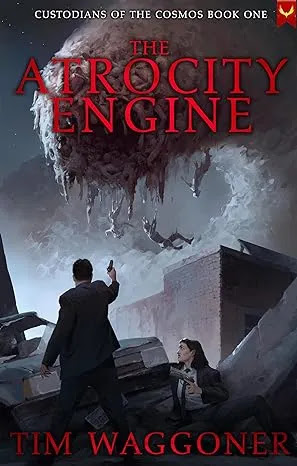
The Atrocity Engine by Tim Waggoner book review

Book Review: Her Majesty's Royal Coven by Juno Dawson

Soon I Will Be Invincible by Austin Grossman review

Book links: Amazon, Goodreads
ABOUT THE AUTHOR: Austin Grossman is the author of three novels: SOON I WILL BE INVINCIBLE, YOU, and CROOKED.
Publisher: Vintage; 1st edition (June 5, 2007) Print length: 338 Formats: ebook, audiobook, paperback, hardback


Book links: Amazon, Goodreads
AUTHOR INFO: Born and raised in southern Alabama, Robert (Bob) has been writing as long as he can remember, though only began to take it seriously in the fall of 2012. That year he completed his first NaNoWriMo writing a collection of short stories. This gave him the impetus to actually attempt to pursue a career as a writer. Since then he has written a number of short pieces in a variety of genres: horror, southern gothic, steampunk, and fantasy.
A graduate of Troy University, holding a Bachelors in Anthropology and a Masters in Post Secondary Education (Music Industry), he currently pays the bills by working at a warehouse, and occasional small writing gigs for bands and businesses.
He is a firm believer that puns are the highest form of humor.
Publisher: Broken Oak Publishing (August 22, 2021) Page count: 290
Blitz by Daniel O'Malley review
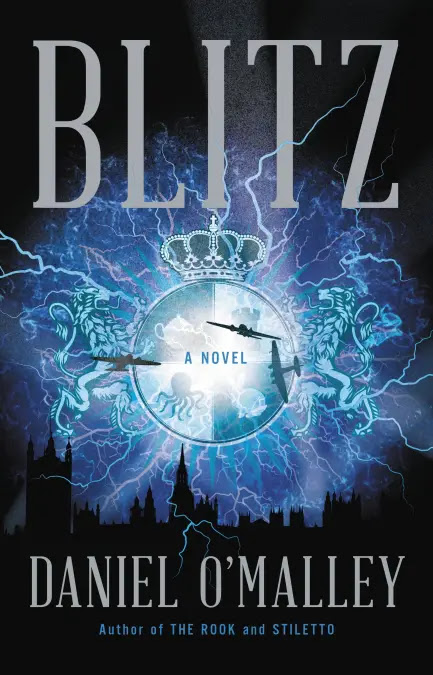

Publisher: Demimonde Books (April 26, 2022) Length: 356 pages Formats: ebook, paperback


Official Author Website
Pre-order Blood Heir over HERE
AUTHOR INFORMATION: Ilona Andrews is the pseudonym for the husband-and-wife writing team of Ilona Gordon & Andrew Gordon. Together, Andrew and Ilona are the co-authors of the New York Times bestselling Kate Daniels urban fantasy series and several other series. They live in Texas with their children.

Make them late; make things go wrong around them; ruin their dry cleaning and dinners and marriages. Fuck with their social media profiles and public perception.

The unintentional horror of The Library of the Unwritten might specifically apply to me. I have been a librarian for most of my adult life, and also a writer. The main character of The Library of the Unwritten is a woman named Claire, librarian of Hell's library and an author whose own literary ideas never found fruition. As I read though AJ Hackwith's novel, I couldn't help but feel a little called out. There is an idea in this book that if an author thinks about their unwritten character enough, that character will manifest and start walking around in the world. The idea of meeting my own main character, and the overwhelming guilt that would follow that meeting, terrifies me. Why did AJ Hackwith write a book specifically to shame me into finishing my own?
Strengths
The idea of a library in hell where unwritten books go to linger is a good one, but it isn't unique. The first time I came across such an idea was in Neil Gaiman's Sandman graphic novel series, where the lead character has exactly this kind of library in his domain. In Gaiman's work, the idea is not fully fleshed out and is only really mentioned in passing. Hackwith runs with the notion, sets her library in Hell (because apparently unwritten ideas don't make it to Heaven), and sets a story in it. I'll admit, I am always a little uncomfortable when authors decide to claim the existence of a Judeo-Christian Heaven and Hell, but Hackwith softens this fear with the inclusion of other religions, including Valhalla which is always a plus with me, and even some dead ones. Claire's journey takes readers on a ride, and along the way she gathers up a ragtag group of adventurers to help and hinder her. Claire herself is an excellent lead, fleshed out and sympathetic, while being deeply flawed (let's face it, she wouldn't have earned her turn as Hell's librarian if she weren't full of regrets).There would be a real danger, in a novel like this, of abusing its connection and adoration of books and the written word. Puns would kill The Library of the Unwritten, and I am happy to say that it handles its connection with literature in as deft and plausible way as it could. The concept of book characters coming to life could feel hokey, on paper, and it takes suspension of disbelief to make it work even in this book, but that's the nature of fantasy. The meta-conversation about how characters are alive is in full swing here - many of Hackwith's inside-the-book characters feel as fleshed out as her "real" characters, and that says something about a writer's ability to humanize imagination. Of particular note is when Claire's history reveals that she has literally fallen in and out of love with one of her characters, revealing the kind of tangled psychology that would require months of therapy to unravel. What could have been a comedy fantasy about living books in Hackwith's hands becomes something much deeper.
I also had a moment in this book, which is full of beautiful prose and captivating imagery, when I was imagining the actual library. I thought of all those stories, potentially billions, that had never been written down, never conceptualized beyond the step of creation, and it hurt. It made me physically uncomfortable to think about every story that someone felt too afraid to write down, or show someone else, or to even think about for fear that they might not be praised, or worse, might be shunned. This was perhaps an unintended moment for the author, but a welcome one for a reader.
Weaknesses
As much as I did like The Library of the Unwritten, there were aspects of it that prevented it from being truly great - even for a library book nerd like me. Many of these hiccups are parallel to the book's strengths. For instance, the inclusion of non-Judeo-Christian religions was a nice nod, but it almost feels like a begrudging addition. I never had the sense that any of these other religions carried any weight, and it was the belief in Heaven and Hell that was the supreme arbiter of faith. Now, this tracks on a percentage basis, Christians and Muslims make up the majority of the world's religious, but it feels like it places too much weight on one particular belief. Nor does it take into account the nearly one billion or so folks who claim no faith or a faith that lies outside of the major ones. This same critique can be applied to a dozen authors who write books like this, Gaiman, Pratchett, Moore, etc., and it likely boils down to the author's own background and shouldn't be counted as a ding against the book, but I would have really loved a deeper exploration of faith-based systems that did not center so much on Judeo-Christian beliefs. Perhaps that's asking too much for a book that carries a lighter hearted tone than many that deal in religion.I mentioned liking Claire quite a bit, and I did, but I had some issues with other characters in the novel. Leto, for one, who is a good character in his own right, feels largely forced into the story for a big reveal later that, for me, fell completely flat. There are actually a few characters in the book that feel largely purposeless, but is it fair to criticize characters, even well-written ones, for not serving much purpose? Probably not.
To again parallel some of my earlier thoughts on the strengths of The Library of the Unwritten, while the reference to books and writing are well done, there is also a pattern of characters consistently trying to say these lines as though they are trying to get into Barlett's Book of Quotations. If it hadn't happened so often, I might not have noticed, but the novel has a persistence of characters basically turning to the camera and delivering one-liners that they hope will feel meaningful but ultimately feel a little cheesy.
The last area where The Library of the Unwritten falls flat for me is in its inability to go further. This is a series, so perhaps this critique will correct itself in subsequent novels, but for a book about the power of imagination, the sheer depth and breadth of it, it stays fairly tame. When I consider the amount of unwritten stories in a library like this, how many tales the author had to draw from with almost no limitation, I find myself disappointed in how mundane some of the events of the book play out. There is a climactic scene at the end, in particular, that could have really been a memorable one, but it plays out in a predictable way with one contrived deus ex machina moment that made me sad to read.
If You Liked
I was a little surprised, given the clear influences, that the author did not mention Neil Gaiman in her acknowledgements. This book screams Good Omens and Sandman to me, but I will acknowledge that similar ideas can bloom in different minds at different times. Regardless, readers who enjoy the more Judeo-Christian tones of some of Gaiman's England-centered work will find this enjoyable. I also found some pretty heavy similarities to Christopher Moore, particularly in the early parts of the novel which are more comedic in tone than some of the latter. Fans of books about big mystical libraries also might find some similarities to Scott Hawkins' fantastic Library at Mount Char, though Hawkins' book is a fair bit darker in tone then Hackwith's.Parting Thoughts


Official Author Website
Buy the books HERE(USA) or HERE(UK)
Read Fantasy Book Critic's Review of Hero Forged


Sami is currently based in Melbourne, Australia.

Order Redemptor over HERE
Read Fantasy Book Critic's review of Dämoren
Read Fantasy Book Critic's review of Hounacier
Read Fantasy Book Critic's review of Ibenus
Read Fantasy Book Critic interview with Seth Skorkowsky
Read Building The Perfect Revolver by Seth Skorkowsky (guest post)
AUTHOR INFORMATION: Raised in the swamps and pine forests of East Texas, Seth Skorkowsky gravitated to the darker sides of fantasy, preferring horror and pulp heroes over knights in shining armor. When not writing, Seth enjoys cheesy movies, tabletop role-playing games, and traveling the world with his wife.
FORMAT/INFO: Redemptor is 264 pages long divided over thirty-three numbered chapters and is the fourth volume of the Valducan series. The book is currently available in all formats. It was published in 2018 by Crossroad Press. Cover art and design are by Shawn King.
CLASSIFICATION: Redemptor is a character-driven dark urban- fantasy book with immersive world-building and in-depth study of demons lore.
OVERVIEW/ANALYSIS: Seth Skorkowsky brings goods to the table. I’m addicted to his Valducan series, and my secret wish is for it to continue for years to come. It’s this good, guys. I need more stories in this world, the one focusing on Luc
Redemptor is the fourth installment of the series. While you can read it as a standalone, I don’t recommend approaching it as one - you’ll lose way too many nuances that make it an excellent read for those who already know the mythos and the knights.
The series follows an order of modern-day knights that hunt demons. Only a Holy Weapon can kill a demon.
In Redemptor new characters and new weapons appear, each with unique abilities (shifting gravity, making an invisible shield, premonition). It’s cool. Faced with an unspeakable evil threatening orphaned and bonded weapons,
Kofi is an impressively effective, but cold professional who keeps his emotions at a check and doesn’t yearn for acknowledgment. Felisa is more relatable and sensitive. She questions her life in Vatican and experiences more than a few internal struggles that never feel forced or cheap. Also, she brings some comic relief with her internal ramblings (that will make series’ followers smile):
“What did she want? Luiza’s approval? What was that really worth? Luiza, bride of an angel, was married to the American who was also wed to Damoren. Was the union to an angel not enough? Polygamists. That’s what they were”Other new characters who get their POV (in the third person) chapters are the youngest Valducan knight, spouse to Lecrasus - Mei and Sir Uwe. Mei is young and reckless, but likable. Sir Uwe is hilarious - a strange little man who despite his oddities (
Contrary to Hounacier and Ibenus (more character-centered novels), Redemptor is a fast-paced and action-oriented novel with plenty of demons-killing scenes. The breakneck pacing made me turn the pages with growing excitement. A brilliant page-turner.
Overall, though, I have to admit that I didn’t like it as much as Hounacier and Ibenus - two most intimate books in the series that focus on different knights and show how layered human beings they are. Both Malcolm and Allan appear in Redemptor, but they get little exposition.
What else? Be prepared to see one of the most fascinating Valducan (at least to me) characters die. It was heart-wrenching, but he went as a true hero would. Rest in peace.
Redemptor is an enormously satisfying read, with engaging writing and a pace that will keep the pages


